Language and Knowledge: Against Modularity, Atomism, and Generativism as a Viable Basis for a Theory of Language and Mind
- SlideShare title: Language and Knowledge: Against Modularity as a Viable Theory of Language an...
- Talk date: Not established
- SlideShare upload: 2007-08-18 (upload date, not the delivery date)
- Event: Not established
- Place: Not established
- Topics: Language & meaning
- Language: en
- Slides in the original listing: 68
- Coverage: Full text of all 68 slides, each paired with its original slide image (slide N is section N).
- Original listing: https://www.slideshare.net/slideshow/language-and-knowledge-against-modularity-as-a-viable-theory-of-language-and-mind/93705
- Cover image: https://slides.dominiklukes.net/readers/language-and-knowledge-against-modularity-as-a-viable-theory-of-language-and-mind/pages/page-01.png
- Reader data (JSON): https://slides.dominiklukes.net/readers/language-and-knowledge-against-modularity-as-a-viable-theory-of-language-and-mind/presentation.json
- TalkWeaver package (outline and images, ZIP): https://slides.dominiklukes.net/language-and-knowledge-against-modularity-as-a-viable-theory-of-language-and-mind/language-and-knowledge-against-modularity-as-a-viable-theory-of-language-and-mind-talkweaver.zip
- TalkWeaver outline: https://slides.dominiklukes.net/language-and-knowledge-against-modularity-as-a-viable-theory-of-language-and-mind/talkweaver/language-and-knowledge-against-modularity-as-a-viable-theory-of-language-and-mind-outline.md
- Markdown copy: https://slides.dominiklukes.net/language-and-knowledge-against-modularity-as-a-viable-theory-of-language-and-mind/index.md
Slide 1: Language and Knowledge: Against Modularity, Atomism, and Generativism as a Viable Basis for a Theory of Language and Mind
Language and Knowledge: Against Modularity, Atomism, and Generativism as a Viable Basis for a Theory of Language and Mind
Dominik Lukeš

Slide 2: Slide 2
"The person who has mastered any human language has developed a system of knowledge that is rich and complex."
— Chomsky, 1988, Language and Problems of Knowledge, p. 131
Slide 3: Slide 3
“If you want to know what seems to refute the strong minimalist thesis, the answer is just about everything you can think of or pick at random from a corpus of material. That is not particularly interesting because it is the normal situation in the sciences, even the most advanced.” … “it is the experiments that matter, and the well-designed ones, the ones that fit into a sensible theory.“
— Chomsky, 2002, An interview on minimalism, p. 127-8
Slide 4: Slide 4
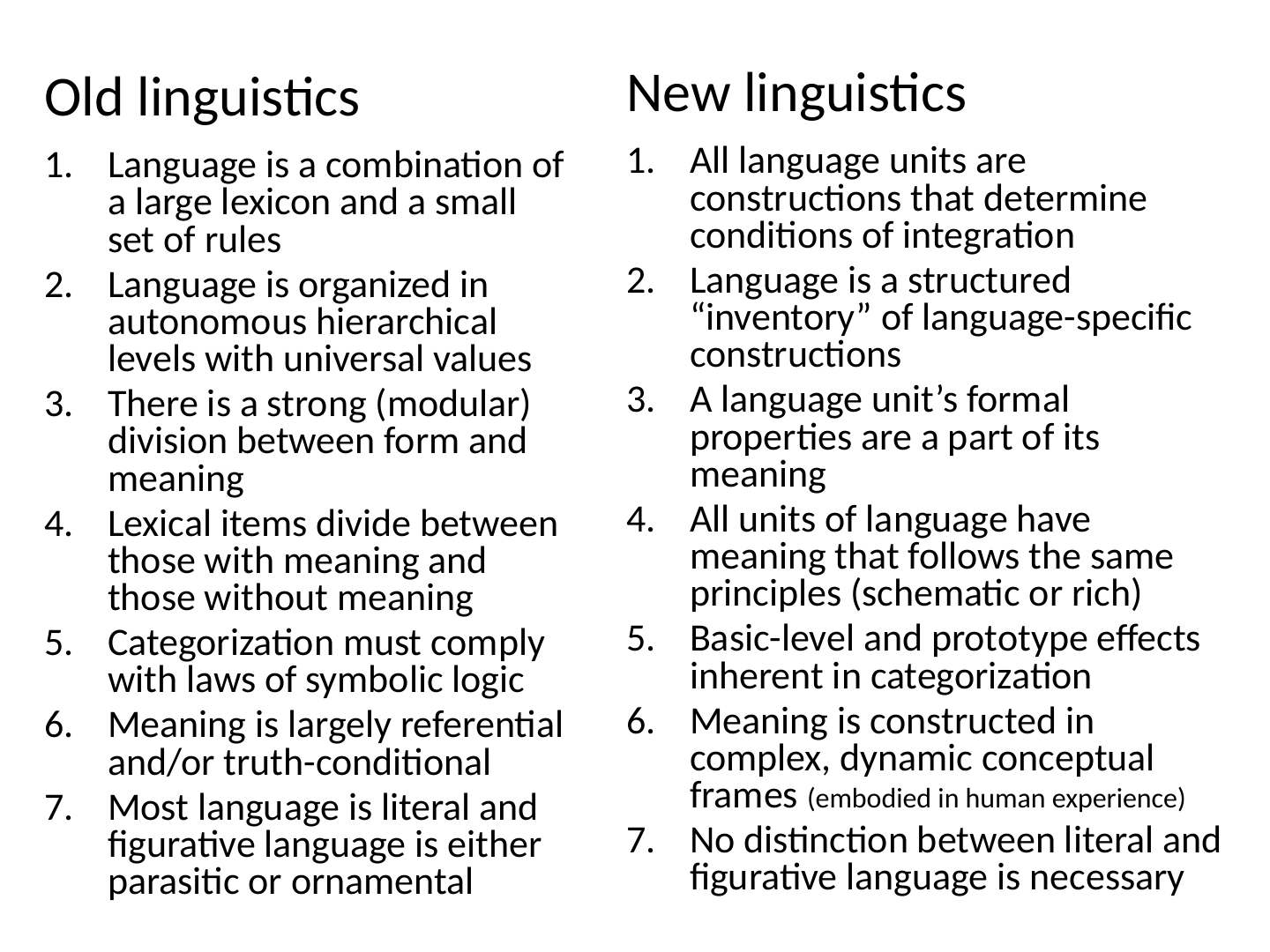
Old linguistics
- Language is a combination of a large lexicon and a small set of rules
- Language is organized in autonomous hierarchical levels with universal values
- There is a strong (modular) division between form and meaning
- Lexical items divide between those with meaning and those without meaning
- Categorization must comply with laws of symbolic logic
- Meaning is largely referential and/or truth-conditional
- Most language is literal and figurative language is either parasitic or ornamental
New linguistics
- All language units are constructions that determine conditions of integration
- Language is a structured “inventory” of language-specific constructions
- A language unit’s formal properties are a part of its meaning
- All units of language have meaning that follows the same principles (schematic or rich)
- Basic-level and prototype effects inherent in categorization
- Meaning is constructed in complex, dynamic conceptual frames (embodied in human experience)
- No distinction between literal and figurative language is necessary
Slide 5: Road to modularity
Road to modularity
Slide 6: Slide 6
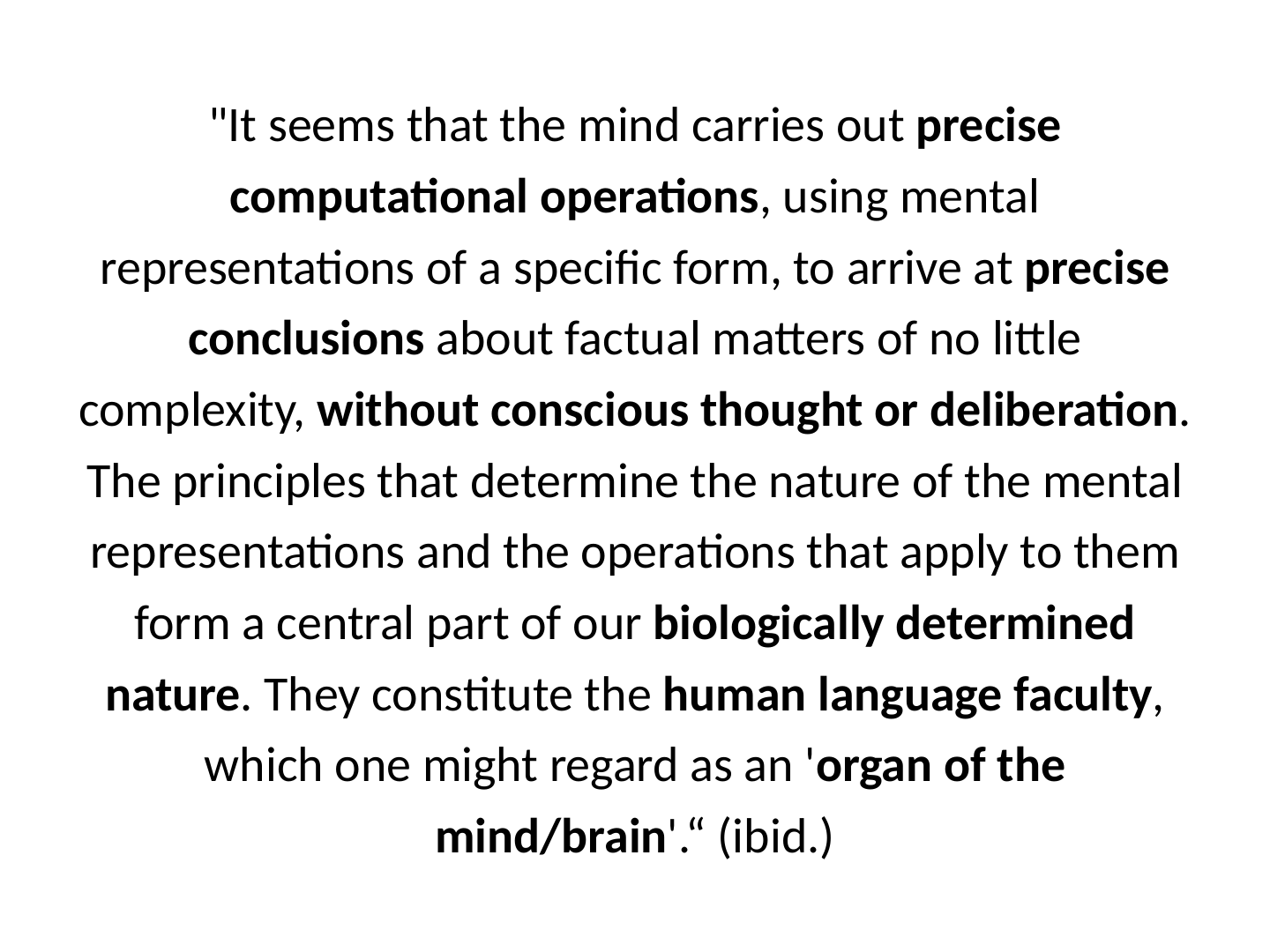
"It seems that the mind carries out precise computational operations, using mental representations of a specific form, to arrive at precise conclusions about factual matters of no little complexity, without conscious thought or deliberation. The principles that determine the nature of the mental representations and the operations that apply to them form a central part of our biologically determined nature. They constitute the human language faculty, which one might regard as an 'organ of the mind/brain'.“
— ibid.
Slide 7: Road to modularity
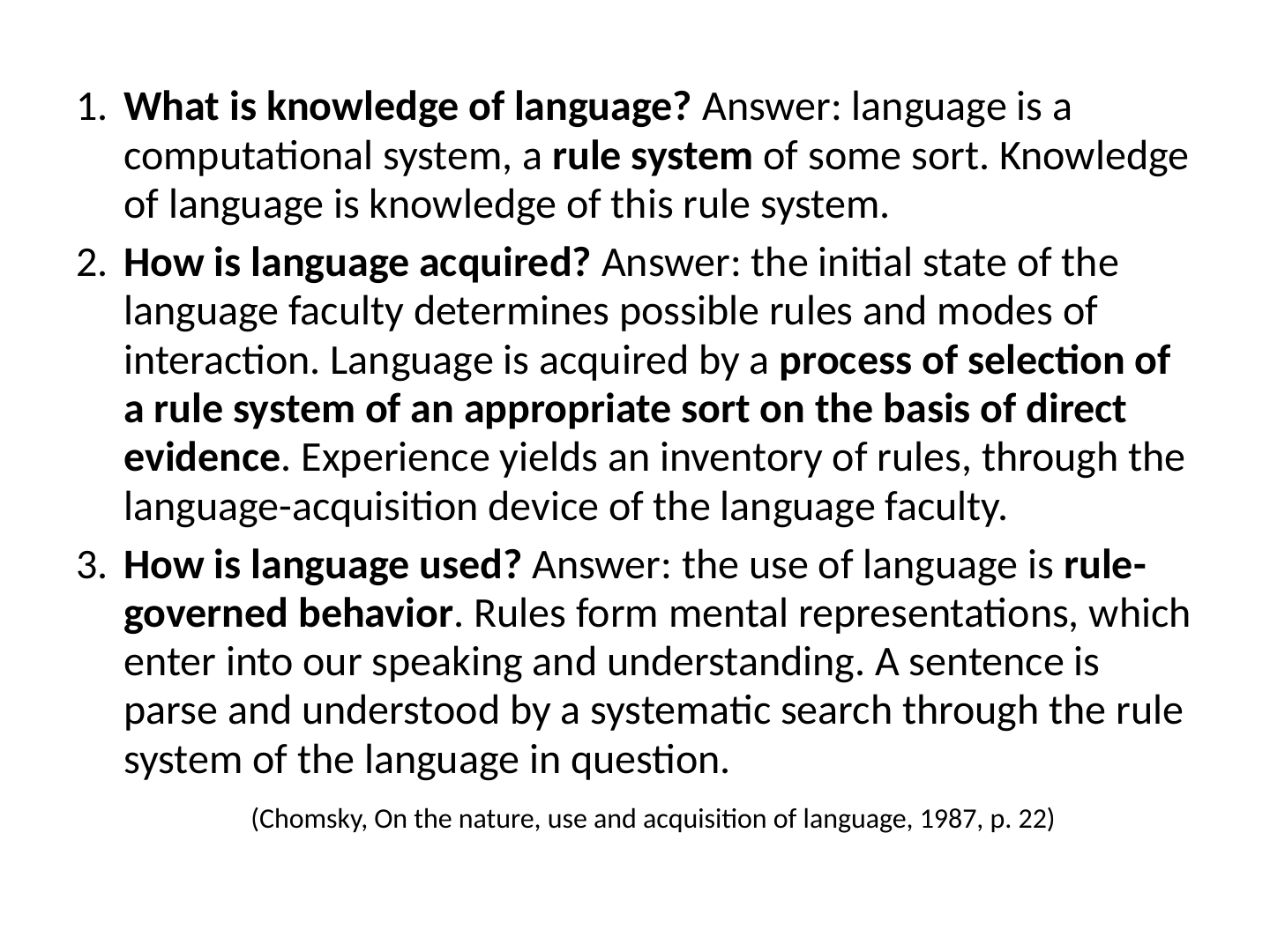
What is knowledge of language? Answer: language is a computational system, a rule system of some sort. Knowledge of language is knowledge of this rule system.
How is language acquired? Answer: the initial state of the language faculty determines possible rules and modes of interaction. Language is acquired by a process of selection of a rule system of an appropriate sort on the basis of direct evidence. Experience yields an inventory of rules, through the language-acquisition device of the language faculty.
How is language used? Answer: the use of language is rule-governed behavior. Rules form mental representations, which enter into our speaking and understanding. A sentence is parse and understood by a systematic search through the rule system of the language in question.
(Chomsky, On the nature, use and acquisition of language, 1987, p. 22)
Slide 8: Road to modularity
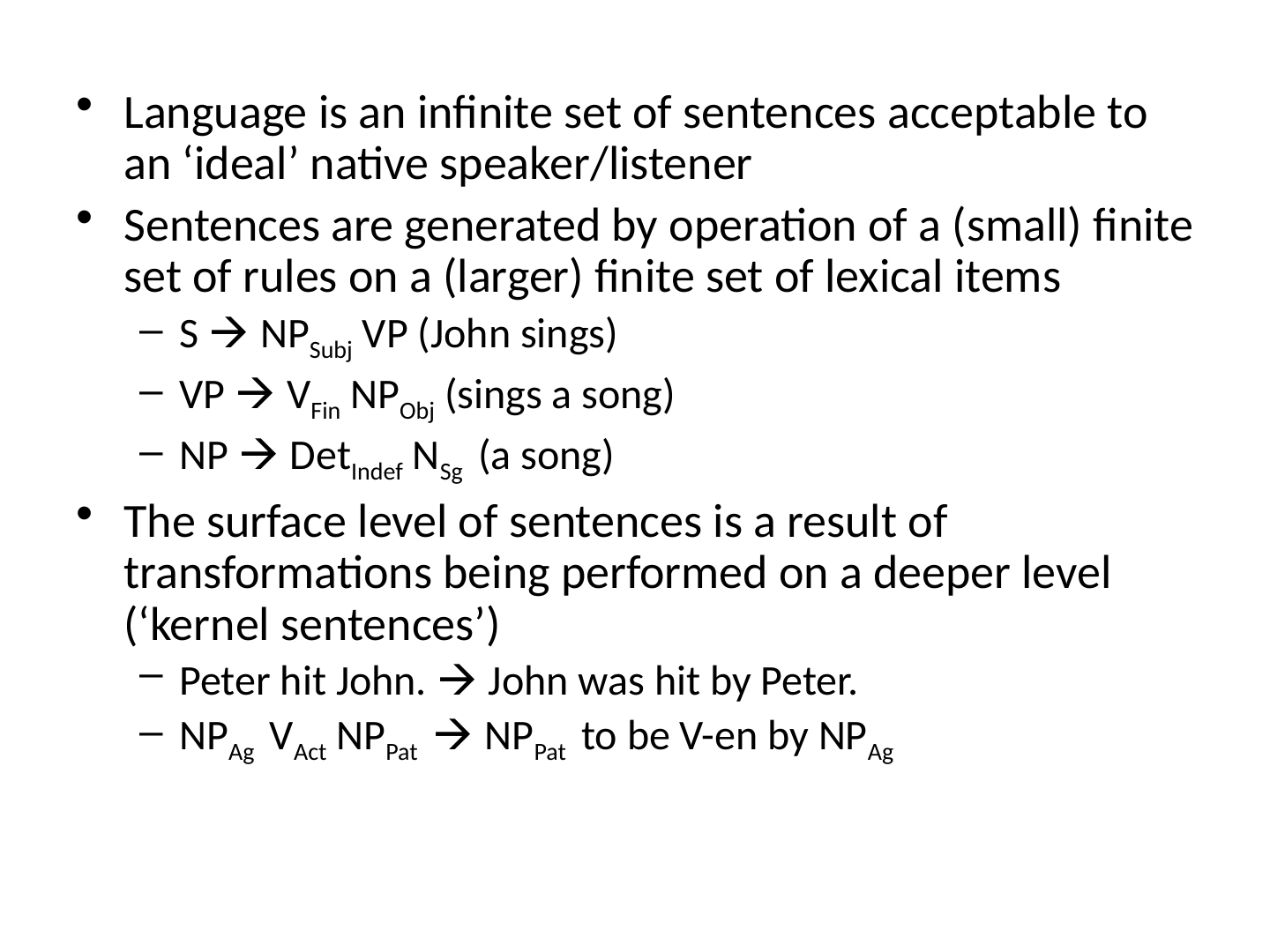
- Language is an infinite set of sentences acceptable to an ‘ideal’ native speaker/listener
- Sentences are generated by operation of a (small) finite set of rules on a (larger) finite set of lexical items
- S → NPSubj VP (John sings)
- VP → VFin NPObj (sings a song)
- NP → DetIndef NSg (a song)
- The surface level of sentences is a result of transformations being performed on a deeper level (‘kernel sentences’)
- Peter hit John. → John was hit by Peter.
- NPAg VAct NPPat → NPPat to be V-en by NPAg
Slide 9: Road to modularity
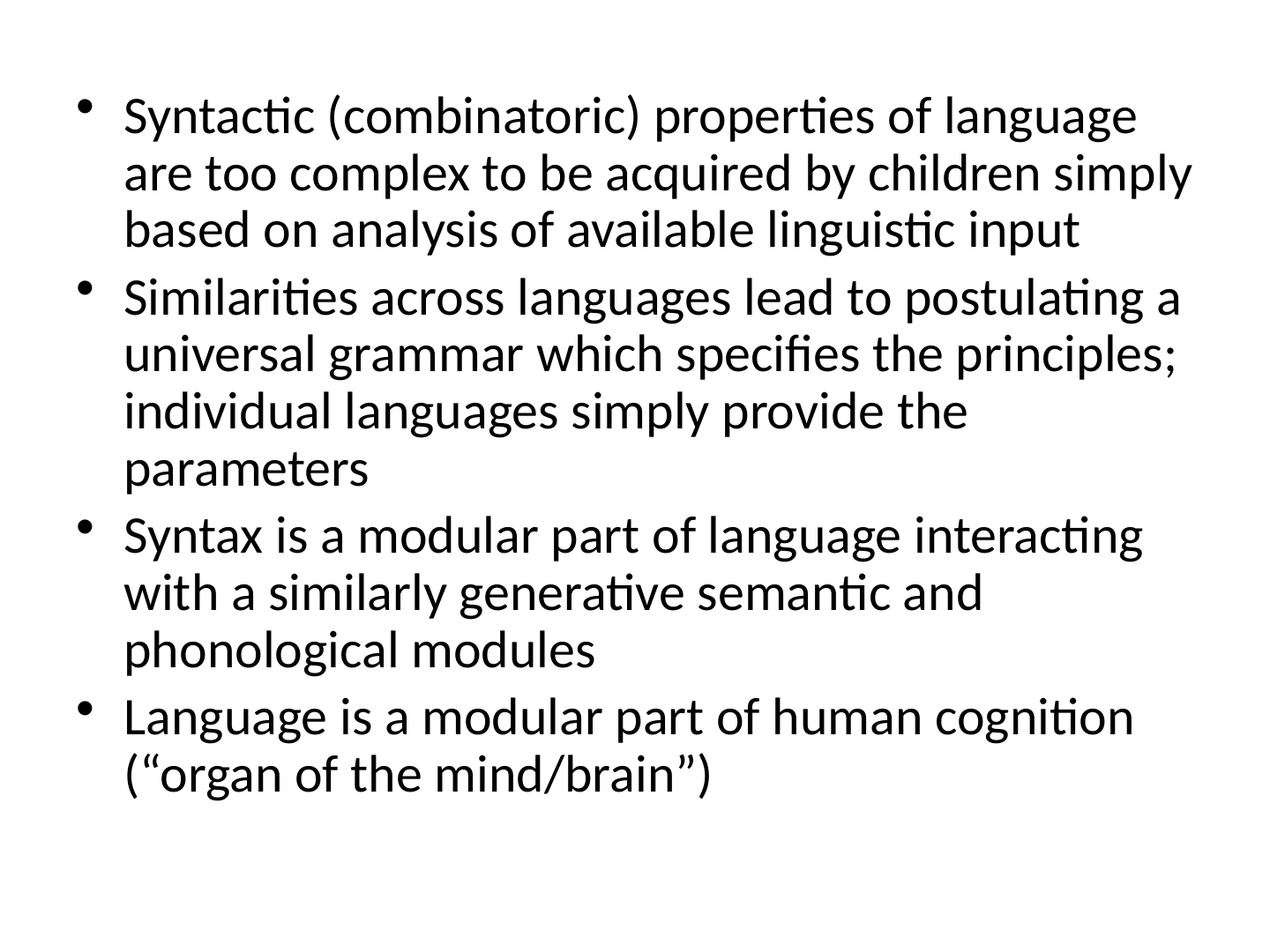
- Syntactic (combinatoric) properties of language are too complex to be acquired by children simply based on analysis of available linguistic input
- Similarities across languages lead to postulating a universal grammar which specifies the principles; individual languages simply provide the parameters
- Syntax is a modular part of language interacting with a similarly generative semantic and phonological modules
- Language is a modular part of human cognition (“organ of the mind/brain”)
Slide 10: Road to modularity
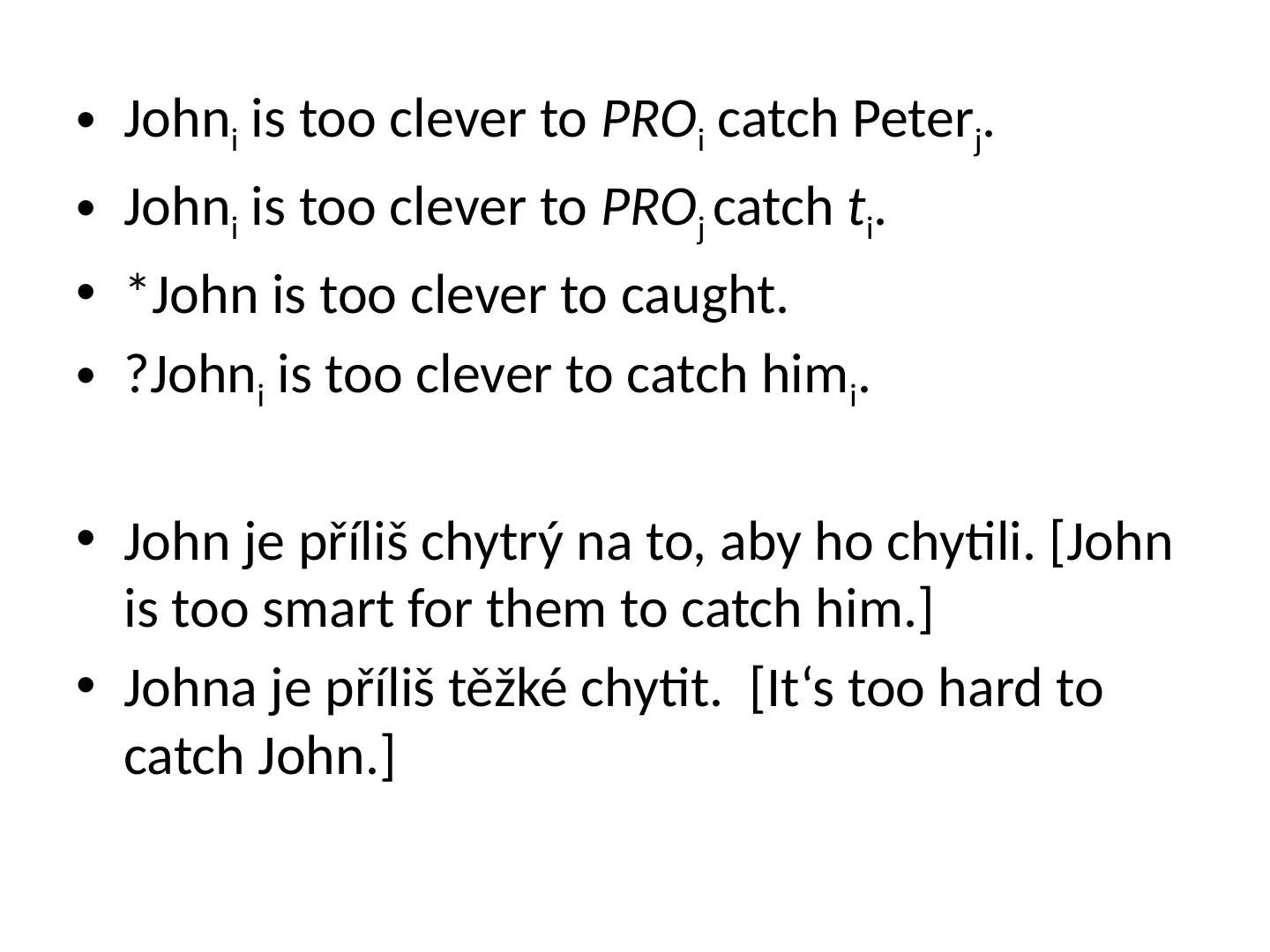
- Johnᵢ is too clever to PROᵢ catch Peterⱼ.
- Johnᵢ is too clever to PROⱼ catch tᵢ.
- *John is too clever to caught.
- ?Johnᵢ is too clever to catch himᵢ.
- John je příliš chytrý na to, aby ho chytili. [John is too smart for them to catch him.]
- Johna je příliš těžké chytit. [It‘s too hard to catch John.]
Slide 11: Slide 11
"Words and rules give rise to the vast expressive power of language, allowing us to share the fruits of the vast creative power of thought." (p. 287)
— Pinker, 1999, Words and rules
Slide 12: Consequences and travelling companions of modular generativism
Consequences and travelling companions of modular generativism
Slide 13: Consequences and travelling companions of modular generativism
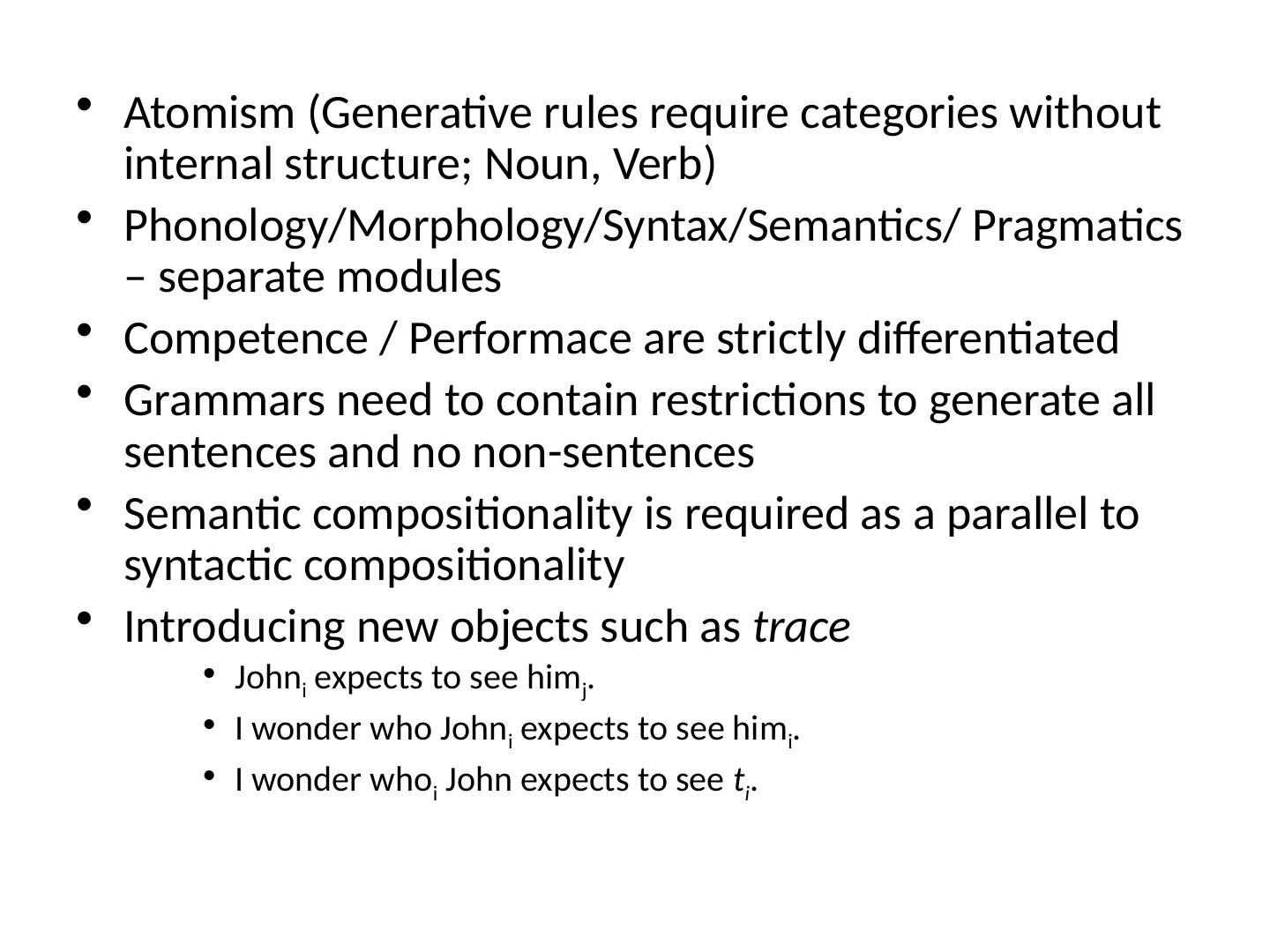
- Atomism (Generative rules require categories without internal structure; Noun, Verb)
- Phonology/Morphology/Syntax/Semantics/ Pragmatics – separate modules
- Competence / Performace are strictly differentiated
- Grammars need to contain restrictions to generate all sentences and no non-sentences
- Semantic compositionality is required as a parallel to syntactic compositionality
- Introducing new objects such as trace
- Johnᵢ expects to see himⱼ.
- I wonder who Johnᵢ expects to see himᵢ.
- I wonder whoᵢ John expects to see tᵢ.
Slide 14: Challenges to modularity
Challenges to modularity
Slide 15: Slide 15
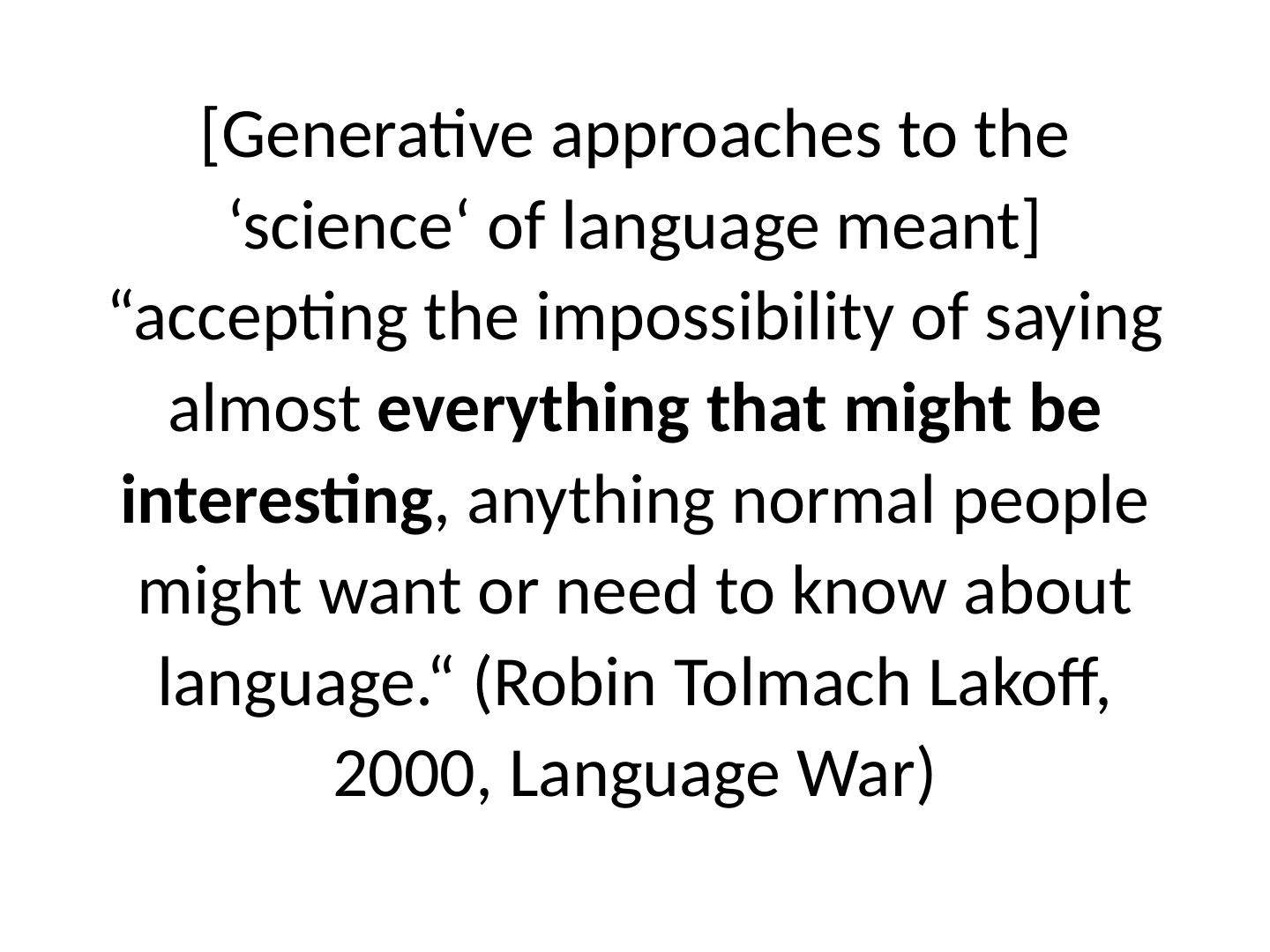
[Generative approaches to the ‘science‘ of language meant] “accepting the impossibility of saying almost everything that might be interesting, anything normal people might want or need to know about language.“
— Robin Tolmach Lakoff, 2000, Language War
Slide 16: Slide 16
"The Justice Department has begun an internal investigation into whether a former senior adviser to Attorney General Alberto R. Gonzales improperly tried to fill vacancies for career prosecutors at the agency with Republicans loyal to the Bush administration, department officials said Wednesday. The inquiry focuses on whether the former adviser, Monica Goodling, sought to determine the political affiliations of job applicants before they were hired as prosecutors -- potentially a violation of civil service laws and a break with a tradition of nonpartisanship in the career ranks at the Justice Department."
— From Eric Lipton and David Johnston at the New York Times

Slide 17: Challenges to modularity
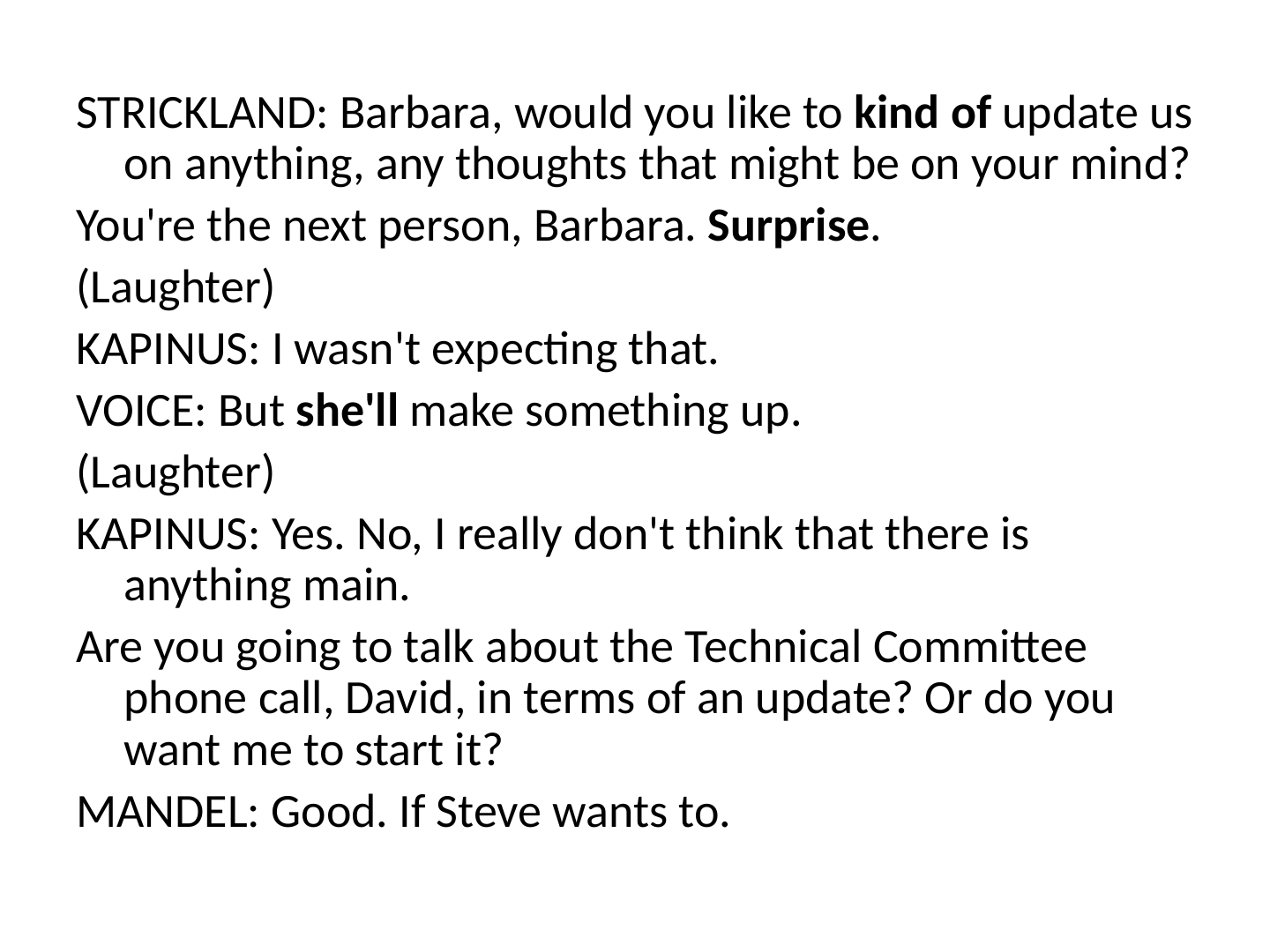
STRICKLAND: Barbara, would you like to kind of update us on anything, any thoughts that might be on your mind?
You're the next person, Barbara. Surprise.
(Laughter)
KAPINUS: I wasn't expecting that.
VOICE: But she'll make something up.
(Laughter)
KAPINUS: Yes. No, I really don't think that there is anything main.
Are you going to talk about the Technical Committee phone call, David, in terms of an update? Or do you want me to start it?
MANDEL: Good. If Steve wants to.
Slide 18: Challenges to modularity
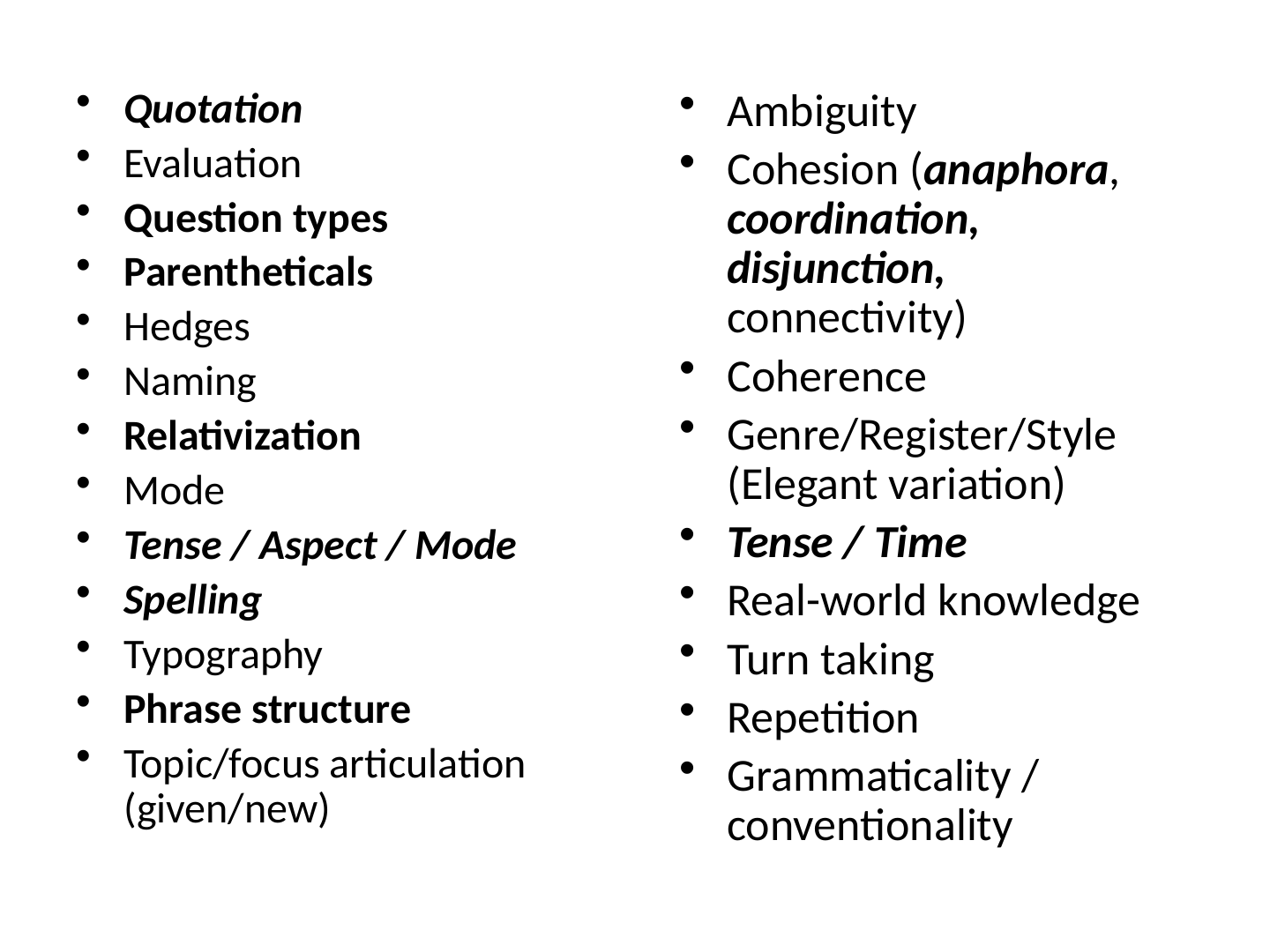
- Quotation
- Evaluation
- Question types
- Parentheticals
- Hedges
- Naming
- Relativization
- Mode
- Tense / Aspect / Mode
- Spelling
- Typography
- Phrase structure
- Topic/focus articulation (given/new)
- Ambiguity
- Cohesion (anaphora, coordination, disjunction, connectivity)
- Coherence
- Genre/Register/Style (Elegant variation)
- Tense / Time
- Real-world knowledge
- Turn taking
- Repetition
- Grammaticality / conventionality
Slide 19: Slide 19
[the cognitive revolution] was “an all-out effort to establish meaning as the central concept of psychology […]. It was not a revolution against behaviorism with the aim of transforming behaviorism into a better way of pursuing psychology by adding a little mentalism to it. […] Its aim was to discover and to describe formally the meanings that human beings created out of their encounters with the world, and then to propose hypotheses about what meaning-making processes were implicated. It focused upon the symbolic activities that human beings employed in constructing and in making sense not only of the world, but of themselves. Its aim was to prompt psychology to join forces with its sister interpretive disciplines in the humanities and in the social sciences.” [but with the introduction of the computational metaphor] “emphasis began shifting from “meaning” to “information,” from the construction of meaning to the processing of information. […] Information is indifferent with respect to meaning.”
— Jerome Bruner, Acts of Meaning, 1990
Slide 20: Challenges to modularity
- Doesn’t describe almost anything of interest to the study of language other than the identification of “grammatical” sentences
- Relies on unreliable idealized speakers for judgments of grammaticality
- Only describes adequately a subset of the combinatoric properties of language
- UG structures suspiciously close to shapes specific to written English
- Very restricted notion of (generative) creativity
- Assumes isomorphism between linguistic system and structures in the mind/brain
- Doesn’t differentiate between description, notation and modeling
- Standard Theory → Government/Binding → Minimalism contains no new findings about language only refining formalism
- Insist on the ‘scientific’ nature of linguistics with a very limiting prescriptive notion of science
Slide 21: Challenges to modularity
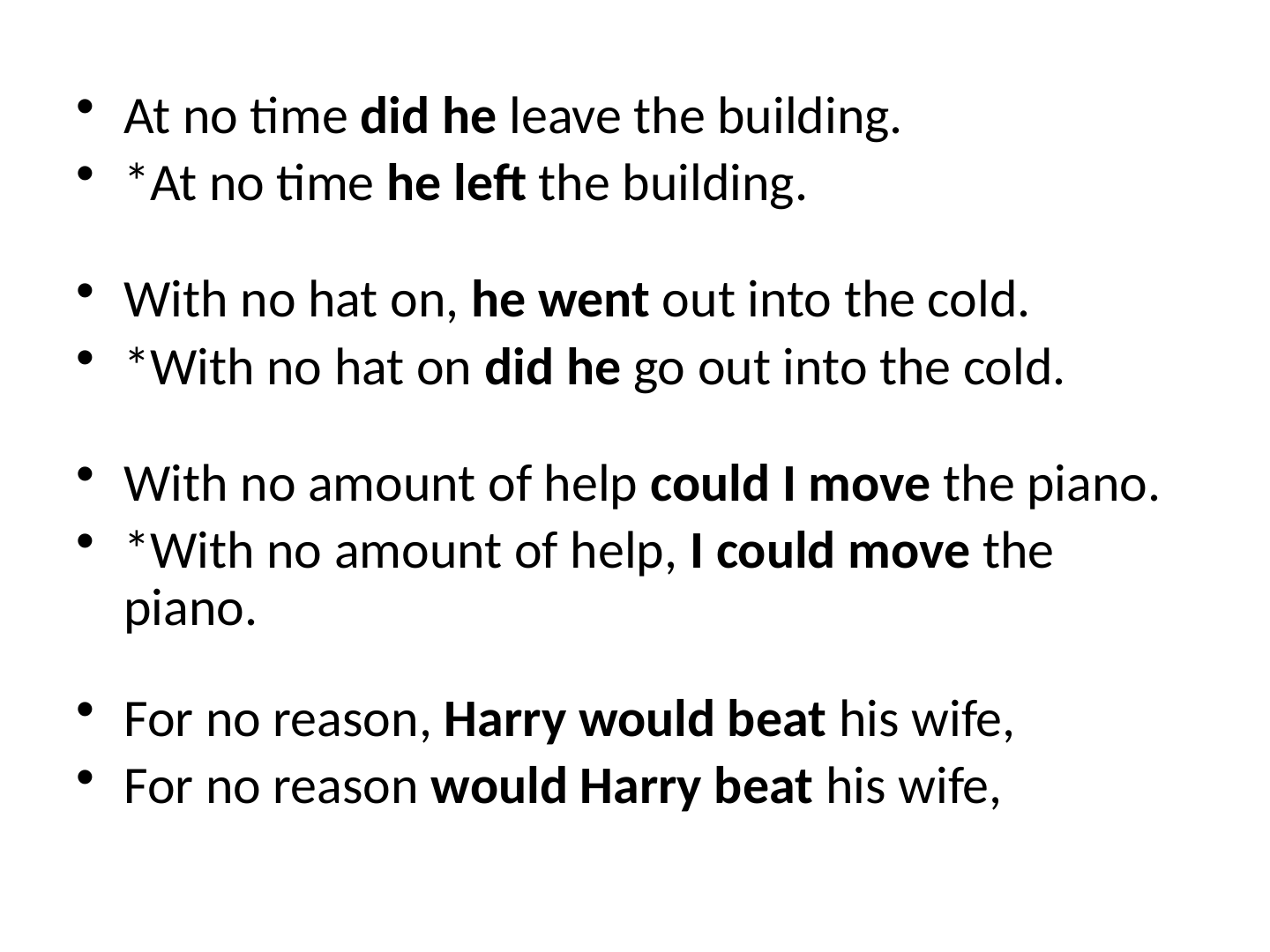
- At no time did he leave the building.
- *At no time he left the building.
- With no hat on, he went out into the cold.
- *With no hat on did he go out into the cold.
- With no amount of help could I move the piano.
- *With no amount of help, I could move the piano.
- For no reason, Harry would beat his wife,
- For no reason would Harry beat his wife,
Slide 22: Challenges to modularity
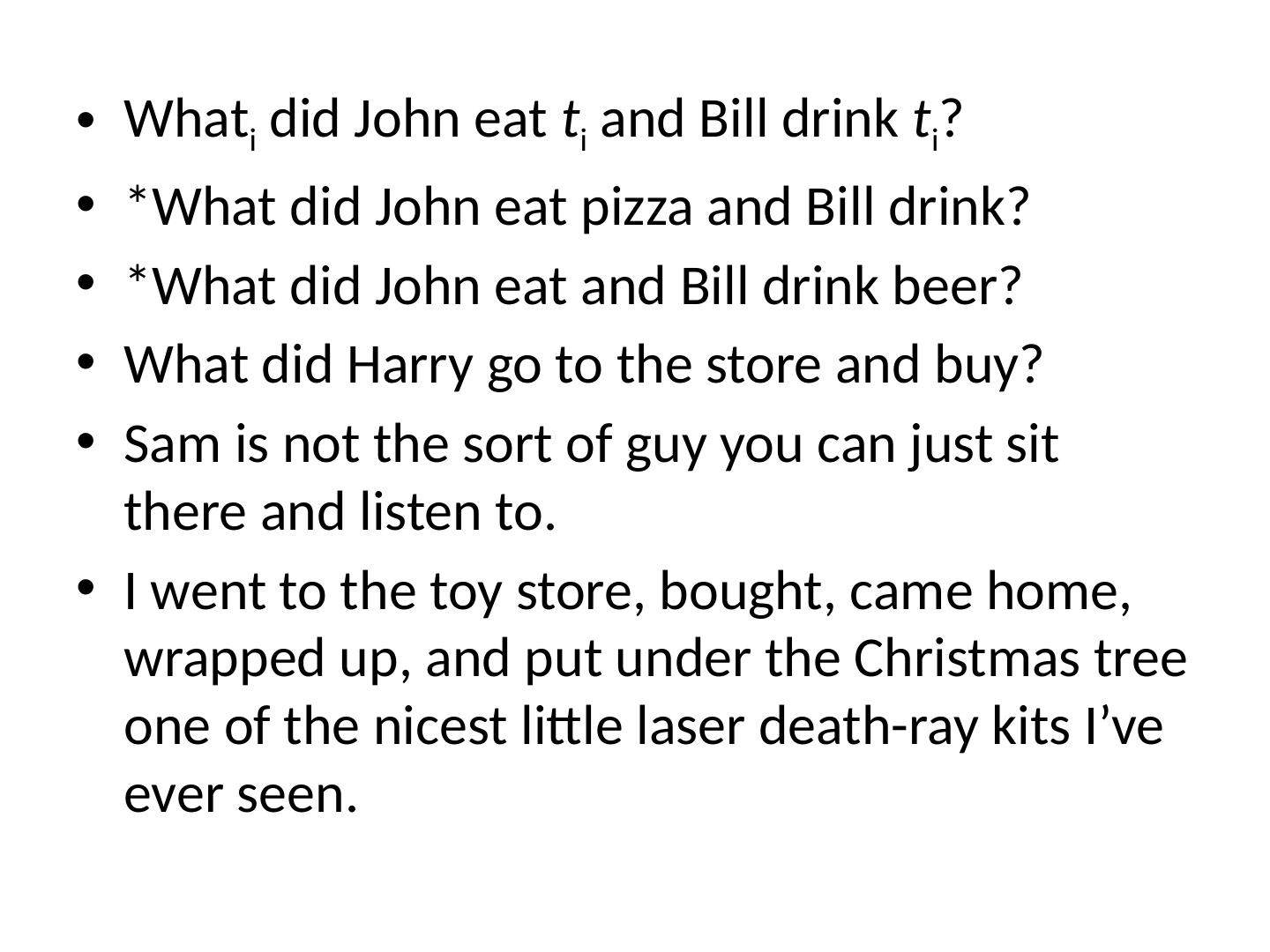
- Whatᵢ did John eat tᵢ and Bill drink tᵢ?
- *What did John eat pizza and Bill drink?
- *What did John eat and Bill drink beer?
- What did Harry go to the store and buy?
- Sam is not the sort of guy you can just sit there and listen to.
- I went to the toy store, bought, came home, wrapped up, and put under the Christmas tree one of the nicest little laser death-ray kits I’ve ever seen.
Slide 23: Slide 23
“The Chomskyan Commitment is a commitment as to the form of the answer: it must be in a symbol-manipulation system (which cannot make use of general cognition, meaning, or communicative function). The Cognitive Commitment makes no commitment as to the form of an answer; it is just a commitment to engage in scientific research, to study language as an implicit part of human cognition.”
— George Lakoff, 1991, Cognitive Versus Generative Linguistics
Slide 24: Slide 24
Research in the so-called social sciences has made no contribution whatsoever to our understanding of linguistic competence beyond the trivial.
(John Collins, web page introducing the following quote from Chomsky, http://www.uea.ac.uk/~j108/lingpol.htm)
“[T]he existence of a discipline called “sociolinguistics” remains for me an obscure matter… [It] is, I suppose, a discipline that seeks to apply principles of sociology to the study of language; but I suspect that it can draw little from sociology, and I wonder whether it is likely to contribute much to it… You can also collect butterflies and make many observations. If you like butterflies, that’s fine; but such work must not be confounded with research, which is concerned to discover explanatory principles of some depth and fails if it does not do so.”
— Noam Chomsky, Language and Responsibility (1979)
Slide 25: Utility of linguistic description
Utility of linguistic description
Slide 26: Utility of linguistic description
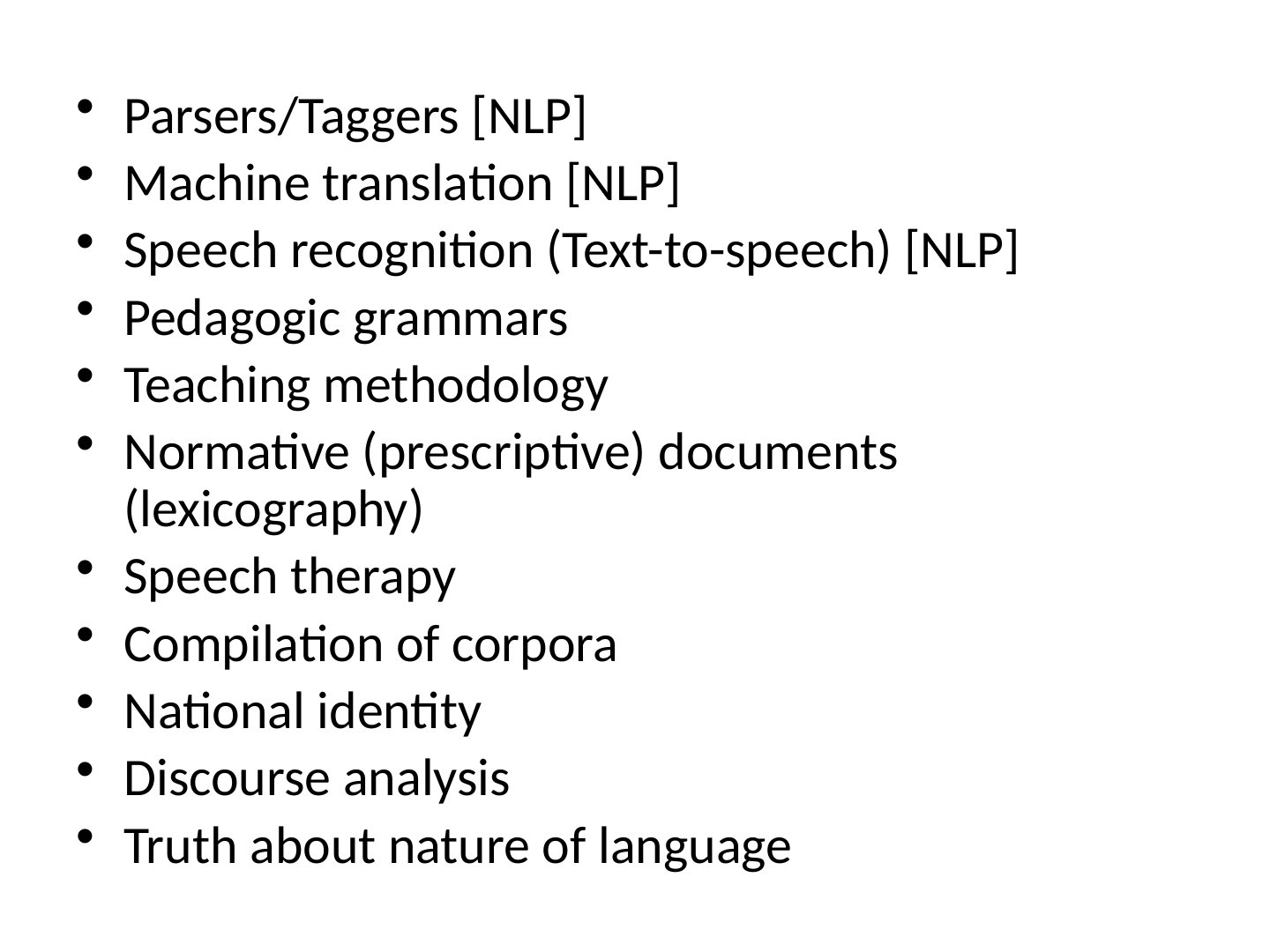
- Parsers/Taggers [NLP]
- Machine translation [NLP]
- Speech recognition (Text-to-speech) [NLP]
- Pedagogic grammars
- Teaching methodology
- Normative (prescriptive) documents (lexicography)
- Speech therapy
- Compilation of corpora
- National identity
- Discourse analysis
- Truth about nature of language
Slide 27: Variability of linguistic description
Variability of linguistic description
Slide 28: Variability of linguistic description
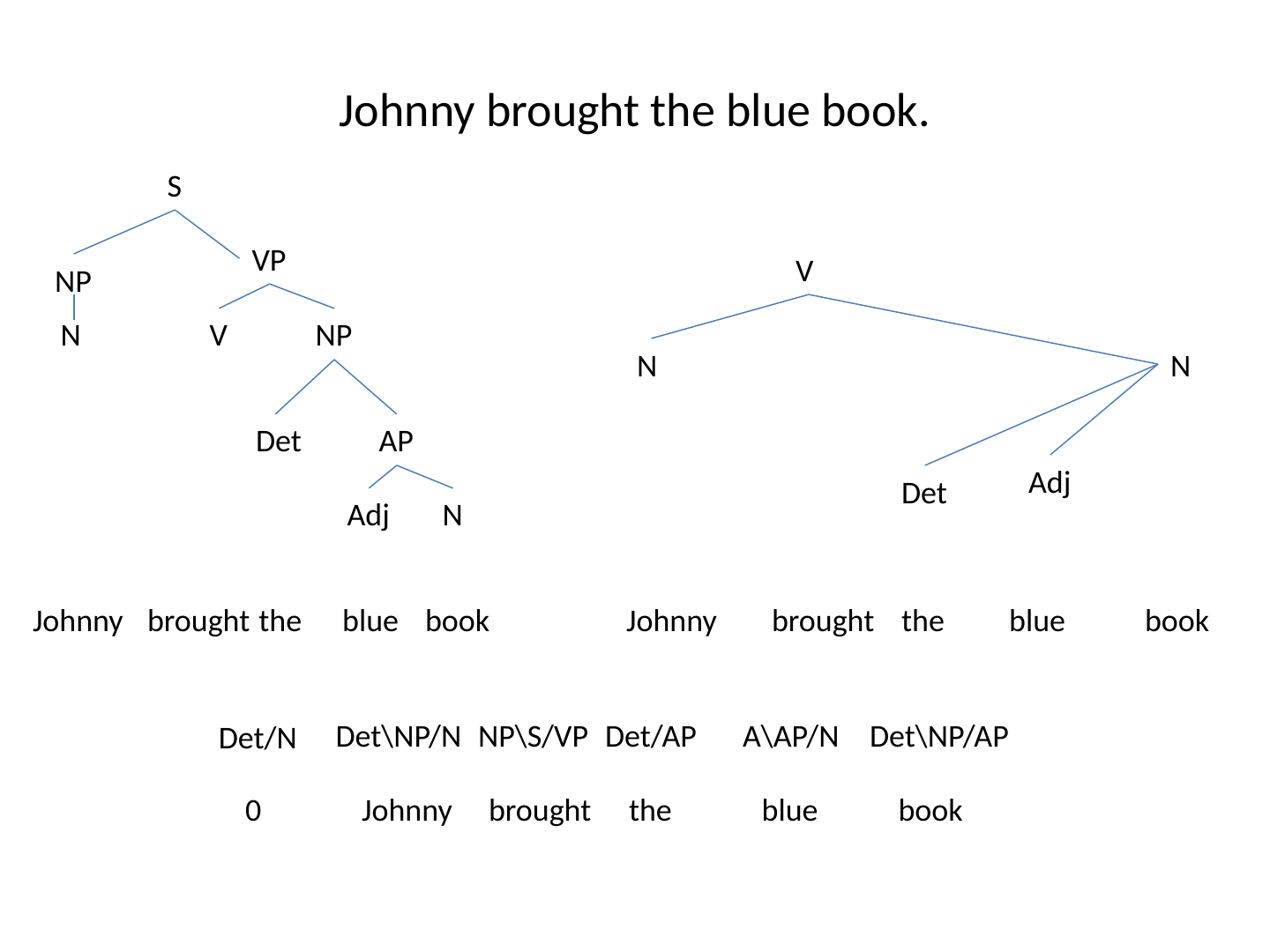
Johnny brought the blue book.
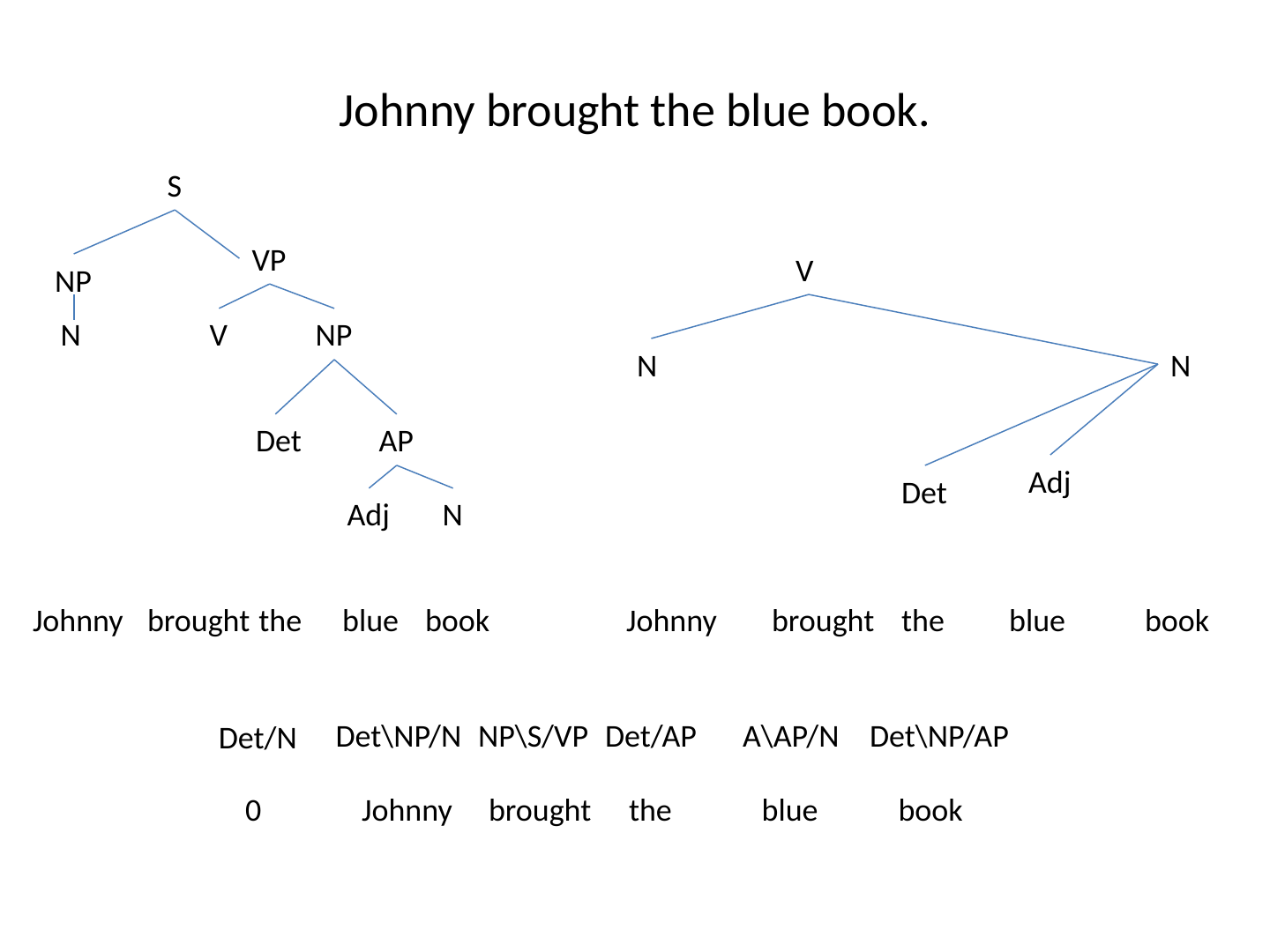
Constituency tree (left), over the words Johnny brought the blue book: S branches into NP and VP; the NP is a single N (Johnny); the VP branches into V (brought) and NP; that NP branches into Det (the) and AP; the AP branches into Adj (blue) and N (book).
Dependency-style tree (right), over the same words: V (brought) is linked to two N nodes, the left N (Johnny) and the right N (book); the right N (book) is linked to Det (the) and Adj (blue).
Category notation under the sentence. The slash notation is the author’s; the backslashes are part of the notation. Each label stands over the word below it, and the first label, Det/N, stands over a 0:
Det/N | Det\NP/N | NP\S/VP | Det/AP | A\AP/N | Det\NP/AP |
|---|---|---|---|---|---|
| 0 | Johnny | brought | the | blue | book |
Slide 29: Variability of linguistic description
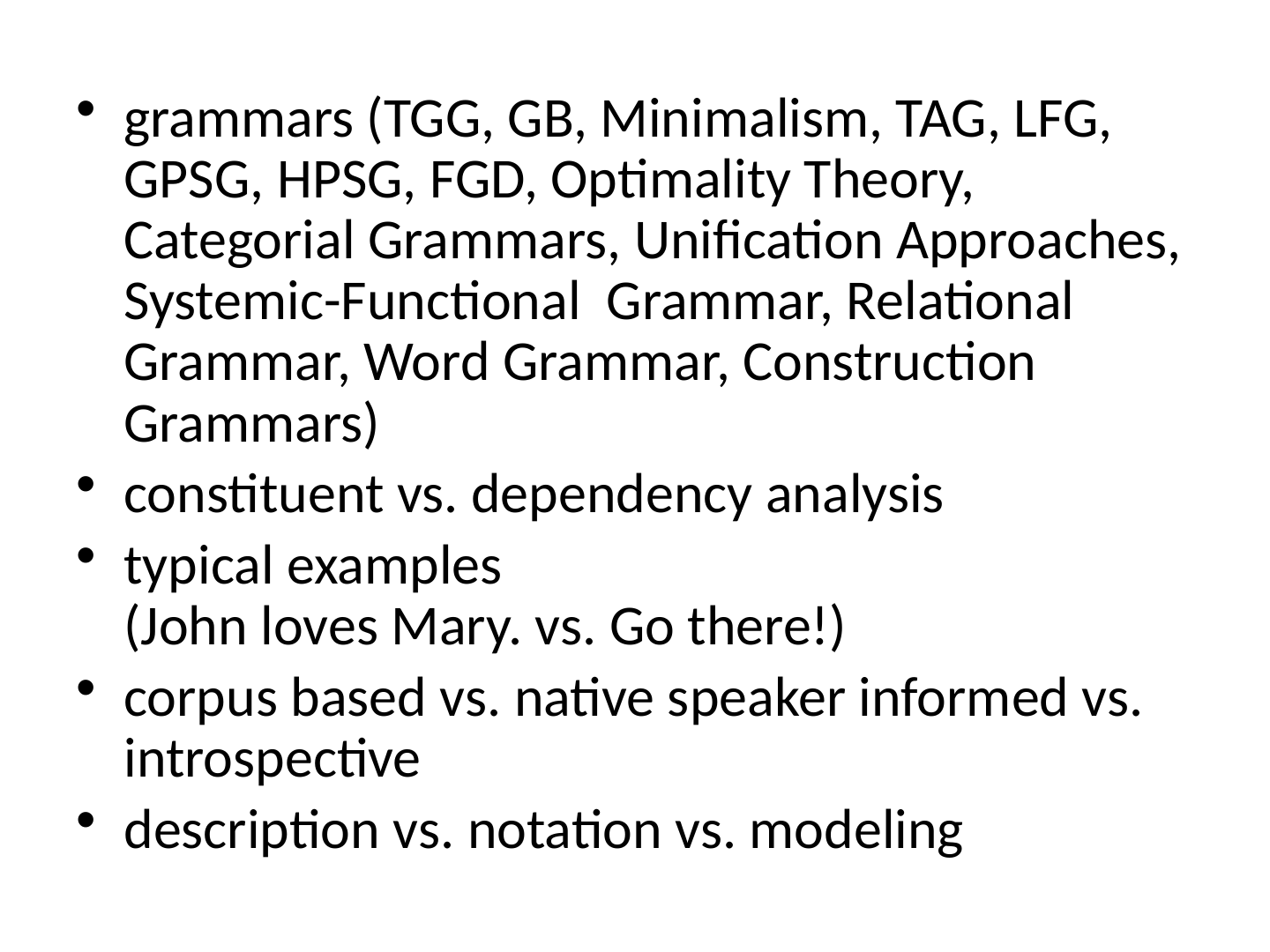
- grammars (TGG, GB, Minimalism, TAG, LFG, GPSG, HPSG, FGD, Optimality Theory, Categorial Grammars, Unification Approaches, Systemic-Functional Grammar, Relational Grammar, Word Grammar, Construction Grammars)
- constituent vs. dependency analysis
- typical examples (John loves Mary. vs. Go there!)
- corpus based vs. native speaker informed vs. introspective
- description vs. notation vs. modeling
Slide 30: Isomorphism assumption
Isomorphism assumption
Slide 31: Isomorphism assumption


Slide 32: Isomorphism assumption
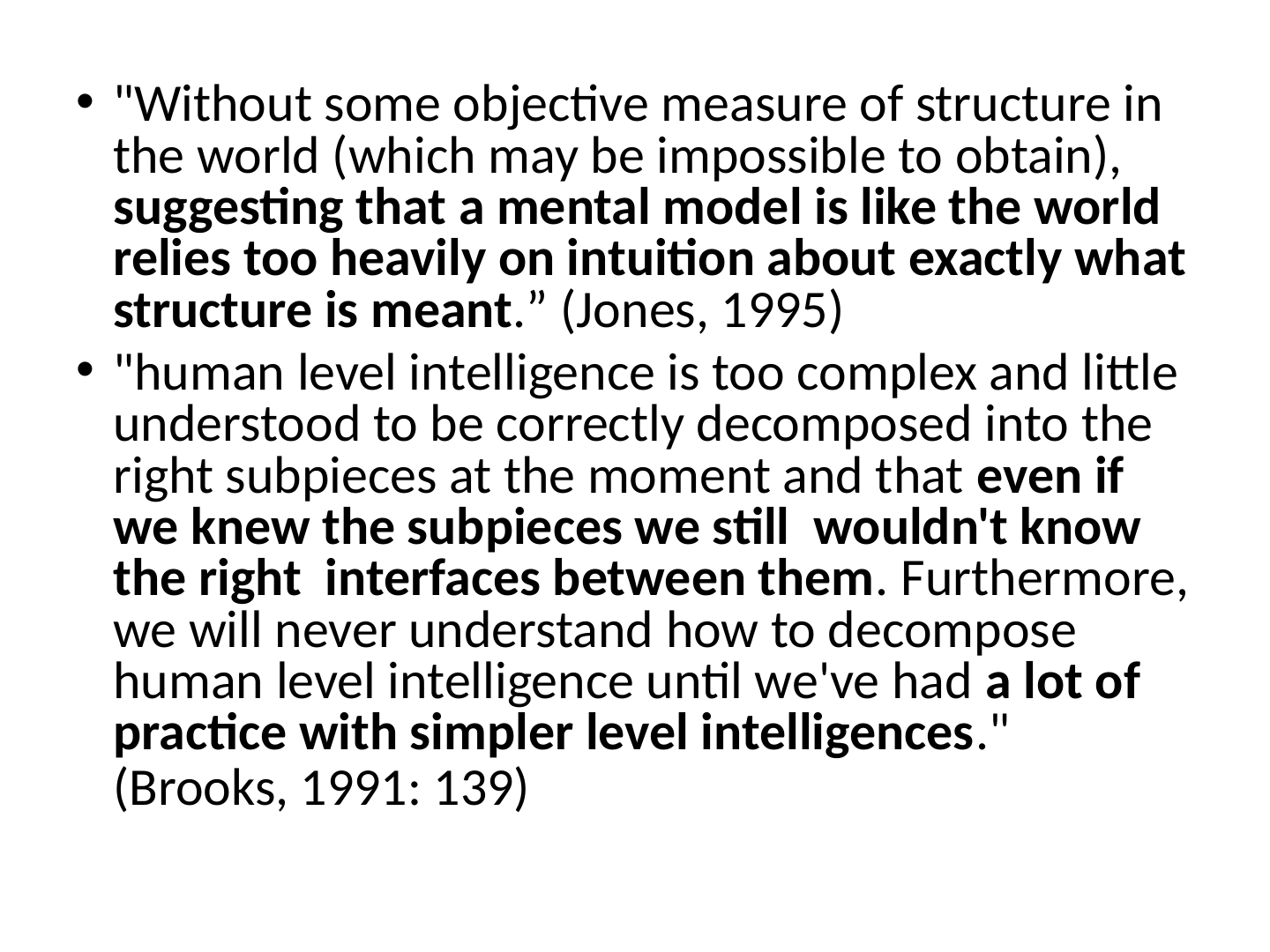
- "Without some objective measure of structure in the world (which may be impossible to obtain), suggesting that a mental model is like the world relies too heavily on intuition about exactly what structure is meant.” (Jones, 1995)
- "human level intelligence is too complex and little understood to be correctly decomposed into the right subpieces at the moment and that even if we knew the subpieces we still wouldn't know the right interfaces between them. Furthermore, we will never understand how to decompose human level intelligence until we've had a lot of practice with simpler level intelligences." (Brooks, 1991: 139)
Slide 33: Slide 33
"there are a number of areas of language which fit uneasily, if at all, into a Generalized description of the grammar of a language. These are areas such as idioms and names which clearly have a patterning of their own but which can be handled within a Generalized description only as exceptions or 'leftovers', because this patterning is frequently different in kind from that seen when the traditional perspective of the verb-centered clause is taken. For such areas a local grammar is needed. Local grammars do not need to squeeze the description into ill-adapted General categories but use a categorization and terminology that is developed specifically for each area. The loss in Generalizability is compensated for by the gains in qualities such as accuracy, transparency, and cumulative coverage."
— Hunston and Thomson, 2000: 74
Slide 34: Pseudo-modular effects in language and mind
Pseudo-modular effects in language and mind
Slide 35: Pseudo-modular effects in language and mind
- overregularization (U-shaped language acquisition) – went → *goed → went
- aphasias
- creolization
- second-language acquisition interference
- sound laws
- areal convergence phenomena
- generative propositional theories
- multilingual societies/diglossia
- code-switching
Slide 36: Alternatives to modularity: Cognitivism and construction grammar
Alternatives to modularity: Cognitivism and construction grammar
Slide 37: Slide 37
“The Cognitive Commitment […] forces one to be responsive to empirical results from cognitive and developmental psychology, cognitive anthropology, neurobiology, etc. Examples include results that indicate the existence of basic-level categories and conceptual prototypes (cf. Lakoff, 1987); results about the nature of color perception and categorization from psychology, anthropology, and neurobiology; results from psychology linking convention mental imagery and language […]
[…] changes what is meant by ‘empirical linguistics’. The reason is that it gives different meaning to the notion ‘generalization’. Generalizations are statements about categories. But what a ‘category’ is is in itself very much at issue.”
— George Lakoff, 1991, Cognitive Versus Generative Linguistics
Slide 38: Slide 38
“To adopt a constructional approach is to undertake a commitment in principle to account for the entirety of each language. This means that the relatively general patterns of the language, such as the one licensing the ordering of a finite auxiliary verb before its subject in English […], and the more idiomatic patterns[…] stand on an equal footing as data for which the grammar must provide an account. “
— Fillmore and Kay, 1999, Grammatical Constructions and Linguistic Generalizations: the What's X doing Y? Construction
Slide 39: Alternatives to modularity: Cognitivism and construction grammar
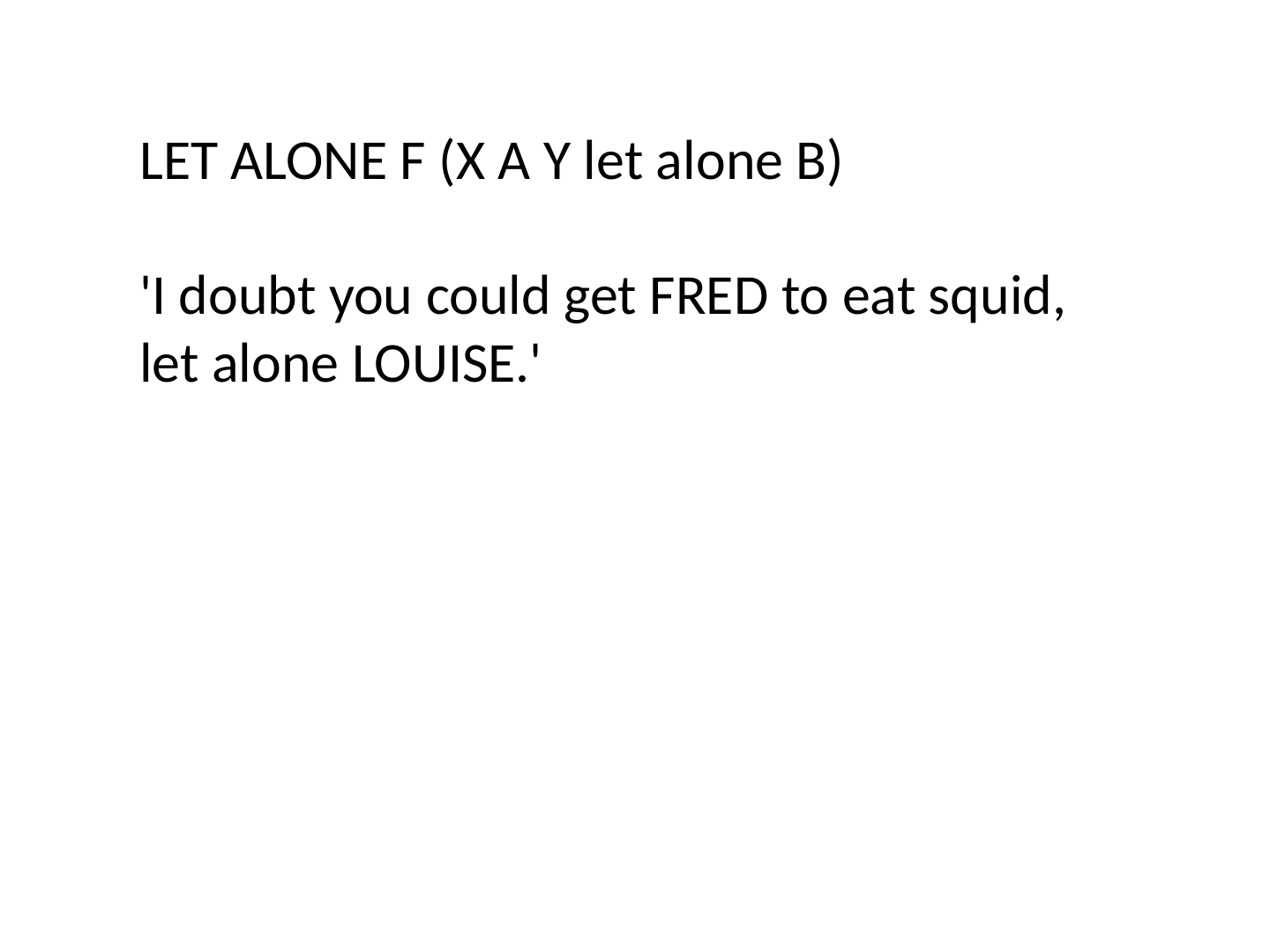
LET ALONE F (X A Y let alone B)
'I doubt you could get FRED to eat squid, let alone LOUISE.'
Slide 40: New knowledge (Frame-based cognition)
New knowledge (Frame-based cognition)
Slide 41: New knowledge (Frame-based cognition)
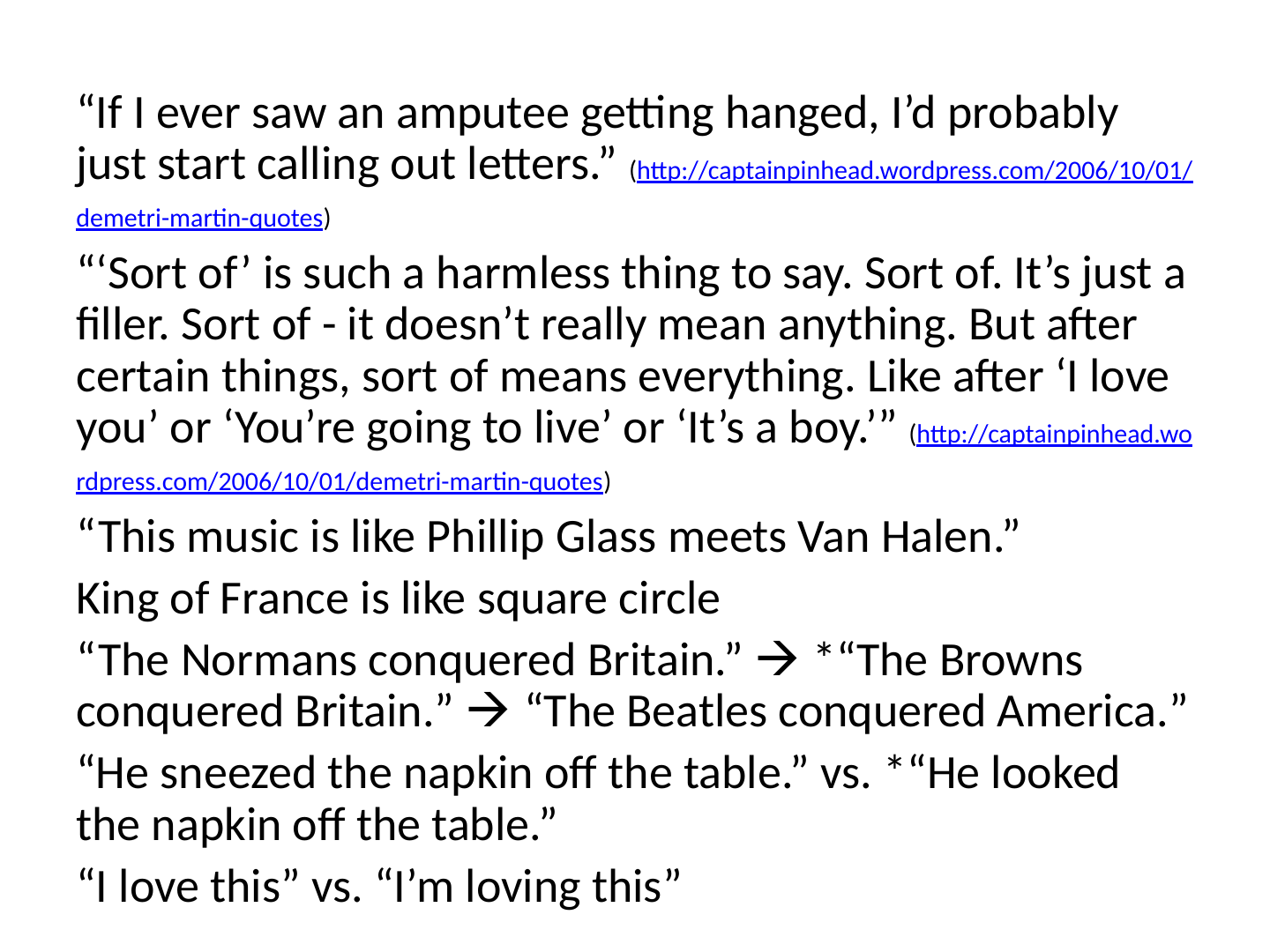
“If I ever saw an amputee getting hanged, I’d probably just start calling out letters.” (http://captainpinhead.wordpress.com/2006/10/01/demetri-martin-quotes)
“‘Sort of’ is such a harmless thing to say. Sort of. It’s just a filler. Sort of - it doesn’t really mean anything. But after certain things, sort of means everything. Like after ‘I love you’ or ‘You’re going to live’ or ‘It’s a boy.’” (http://captainpinhead.wordpress.com/2006/10/01/demetri-martin-quotes)
“This music is like Phillip Glass meets Van Halen.”
King of France is like square circle
“The Normans conquered Britain.” → *“The Browns conquered Britain.” → “The Beatles conquered America.”
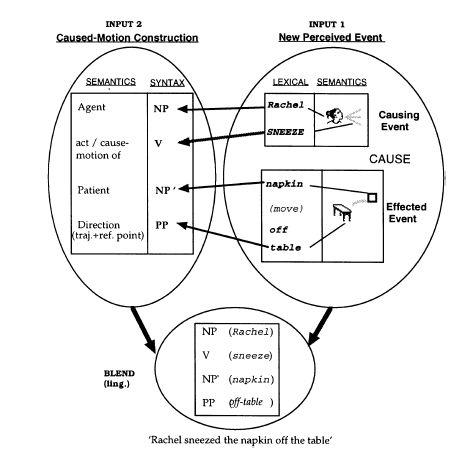
“He sneezed the napkin off the table.” vs. *“He looked the napkin off the table.”
“I love this” vs. “I’m loving this”
Slide 42: New knowledge (Frame-based cognition)
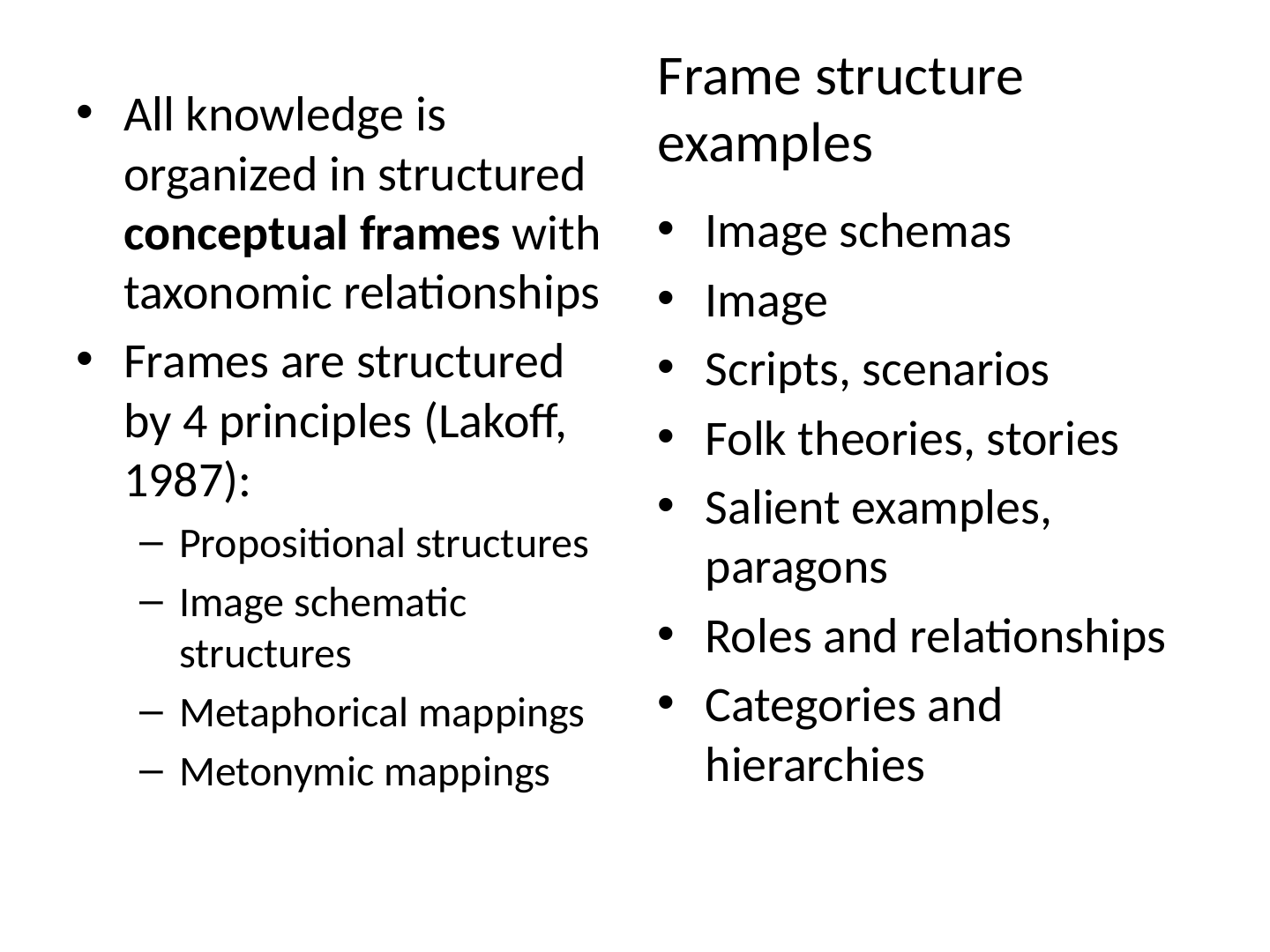
- All knowledge is organized in structured conceptual frames with taxonomic relationships
- Frames are structured by 4 principles (Lakoff, 1987):
- Propositional structures
- Image schematic structures
- Metaphorical mappings
- Metonymic mappings
Frame structure examples
- Image schemas
- Image
- Scripts, scenarios
- Folk theories, stories
- Salient examples, paragons
- Roles and relationships
- Categories and hierarchies
Slide 43: New knowledge (Frame-based cognition)
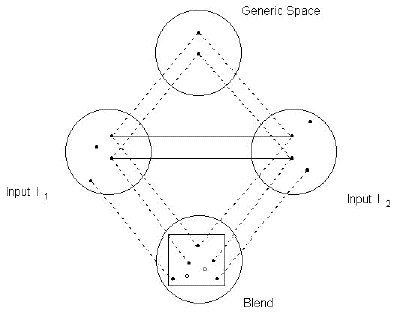
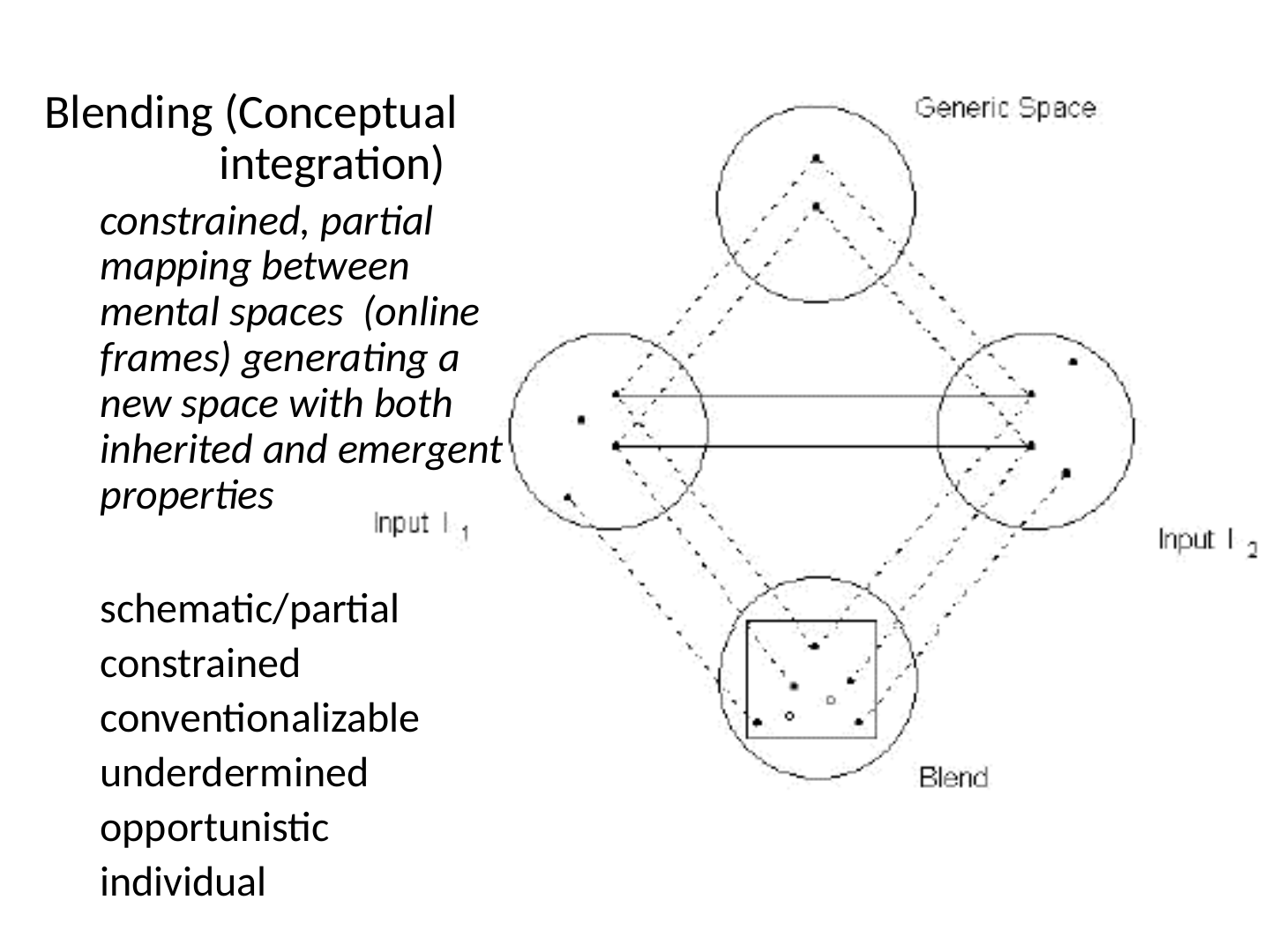
Blending (Conceptual integration)
constrained, partial mapping between mental spaces (online frames) generating a new space with both inherited and emergent properties
- schematic/partial
- constrained
- conventionalizable
- underdermined
- opportunistic
- individual
Slide 44: New knowledge (Frame-based cognition)
Slide 45: New knowledge (Frame-based cognition)
Slide 46: Non-modular sentence structure Construction grammar
Non-modular sentence structure Construction grammar
Slide 47: Non-modular sentence structure Construction grammar
- Central hypotheses (Croft & Cruse, 2004, Cognitive Linguistics)
- language is not an autonomous cognitive faculty
- grammar is conceptualization
- knowledge of language emerges from language use (so called, usage-based approach)
- Supporting hypotheses
- Lexicon-syntax continuum
- Syntax-semantics unity
- Semantics includes pragmatics
- Basic principles
- schemas vs. rules
- elaboration, profiling, active zones, etc. vs. transformations
- Language: Structured inventory of (language specific) constructions
Slide 48: Structure representation
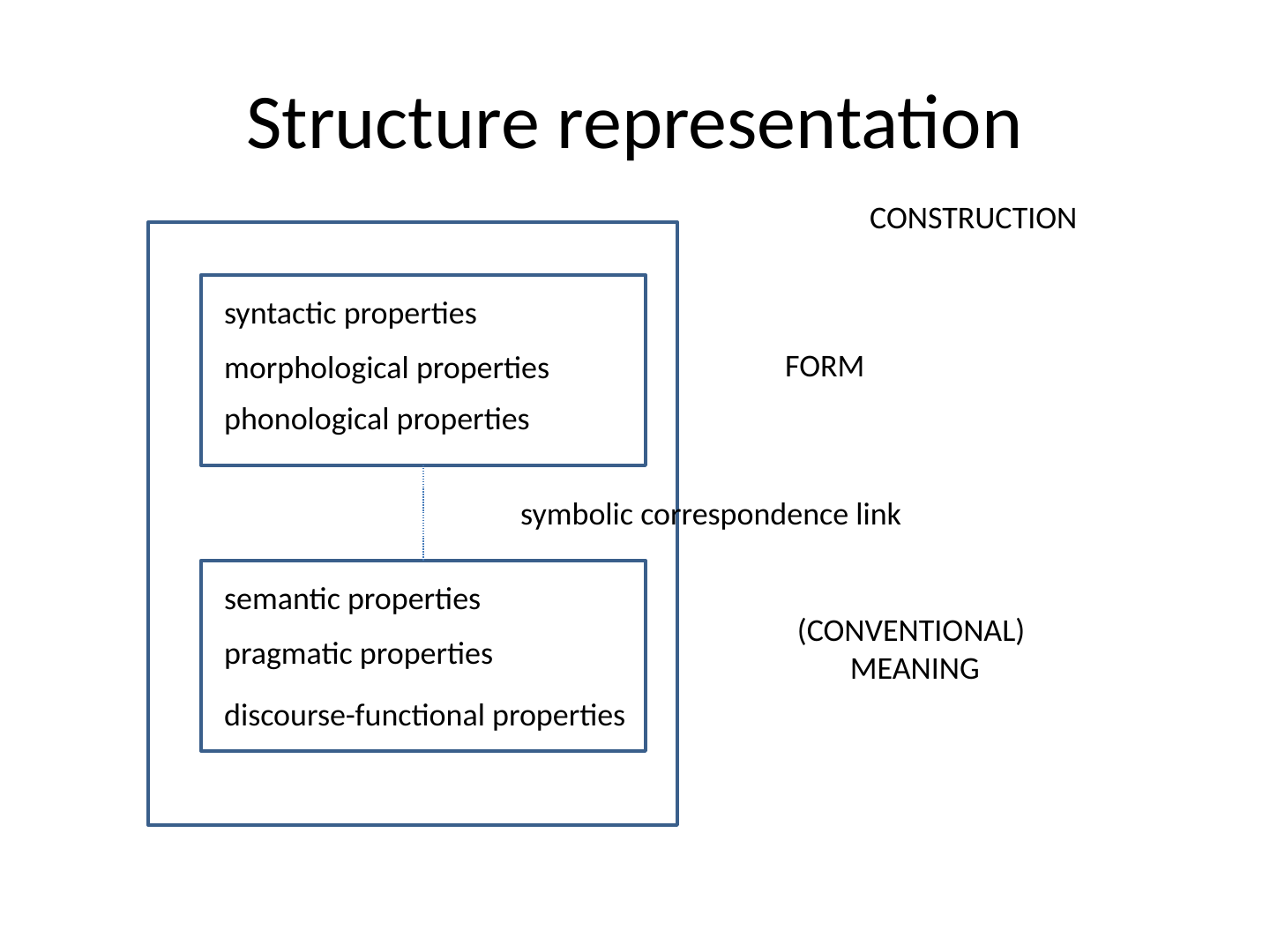
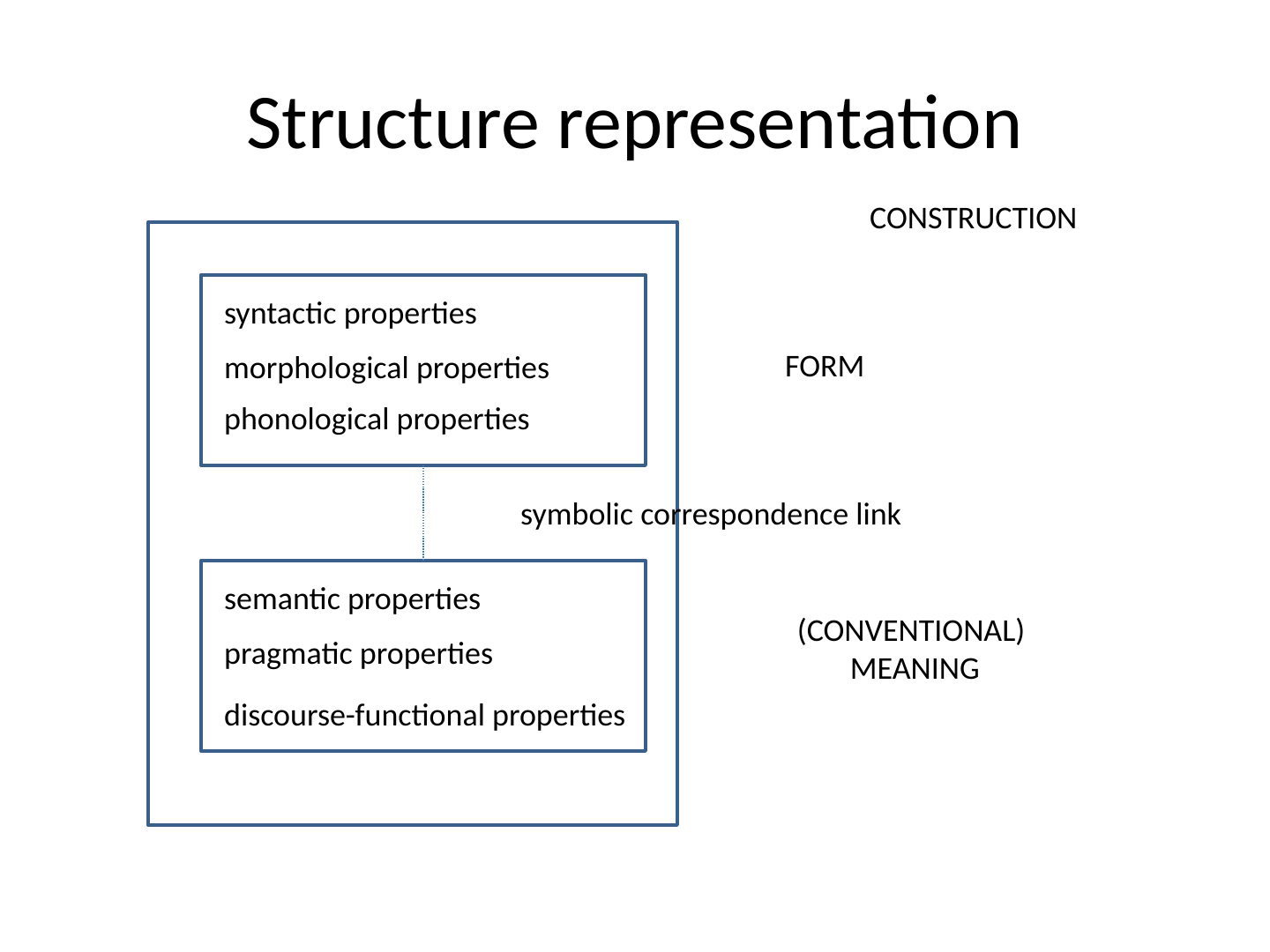
Structure representation
- CONSTRUCTION
- FORM
- syntactic properties
- morphological properties
- phonological properties
- symbolic correspondence link
- (CONVENTIONAL) MEANING
- semantic properties
- pragmatic properties
- discourse-functional properties
- FORM
Slide 49: Representation compared
Representation compared
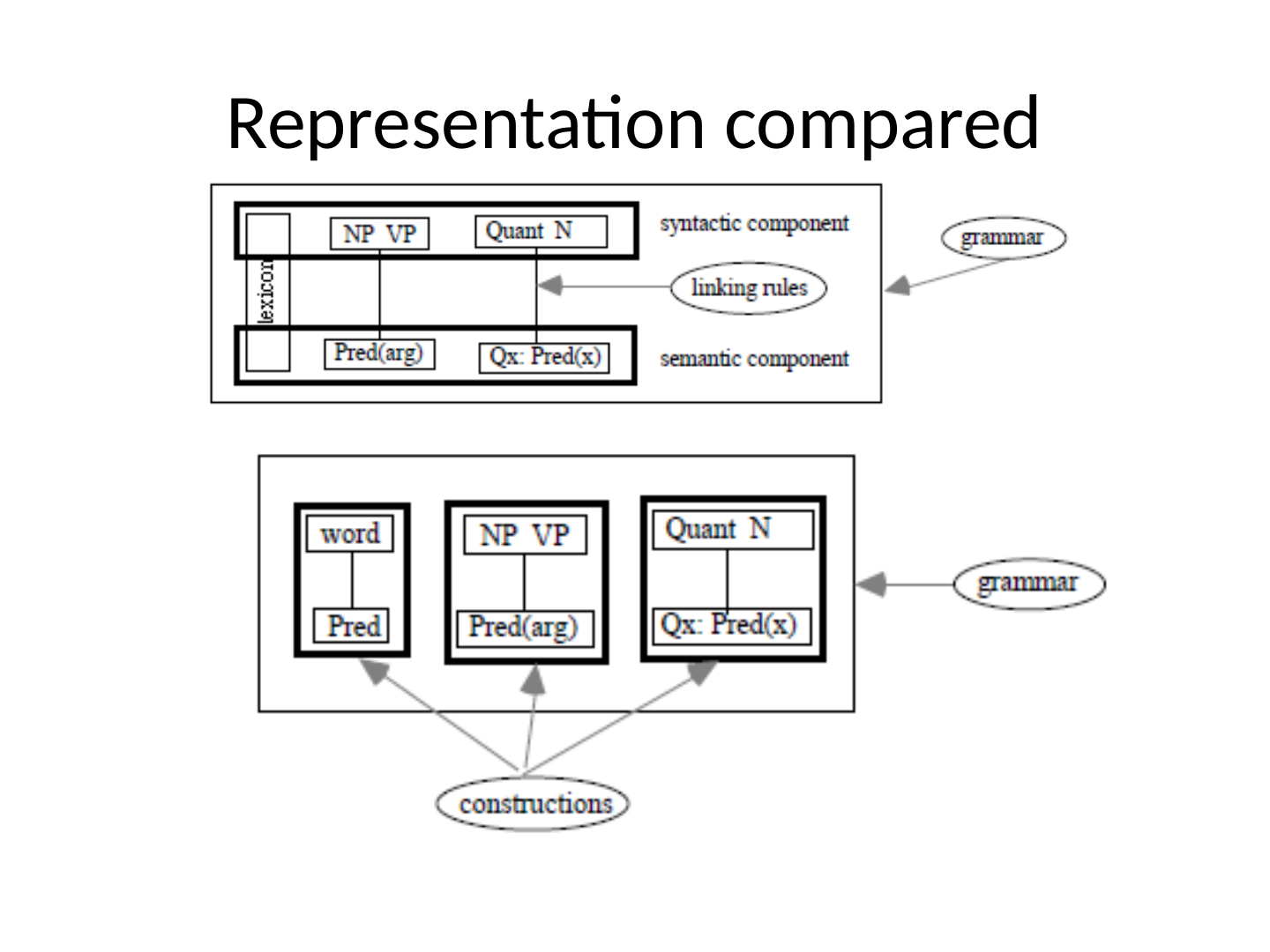
Slide 50: Organization and use of grammatical knowledge
Organization and use of grammatical knowledge
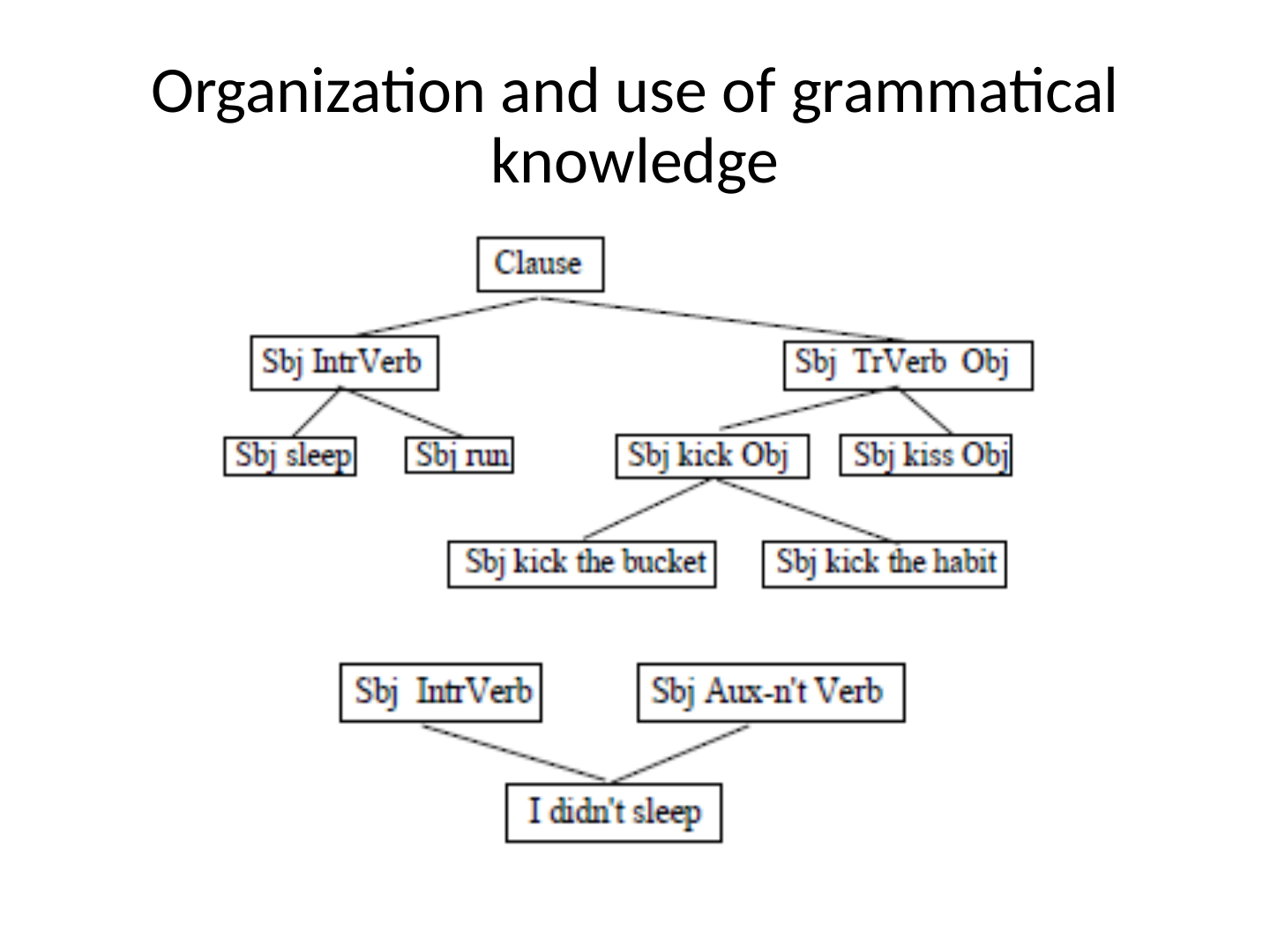
Slide 51: Non-modular sentence structure Construction grammar
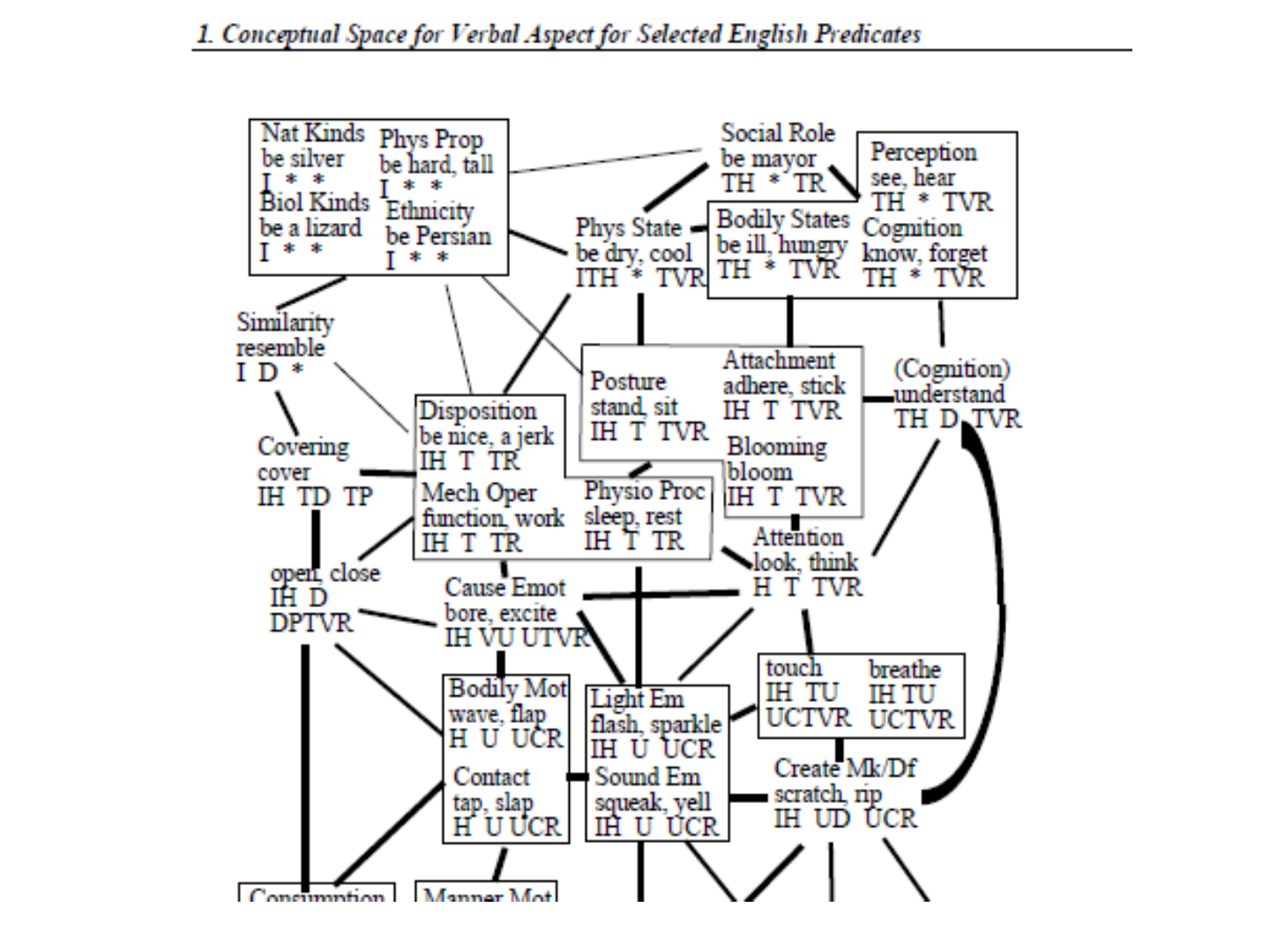
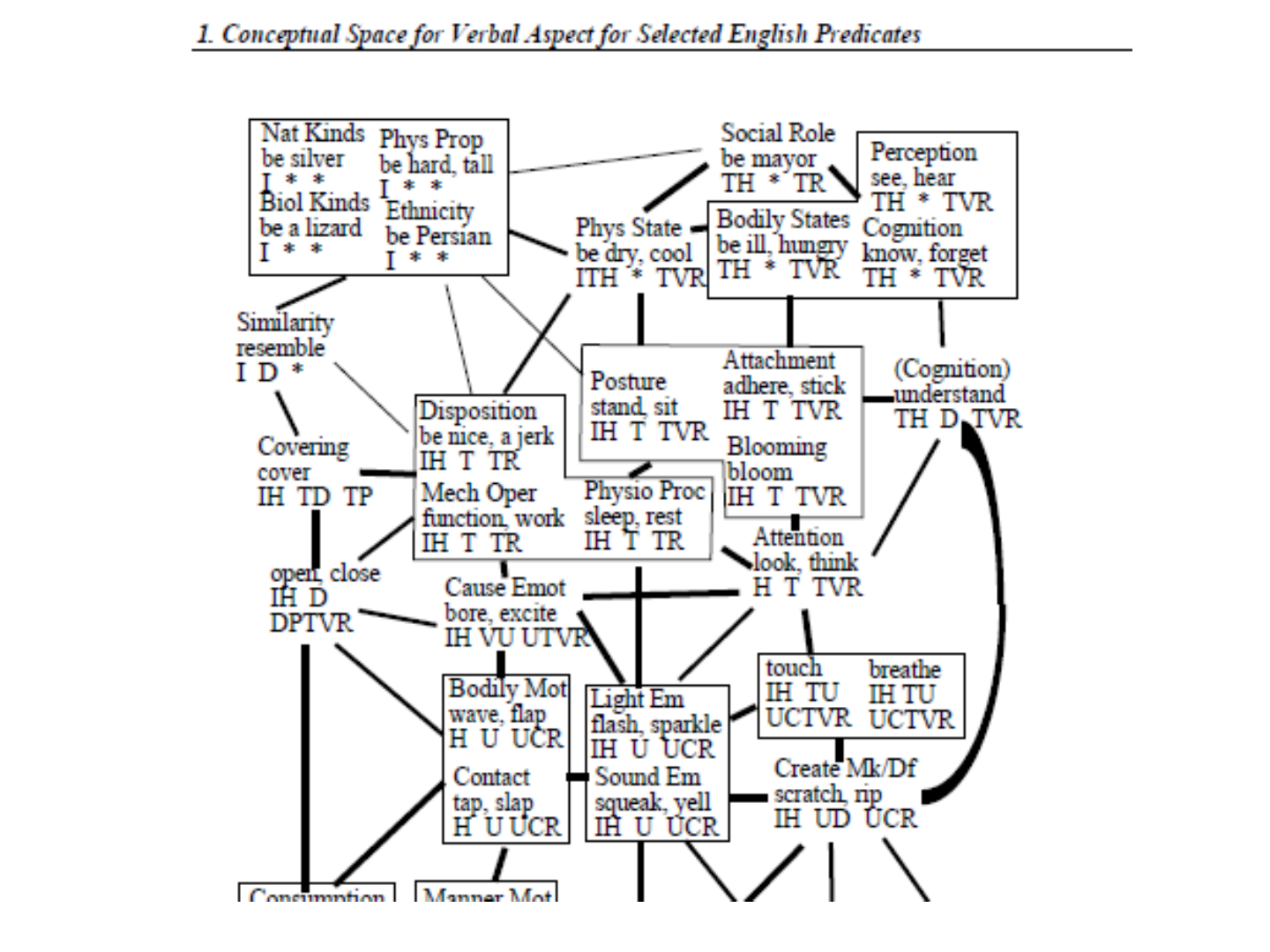
The figure’s title is “1. Conceptual Space for Verbal Aspect for Selected English Predicates”. Each class in the table below is printed in the figure as a class name, example verbs and a three-part code (the asterisks are part of the codes). The lines joining the boxes are listed in the second table below.
| Box | Class | Example verbs | Code 1 | Code 2 | Code 3 |
|---|---|---|---|---|---|
| top left | Nat Kinds | be silver | I | * | * |
| top left | Biol Kinds | be a lizard | I | * | * |
| top left | Phys Prop | be hard, tall | I | * | * |
| top left | Ethnicity | be Persian | I | * | * |
| single box | Social Role | be mayor | TH | * | TR |
| top right | Perception | see, hear | TH | * | TVR |
| top right | Bodily States | be ill, hungry | TH | * | TVR |
| top right | Cognition | know, forget | TH | * | TVR |
| single box | Phys State | be dry, cool | ITH | * | TVR |
| single box | Similarity | resemble | I | D | * |
| single box | Covering | cover | IH | TD | TP |
| centre left | Disposition | be nice, a jerk | IH | T | TR |
| centre left | Mech Oper | function, work | IH | T | TR |
| centre left | Physio Proc | sleep, rest | IH | T | TR |
| centre | Posture | stand, sit | IH | T | TVR |
| centre | Attachment | adhere, stick | IH | T | TVR |
| centre | Blooming | bloom | IH | T | TVR |
| single box | (Cognition) | understand | TH | D | TVR |
| single box | (no class name shown) | open, close | IH | D | DPTVR |
| single box | Cause Emot | bore, excite | IH | VU | UTVR |
| single box | Attention | look, think | H | T | TVR |
| lower left | Bodily Mot | wave, flap | H | U | UCR |
| lower left | Contact | tap, slap | H | U | UCR |
| lower centre | Light Em | flash, sparkle | IH | U | UCR |
| lower centre | Sound Em | squeak, yell | IH | U | UCR |
| lower right | (no class name shown) | touch | IH | TU | UCTVR |
| lower right | (no class name shown) | breathe | IH | TU | UCTVR |
| single box | Create Mk/Df | scratch, rip | IH | UD | UCR |
Boxes with the same position label are drawn inside one enclosing box. The tops of two further boxes, Consumption and Manner Mot, are visible at the bottom edge; their contents are cut off in the slide.
The figure joins boxes with 44 straight or curved lines. None of them has an arrowhead, and none is labelled, so each is listed as a plain join between two boxes, with no direction. The enclosing boxes are named by the position labels in the first table: the top left box holds Nat Kinds, Biol Kinds, Phys Prop and Ethnicity; the top right box holds Perception, Bodily States and Cognition (the Bodily States box overlaps the Perception box); the centre left box holds Disposition, Mech Oper and Physio Proc; the centre box holds Posture, Attachment and Blooming; the lower left box holds Bodily Mot and Contact; the lower centre box holds Light Em and Sound Em; the lower right box holds touch and breathe. A line that touches an enclosing box is listed against that box, with the edge it meets.
Line weight is the line's measured pixel width in the full-size figure: hairline is about 1 to 3 pixels, medium about 4 to 6, heavy 7 or more. Lines near 6 or 7 pixels could fall in either class. Lines 23 and 24 cross each other with no junction mark. Line 18 is a curve that bows out to the right of the figure and is thickest at its upper end. Lines 40 to 44 run off the lower edge of the slide, so their other ends are not visible and are not guessed; lines 41 and 42 come together near that edge.
| # | One end | Other end | Line |
|---|---|---|---|
| 1 | top left box (right edge) | Social Role | hairline |
| 2 | Social Role | Phys State | heavy |
| 3 | Social Role | top right box (inner corner where the Perception box meets the top of the Bodily States box) | heavy |
| 4 | top left box (right edge) | Phys State | medium |
| 5 | top left box (bottom edge) | Similarity | medium |
| 6 | top left box (bottom edge) | centre left box (top edge, above Disposition) | hairline |
| 7 | top left box (bottom edge) | centre box (left edge, beside Posture) | hairline |
| 8 | Similarity | centre left box (left edge, beside Disposition) | hairline |
| 9 | Similarity | Covering | medium |
| 10 | Covering | centre left box (left edge) | heavy |
| 11 | Covering | open, close | heavy |
| 12 | Phys State | centre left box (top edge, above Disposition) | medium |
| 13 | Phys State | centre box (top edge, above Posture) | heavy |
| 14 | Phys State | top right box (left edge of the Bodily States box) | heavy |
| 15 | top right box (bottom edge of the Bodily States box) | centre box (top edge, above Attachment) | heavy |
| 16 | top right box (bottom edge, under Cognition) | (Cognition) understand | medium |
| 17 | centre box (right edge, level with Attachment) | (Cognition) understand | heavy |
| 18 | (Cognition) understand | Create Mk/Df | heavy (curved line that bows out to the right of the figure; tapers, widest near understand) |
| 19 | (Cognition) understand | Attention | medium |
| 20 | centre box (bottom edge, under Posture) | centre left box (top edge, above Physio Proc) | heavy |
| 21 | centre box (bottom edge, under Blooming) | Attention | heavy |
| 22 | centre left box (right edge, beside Physio Proc) | Attention | heavy |
| 23 | centre left box (bottom edge, below Physio Proc) | lower centre box (top edge, above Light Em) | heavy (crosses edge 24 with no junction mark) |
| 24 | Cause Emot | Attention | heavy (crosses edge 23 with no junction mark) |
| 25 | centre left box (left edge, beside Mech Oper) | open, close | medium |
| 26 | centre left box (bottom edge, below Mech Oper) | Cause Emot | heavy |
| 27 | open, close | Cause Emot | medium |
| 28 | Cause Emot | lower left box (top edge, above Bodily Mot) | heavy |
| 29 | Cause Emot | lower centre box (top edge, above Light Em) | heavy |
| 30 | Attention | lower centre box (top-right corner) | medium |
| 31 | Attention | lower right box (top edge) | heavy |
| 32 | lower centre box (right edge, beside Light Em) | lower right box (left edge) | heavy |
| 33 | lower right box (bottom edge) | Create Mk/Df | heavy |
| 34 | lower left box (right edge, beside Contact) | lower centre box (left edge, beside Sound Em) | heavy |
| 35 | lower centre box (right edge, beside Sound Em) | Create Mk/Df | heavy |
| 36 | open, close | lower left box (left edge, beside Bodily Mot) | medium |
| 37 | open, close | Consumption (box cut off by the lower edge of the slide) | heavy |
| 38 | lower left box (left edge, beside Contact) | Consumption (box cut off by the lower edge of the slide) | heavy |
| 39 | lower left box (bottom edge) | Manner Mot (box cut off by the lower edge of the slide) | heavy |
| 40 | lower centre box (bottom edge, below Sound Em) | not visible: the line runs off the lower edge of the slide | heavy |
| 41 | lower centre box (bottom edge, right of Sound Em) | not visible: the line runs off the lower edge of the slide | medium (meets edge 42 near the lower edge) |
| 42 | Create Mk/Df (bottom, left) | not visible: the line runs off the lower edge of the slide | heavy (meets edge 41 near the lower edge) |
| 43 | Create Mk/Df (bottom) | not visible: the line runs off the lower edge of the slide | medium |
| 44 | Create Mk/Df (bottom, right) | not visible: the line runs off the lower edge of the slide | medium |
In total there are 27 heavy, 13 medium and 4 hairline lines.
Slide 52: Non-modular sentence structure Construction grammar
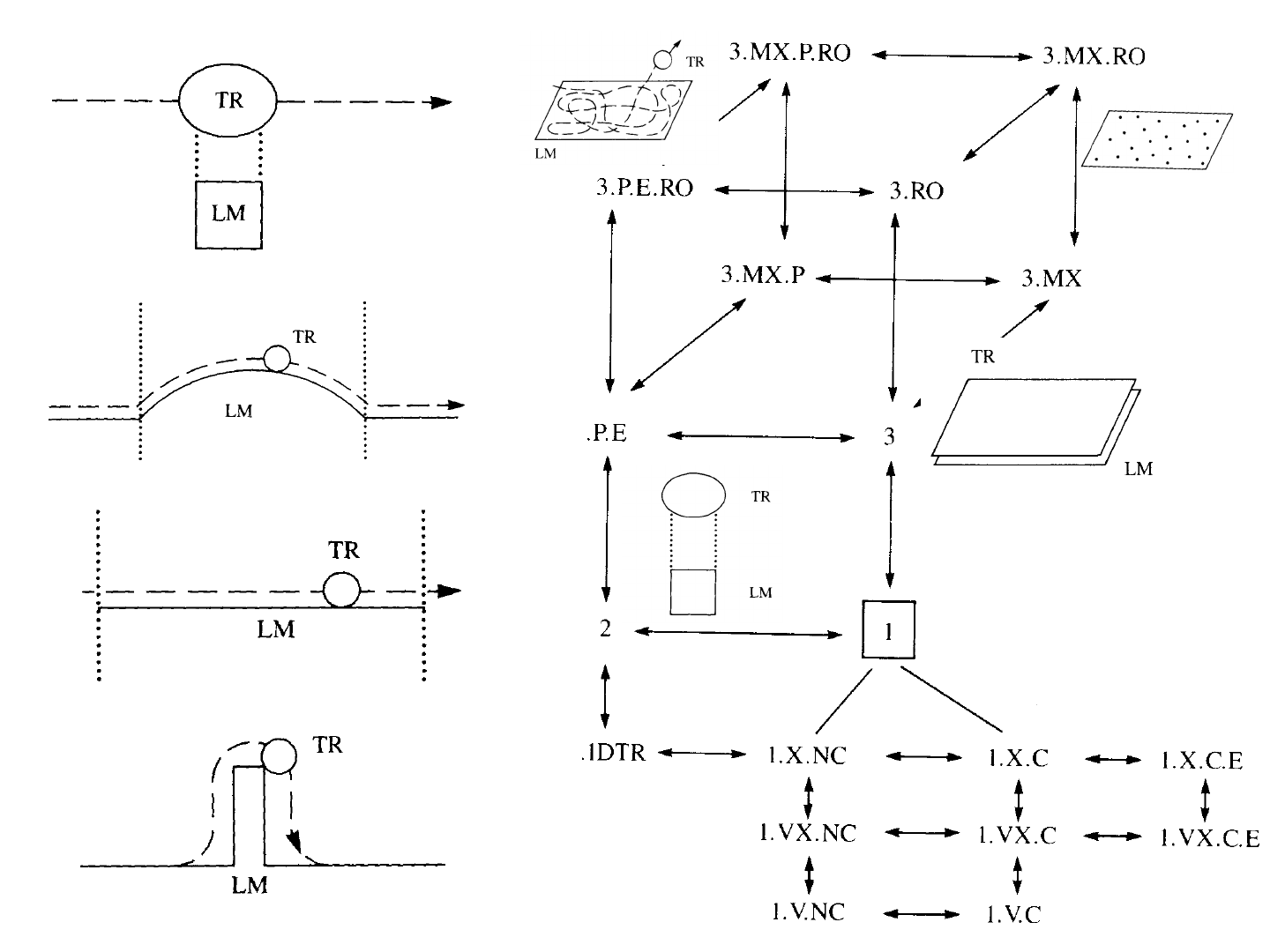
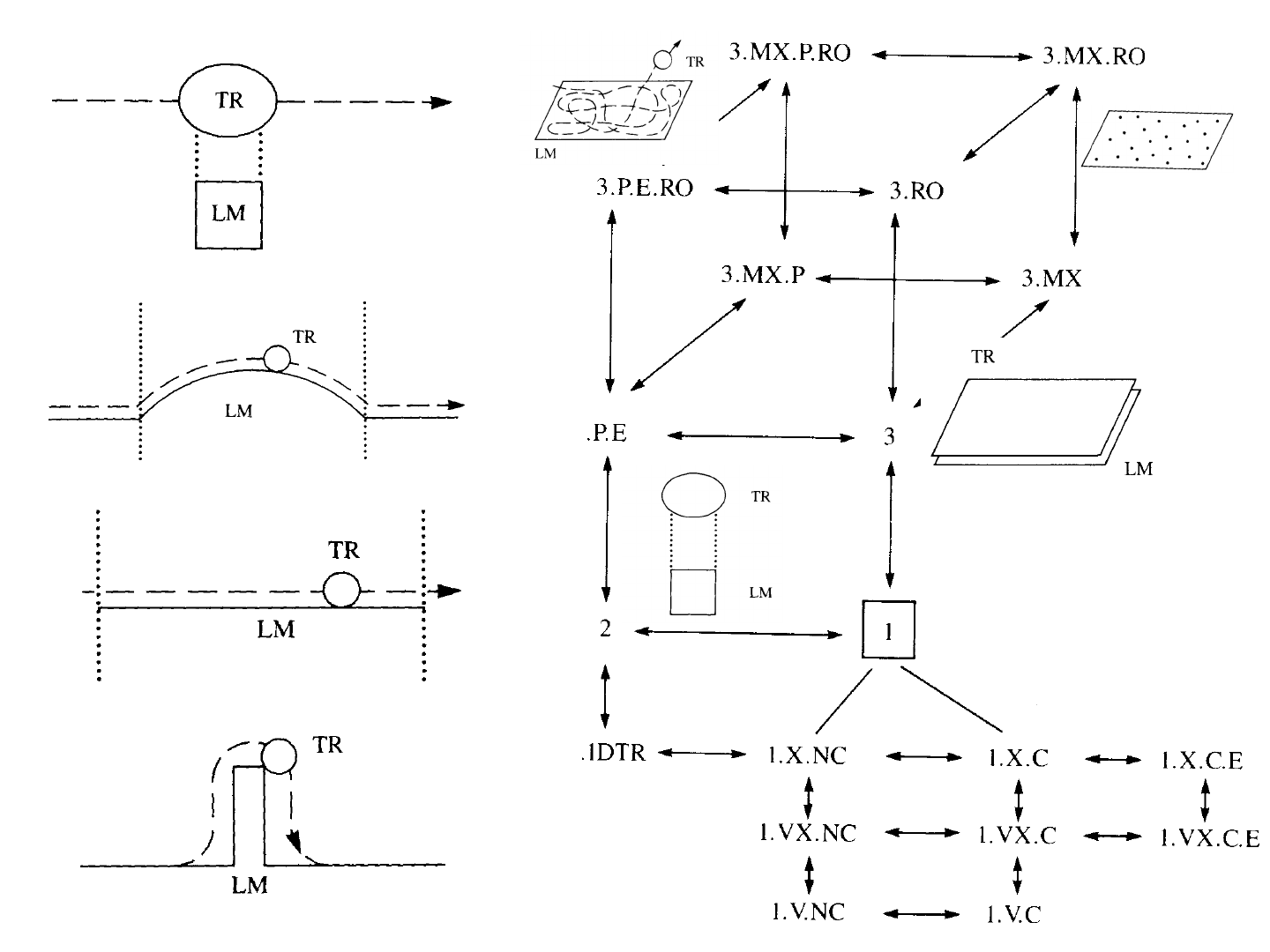
The four diagrams on the left show the trajector (TR) and landmark (LM) in four configurations: TR above a boxed LM; TR passing over a curved LM; TR along a flat LM with dotted limits at each end; TR going up and over a tall narrow LM and down again.
The network on the right has these nodes: 3.MX.P.RO, 3.MX.RO, 3.P.E.RO, 3.RO, 3.MX.P, 3.MX, .P.E, 3, 2, 1, .1DTR, 1.X.NC, 1.X.C, 1.X.C.E, 1.VX.NC, 1.VX.C, 1.VX.C.E, 1.V.NC and 1.V.C. The first character of .P.E and .1DTR is cut off in the image. The links, all double-headed arrows unless stated:
- 3.MX.P.RO — 3.MX.RO; 3.MX.P.RO — 3.MX.P; a one-way arrow leads to 3.MX.P.RO from a small picture of a TR on a tangled path over a LM.
- 3.MX.RO — 3.RO; 3.MX.RO — 3.MX.
- 3.P.E.RO — 3.RO; 3.P.E.RO — .P.E.
- 3.MX.P — 3.MX; 3.MX.P — .P.E.
- 3.RO — 3. A one-way arrow leads to 3.MX from a small picture of a TR over two stacked plates.
- .P.E — 3; .P.E — 2.
- 3 — 1; 2 — 1; 2 — .1DTR.
- 1 is joined by plain lines (no arrowheads) to 1.X.NC and to 1.X.C.
- .1DTR — 1.X.NC; 1.X.NC — 1.X.C; 1.X.C — 1.X.C.E.
- 1.X.NC — 1.VX.NC; 1.X.C — 1.VX.C; 1.X.C.E — 1.VX.C.E; 1.VX.NC — 1.VX.C; 1.VX.C — 1.VX.C.E.
- 1.VX.NC — 1.V.NC; 1.VX.C — 1.V.C; 1.V.NC — 1.V.C.
Slide 53: Non-modular sentence structure Construction grammar
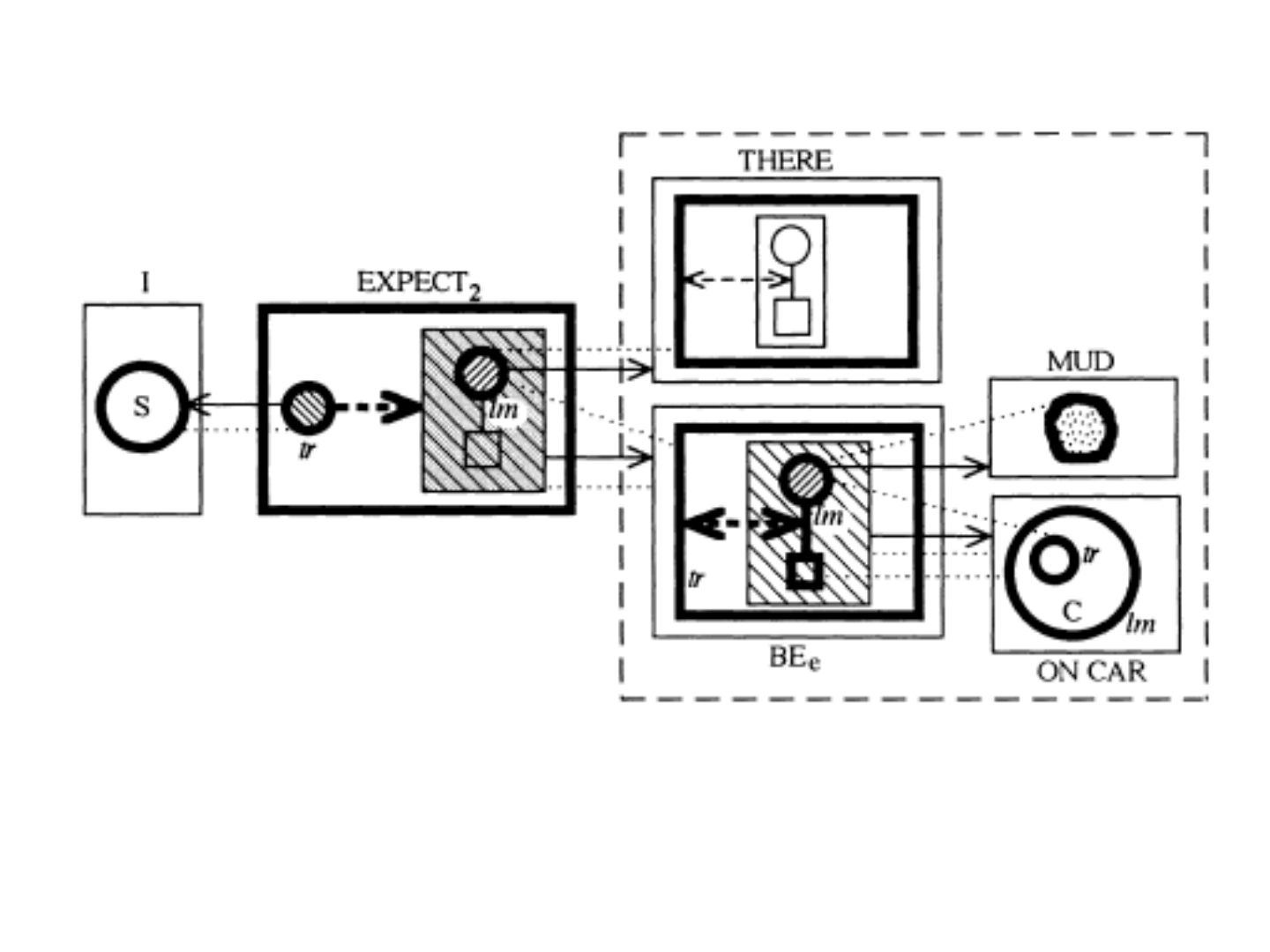
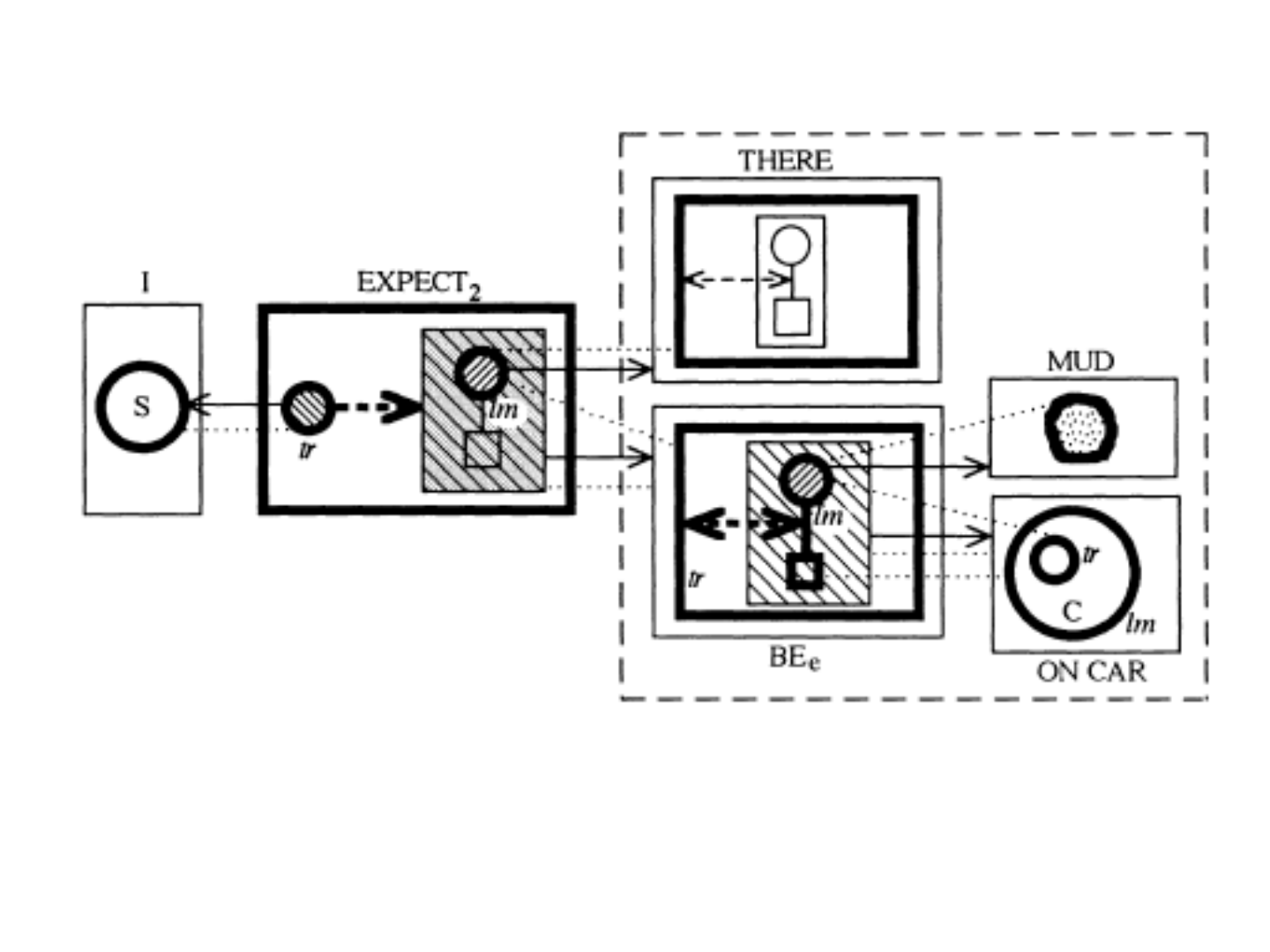
The diagram’s labels are I (with S), EXPECT₂ (with tr and lm), THERE, BEₑ (with tr and lm), MUD and ON CAR (with tr, C and lm). The boxes THERE, BEₑ, MUD and ON CAR sit inside one dashed frame, to the right of EXPECT₂.
Slide 54: Non-modular sentence structure Construction grammar
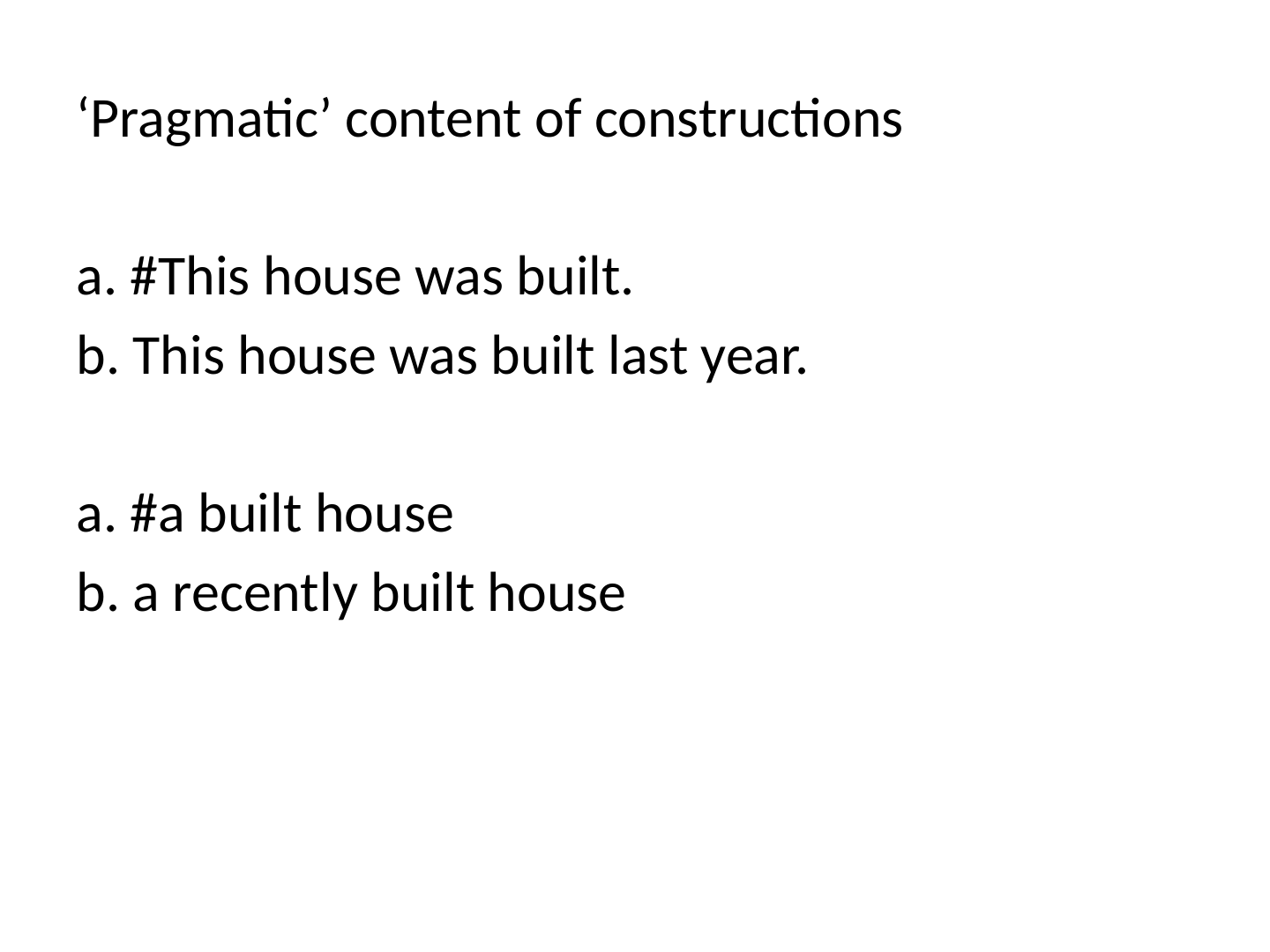
‘Pragmatic’ content of constructions
a. #This house was built.
b. This house was built last year.
a. #a built house
b. a recently built house
Slide 55: Some other alternatives to organization of linguistic strutures
Some other alternatives to organization of linguistic strutures
Slide 56: Some other alternatives to organization of linguistic strutures
- local grammars (Google ‘define’ feature)
- stochastic effects
- bootstrapping
- Zipf’s law
- connectionism / neural nets
- fractal linguistics
- levels of magnification
- self-similarity
- self-organization
- surface patterns of discourse repetition
- text colonies
Slide 57: Some other alternatives to organization of linguistic strutures
Slide 58: Cognitivist alternative to universal grammar
Cognitivist alternative to universal grammar
Slide 59: Cognitivist alternative to universal grammar
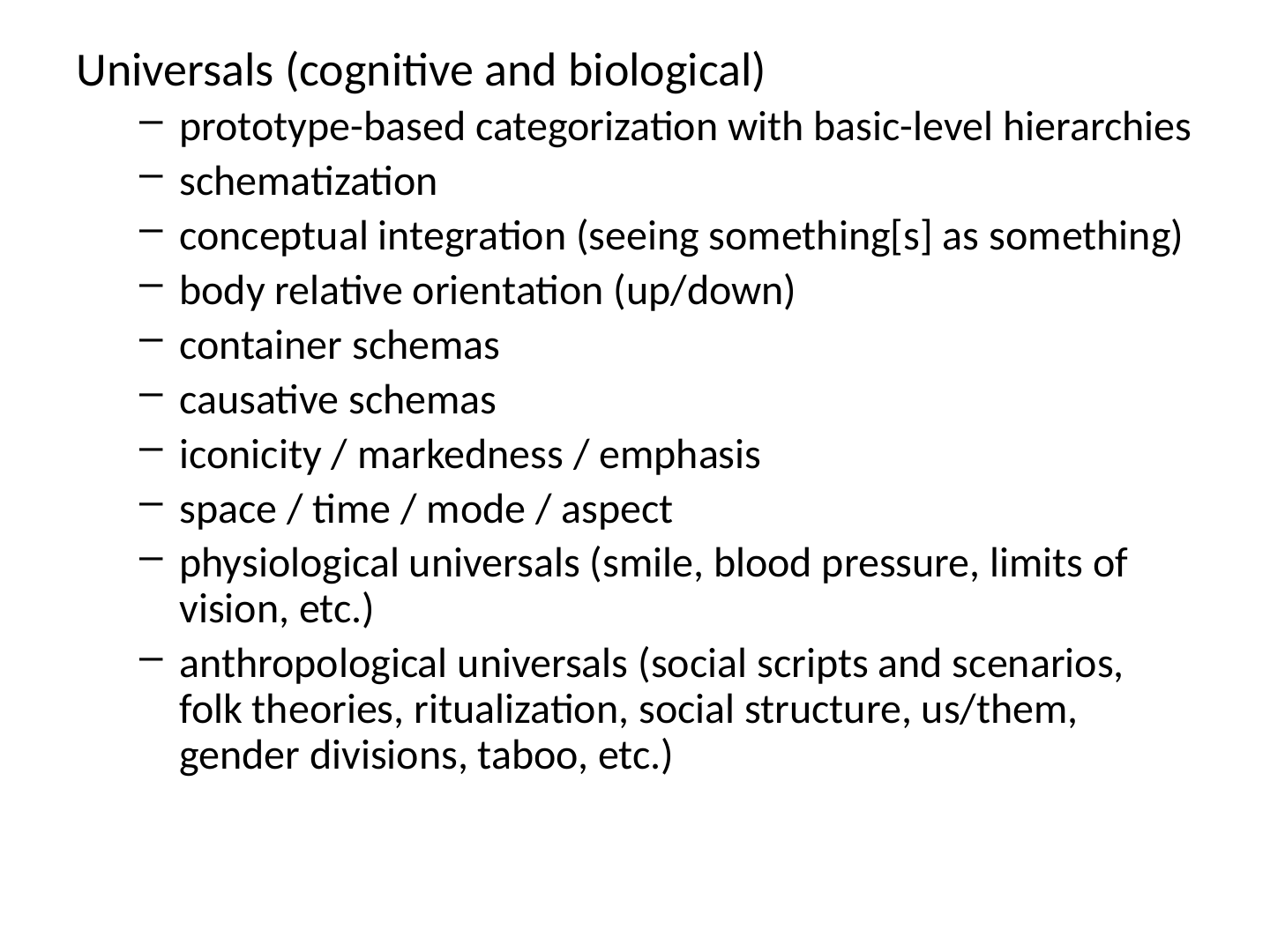
Universals (cognitive and biological)
- prototype-based categorization with basic-level hierarchies
- schematization
- conceptual integration (seeing something[s] as something)
- body relative orientation (up/down)
- container schemas
- causative schemas
- iconicity / markedness / emphasis
- space / time / mode / aspect
- physiological universals (smile, blood pressure, limits of vision, etc.)
- anthropological universals (social scripts and scenarios, folk theories, ritualization, social structure, us/them, gender divisions, taboo, etc.)
Slide 60: Cognitivist alternative to universal grammar
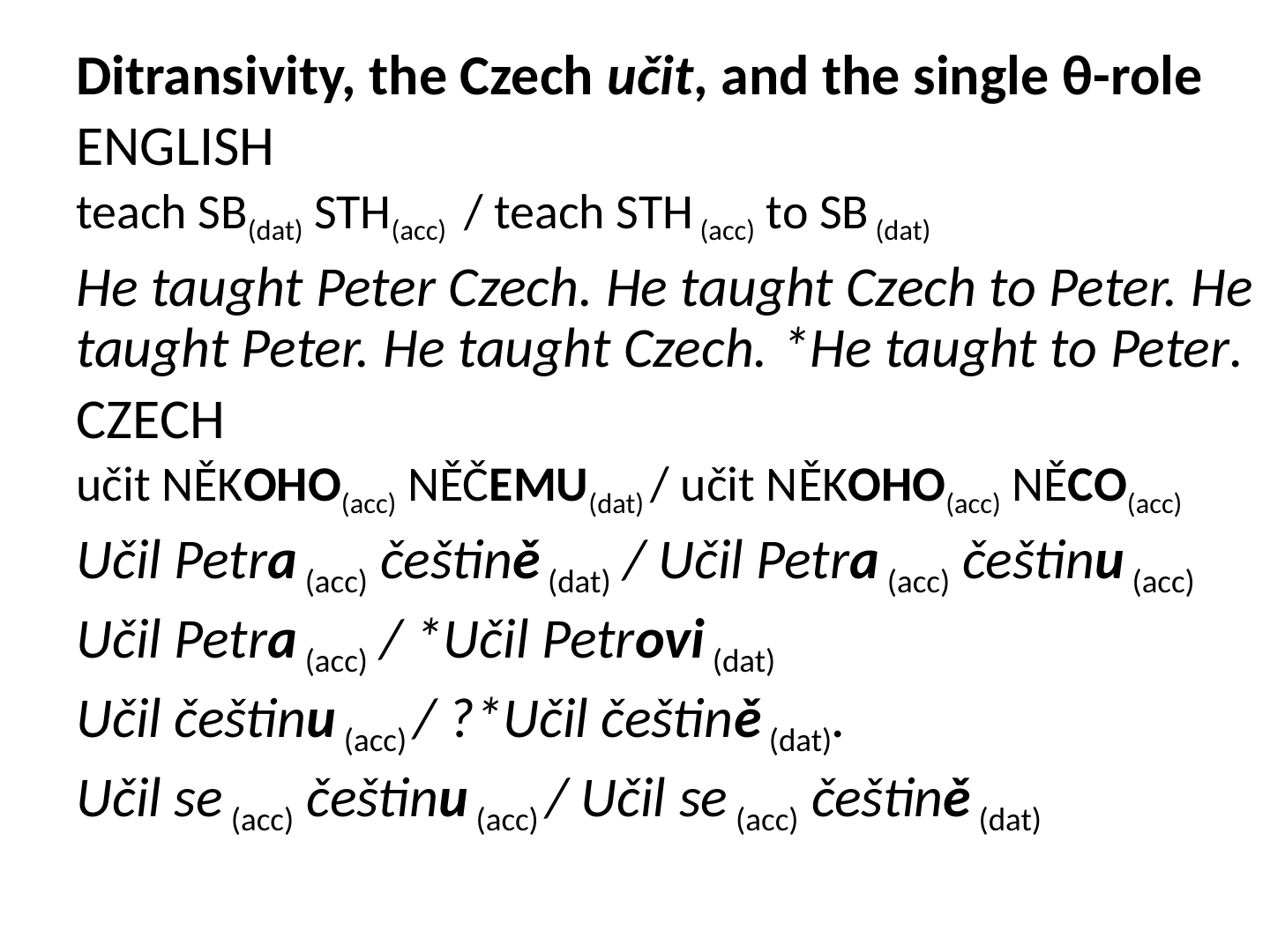
Ditransivity, the Czech učit, and the single θ-role
ENGLISH
teach SB(dat) STH(acc) / teach STH (acc) to SB (dat)
He taught Peter Czech. He taught Czech to Peter. He taught Peter. He taught Czech. *He taught to Peter.
CZECH
učit NĚKOHO(acc) NĚČEMU(dat) / učit NĚKOHO(acc) NĚCO(acc)
Učil Petra (acc) češtině (dat) / Učil Petra (acc) češtinu (acc)
Učil Petra (acc) / *Učil Petrovi (dat)
Učil češtinu (acc) / ?*Učil češtině (dat).
Učil se (acc) češtinu (acc) / Učil se (acc) češtině (dat)
Slide 61: Cognitivist alternative to universal grammar
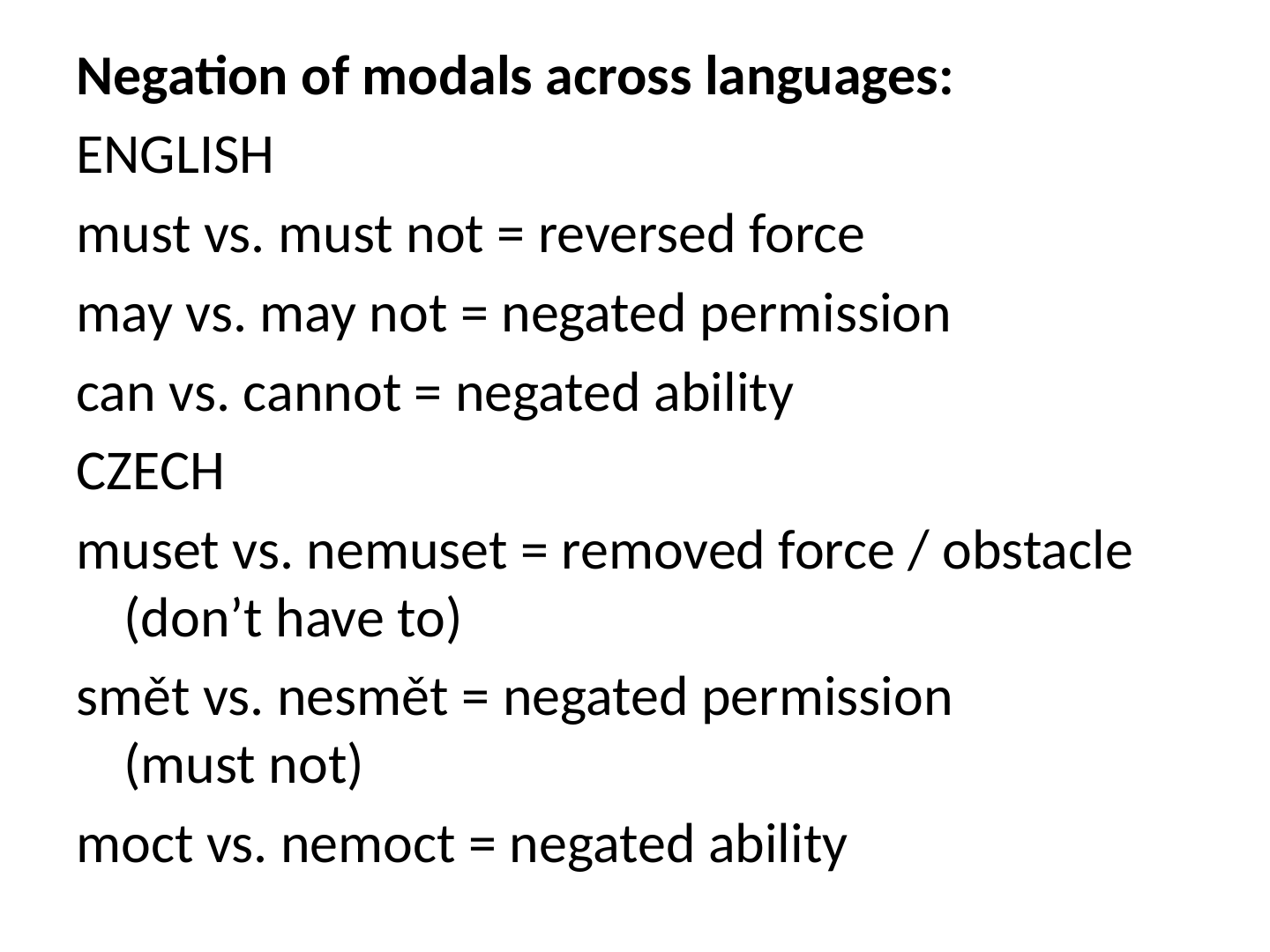
Negation of modals across languages:
ENGLISH
must vs. must not = reversed force
may vs. may not = negated permission
can vs. cannot = negated ability
CZECH
muset vs. nemuset = removed force / obstacle (don’t have to)
smět vs. nesmět = negated permission (must not)
moct vs. nemoct = negated ability
Slide 62: Cognitivist alternative to language acquisition
Cognitivist alternative to language acquisition
Slide 63: Slide 63
“language has appeared special and unassimilable to broader psychological phenomena mainly because linguists have insisted on analyzing it in an inappropriate and highly unnatural fashion; once the many layers of artifact are removed, language starts to look much more natural and learnable in terms of what we know about other facets of human cognitive ability.”
— Langacker, 1987, Foundations of Cognitive Grammar, p. 13
Slide 64: Cognitivist alternative to language acquisition
- Can Johnny play with us?
- *Can Johnny with us play?
- *Can play Johnny with us?
- Can OBJ ACT?
- Can the man whose daughter kicked Johnny in the shins the day before we saw that awful movie about unicorns bring his errant child to play with us today, please?
Slide 65: Slide 65
“What color -- What color blanket -- What color mop -- What color glass ... Not the yellow blanket --- The white ... It't not black -- It's yellow ... Not yellow -- Red ... Put on a blanker -- White blanket -- And yellow blanket -- Where's yellow blanket ... Yellow light ... There is the light -- Where is the light -- Here is the light.”
“Big and little -- Little Bobby -- Little Nancy -- Big Nancy”
“Anthony take the -- Take the book ... This is the -- This is the -- Book... That's a -- That's a -- That's a kitty -- That a Fifi here ... Mommy get some --- Mommy get some -- Soap.”
— Weir, 1962, Language in the crib
Slide 66: Cognitivist alternative to language acquisition
- Primary unit of acquisition is utterance
- Children acquire constructions in the same way they acquire vocabulary – as usage-based schemas
- The process of acquisition is the building and structuring of language as an inventory; repetition with minor variation is a significant factor; old structures motivate new structures
- Early categorizations are different from adult abstractions (mental/linguistic representations)
- Children play an active role in language acquisition through extraction of schemas and active experimentation (language in the crib)
Slide 67: Cognitivist alternative to language acquisition
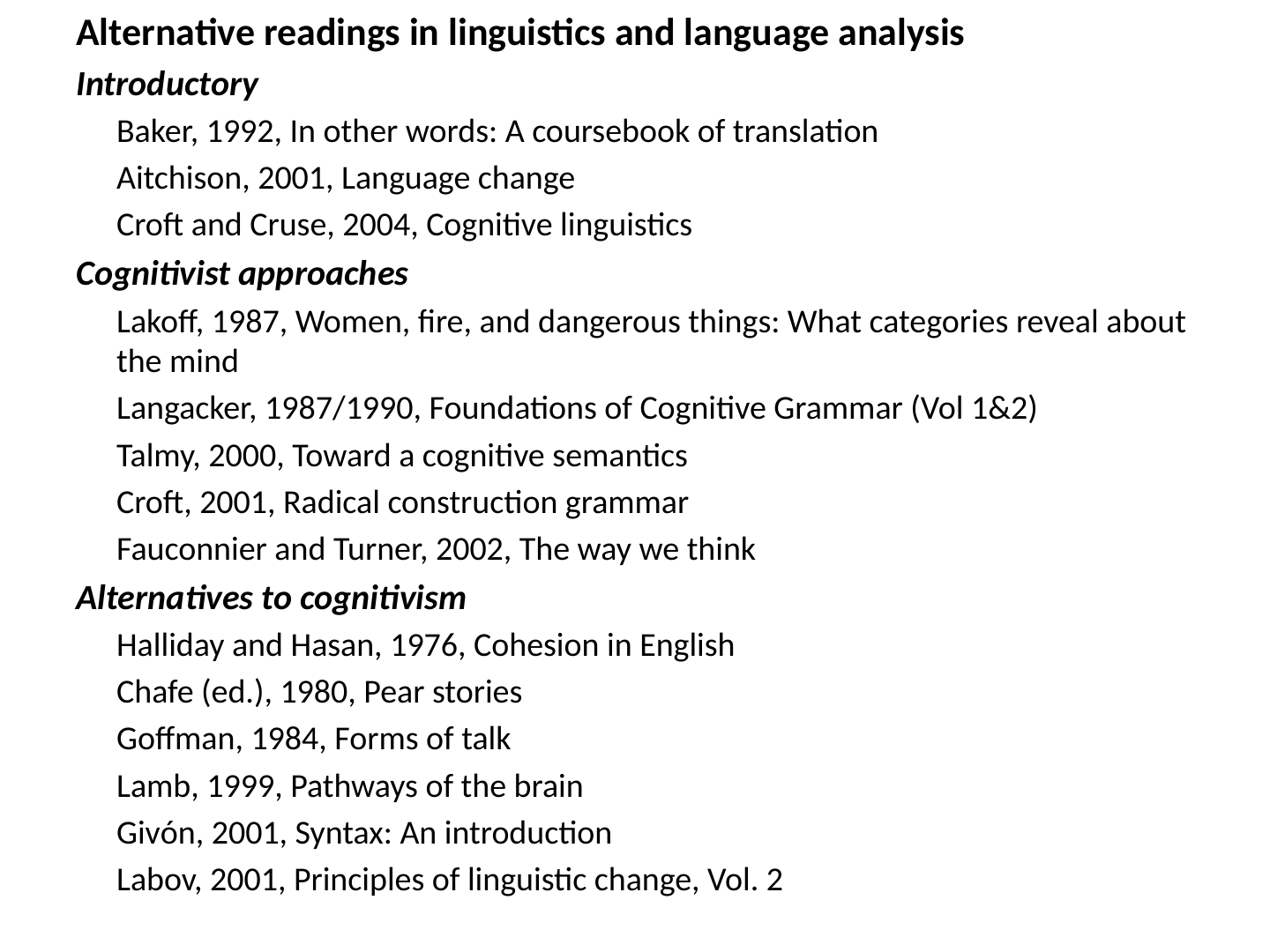
Alternative readings in linguistics and language analysis
Introductory
- Baker, 1992, In other words: A coursebook of translation
- Aitchison, 2001, Language change
- Croft and Cruse, 2004, Cognitive linguistics
Cognitivist approaches
- Lakoff, 1987, Women, fire, and dangerous things: What categories reveal about the mind
- Langacker, 1987/1990, Foundations of Cognitive Grammar (Vol 1&2)
- Talmy, 2000, Toward a cognitive semantics
- Croft, 2001, Radical construction grammar
- Fauconnier and Turner, 2002, The way we think
Alternatives to cognitivism
- Halliday and Hasan, 1976, Cohesion in English
- Chafe (ed.), 1980, Pear stories
- Goffman, 1984, Forms of talk
- Lamb, 1999, Pathways of the brain
- Givón, 2001, Syntax: An introduction
- Labov, 2001, Principles of linguistic change, Vol. 2
Slide 68: Cognitivist alternative to language acquisition
The Gospel according to Chomsky
In the beginning was Bloomfield. And his theory was without form, and structuralist; and darkness was upon the face of Chomsky.
And Chomsky said: Let there be transformations, and there were transformations. And Chomsky saw the transformations, that they were good; and Chomsky divided the surface from the deep structure. And that was the start of generative grammars.
And Chomsky made three great lights. And the greatest light was explanatory adequacy; and the lesser lights were descriptive adequacy, and observational adequacy. And Chomsky set them into the firmament of the 'Aspects' meta-theory, and he said: Let all other grammars be judged by them.
Chomsky said: Let MIT bring forth grammarians and grammars yielding trees after my kind, and the trees yielding sentences after their kind. And Chomsky blessed them, and said: Be infinitely recursive, and multiply. And Chomsky saw that they were good.