Conceptualizing the “Shape” of the Lesson: The Logistics of Learning
- SlideShare title: Lesson Shapes
- Talk date: Not established
- SlideShare upload: 2007-08-18 (upload date, not the delivery date)
- Event: Not established
- Place: Not established
- Topics: Teaching & technology
- Language: en
- Slides in the original listing: 13
- Coverage: Full text of all 13 slides, each paired with its original slide image (slide N is section N).
- Original listing: https://www.slideshare.net/slideshow/lesson-shapes/93691
- Cover image: https://slides.dominiklukes.net/readers/lesson-shapes/pages/page-01.png
- Reader data (JSON): https://slides.dominiklukes.net/readers/lesson-shapes/presentation.json
- TalkWeaver package (outline and images, ZIP): https://slides.dominiklukes.net/lesson-shapes/lesson-shapes-talkweaver.zip
- TalkWeaver outline: https://slides.dominiklukes.net/lesson-shapes/talkweaver/lesson-shapes-outline.md
- Markdown copy: https://slides.dominiklukes.net/lesson-shapes/index.md
Slide 1: Conceptualizing the “Shape” of the Lesson: The Logistics of Learning
Conceptualizing the “Shape” of the Lesson: The Logistics of Learning
Dominik Lukeš, Peace Corps Albania

Slide 2: Lesson Narrative
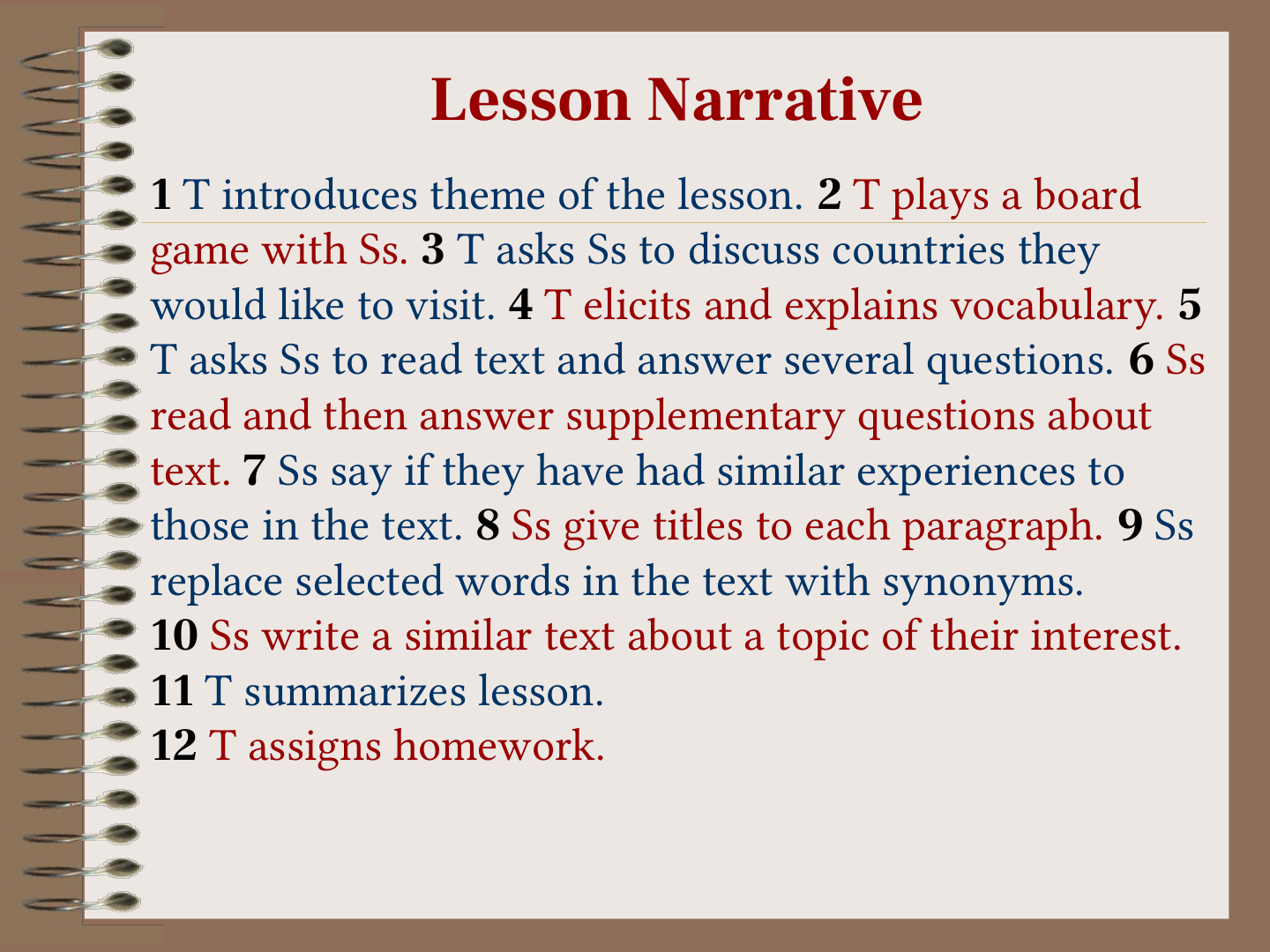
Lesson Narrative
- T introduces theme of the lesson.
- T plays a board game with Ss.
- T asks Ss to discuss countries they would like to visit.
- T elicits and explains vocabulary.
- T asks Ss to read text and answer several questions.
- Ss read and then answer supplementary questions about text.
- Ss say if they have had similar experiences to those in the text.
- Ss give titles to each paragraph.
- Ss replace selected words in the text with synonyms.
- Ss write a similar text about a topic of their interest.
- T summarizes lesson.
- T assigns homework.
Slide 3: Lesson Shapes
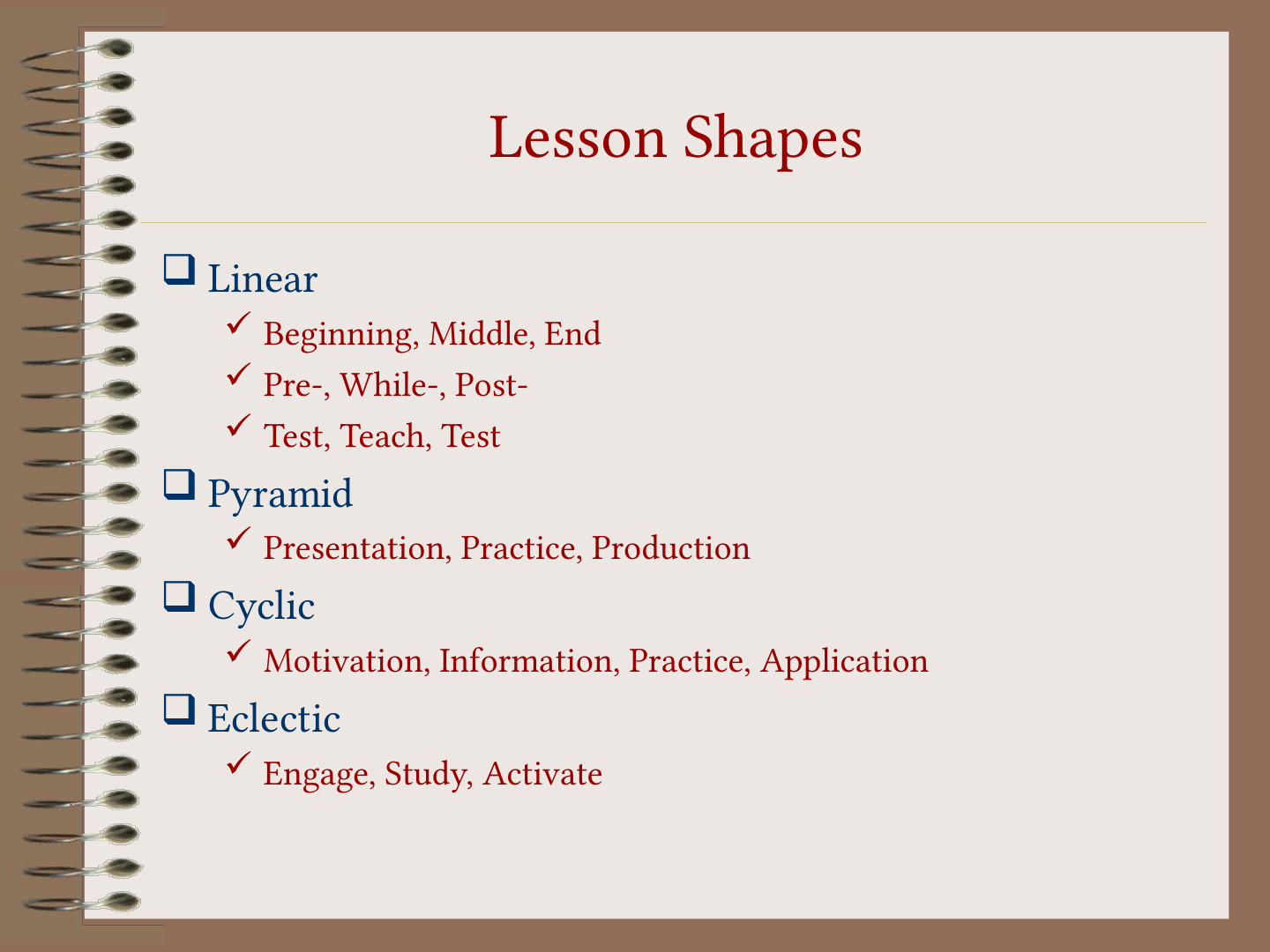
Lesson Shapes
- Linear
- Beginning, Middle, End
- Pre-, While-, Post-
- Test, Teach, Test
- Pyramid
- Presentation, Practice, Production
- Cyclic
- Motivation, Information, Practice, Application
- Eclectic
- Engage, Study, Activate
Slide 4: A: Beginning, Middle, End
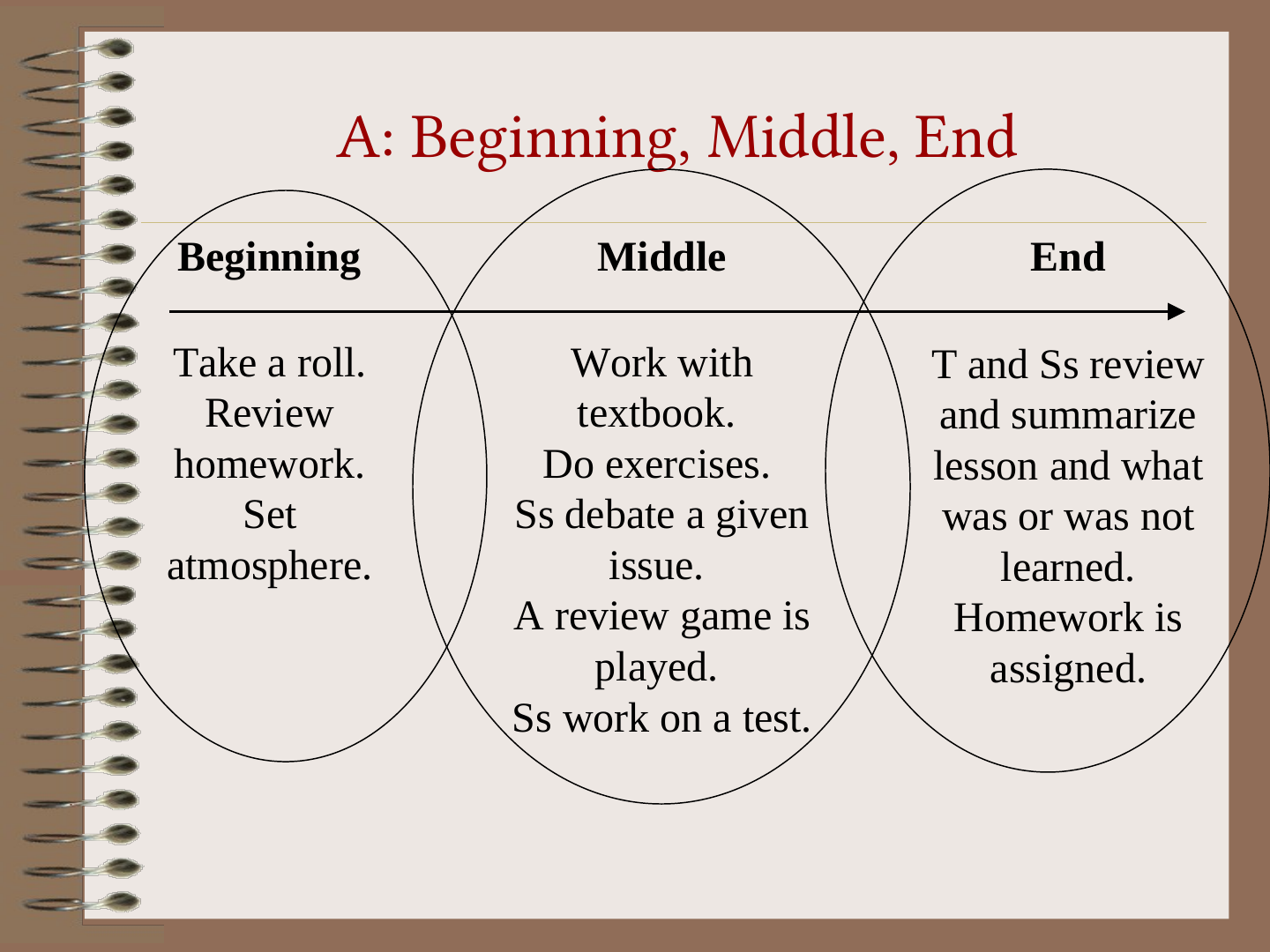
A: Beginning, Middle, End
- Beginning
- Take a roll. Review homework. Set atmosphere.
- Middle
- Work with textbook.
- Do exercises.
- Ss debate a given issue.
- A review game is played.
- Ss work on a test.
- End
- T and Ss review and summarize lesson and what was or was not learned. Homework is assigned.
Slide 5: A (Cont.): Menus and threads
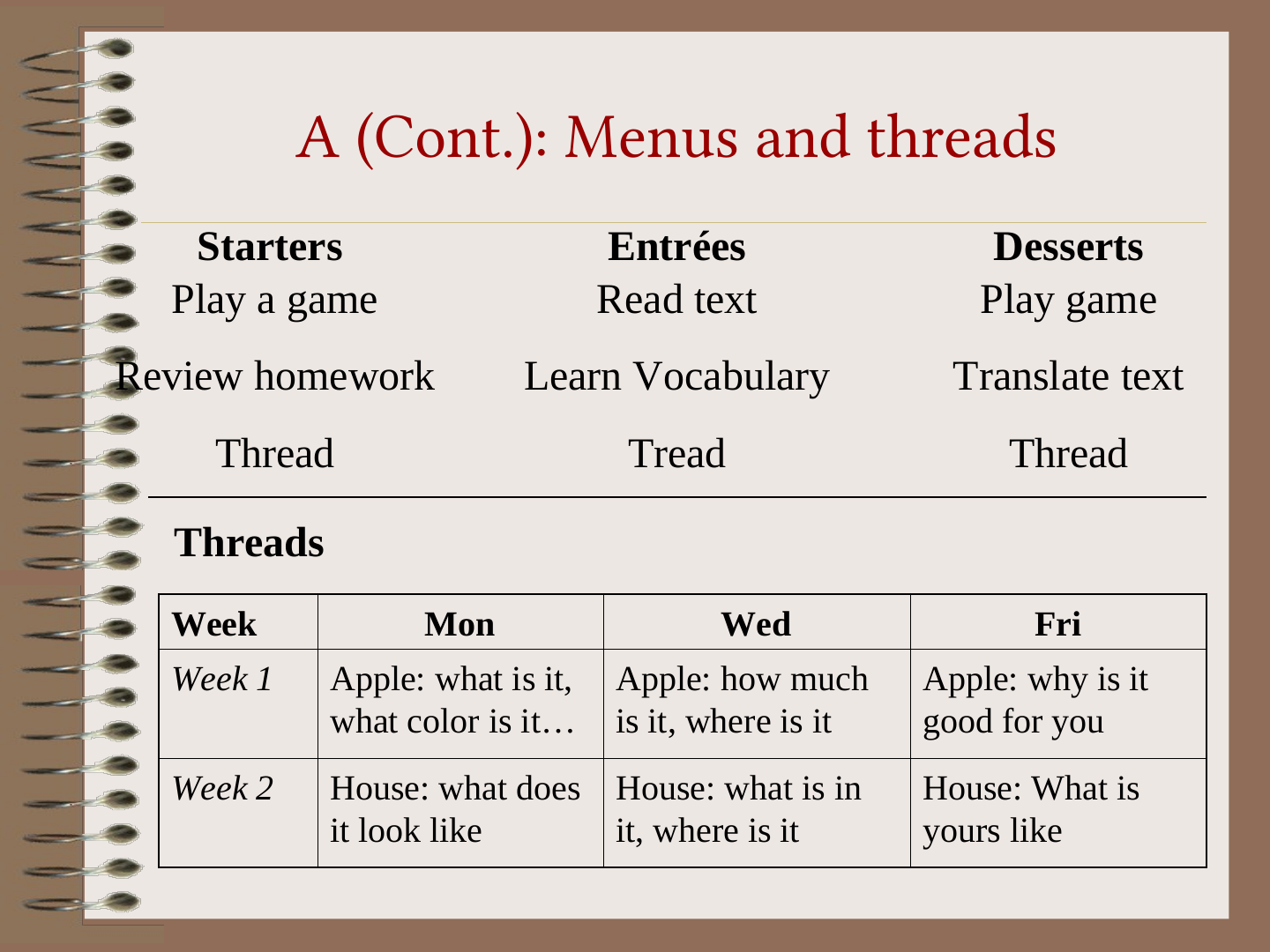
A (Cont.): Menus and threads
| Starters | Entrées | Desserts |
|---|---|---|
| Play a game | Read text | Play game |
| Review homework | Learn Vocabulary | Translate text |
| Thread | Tread | Thread |
Threads
| Week | Mon | Wed | Fri |
|---|---|---|---|
| Week 1 | Apple: what is it, what color is it… | Apple: how much is it, where is it | Apple: why is it good for you |
| Week 2 | House: what does it look like | House: what is in it, where is it | House: What is yours like |
Slide 6: B: Pre-, While-, Post-
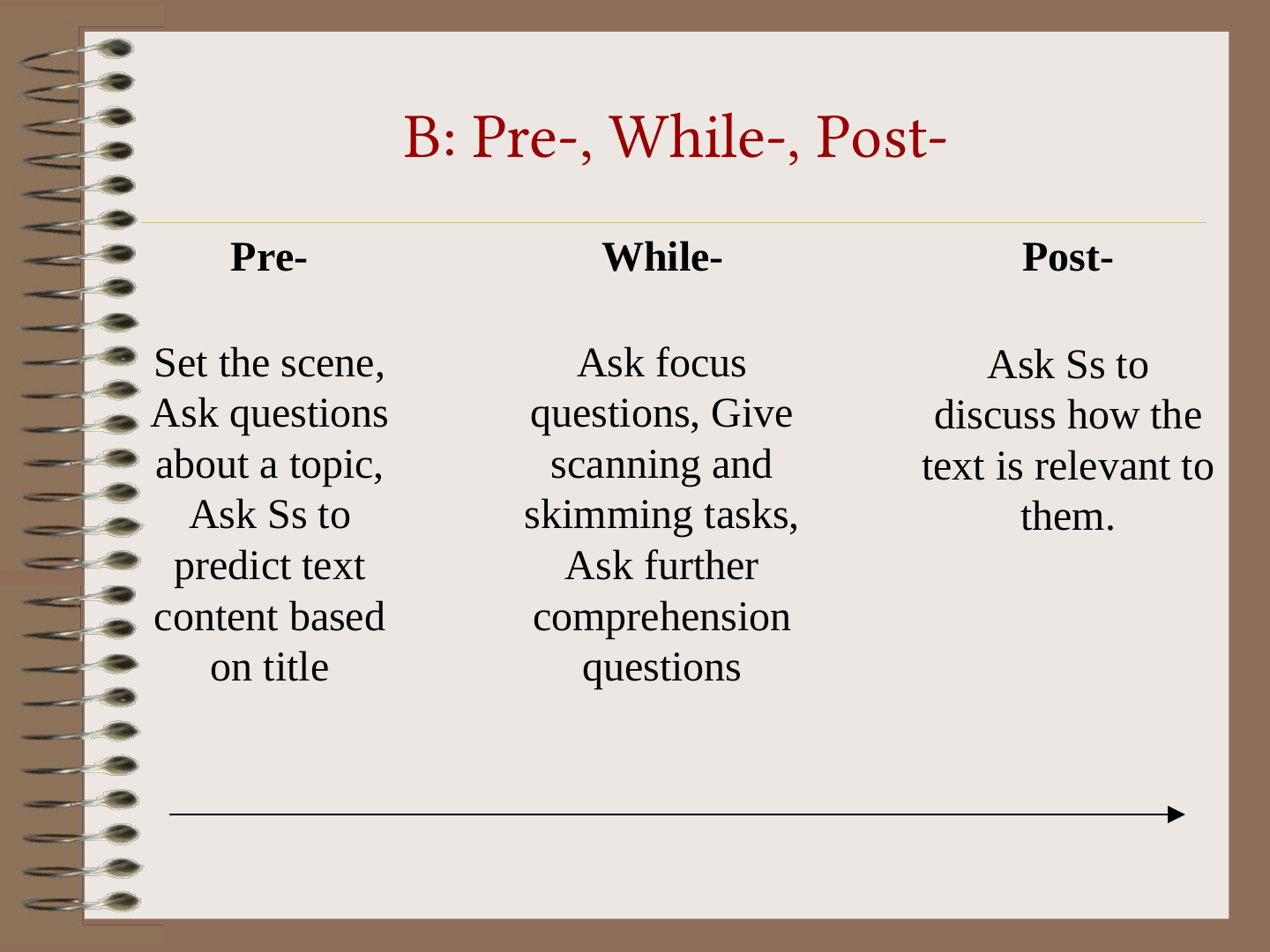
B: Pre-, While-, Post-
| Pre- | While- | Post- |
|---|---|---|
| Set the scene, Ask questions about a topic, Ask Ss to predict text content based on title | Ask focus questions, Give scanning and skimming tasks, Ask further comprehension questions | Ask Ss to discuss how the text is relevant to them. |
Slide 7: C: Test, Teach, Test
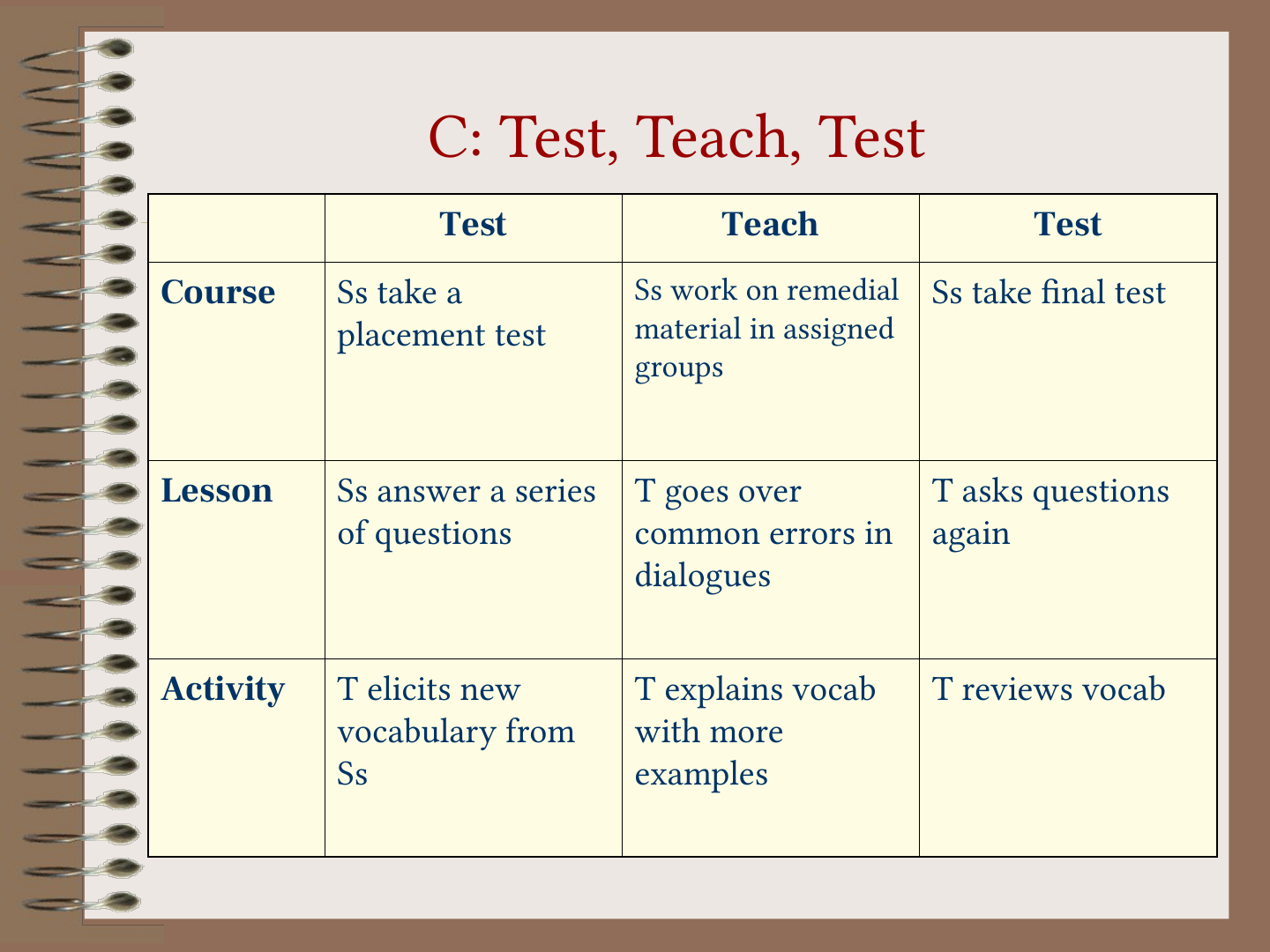
C: Test, Teach, Test
| Test | Teach | Test | |
|---|---|---|---|
| Course | Ss take a placement test | Ss work on remedial material in assigned groups | Ss take final test |
| Lesson | Ss answer a series of questions | T goes over common errors in dialogues | T asks questions again |
| Activity | T elicits new vocabulary from Ss | T explains vocab with more examples | T reviews vocab |
Slide 8: D: Presentation, Practice, Production
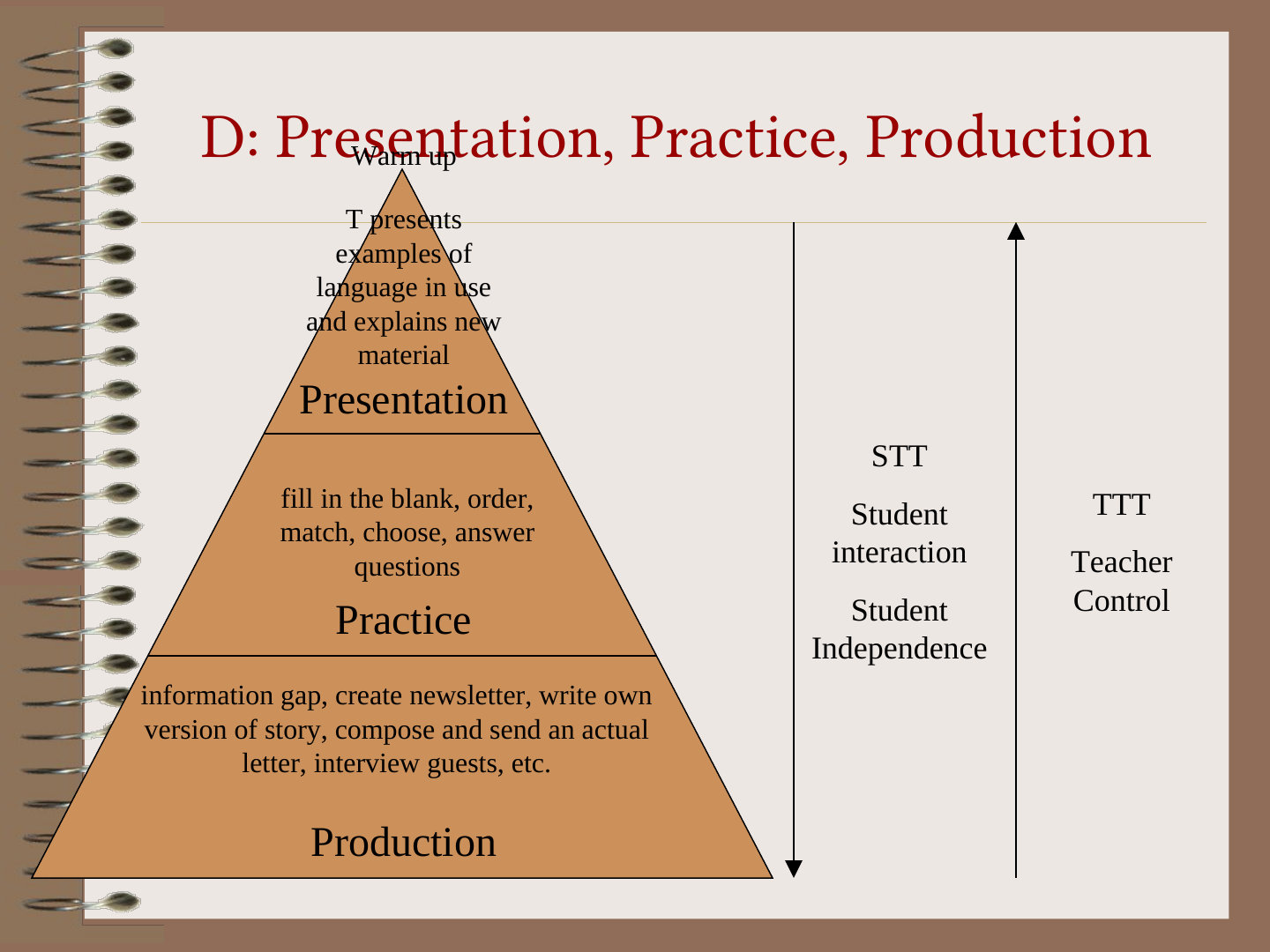
D: Presentation, Practice, Production
- Presentation
- Warm up
- T presents examples of language in use and explains new material
- Practice
- fill in the blank, order, match, choose, answer questions
- Production
- information gap, create newsletter, write own version of story, compose and send an actual letter, interview guests, etc.
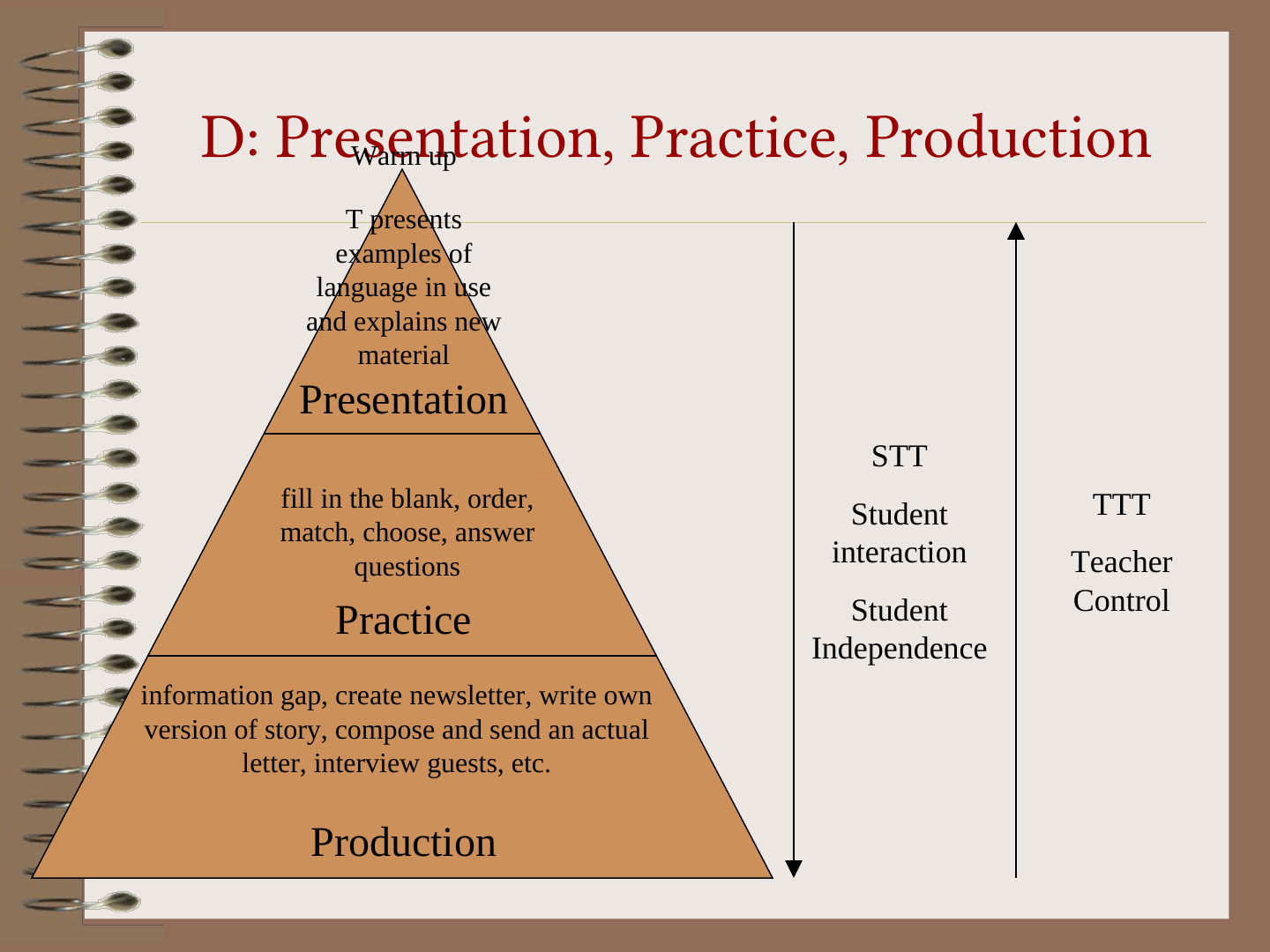
- TTT
- Teacher Control
- STT
- Student interaction
- Student Independence
Slide 9: E: 4MAT
E: 4MAT
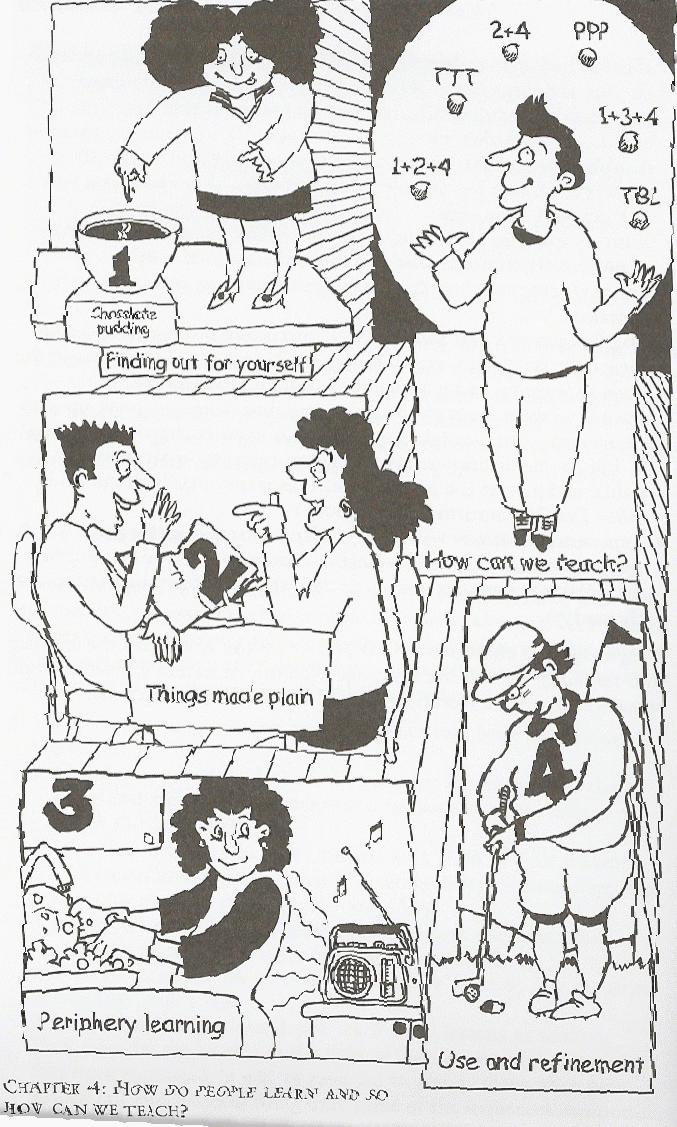
- Concrete Experience
- Reflective Observation
- Abstract Conceptualization
- Active Experimentation
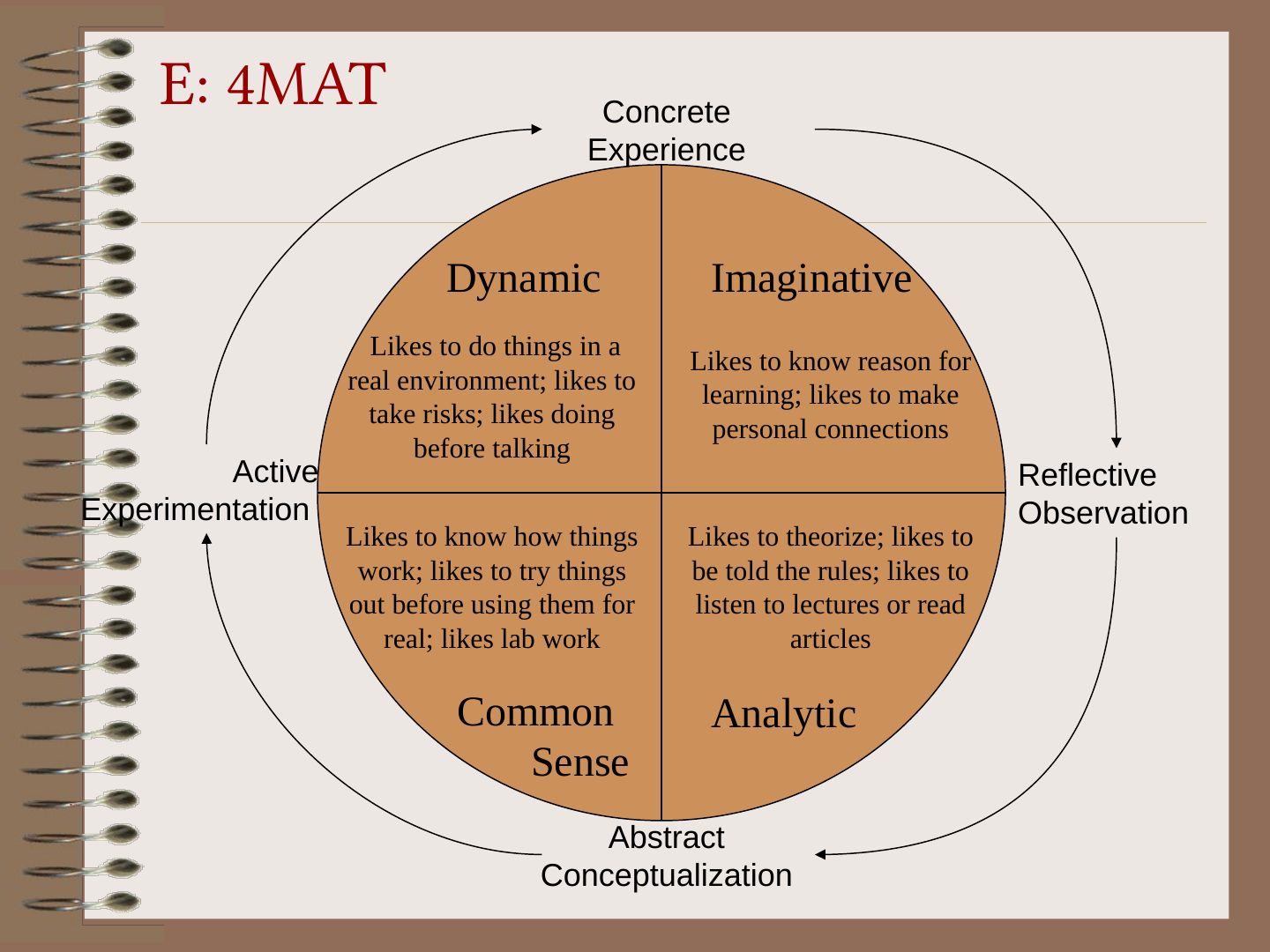
- Imaginative
- Likes to know reason for learning; likes to make personal connections
- Analytic
- Likes to theorize; likes to be told the rules; likes to listen to lectures or read articles
- Common Sense
- Likes to know how things work; likes to try things out before using them for real; likes lab work
- Dynamic
- Likes to do things in a real environment; likes to take risks; likes doing before talking
Slide 10: E: Motivation, Information, Practice, Application
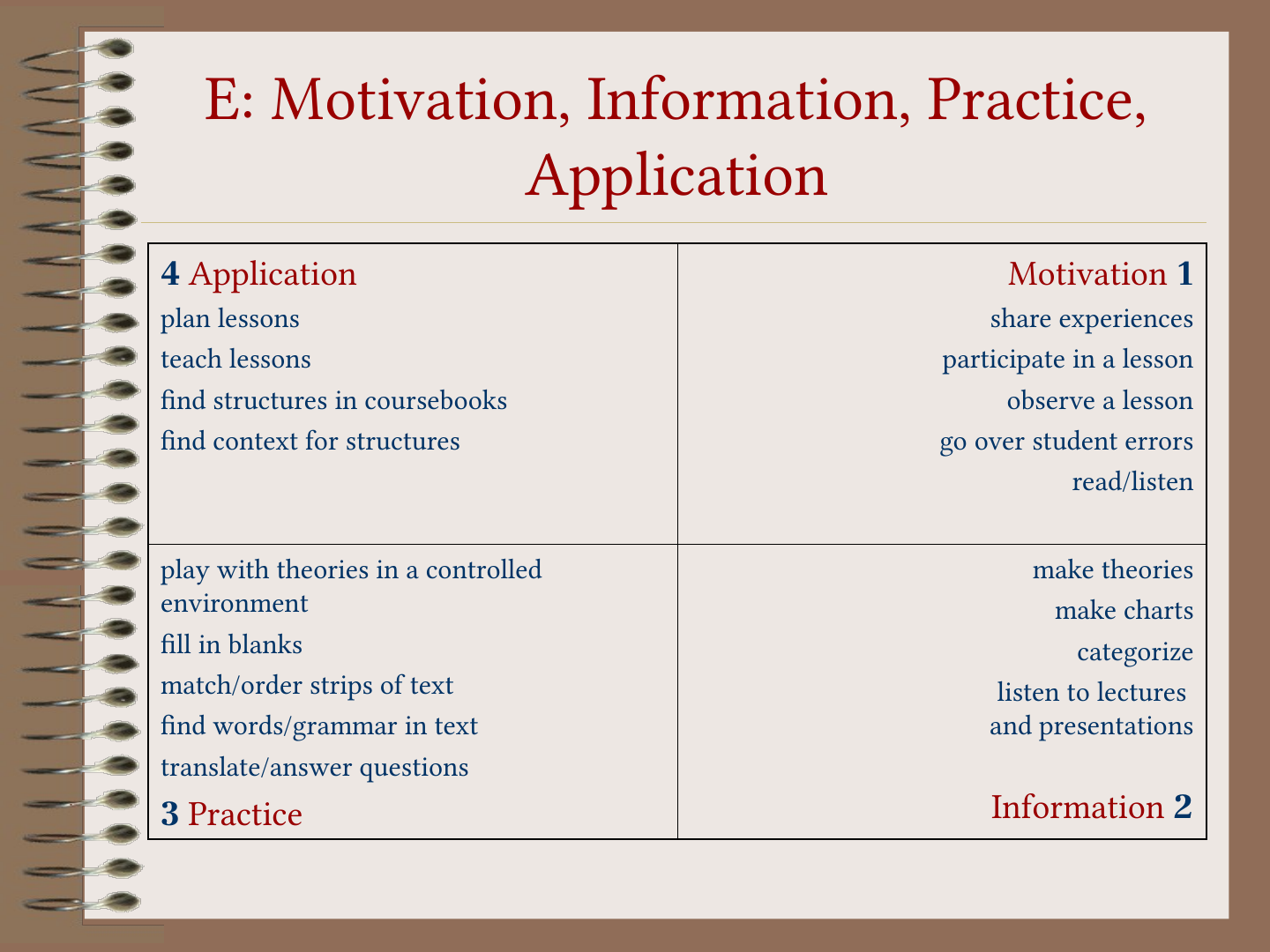
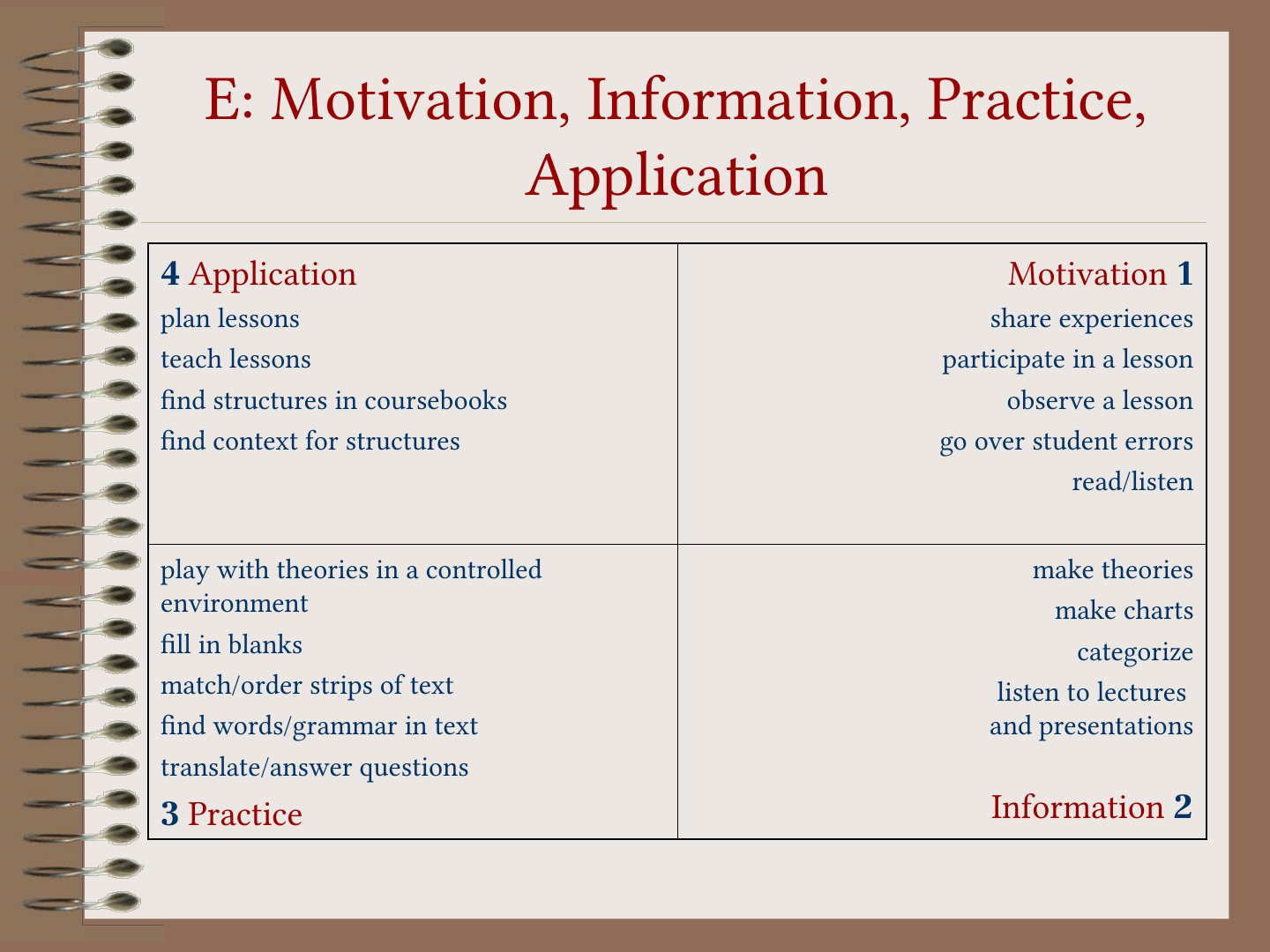
E: Motivation, Information, Practice, Application
- Motivation
- share experiences
- participate in a lesson
- observe a lesson
- go over student errors
- read/listen
- Information
- make theories
- make charts
- categorize
- listen to lectures and presentations
- Practice
- play with theories in a controlled environment
- fill in blanks
- match/order strips of text
- find words/grammar in text
- translate/answer questions
- Application
- plan lessons
- teach lessons
- find structures in coursebooks
- find context for structures
Slide 11: F: Engage, Study, Activate
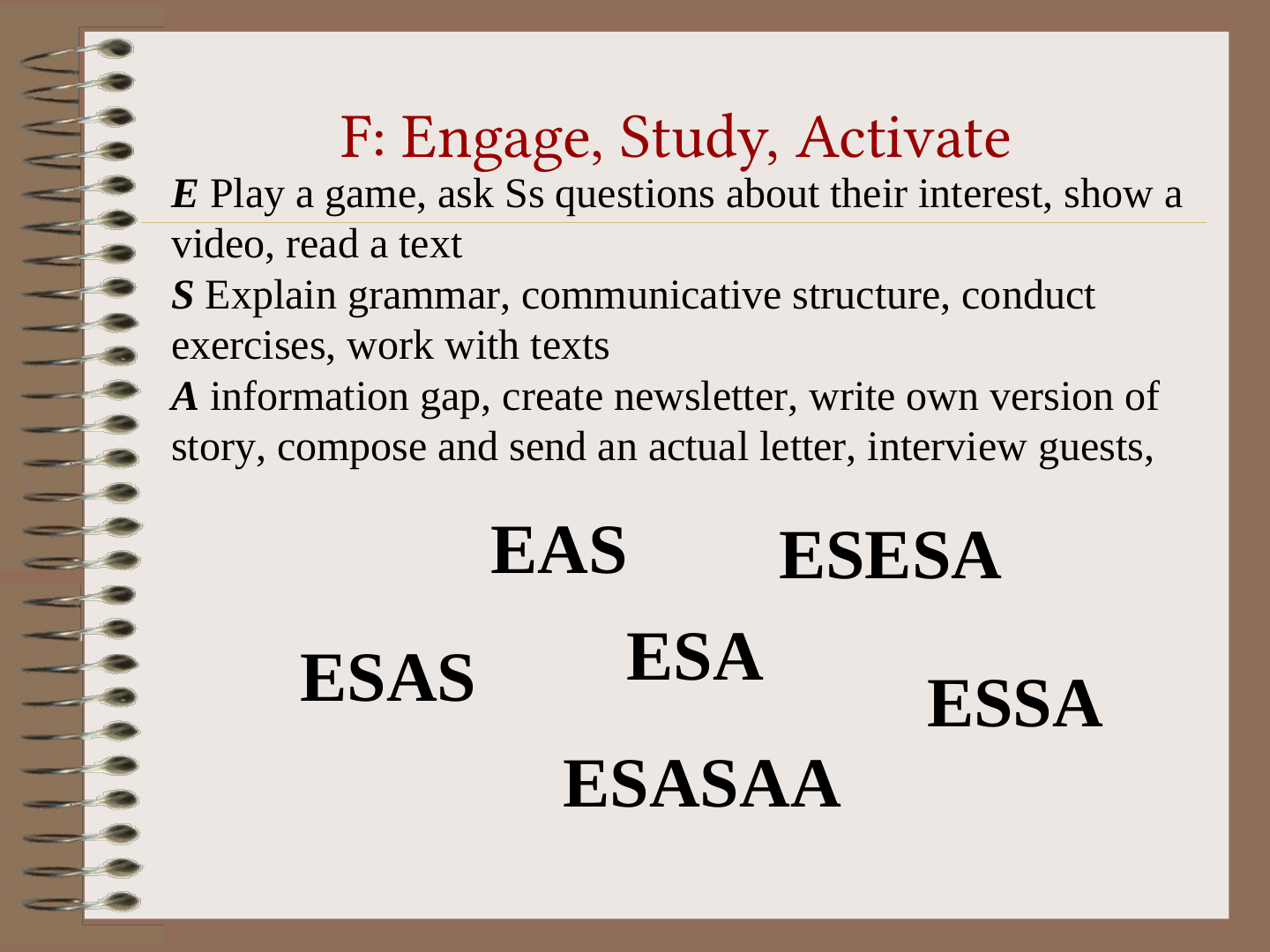
F: Engage, Study, Activate
- E Play a game, ask Ss questions about their interest, show a video, read a text
- S Explain grammar, communicative structure, conduct exercises, work with texts
- A information gap, create newsletter, write own version of story, compose and send an actual letter, interview guests,
EAS
ESESA
ESAS
ESA
ESSA
ESASAA
Slide 12: Inductive and deductive sequence
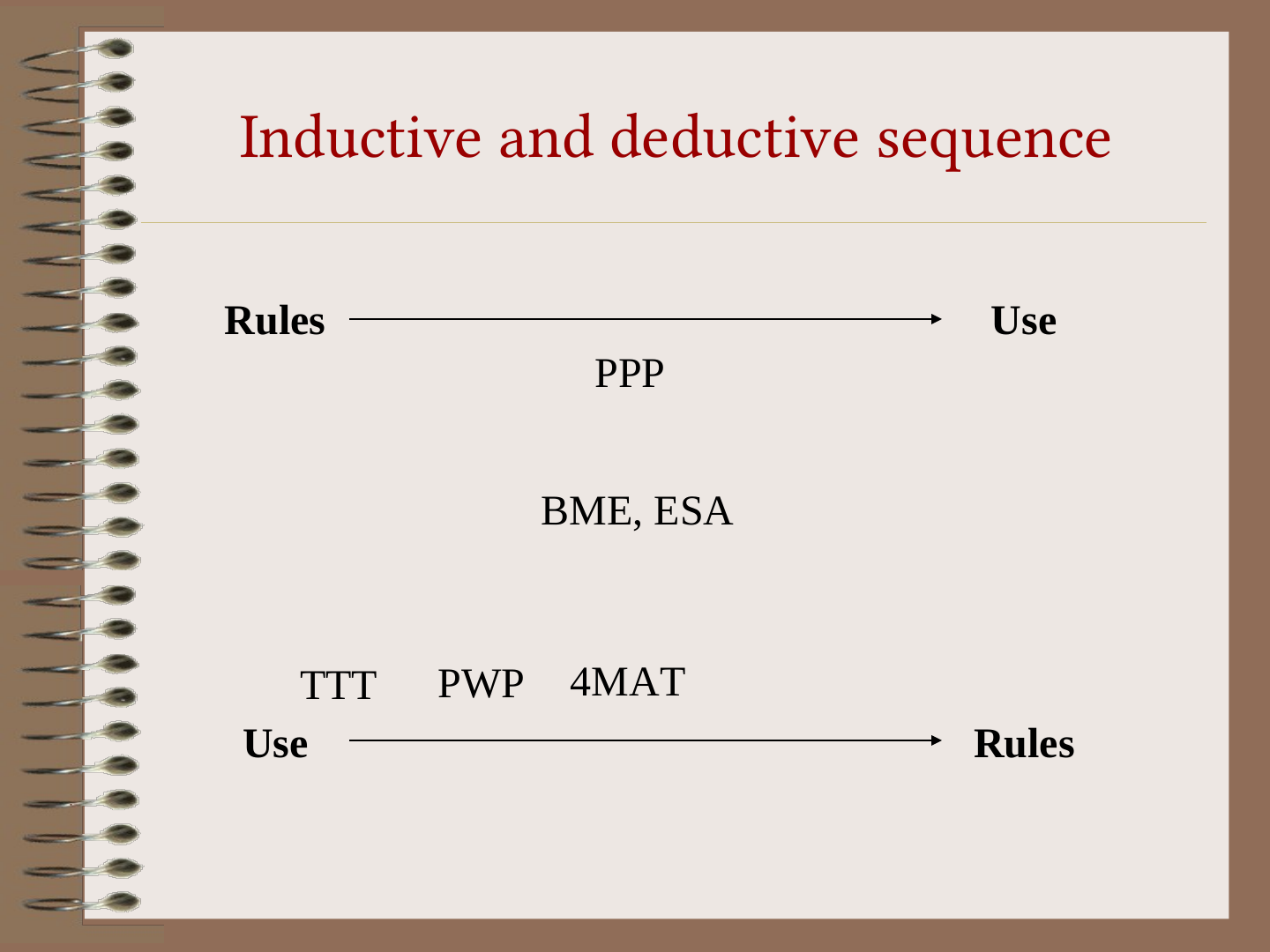
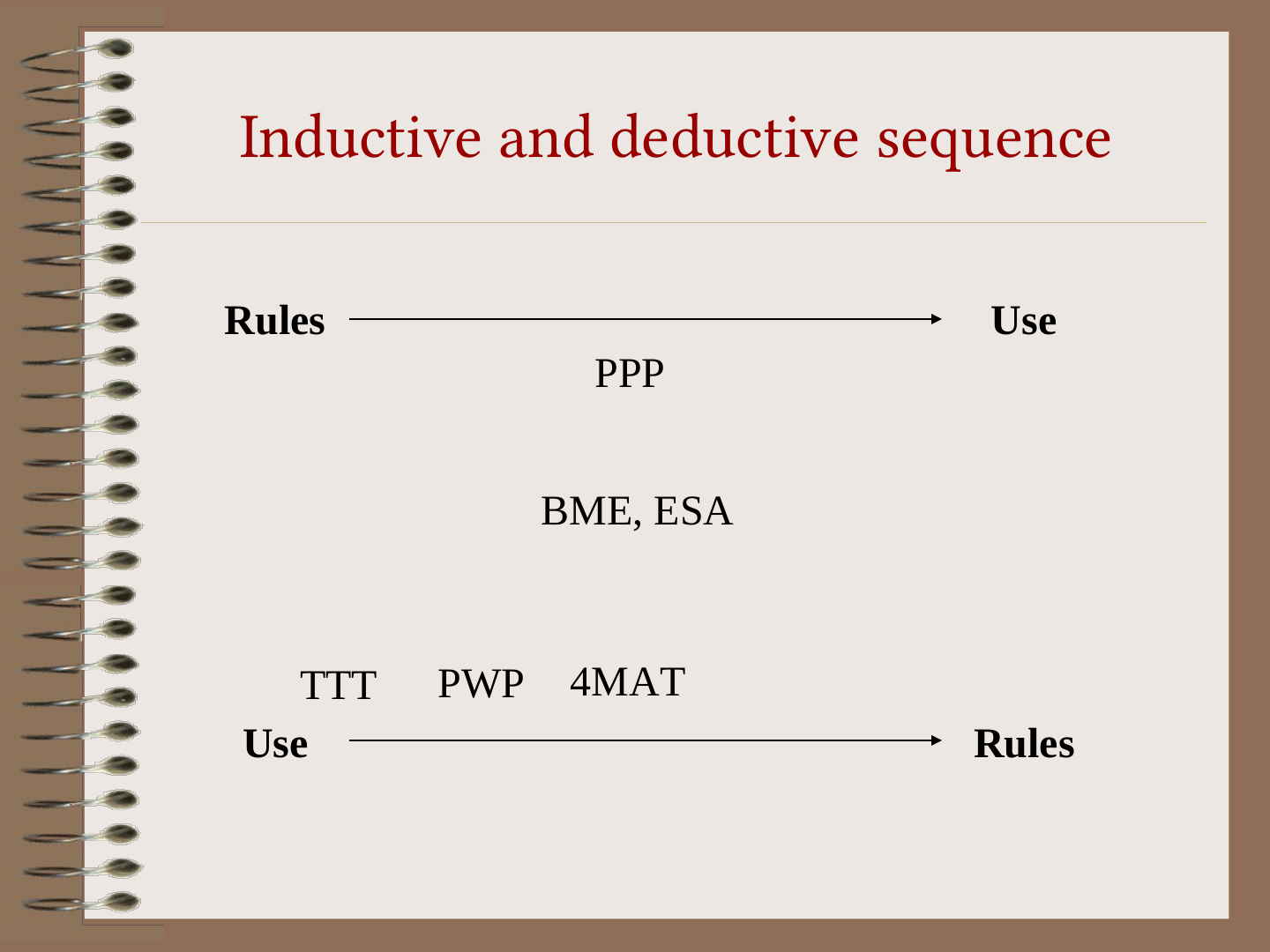
Inductive and deductive sequence
- From Rules to Use: PPP
- BME, ESA
- From Use to Rules: TTT, PWP, 4MAT
Slide 13: Illustration on slide 13