Why do teachers have to provide educational services? Conceptual metaphors, blending and educational discourse
- SlideShare title: Metaphors in education
- Talk date: Not established
- SlideShare upload: 2007-01-22 (upload date, not the delivery date)
- Event: Not established
- Place: Not established
- Topics: Language & meaning
- Language: en
- Slides in the original listing: 55
- Coverage: Full text of all 55 slides, each paired with its original slide image (slide N is section N).
- Original listing: https://www.slideshare.net/slideshow/metaphors-in-education/19662
- Cover image: https://slides.dominiklukes.net/readers/metaphors-in-education/pages/page-01.png
- Reader data (JSON): https://slides.dominiklukes.net/readers/metaphors-in-education/presentation.json
- TalkWeaver package (outline and images, ZIP): https://slides.dominiklukes.net/metaphors-in-education/metaphors-in-education-talkweaver.zip
- TalkWeaver outline: https://slides.dominiklukes.net/metaphors-in-education/talkweaver/metaphors-in-education-outline.md
- Markdown copy: https://slides.dominiklukes.net/metaphors-in-education/index.md
Slide 1: Why do teachers have to provide educational services? Conceptual metaphors, blending and educational discourse
Why do teachers have to provide educational services? Conceptual metaphors, blending and educational discourse
Dominik Lukeš
January 2005

Slide 2: On the importance of making connections
On the importance of making connections
School of Education and Lifelong Learning
S E L L
Slide 3: Outline
Outline
- What are metaphors good for?
- How they work according to the conceptual metaphor theory?
- How are metaphors processed?
- What is conceptual blending?
- How is it used in the way we talk and reason?
- How can this help us understand the market debate within education?
Slide 4: What is and what isn’t metaphor?
What is and what isn’t metaphor?
- Pupils have to pay attention to what the teacher is saying.
- The teacher is a parent who should show proper love to their pupils.
- Schooling is a way of passing down information from one generation to the other.
Slide 5: What does it mean?
What does it mean?
Pete Seeger: “Education is when you read the fine print; experience is what you get when you don’t.” (Quoted in TES for NQTs)
Questions
- What is he saying about education?
- Is he right?
- How can this be reformulated?
- How is it metaphorical?
Slide 6: Conceptual analysis
Conceptual analysis
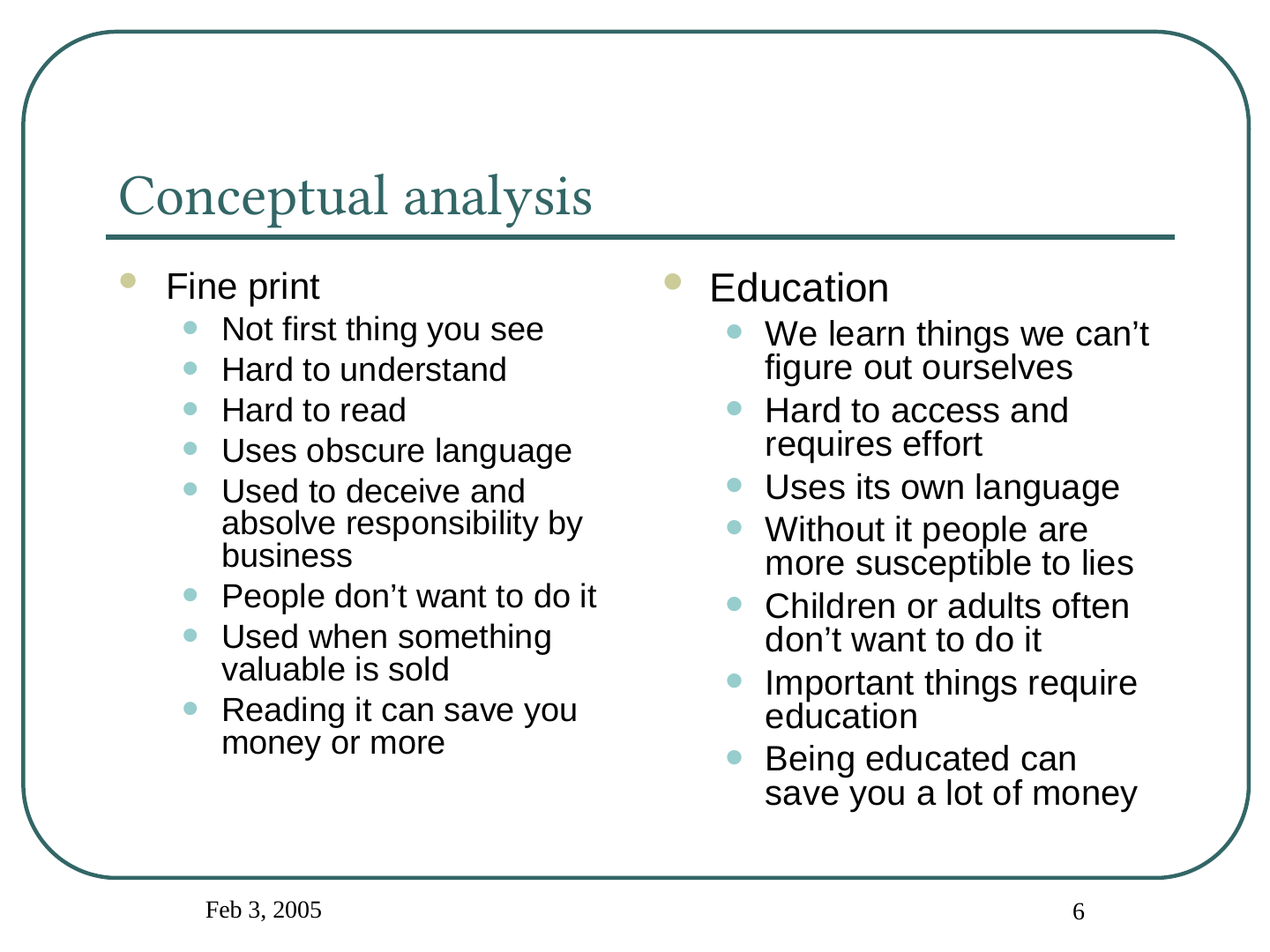
Fine print
- Not first thing you see
- Hard to understand
- Hard to read
- Uses obscure language
- Used to deceive and absolve responsibility by business
- People don’t want to do it
- Used when something valuable is sold
- Reading it can save you money or more
Education
- We learn things we can’t figure out ourselves
- Hard to access and requires effort
- Uses its own language
- Without it people are more susceptible to lies
- Children or adults often don’t want to do it
- Important things require education
- Being educated can save you a lot of money
Slide 7: What are metaphors now?
What are metaphors now?
- Metaphors are rather infrequent stylistic devices that are used to break the monotony of a text or to achieve an artistic effect.
- Metaphors can be very useful for illustrating an obscure point or something that is difficult to understand or too complex to summarize but they are no substitute for careful technical description of a problem.
- Metaphors are mostly used to hide a lack of understanding or to deceive by packaging an idea that would otherwise be unacceptable in confusing and grand-sounding language.
- Metaphors are central to the way we think about the world. They provide an essential link between our immediate experience and abstract thought. They can not only elucidate a point but often, without them, understanding the intangible would often be impossible.
Slide 8: Is this a good idea?
Is this a good idea?
- "metaphors [in education] have all the advantage over explicit language as does theft over honest toil" R. M. Miller, 1976
- "[...] metaphors, and senseless and ambiguous words are like ignes fatui; and reasoning upon them is wandering amongst innumerable absurdities; and their end, contention and sedition, or contempt." Hobbes, 1651
Slide 9: Really?
Really?
"For what is the heart, but a spring; and the nerves, but so many strings; and the joints, but so many wheels, giving motion to the whole body, such as was intended by the Artificer? … by art is created that great LEVIATHAN called a COMMONWEALTH, or STATE, which is but an artificial man, though of greater stature and strength than the natural…in which the sovereignty is an artificial soul, as giving life and motion to the whole body; the magistrates … artificial joints; reward and punishment … are the nerves … the wealth and riches of all the particular members are the strength; counsellors, by whom all things needful for it to know are suggested unto it, are the memory; equity and laws, an artificial reason and will; concord, health; sedition, sickness; and civil war, death."
Hobbes, Leviathan
Slide 10: Conceptual metaphor
Conceptual metaphor
- Mapping between two domains of experience (source – target)
- Important inferential structure is inherited from the source domain in projection
- The projection from one domain to another is partial consistent with the topology of both domains
- The use of metaphor is a central and mostly unconscious process
- Metaphor functions at all levels of discourse
Slide 11: Typical conceptual metaphors
Typical conceptual metaphors
- HAPPY IS UP / SAD IS DOWN
- UP IS CONTROL – The people above control our lives.
- ARGUMENT IS WAR – He attacked his position. She destroyed his argument.
- CHANGE IS MOTION – Our progress ground to a halt.
- IDEAS ARE OBJECTS / MIND IS A CONTAINER – Who put those ideas into your head?
- STATES ARE PEOPLE
Slide 12: What is and what isn’t metaphor? Revisited
What is and what isn’t metaphor? Revisited
- Pupils have to pay attention to what the teacher is saying.
- The teacher is a parent who should show proper love to their pupils.
- Schooling is a way of passing down information from one generation to the other.
Slide 13: Back to Seger 1: Similar conceptualizations
Back to Seger 1: Similar conceptualizations
- “If you think education is expensive – try ignorance.” Derek Bok
- “Good teachers are costly, but bad teachers cost more.” Bob Talbert
- “Human history becomes more and more a race between education and catastrophe.” H. G. Wells
- “If a man empties his purse into his head, no one can take it from him.” Benjamin Franklin
- “A man who has never gone to school may steal from a freight car, but if he has a university education he may steal the whole railroad.” Franklin D. Roosevelt
Slide 14: Back to Seger 2: Dissimilar conceptualizations
Back to Seger 2: Dissimilar conceptualizations
- “Education is what survives when what has been learnt has been forgotten.” B. F. Skinner, ‘New Scientists’ 21 May 1964
- “Creative minds have always been known to survive any king of bad training.” Anna Freud
- “It is nothing short of a miracle that modern methods of instruction have not yet strangled the holy curiosity of enquiry.” Albert Einstein
- “I have never let my schooling interfere with my education.” Mark Twain
- Teaching kids to count is fine, but teaching them what counts is best. Bob Talbert
Slide 15: Some conceptual metaphors of education
Some conceptual metaphors of education
- EDUCATION IS A TOOL/WEAPON
- EDUCATION IS A COMMODITY
- EDUCATION IS ON THE SURFACE
- EDUCATION IS INSIDE
- EDUCATION IS A BARRIER
- EDUCATION IS A FORCE
Slide 16: Types of metaphors I: Conventionality
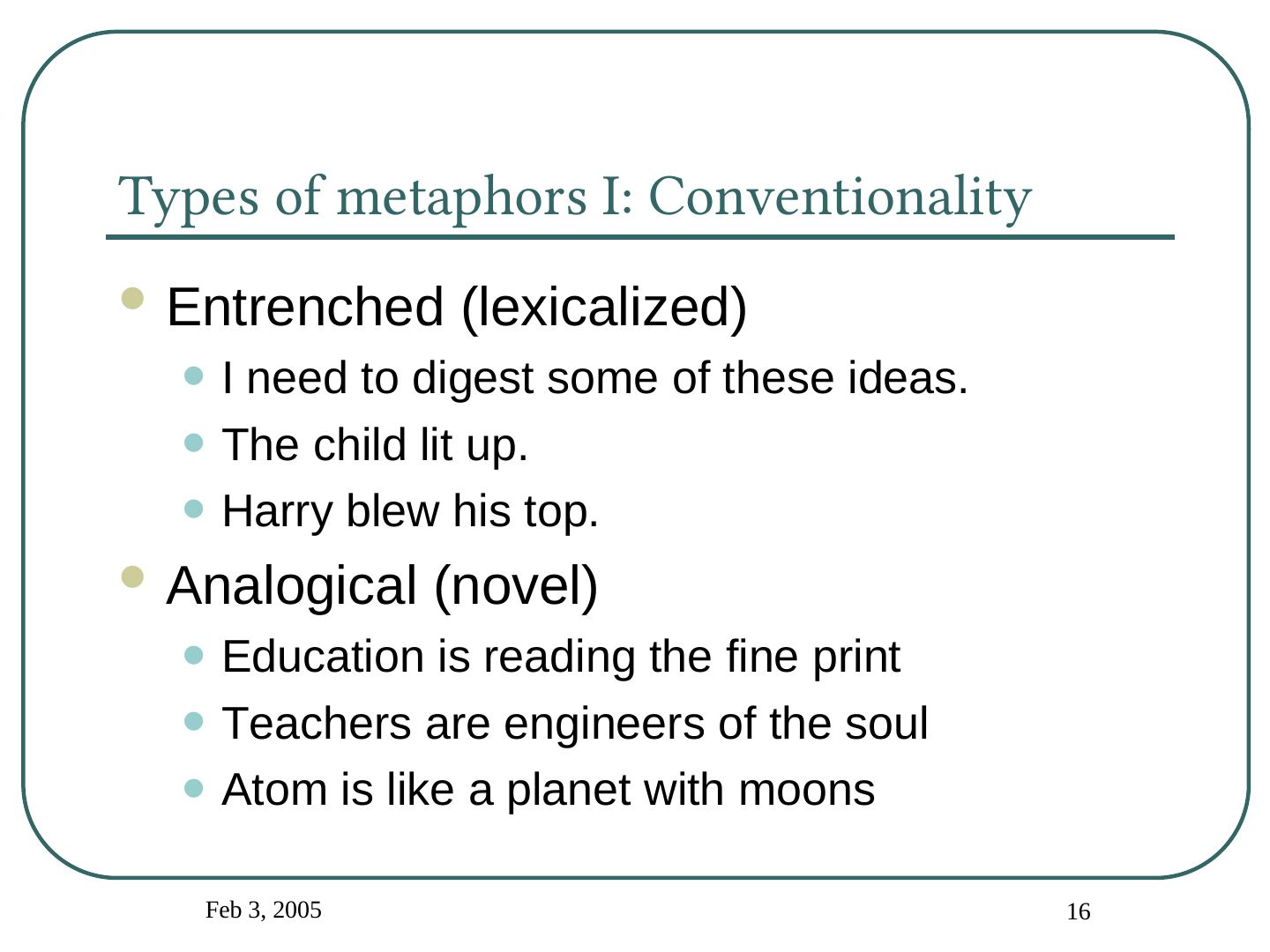
Types of metaphors I: Conventionality
- Entrenched (lexicalized)
- I need to digest some of these ideas.
- The child lit up.
- Harry blew his top.
- Analogical (novel)
- Education is reading the fine print
- Teachers are engineers of the soul
- Atom is like a planet with moons
Slide 17: Types of metaphors II: Cognitive function
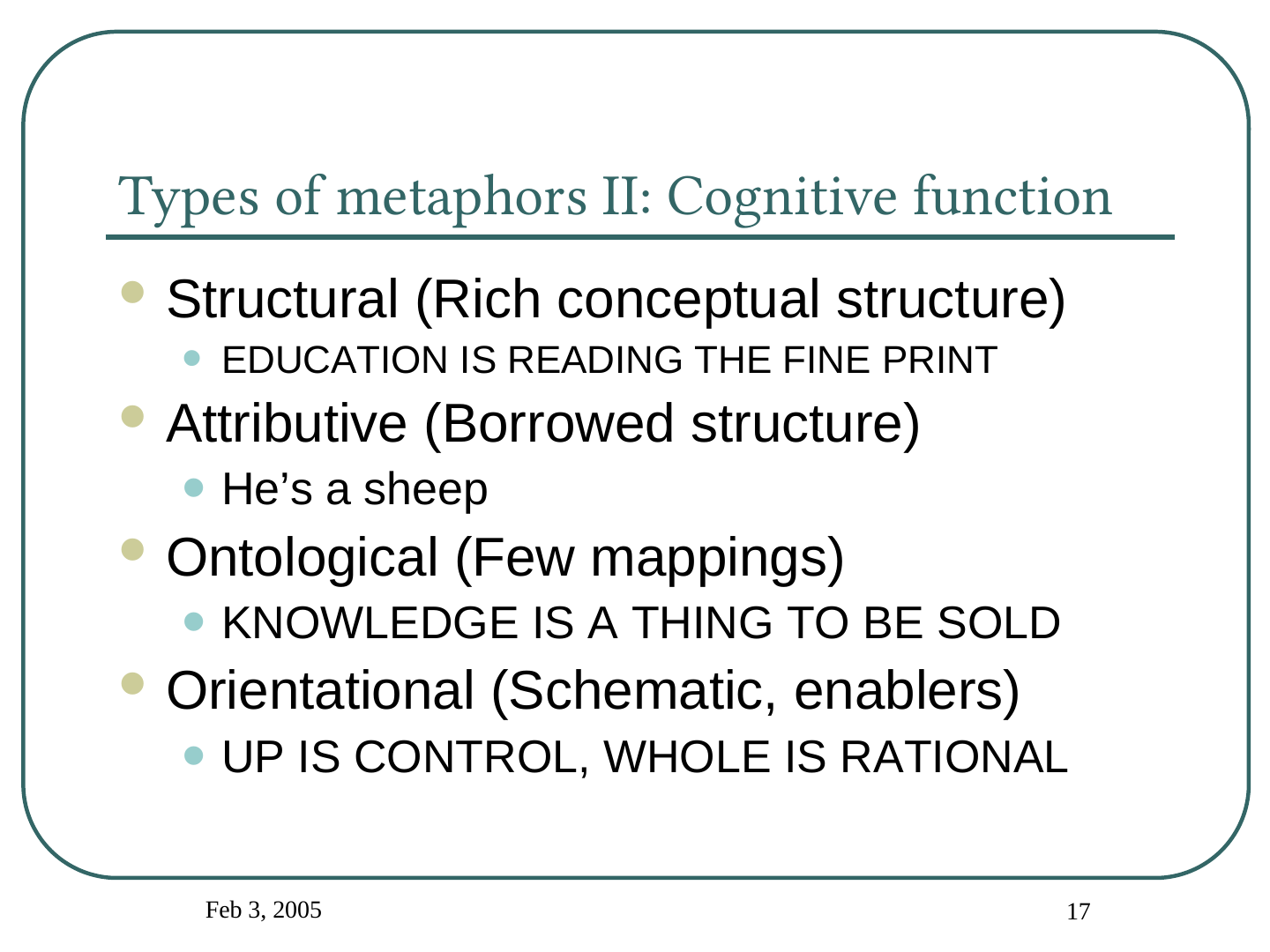
Types of metaphors II: Cognitive function
- Structural (Rich conceptual structure)
- EDUCATION IS READING THE FINE PRINT
- Attributive (Borrowed structure)
- He’s a sheep
- Ontological (Few mappings)
- KNOWLEDGE IS A THING TO BE SOLD
- Orientational (Schematic, enablers)
- UP IS CONTROL, WHOLE IS RATIONAL
Slide 18: Types of metaphor III: Nature
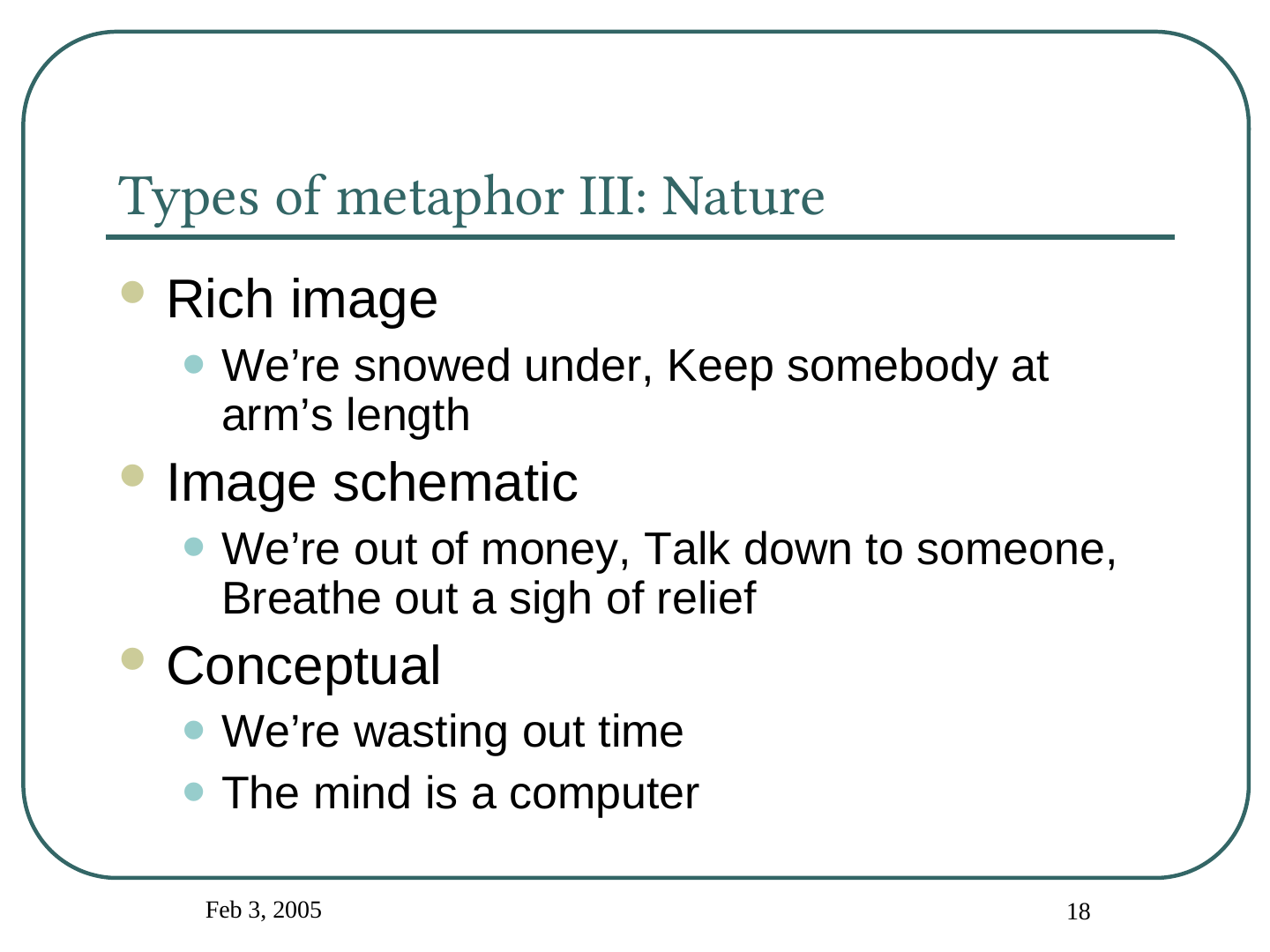
Types of metaphor III: Nature
- Rich image
- We’re snowed under, Keep somebody at arm’s length
- Image schematic
- We’re out of money, Talk down to someone, Breathe out a sigh of relief
- Conceptual
- We’re wasting out time
- The mind is a computer
Slide 19: Types of source domains
Types of source domains
- Space/movement/physical world/forces
- Human body/animals/plants
- Food/cooking
- Light/darkness/vision
- Machines/tools/structures
- Money/market
Slide 20: What do domains look like
What do domains look like
- Image schemas
- Images
- Scripts, scenarios
- Folk theories, stories
- Salient examples, paragons
- Roles and relationships
- Categories
Slide 21: More about metaphors
More about metaphors
- One target domain is usually structured by several source domains (ARGUMENT IS WAR, BUILDING, JOURNEY)
- One source domain is usually used to conceptualize multiple target domains (THEORIES, CAREERS, COMPANIES ARE BUILDINGS)
- Metaphors create complex interconnected systems (COMPLEX SYSTEMS ARE MACHINES)
- Metaphorical understanding is inseparable from literal understanding
Slide 22: How and what for are metaphors used
How and what for are metaphors used
- Make sense of the world
- Express complex meaning
- Construct alternatives
- Organize systematic concepts
- Invite interaction
- Add dramatic effect
adapted from Cortazzi and Jin 1999
Slide 23: Bibliographical interlude I
Bibliographical interlude I
- Lakoff and Johnson 1980 Metaphors we live by
- Mark Turner 1987 Death is the mother of beauty
- Lakoff 1993 Modern theory of metaphor
- Lakoff 2002 Moral politics
- Kövecses 2002 Metaphor
- Donald A. Schön, Michael Reddy
- I. A. Richards, Max Black
Slide 24: More questions about metaphor
More questions about metaphor
- How do domains merge in online processing?
- What makes this complicated understanding possible?
- Does domain mapping happen only with metaphors?
- Is metaphor different from other types of reasoning?
Slide 25: Other examples of domain mapping
Other examples of domain mapping
- Adjectives and other predicates
- Brown car, brown chocolate, brown cow
- Safe beach, safe companion, safe house
- Nazi Holocaust or Jewish Holocaust?
- She’s a creative teacher. He’s a creative mechanic.
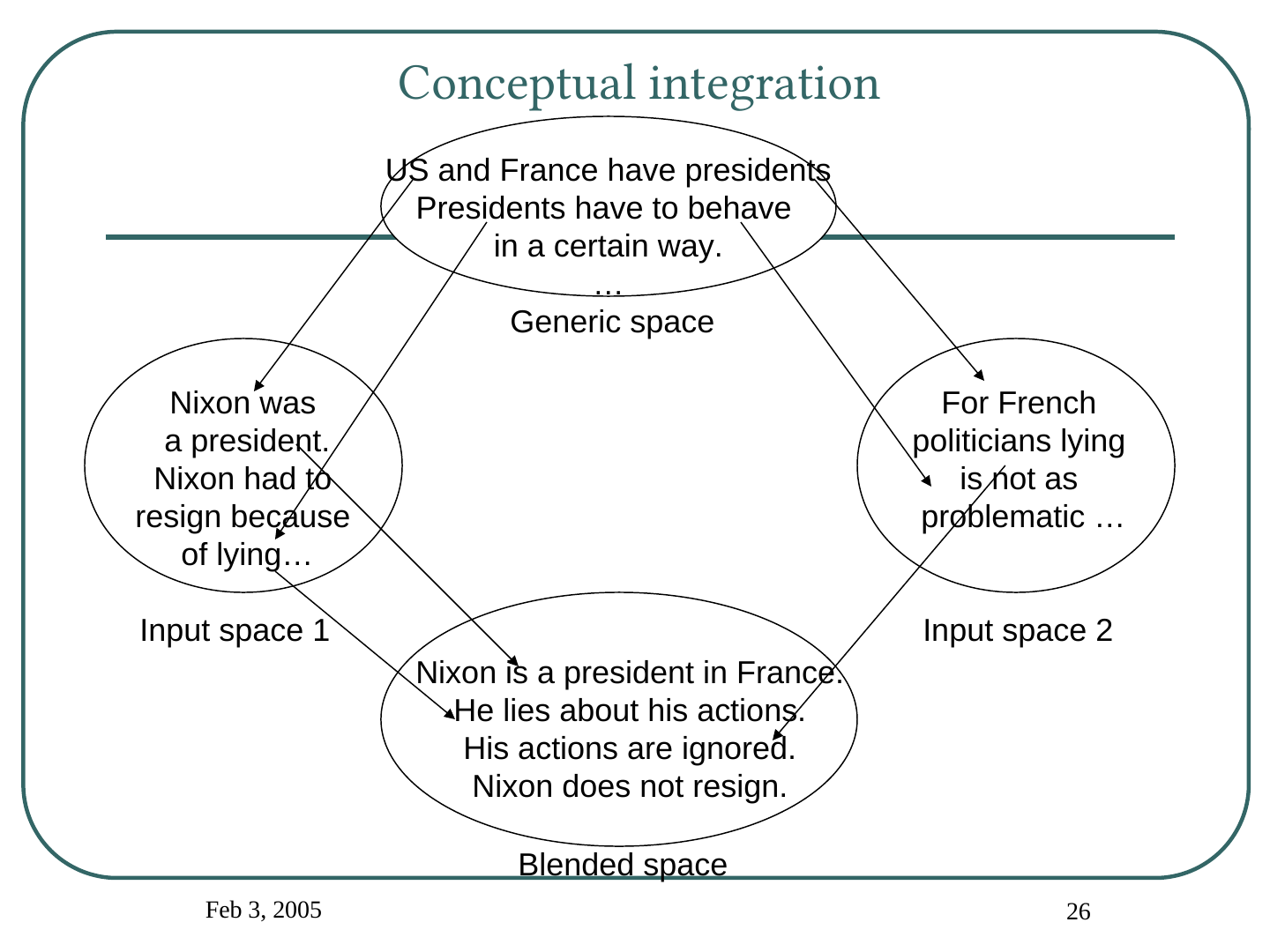
- Counterfactuals
- In France, Nixon wouldn’t have had to resign.
- Comparisons
- Ellen MacArthur is two days ahead of Francis Joyon
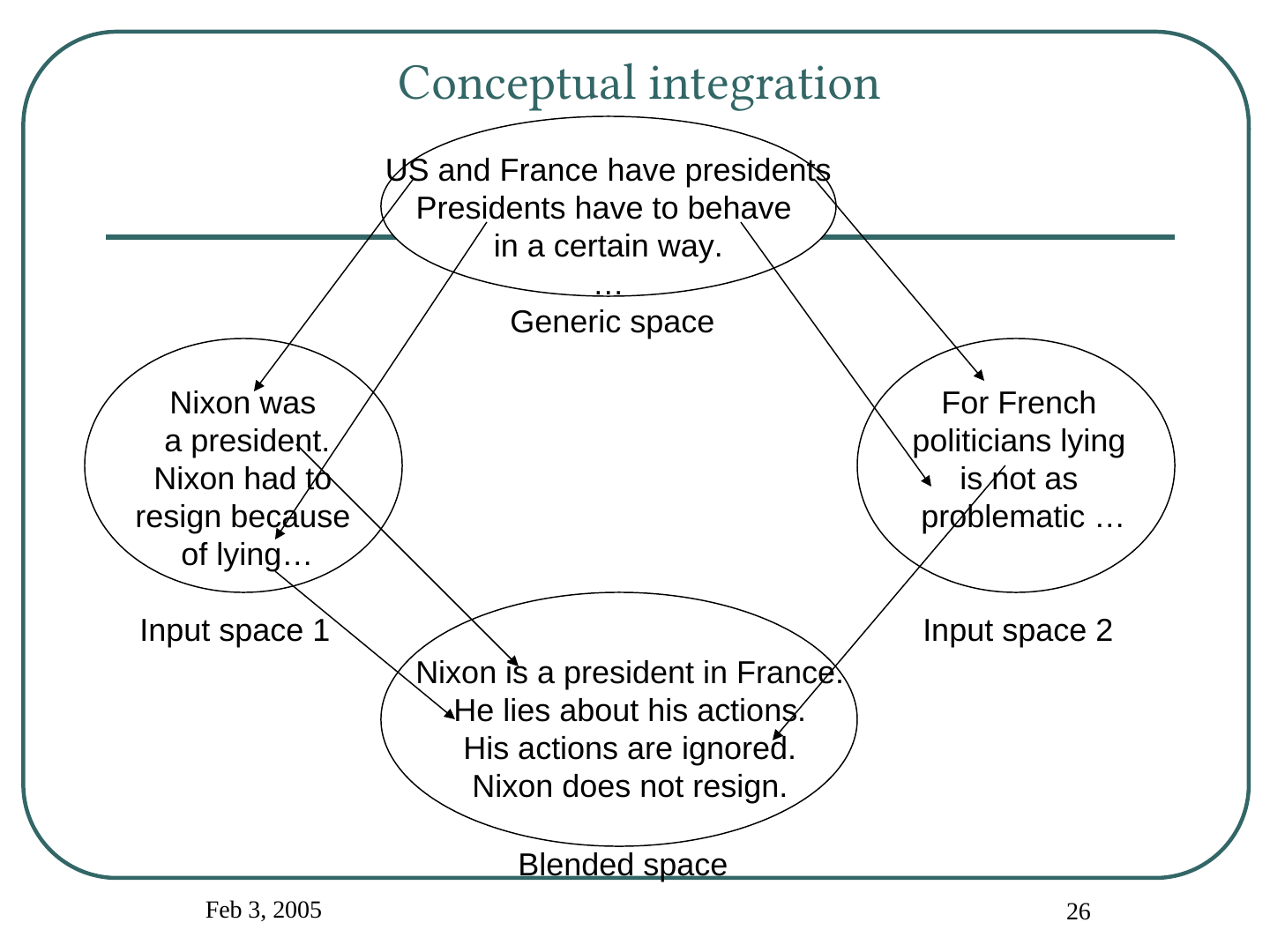
Slide 26: Conceptual integration
Conceptual integration
Slide 27: Blending Pete Seeger
Blending Pete Seeger
- What does the generic space need to contain?
- What does the blended conceptual space look like?
- Additional questions: why is it important to know that it was Pete Seeger? Why did TES use it?
Slide 28: Bibliographical interlude II
Bibliographical interlude II
- Fauconnier and Turner 2002 The way we think
- Todd and Coulson 2000 Blending basics
- Gibbs 1994 Poetics of mind
- Glucksberg 2001 Understanding figurative language
- Gentner et al. 2001 ‘Metaphors are like analogies’
Slide 29: Metaphors of Education
Metaphors of Education
- teacher is …
- school is …
- student is …
- education is …
- learning is …
Slide 30: Metaphor research in Education
Metaphor research in Education
- Metaphors as an instructional tool
- Metaphors in the language of instruction
- Metaphors in conceptualization of self in teachers (new and experienced) and students
- Metaphors in educational discourse
- Public discourse
- Policy debates (not all conceptual)
- Conceptualizing innovation (dtto)
- Conscious and unconscious metaphors
Slide 31: Metaphors of Education
Metaphors of Education
- SCHOOLS ARE PRISONS, GARDENS, FACTORIES, SOCIETIES
- TEACHERS ARE PARENTS, GUIDES, DIRECTORS, ACTORS
- STUDENTS ARE CONTAINERS, PLANTS, ANIMALS TO BE CONTROLLED
- LEARNING IS GROWTH, FILLING UP, LIFE
Slide 32: Education as a source domain
Education as a source domain
LIFE IS A TEACHER
EXPERIENCE IS A SCHOOL
COMPANY IS A SCHOOL (The learning organization)
EMPLOYEES ARE PUPILS
BEING ABLE TO DO SOMETHING IS BEING ABLE TO READ (functional literacy, emotional literacy, numeracy, computer literacy, academic literacy)
Slide 33: Metaphors and actions
Metaphors and actions
- Metaphors influence actions
- People who think of language as a tool are more likely to be pro-reform than those who think of it as a person
- Metaphors interpret actions/states
- Teachers are more likely to see students as container than students who might see themselves as such
- Metaphors and actions/states cooexist
- Experienced teachers see learning in a behaviorist way rather than constructivist way
Slide 34: Metaphorical or literal?
Metaphorical or literal?
- Teacher and learner learn together.
- In the world outside school there will not always be a teacher around to point out weaknesses and suggest improvements in children's information-handling.
- It misses the point that being an effective teacher, leading students to a measure of intellectual and professional independence such that they are able to articulate with others their own viewpoint, is a major achievement.
- Although she had pronounced likes and dislikes for the various members of her class she was perhaps the best teacher in the school, and at the end of four years she had hardly any failures in the final examinations.
Slide 35: Education as a market place
Education as a market place
- Education is like the marketplace because…
- Education is not like the marketplace because…
Slide 36: Market place and moral values
Market place and moral values
- Kenneth Baker introducing Education bill in 1987: "We must give consumers of education a central part in decision-making. That means freeing schools and colleges to deliver the standards that parents and employers want. It means encouraging the consumer to expect and demand that all educational bodies do the best job possible. In a word, it means choice."
- Conservative reforms of 80s and 90s "sought deliberately to introduce market relations into educational services at all levels“ … "The 'LEA monopolies' of schooling were eroded by the introduction of the grant-maintained sector.“ (Bridges and Husbands 1996)
Slide 37: Marketplace domain I
Marketplace domain I
- People buy things they need
- Things you can buy are food, goods, ideas, alliance, services
- People are free to choose what to pay money for
- People who sell things make a profit by acquiring for less and selling for more
- People who sell things try to attract other people (clients, customers) to buy them from them
- People who buy things will not buy more things if they’re not satisfied with the quality
Slide 38: Marketplace and effectiveness
Marketplace and effectiveness
“From a business perspective, the education system presents an alarming picture. It is one in which too little is expected of too many, results are sacrificed to bureaucratic convenience, and professionalism--particularly teacher professionalism--is discouraged. The system is not just failing a large number of students--those who drop out or fail to make satisfactory academic progress; it is failing dedicated teachers as well.” … “Today's high-tech firm is lean: It has stripped away middle management. It is decentralized, relying on the know-how and professionalism of workers close to the problem. It is innovative in the deployment of personnel, no longer relying on limiting job classifications. It spends heavily on employee education and training. It invests heavily in research.
Successful firms have discarded the archaic, outmoded, and thoroughly discredited practices that are still in place in most of our large school districts. Those districts are organized like a factory of the late 19th century: top-down, command-control management, a system designed to stifle creativity and independent judgment.” 1988 Education Week
Slide 39: Marketplace domain II
Marketplace domain II
- Competition drives down prices and decreases costs
- Entities motivated by profit operate more effectively
- The more competition the more motivation for profit, the more effectiveness
- Over time effectiveness increases as companies learn during competition
- New techniques are more efficient than old techniques
Slide 40: Marketplace and choice
Marketplace and choice
“The most important aspect of using the market model to improve education is the incentives that come with competition. The only hope of changing a rigid, dysfunctional system is by empowering its customers to make choices that penalize dismal performers. The mind-set that "public education is a social commitment that transcends individual interest and corporate gain" enshrines the system at the expense of its intended beneficiaries. Instead, we have to think about the "education of the public," which is crucial in a democratic republic. And we have to develop mechanisms that enable consumers to use our tax dollars in the schools that best educate the individual child.
“It is only through the market mechanism of choice that we can get away from the stultifying and inherently unjust method of assigning children to schools according to their ZIP codes.” Education Week 2002
Slide 41: Marketplace domain III
Marketplace domain III
- Everybody has the right to choose freely
- People’s choices depend on their individual needs, wants and desires
- It is immoral to deny people choice
- It is immoral to suppress individual needs, desires and wants
- People’s choices determine what is offered to them
Slide 42: Marketplace and values
Marketplace and values
“Public education is a social commitment that transcends individual interest and corporate gain. It is highly probable that schools designed to meet this responsibility are inherently unprofitable. This does not mean the commitment should be abandoned. It means that, as a human service, education is grounded in a belief in human dignity that transcends the values and behaviors associated with markets. It means public education cannot be squeezed to fit the market model and still meet the needs of a just society.” 2002 Education Week
Slide 43: Marketplace domain IV
Marketplace domain IV
- Not everybody has equal amount of money at the start
- People who start with much money will acquire more
- People who start with little money spend it all on basic needs
- People with little money are denied free choice in their pursuit of satisfaction
- Having basic needs met is to lead a dignified life
Slide 44: Possible models and mappings I
Possible models and mappings I
- Education is the transmission of knowledge
- Knowledge is a thing to be sold
- Parents are customers
- Government is a customer
- Society is a customer
- Companies in need of workers are customers
- Students are customers
- Customers can choose what education they want
Slide 45: Possible models and mappings II
Possible models and mappings II
- Schools are companies
- Principals are CEOs
- Schools must operate effectively
- Schools must provide value for money (return on investment)
- Schools must have an attractive product
- Schools must compete with other schools
- Customers can choose which school they want
Slide 46: Possible models and mappings III
Possible models and mappings III
- Schools are products
- Parents buy schools
- Parents choose which schools to buy
- The more money parents have, the better school they can buy
- The better the school the more parents will choose it
Slide 47: Possible models and mappings IV
Possible models and mappings IV
- Teachers are workers
- Students’ results are products
- Teaching is a product
- Teachers are paid by students’ results
- Number of hours they teach
- Number of students they teach
- Number of points on a test
Slide 48: Areas of policy influenced
Areas of policy influenced
- School vouchers
- School choice
- School (academic) performance and league tables
- Performance-related pay
- No strikes for teachers (as professionals)
- Effective administration (school/district/nation level)
- Economies of scale (Edison schools)
- Superheads
- Curriculum for needs of country i.e. business
- Competition in textbook design
- Teacher training
Slide 49: Generic space structure
Generic space structure
- knowledge is things
- learning is acquiring knowledge
- things can be bought
- ideas can be put into people’s heads
- markets improve things
- markets are a model to emulate
Slide 50: Debating the market metaphor
Debating the market metaphor
- Using facts?
- Exposing the metaphoric links?
- Modifying the metaphoric projection?
- Understanding the market better?
- Offering a new source domain?
Slide 51: Alternatives to Market Metaphor
Alternatives to Market Metaphor
- Education as society
- Education as family
- Education as art
- Education as medicine
- Education as moral duty
- Education as civilization
- Education as sport or hobby
Slide 52: Conclusions I
Conclusions I
- The market metaphor is present in the educational discourse on multiple levels and pervades both daily conversations and simple statements, and complex models of the educational system.
- It makes sense because its source domain is well understood, pervasive and provides a rich conceptual structure.
- It receives not only its conceptual structure but also its moral legitimacy from its source domain.
Slide 53: Conclusions II
Conclusions II
- The market metaphor is partial and presents multiple possibilities for mapping.
- Opponents of the market view do not have a metaphorical equivalent with sufficient conceptual structure and reach.
- They often try to mix their metaphors with and often co-opt the market metaphor in their discussions.
- To mount a successful challenge, they must present a more compelling metaphor that is not only attractive but also inferentially rich in a way that is not a mere rhetorical ploy.
- Another option is to retain the education in the market place metaphor but redefine the mappings.
Slide 54: Bibliographical endnotes
Bibliographical endnotes
Metaphor: An Annotated Bibliography
available upon request
Slide 55: Feedback: Please complete these statements:
Feedback: Please complete these statements:
- Today I learned …
- I think this metaphor business could be useful for…
- I’m still not clear about … /don’t think … is right.