All presentations

Online Corpus Literacy Teachers’ Best Friend

Associated online-corpus recording; the presentation version is unconfirmed.

Slide 1: Online Corpus Literacy Teachers’ Best Friend

Online Corpus Literacy Teachers’ Best Friend

training.dyslexiaaction.org.uk

Dominik Lukeš

http://dominiklukes.net

Dyslexia Guild

Summer Conference 2011

Original slide 1 (image)

Slide 2: Outline

Outline

  • What is a corpus
  • Answering questions with a corpus
  • The language of corpus searches
  • The corpus and the classroom
  • Practice

Photograph of a paved pavement with a black lamp post; a chalk outline of a lying figure, drawn in light blue, runs across the paving stones, with the lamp post’s shadow beside it.

http://www.flickr.com/photos/adactio/3563832656

Original slide 2 (image)

Slide 3: Corpus / Corpora

Corpus / Corpora

????
Original slide 3 (image)

Slide 4: of about

of about

knowledge

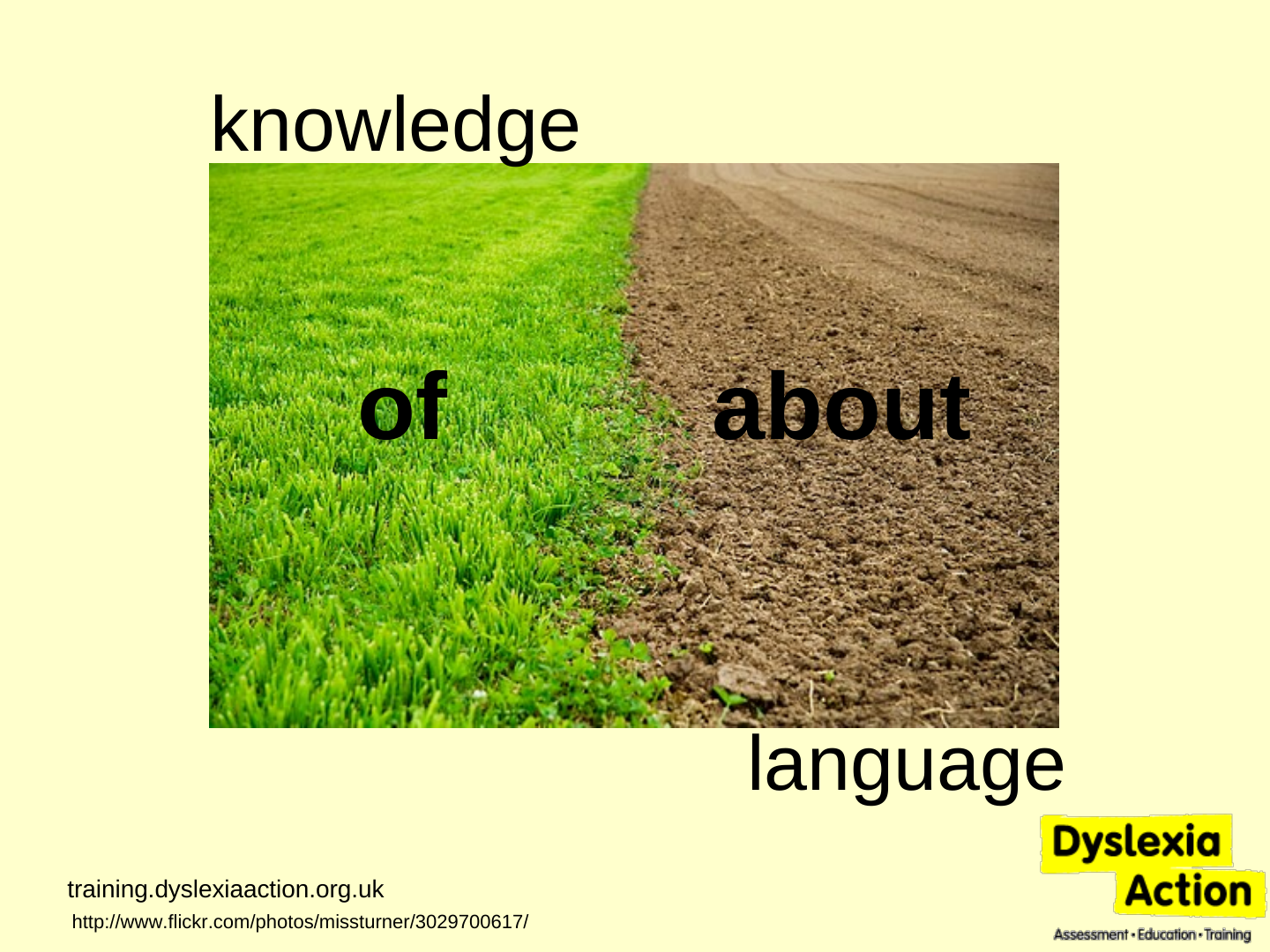
Photograph of a lawn divided diagonally: bright green grass on the left and bare brown soil on the right. The photograph itself carries no words; on the original slide the word “of” is laid over the grass and the word “about” over the soil, with “knowledge” above the photograph and “language” below it.

language

http://www.flickr.com/photos/missturner/3029700617/

Original slide 4 (image)

Slide 5: Prescriptivism

Prescriptivism

… how language should be used

v

… how language is used

Descriptivism
Original slide 5 (image)

Slide 6: Slide 6

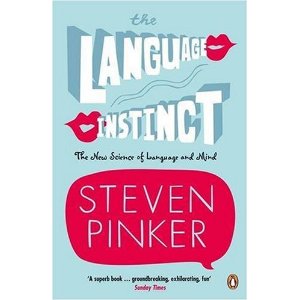
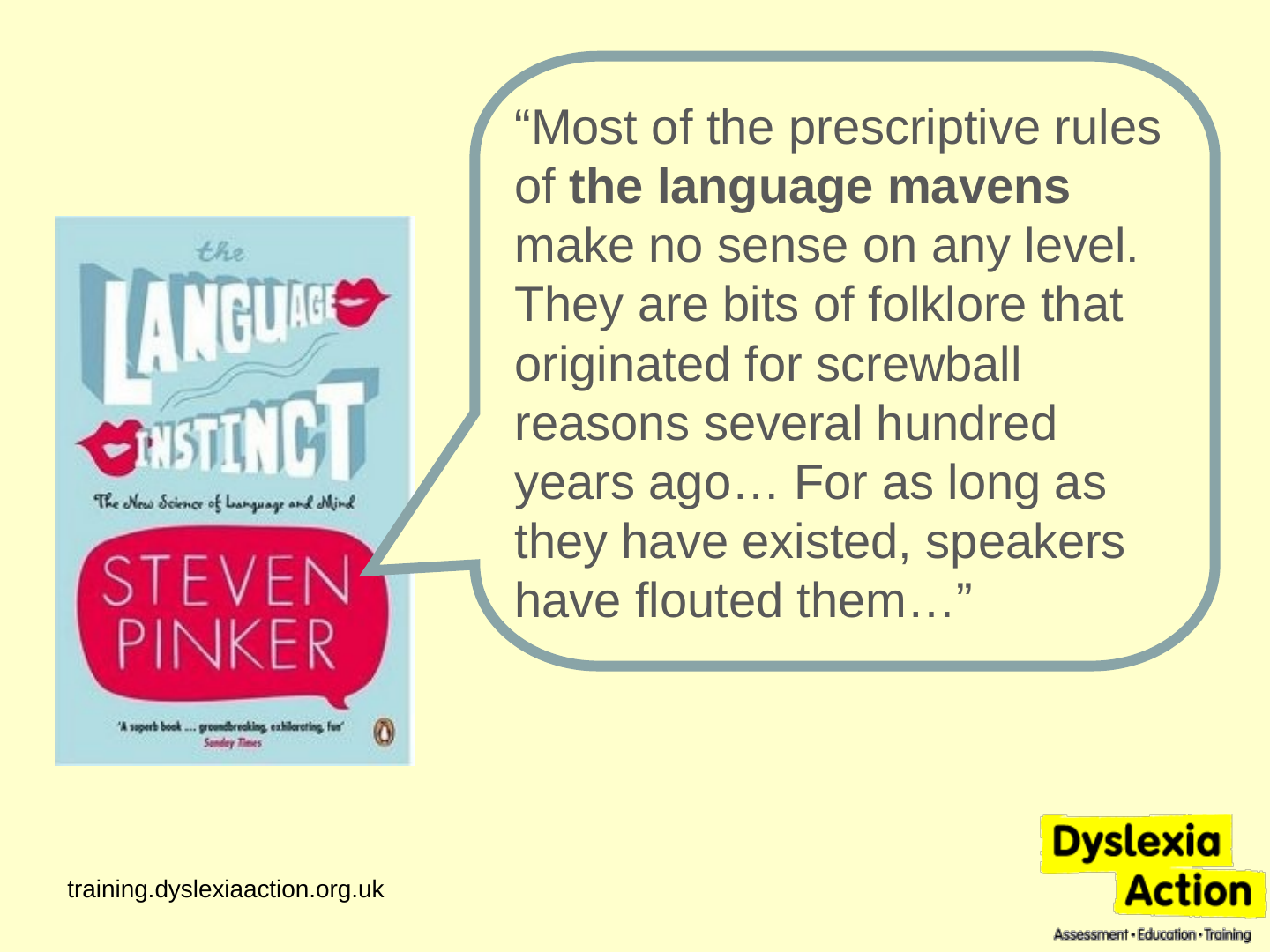
Cover of The Language Instinct by Steven Pinker: pale blue with a drawing of red lips and the subtitle “The New Science of Language and Mind”.

“Most of the prescriptive rules of the language mavens make no sense on any level. They are bits of folklore that originated for screwball reasons several hundred years ago… For as long as they have existed, speakers have flouted them…”

— Steven Pinker, The Language Instinct
Original slide 6 (image)

Slide 7: Slide 7

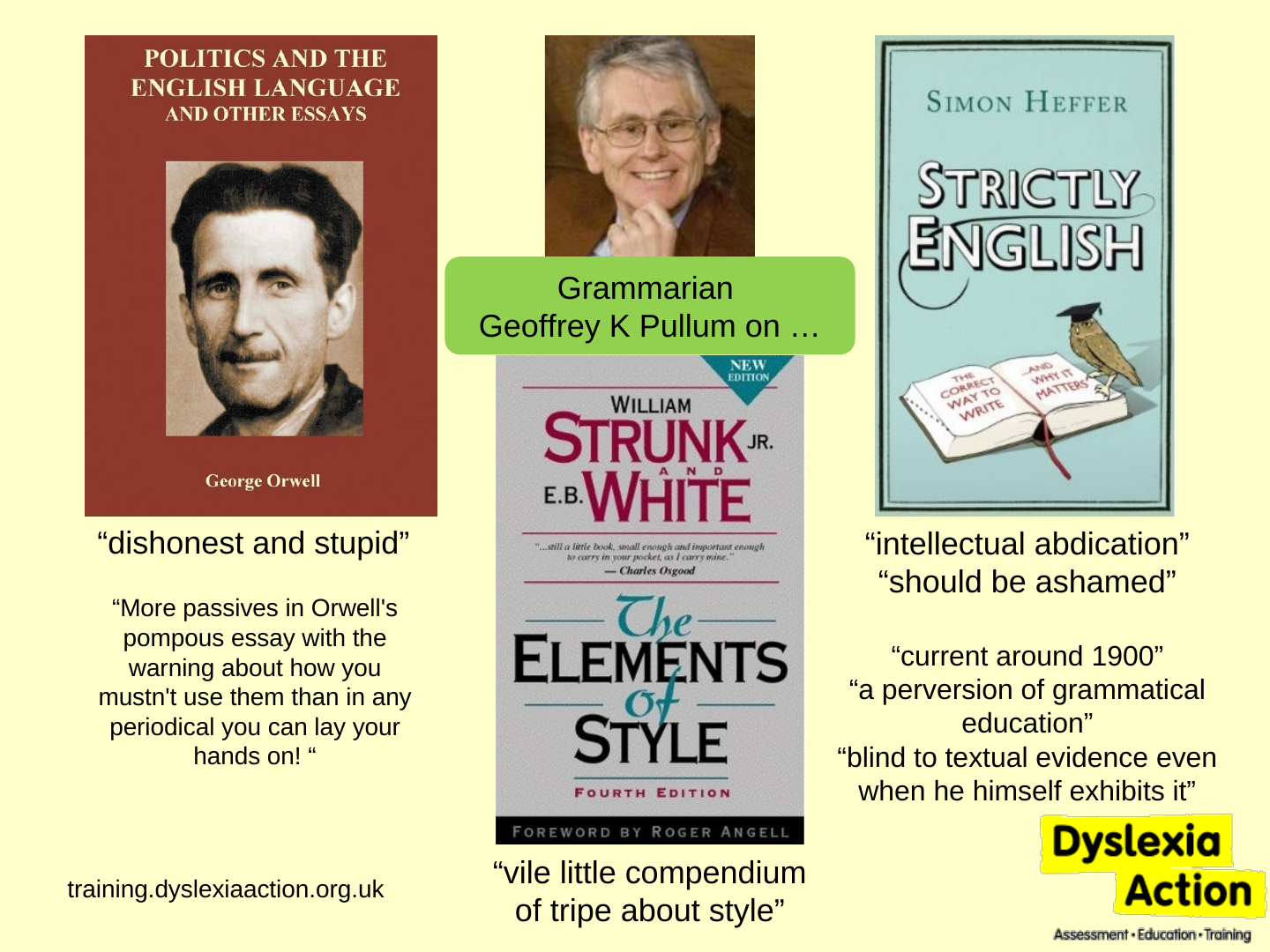
Grammarian Geoffrey K Pullum on …

  • Politics and the English Language, George Orwell (cover shown):
    • “dishonest and stupid”
    • “More passives in Orwell's pompous essay with the warning about how you mustn't use them than in any periodical you can lay your hands on! “
  • The Elements of Style, Strunk and White (cover shown):
    • “vile little compendium of tripe about style”
  • Strictly English, Simon Heffer (cover shown):
    • “intellectual abdication”
    • “should be ashamed”
    • “current around 1900”
    • “a perversion of grammatical education”
    • “blind to textual evidence even when he himself exhibits it”
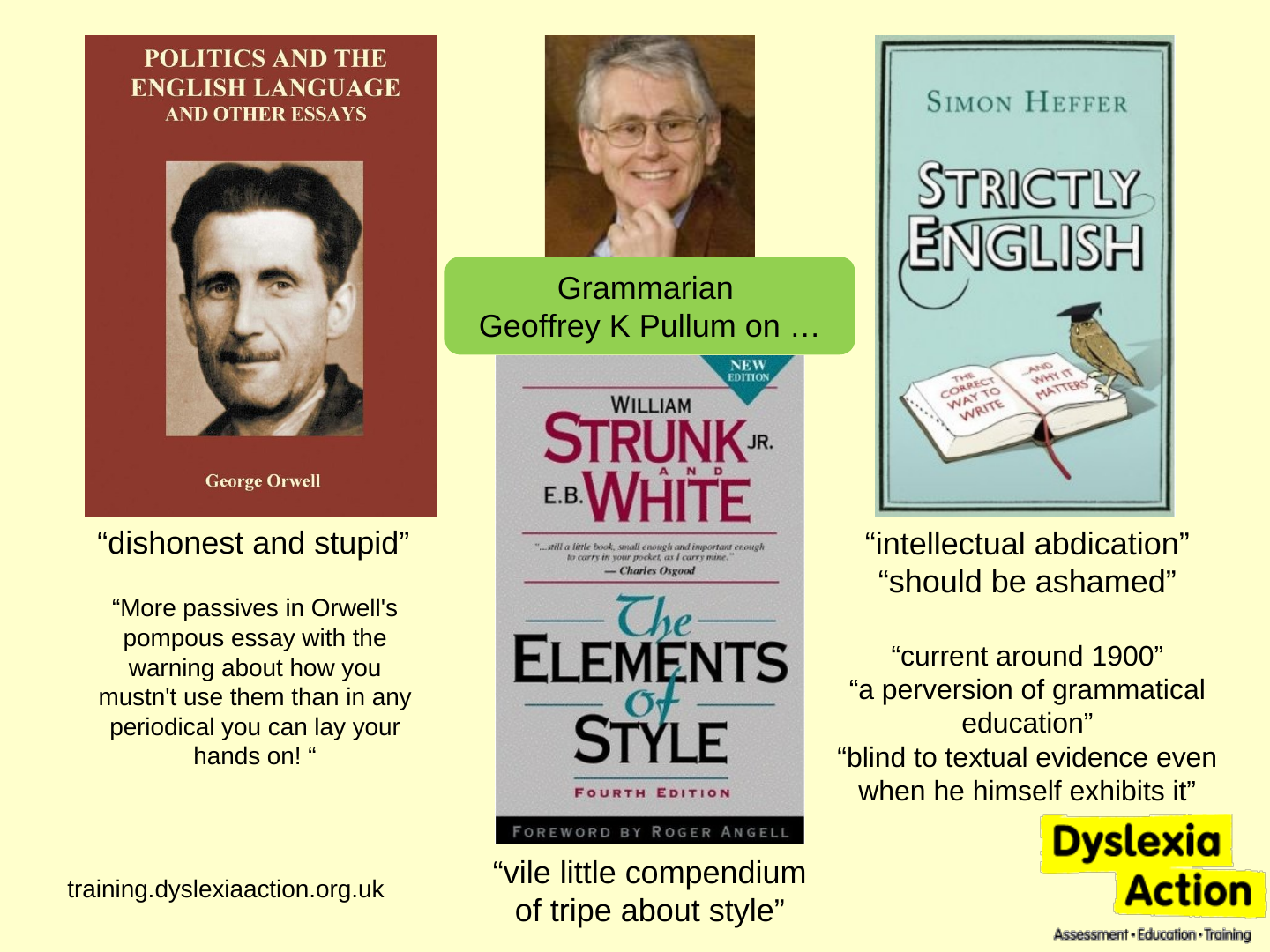
Three book covers side by side on a pale yellow slide: Politics and the English Language and Other Essays by George Orwell (dark red with a portrait photograph), The Elements of Style by William Strunk Jr. and E. B. White, fourth edition (grey), and Strictly English by Simon Heffer (pale blue, with an owl on an open book). A small photograph of a smiling grey-haired man in glasses is labelled “Grammarian Geoffrey K Pullum on …”. Quotation marks under each cover give the quotations listed above.

Original slide 7 (image)

Slide 8: Slide 8

This usage stuff is not straightforward and easy. If ever someone tells you that the rules of English grammar are simple and logical and you should just learn them and obey them, walk away, because you're getting advice from a fool.
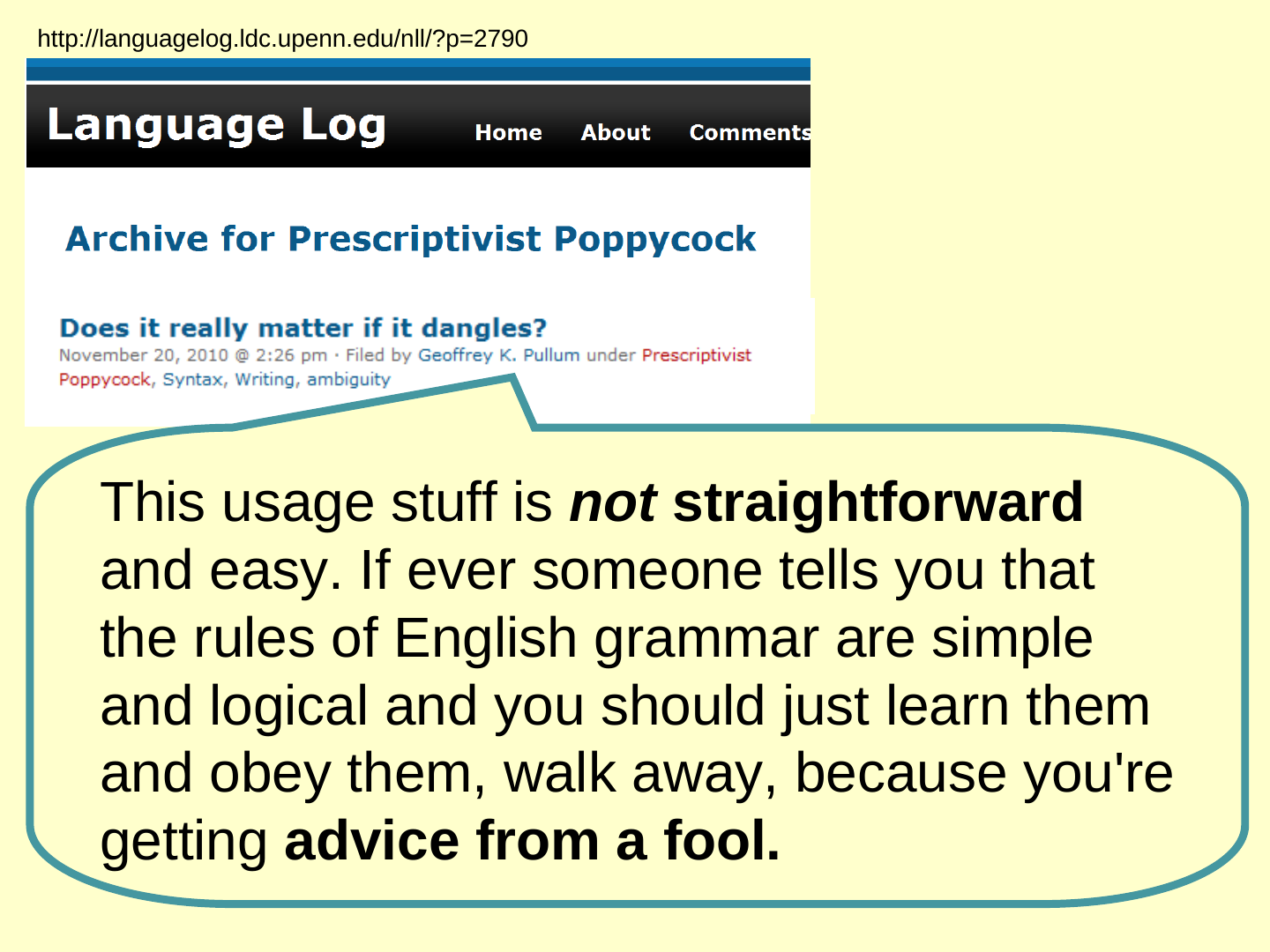
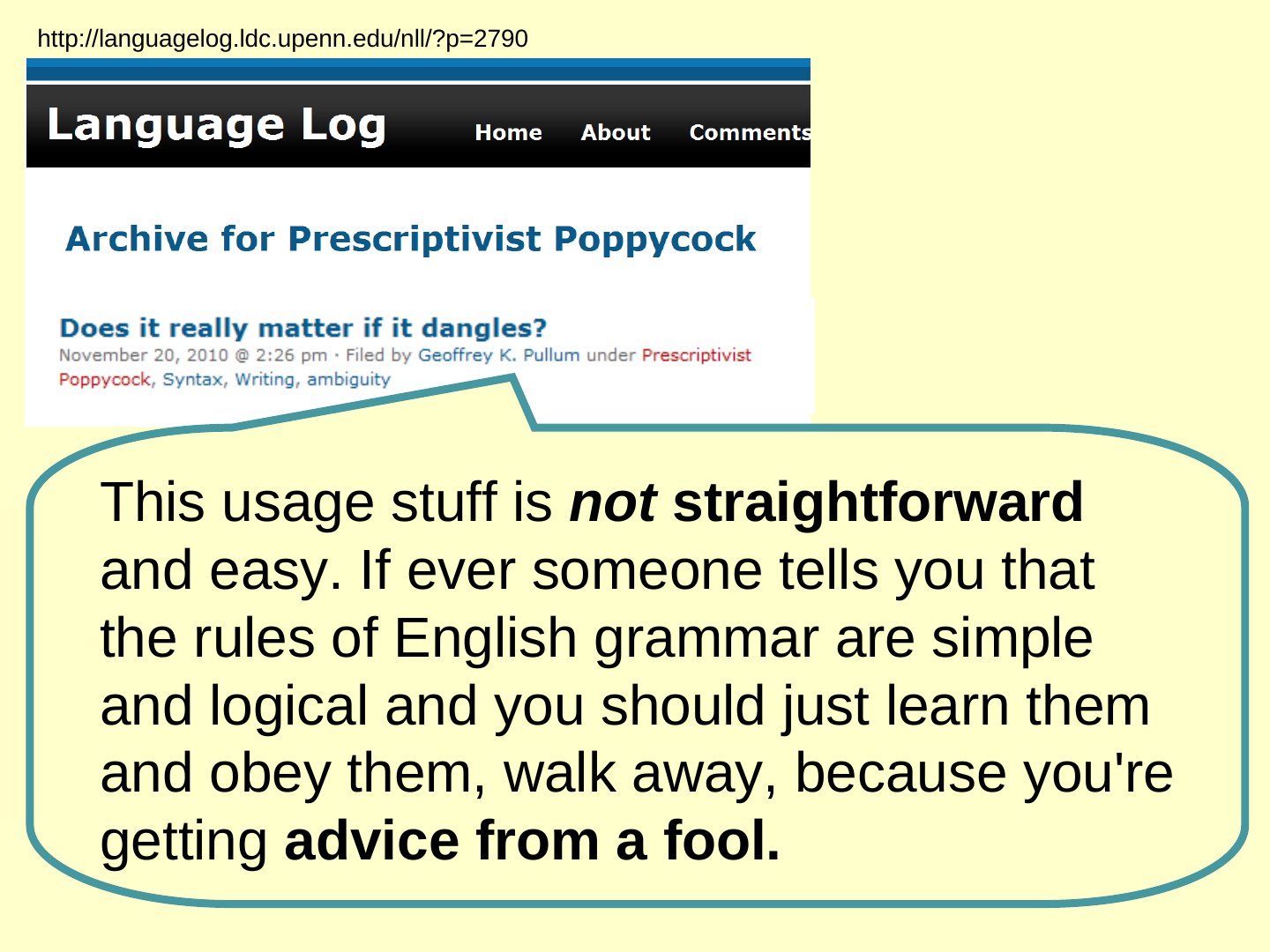
— http://languagelog.ldc.upenn.edu/nll/?p=2790

A web page captured from Language Log: a black header with the name and the links Home, About and Comments, then the heading “Archive for Prescriptivist Poppycock” and a post titled “Does it really matter if it dangles?”, dated November 20, 2010, filed by Geoffrey K. Pullum. The quotation above sits in a speech bubble below it.

Original slide 8 (image)

Slide 9: Corpus

Corpus

Key modern tool for finding out about how language works…
Original slide 9 (image)

Slide 10: Corpus

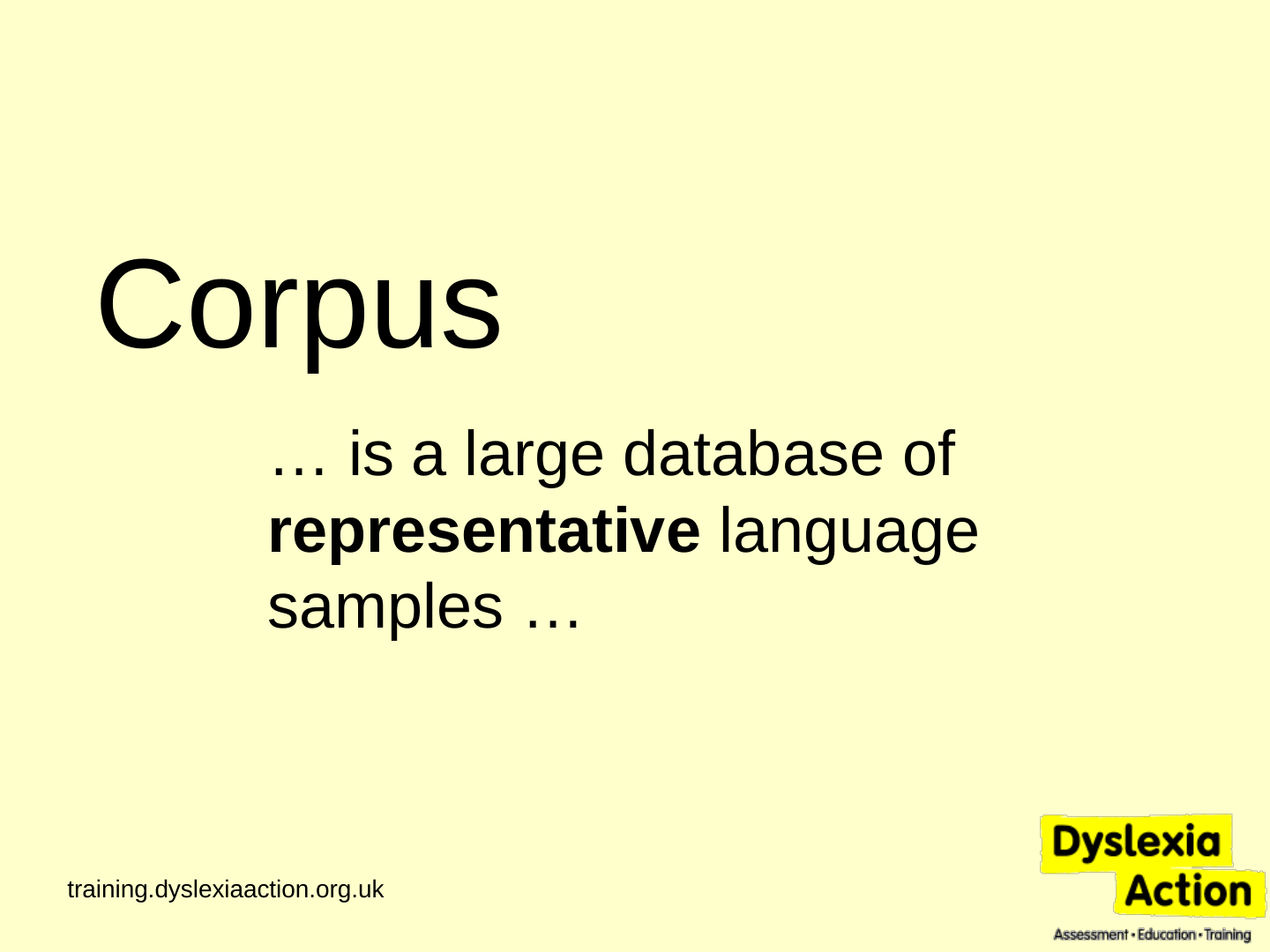
Corpus

… is a large database of representative language samples …
Original slide 10 (image)

Slide 11: Corpus

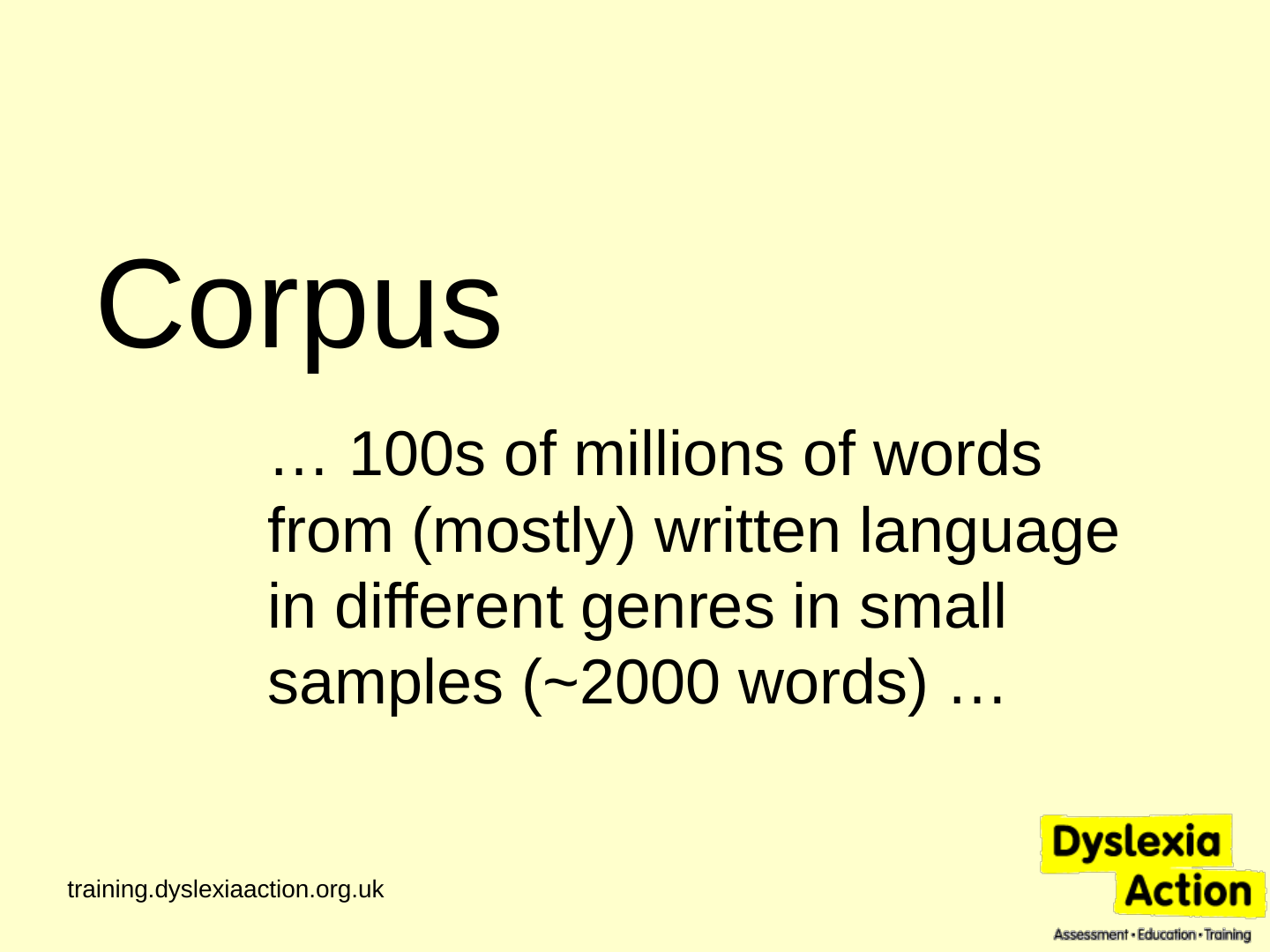
Corpus

… 100s of millions of words from (mostly) written language in different genres in small samples (~2000 words) …
Original slide 11 (image)

Slide 12: Corpus

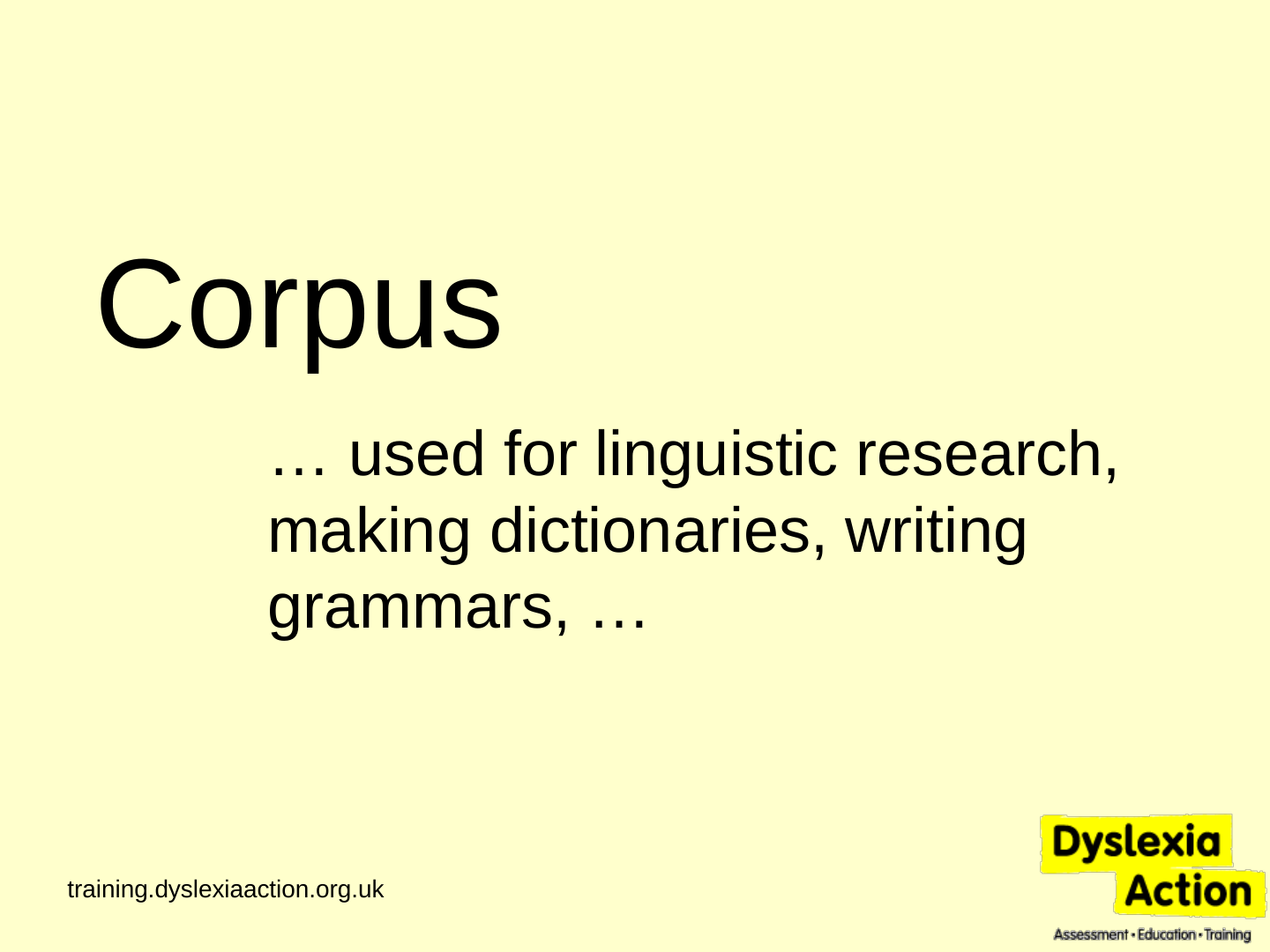
Corpus

… used for linguistic research, making dictionaries, writing grammars, …
Original slide 12 (image)

Slide 13: Slide 13

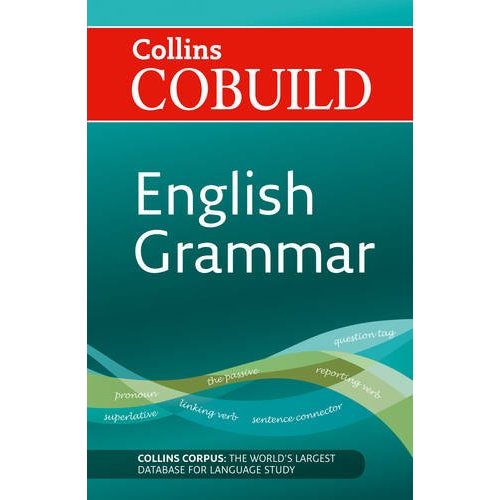
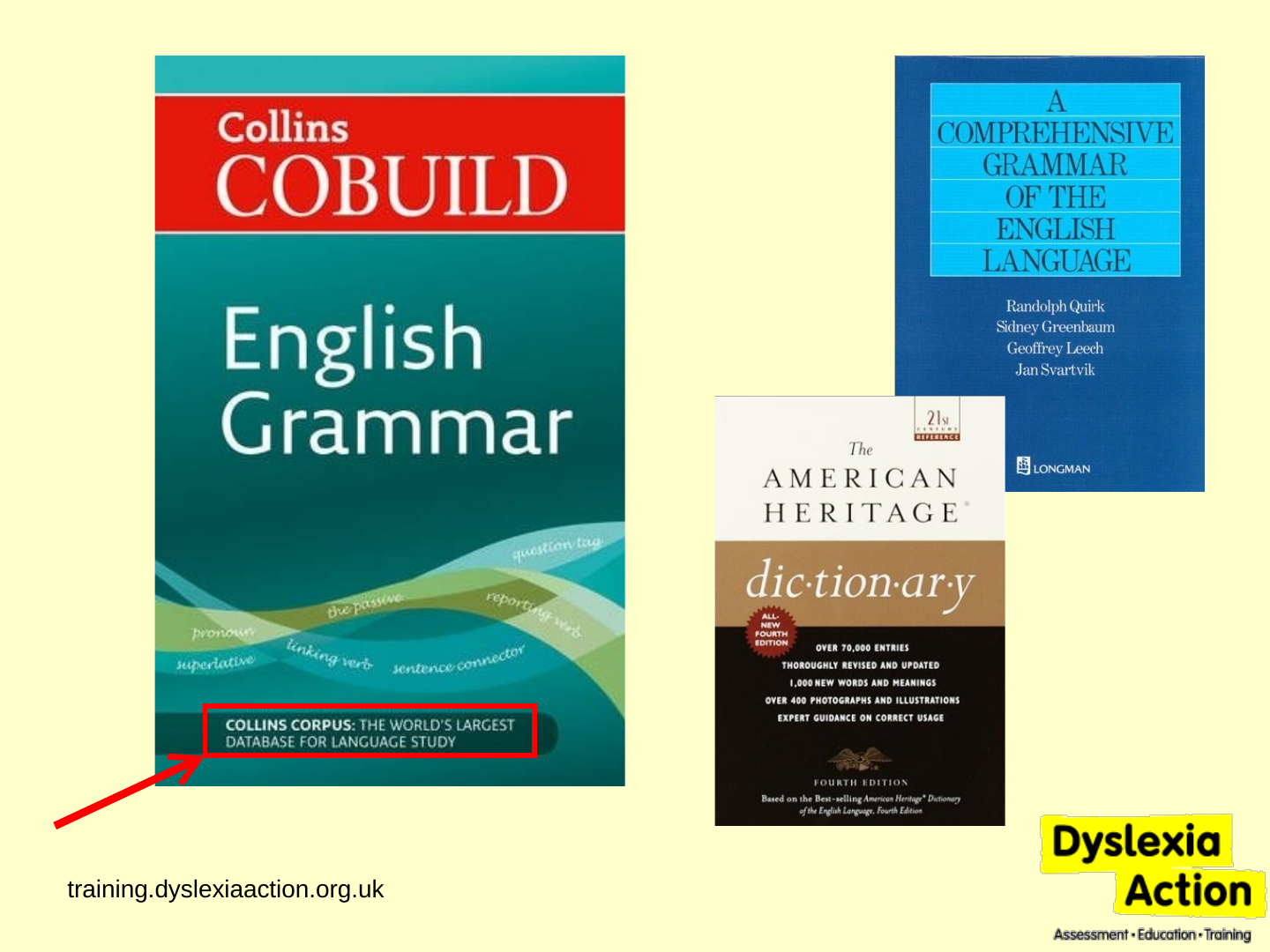
Cover of Collins COBUILD English Grammar: red and dark blue, with the printed words “COLLINS CORPUS: THE WORLD’S LARGEST DATABASE FOR LANGUAGE STUDY” near its foot. The cover itself carries no red box or arrow; on the original slide a red box is drawn round those words and a red arrow points at the box from the lower left.

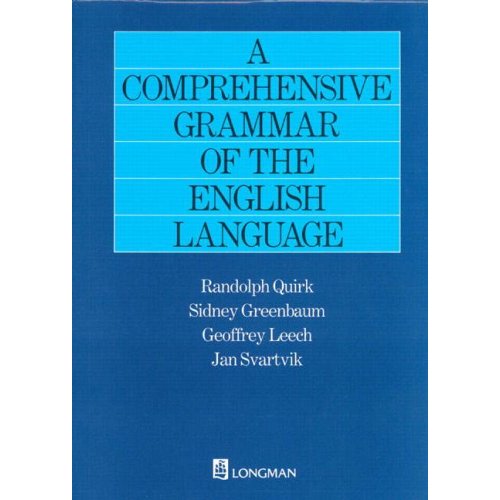
Cover of A Comprehensive Grammar of the English Language by Randolph Quirk, Sidney Greenbaum, Geoffrey Leech and Jan Svartvik, Longman: dark blue with the title in a box.

Cover of The American Heritage Dictionary, fourth edition (grey and brown), with a list of features at the bottom.

Original slide 13 (image)

Slide 14: Corpora available for teachers

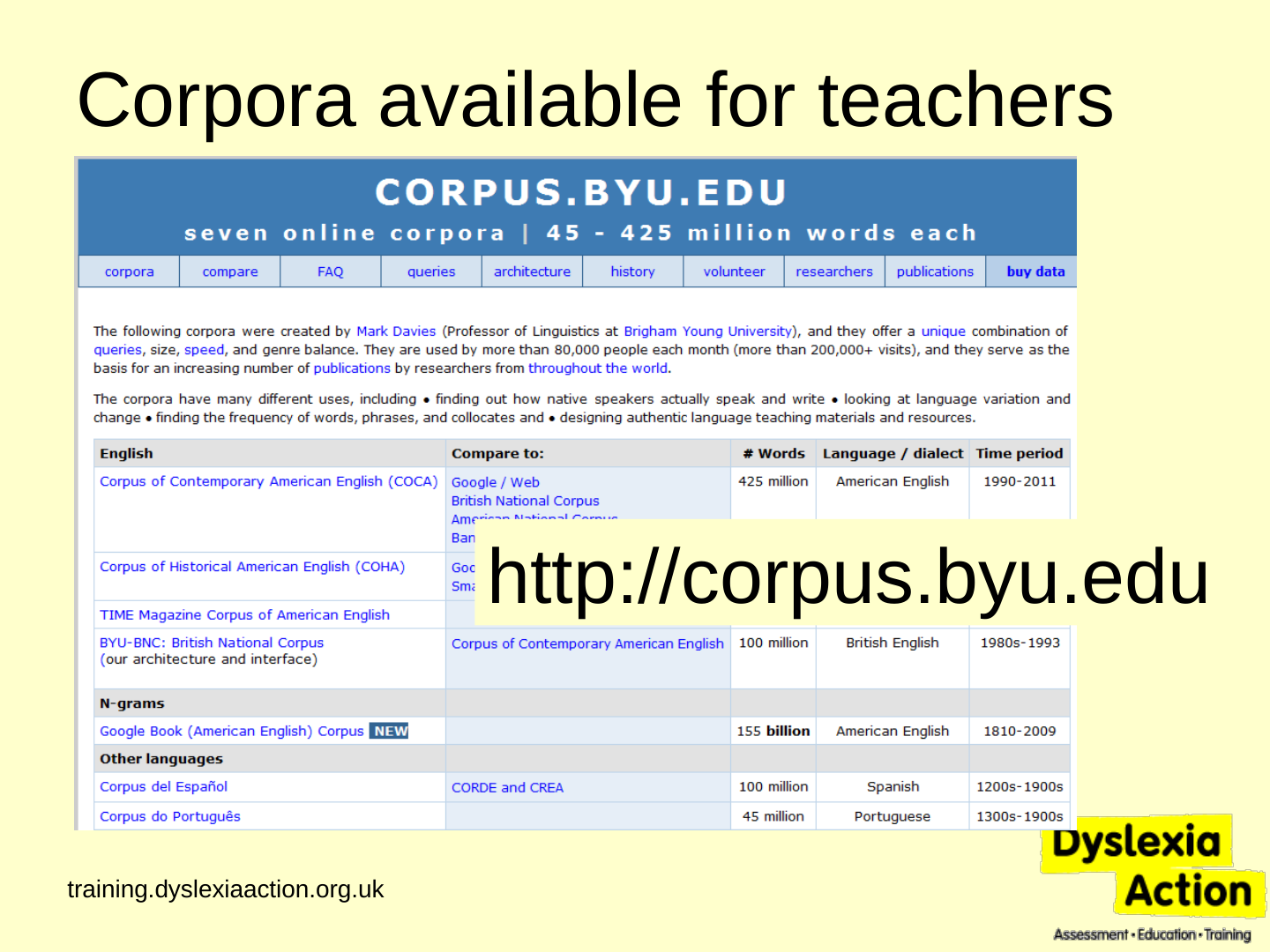
Corpora available for teachers
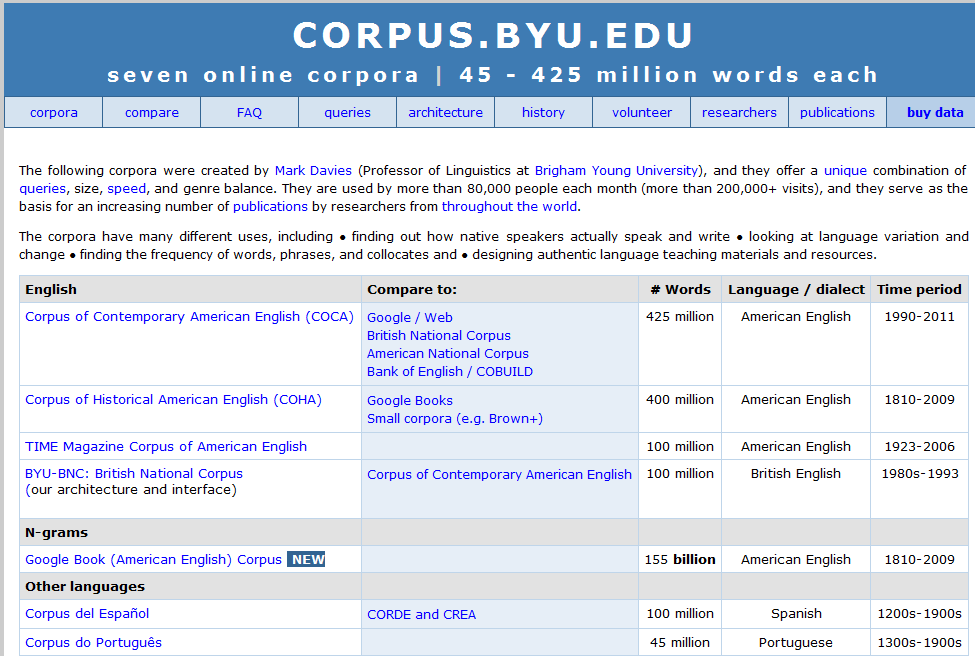
Screenshot of the home page of corpus.byu.edu, headed “Corpus.byu.edu: seven online corpora, 45 to 425 million words each”, with a table of the corpora (COCA, COHA, TIME, the BYU-BNC, Google Books, Corpus del Español, Corpus do Português) and their sizes, dialects and time periods.

http://corpus.byu.edu

Original slide 14 (image)

Slide 15: Access to COCA and related BYU corpora is free…

Access to COCA and related BYU corpora is free…

A blue log-in form with fields for email and password, a Help link and a Log in button.

…but free registration required for more than ~10 queries a day
Original slide 15 (image)

Slide 16: Slide 16

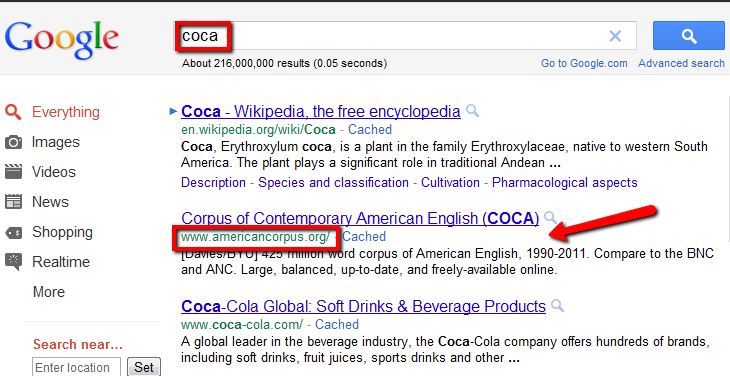
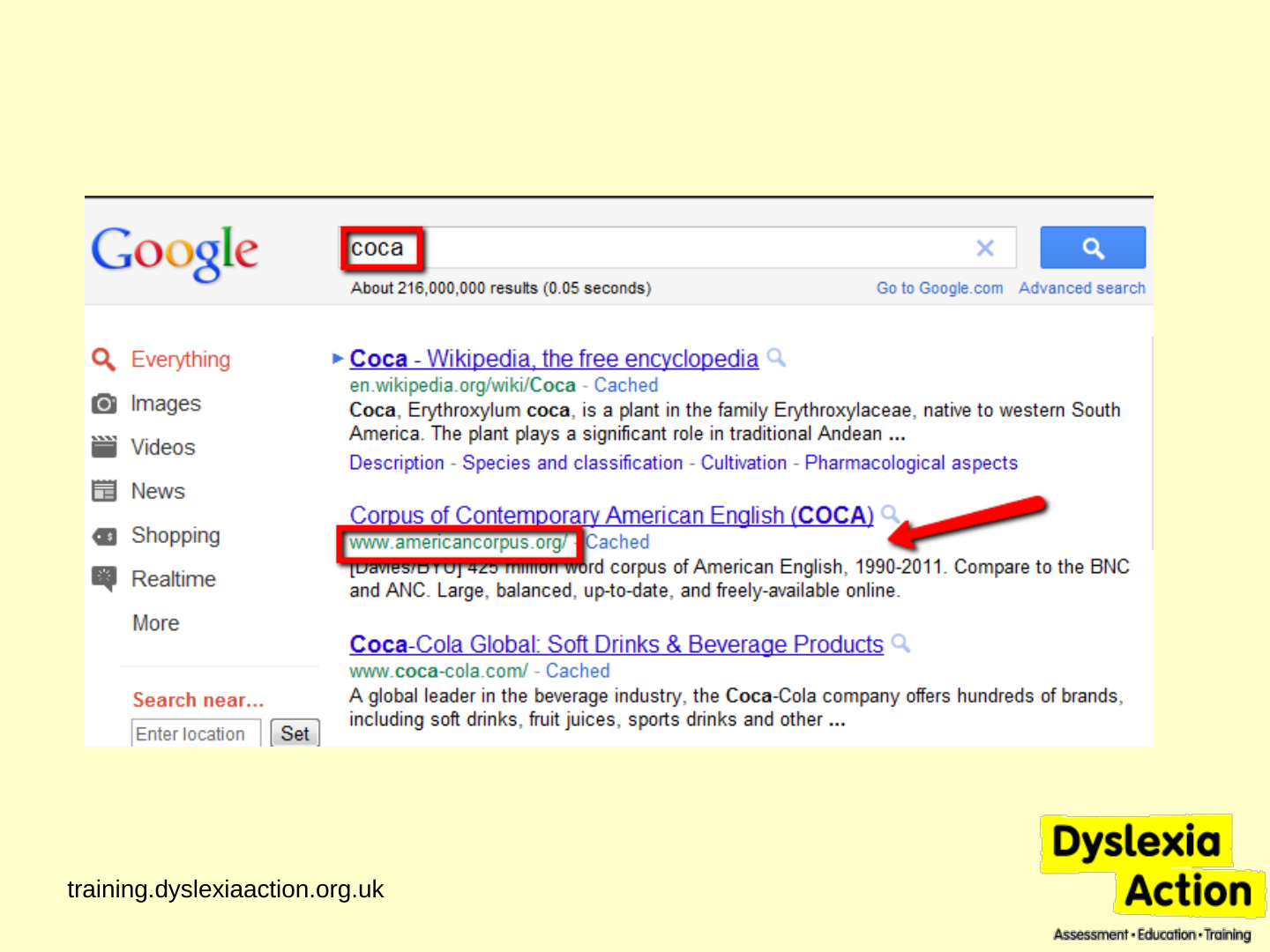
Screenshot of a Google search for “coca”, about 216,000,000 results. The result “Corpus of Contemporary American English (COCA)” with the address www.americancorpus.org is outlined in red and marked by a red arrow, above a result for Coca-Cola.

Original slide 16 (image)

Slide 17: Slide 17

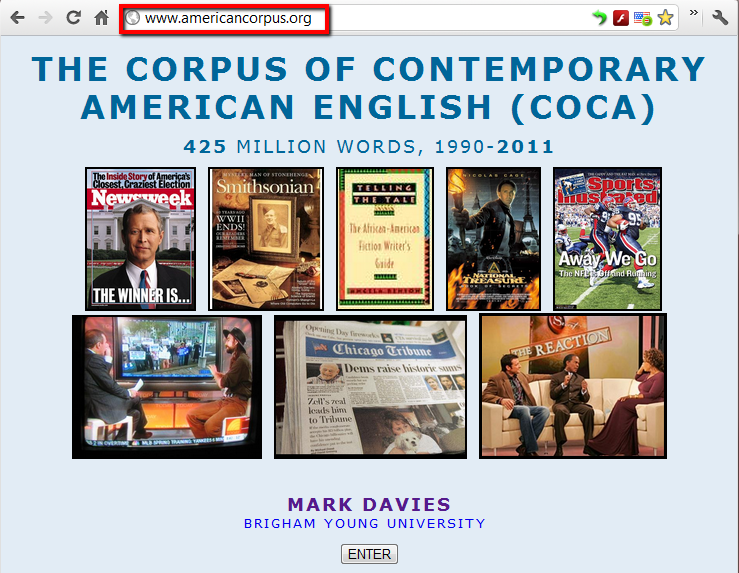
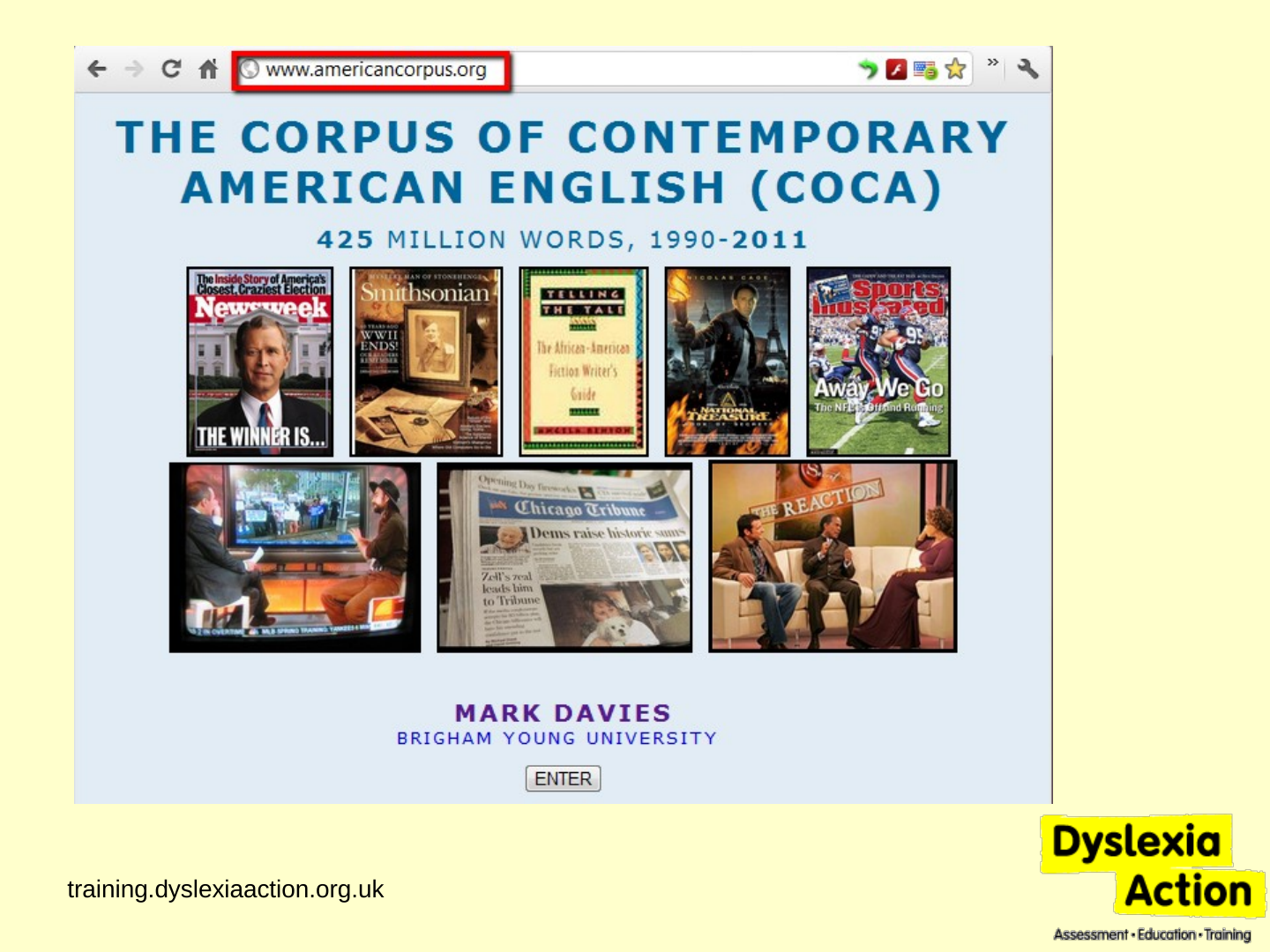
Screenshot of the home page of the Corpus of Contemporary American English (COCA), 425 million words, 1990–2011, shown in a browser with the address www.americancorpus.org outlined in red; a collage of magazine, newspaper, book and television images and the credit “Mark Davies, Brigham Young University”.

Original slide 17 (image)

Slide 18: Slide 18

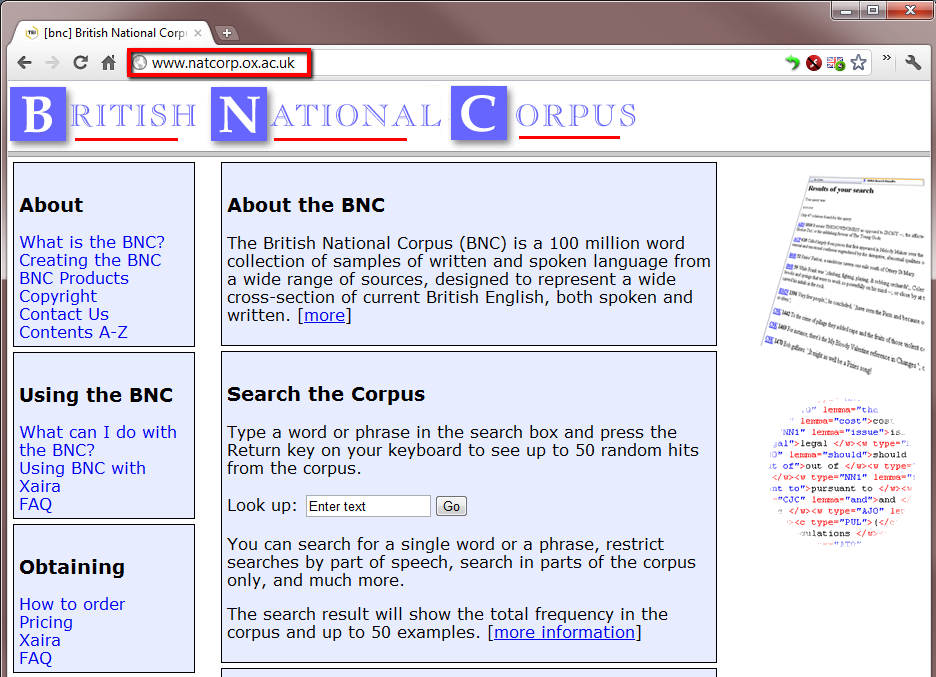
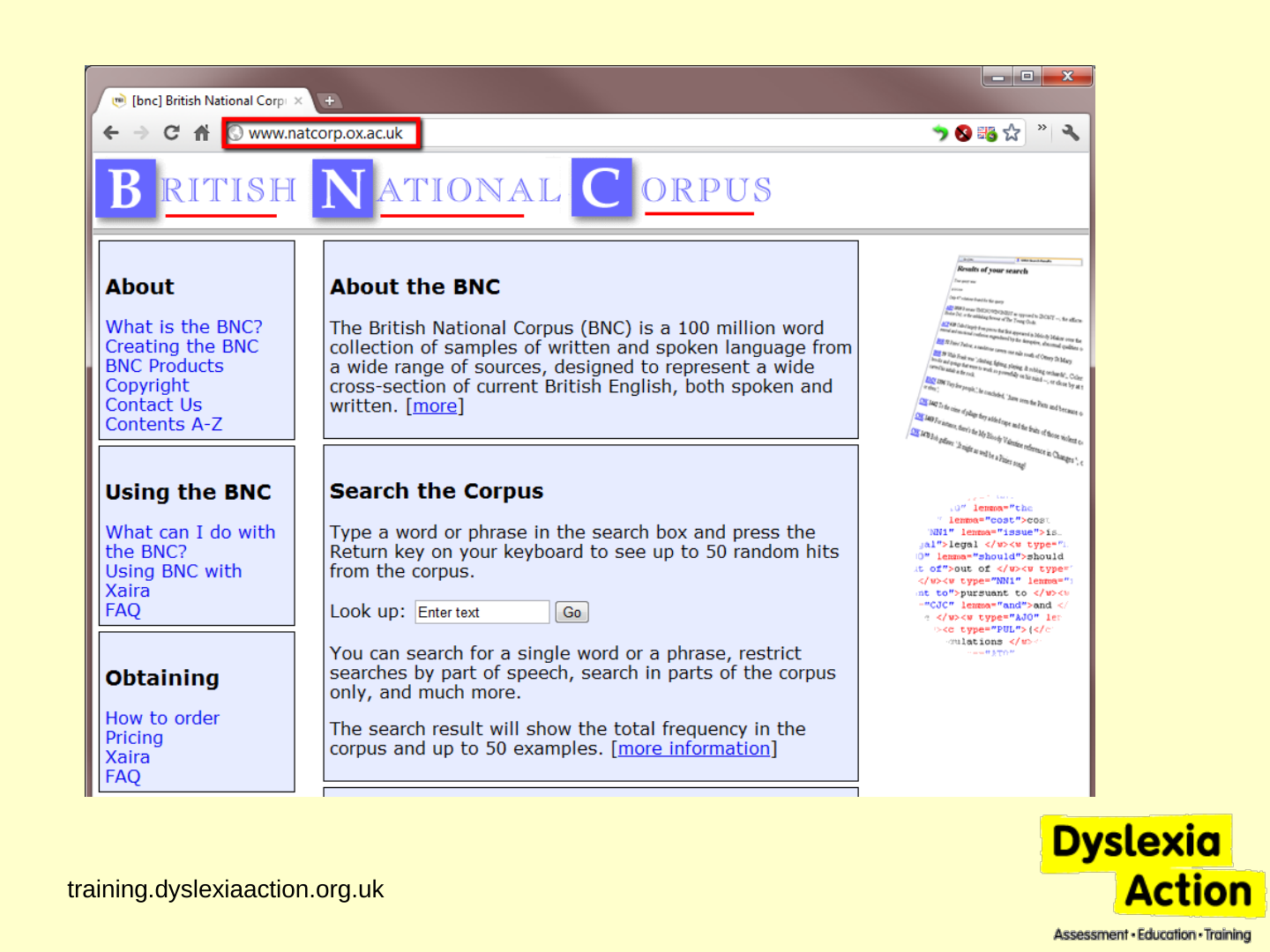
Screenshot of the home page of the British National Corpus in a browser, with the address www.natcorp.ox.ac.uk outlined in red; menus headed About, Using the BNC and Obtaining, and a box “Search the Corpus”.

Original slide 18 (image)

Slide 19: Slide 19

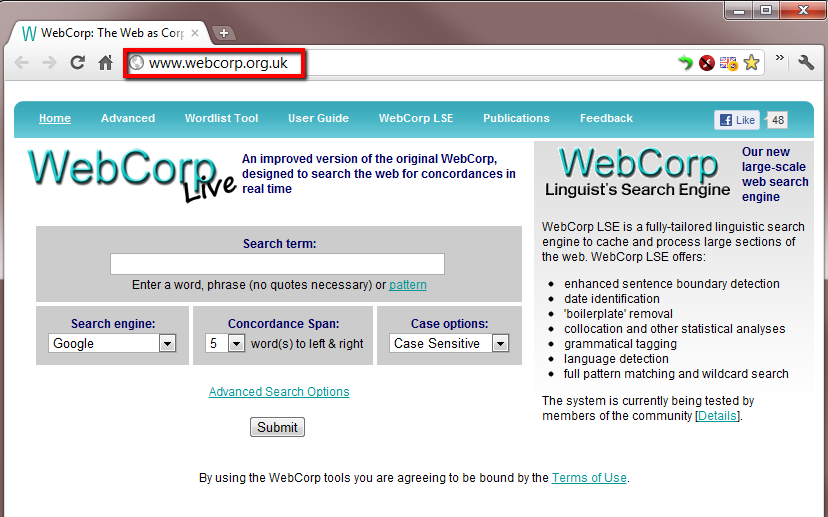
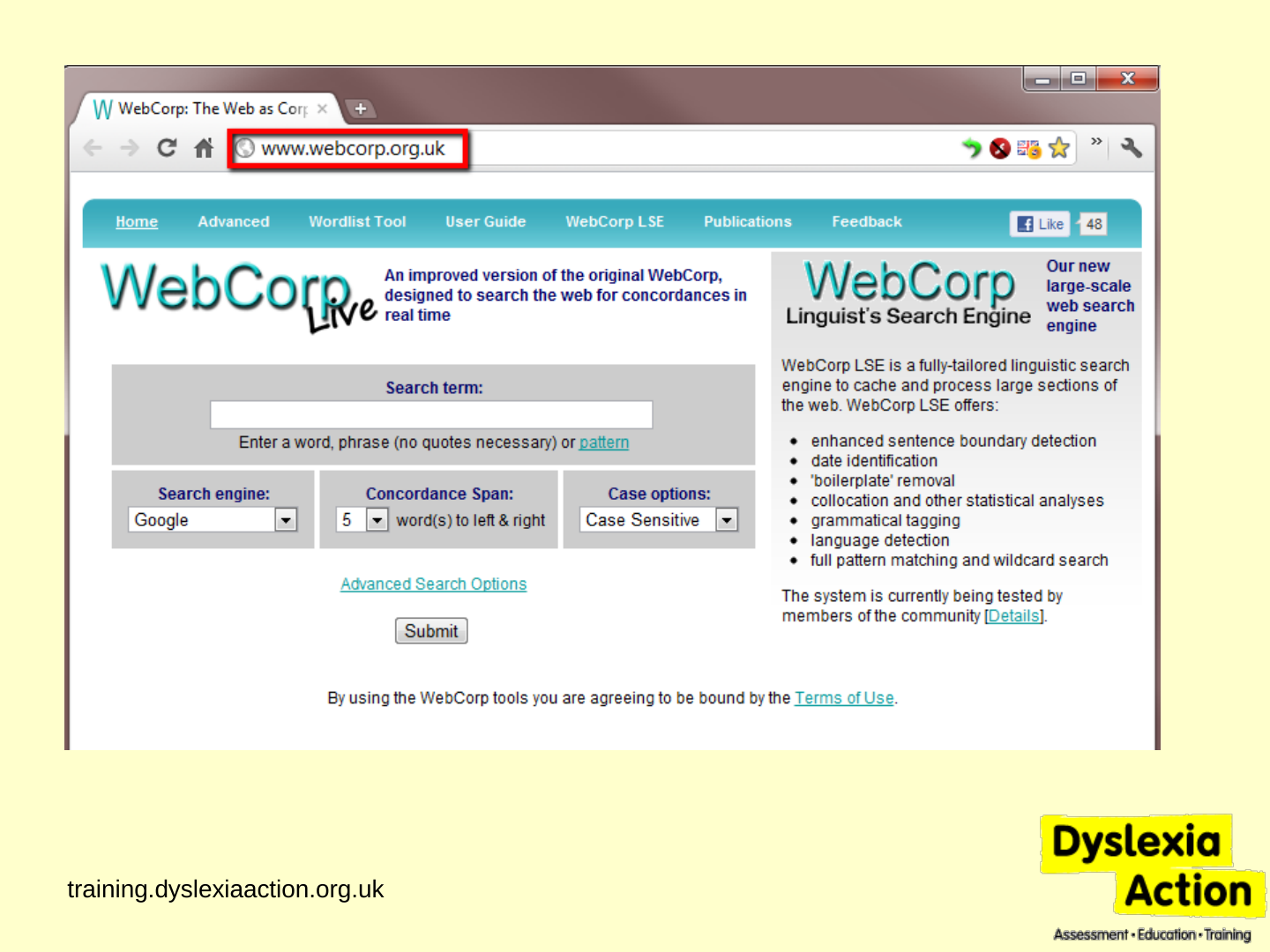
Screenshot of the WebCorp Live search page in a browser, with the address www.webcorp.org.uk outlined in red: a search-term box, options for search engine, concordance span and case, and a panel describing WebCorp Linguist’s Search Engine.

Original slide 19 (image)

Slide 20: Slide 20

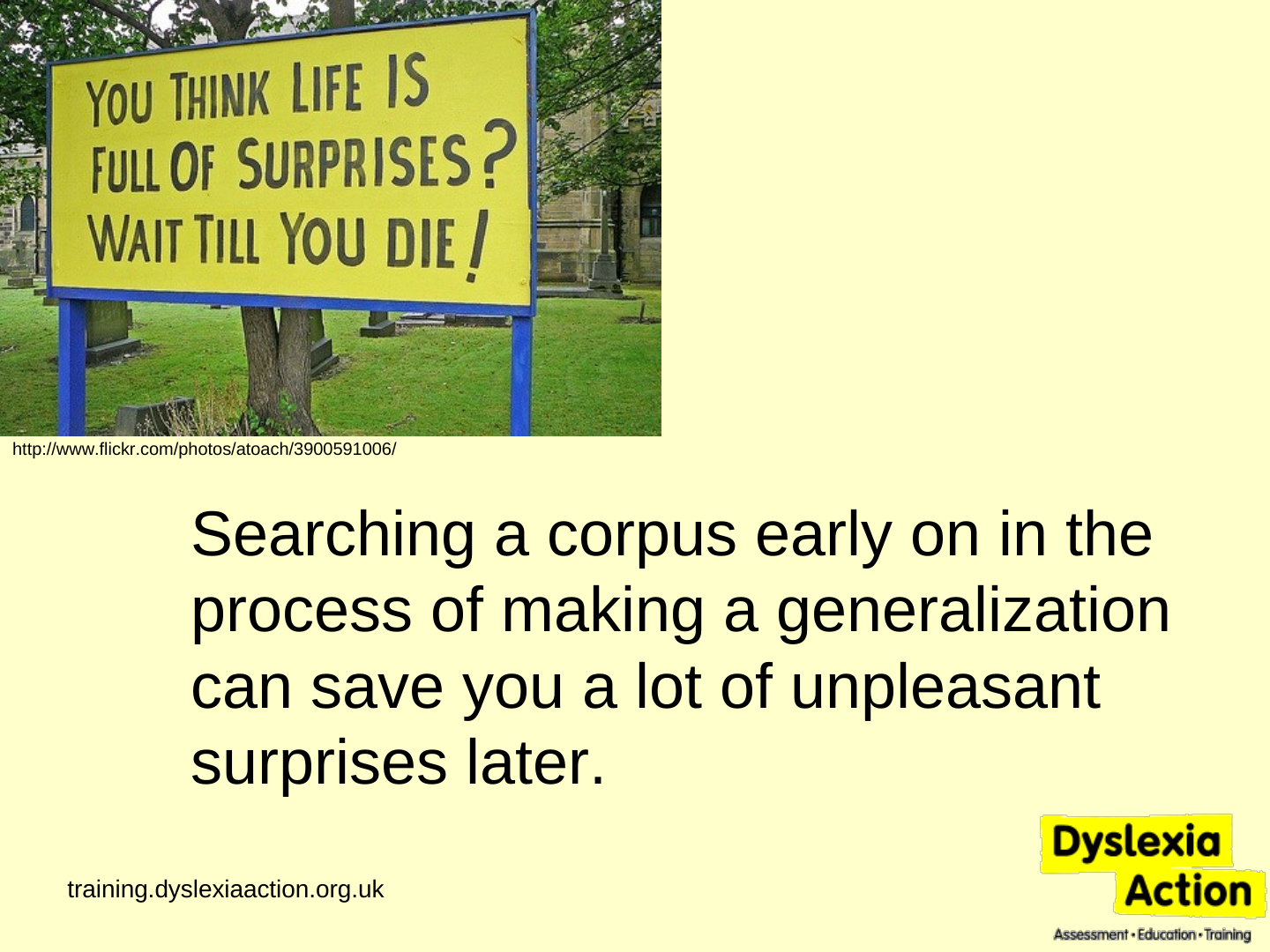
Photograph of a yellow roadside sign with black capitals reading “You think life is full of surprises? Wait till you die!”, in front of trees.

http://www.flickr.com/photos/atoach/3900591006/

Searching a corpus early on in the process of making a generalization can save you a lot of unpleasant surprises later.
Original slide 20 (image)

Slide 21: How do we use the word dyslexia?

How do we use the word dyslexia?

We speak more often of dyslexic children than adults.

We speak more often of dyslexia than any other dys- word.
Original slide 21 (image)

Slide 22: Concordance

Concordance

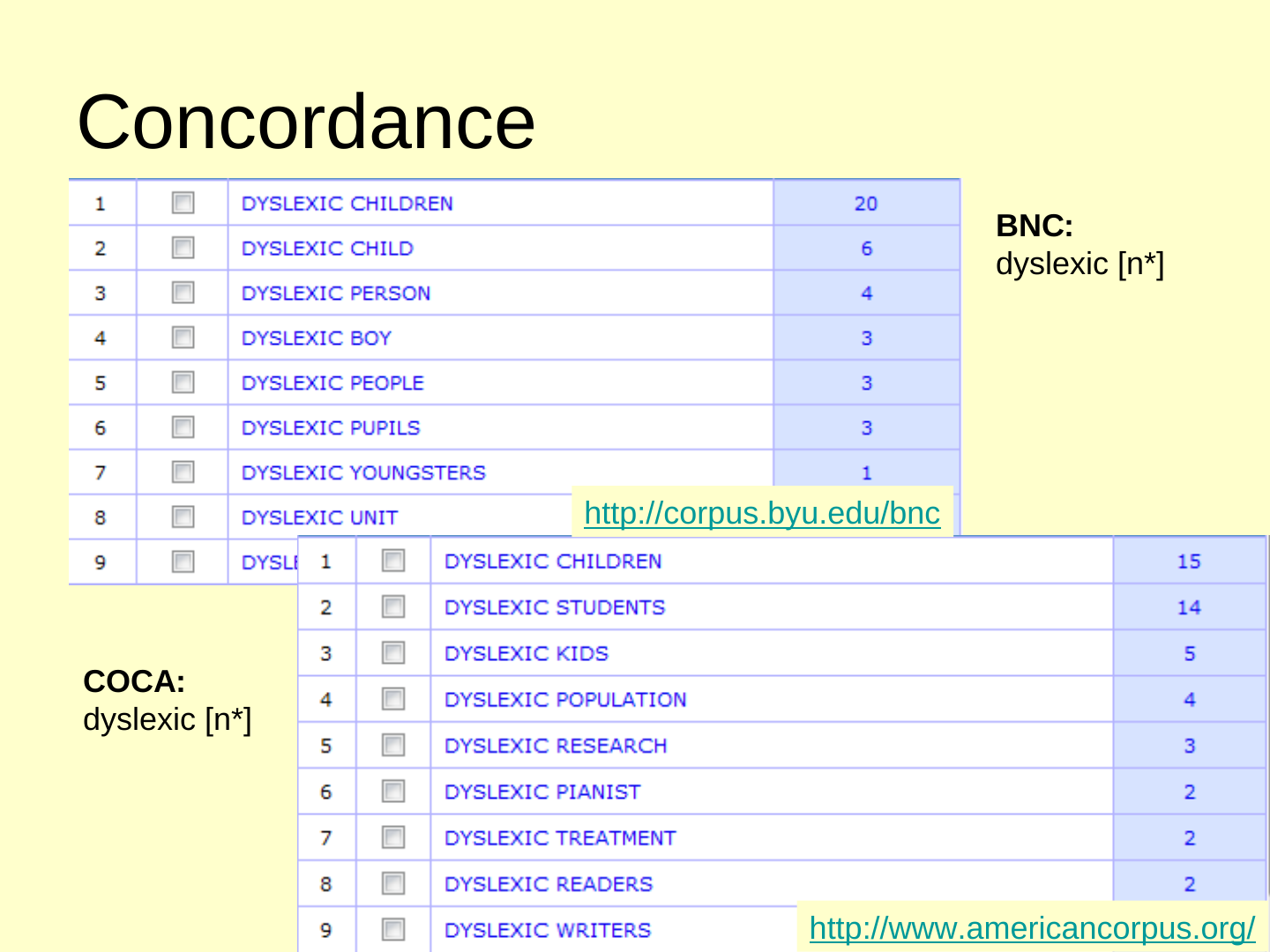
BNC: dyslexic [n*]
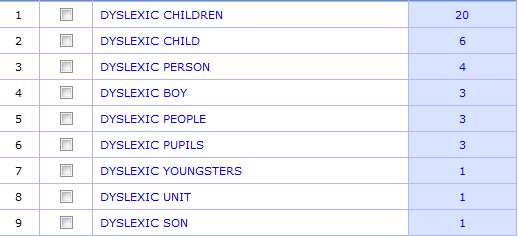
Screenshot of a BNC list of phrases beginning DYSLEXIC with their counts, transcribed in the list below the image.

  • DYSLEXIC CHILDREN 20
  • DYSLEXIC CHILD 6
  • DYSLEXIC PERSON 4
  • DYSLEXIC BOY 3
  • DYSLEXIC PEOPLE 3
  • DYSLEXIC PUPILS 3
  • DYSLEXIC YOUNGSTERS 1
  • DYSLEXIC UNIT 1
  • DYSLEXIC SON 1

http://corpus.byu.edu/bnc

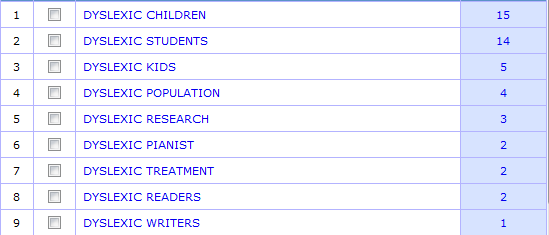
COCA: dyslexic [n*]

Screenshot of a COCA list of phrases beginning DYSLEXIC with their counts, transcribed in the list below the image.

  • DYSLEXIC CHILDREN 15
  • DYSLEXIC STUDENTS 14
  • DYSLEXIC KIDS 5
  • DYSLEXIC POPULATION 4
  • DYSLEXIC RESEARCH 3
  • DYSLEXIC PIANIST 2
  • DYSLEXIC TREATMENT 2
  • DYSLEXIC READERS 2
  • DYSLEXIC WRITERS 2

http://www.americancorpus.org/

Original slide 22 (image)

Slide 23: Slide 23

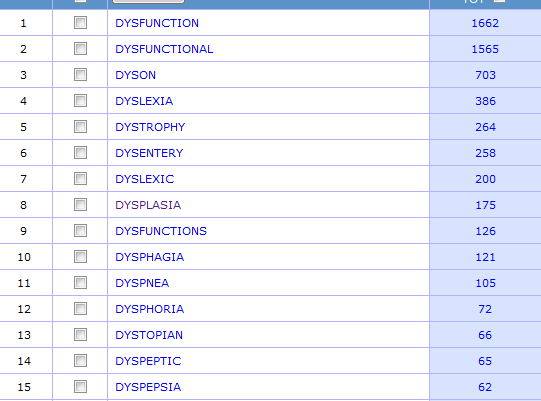
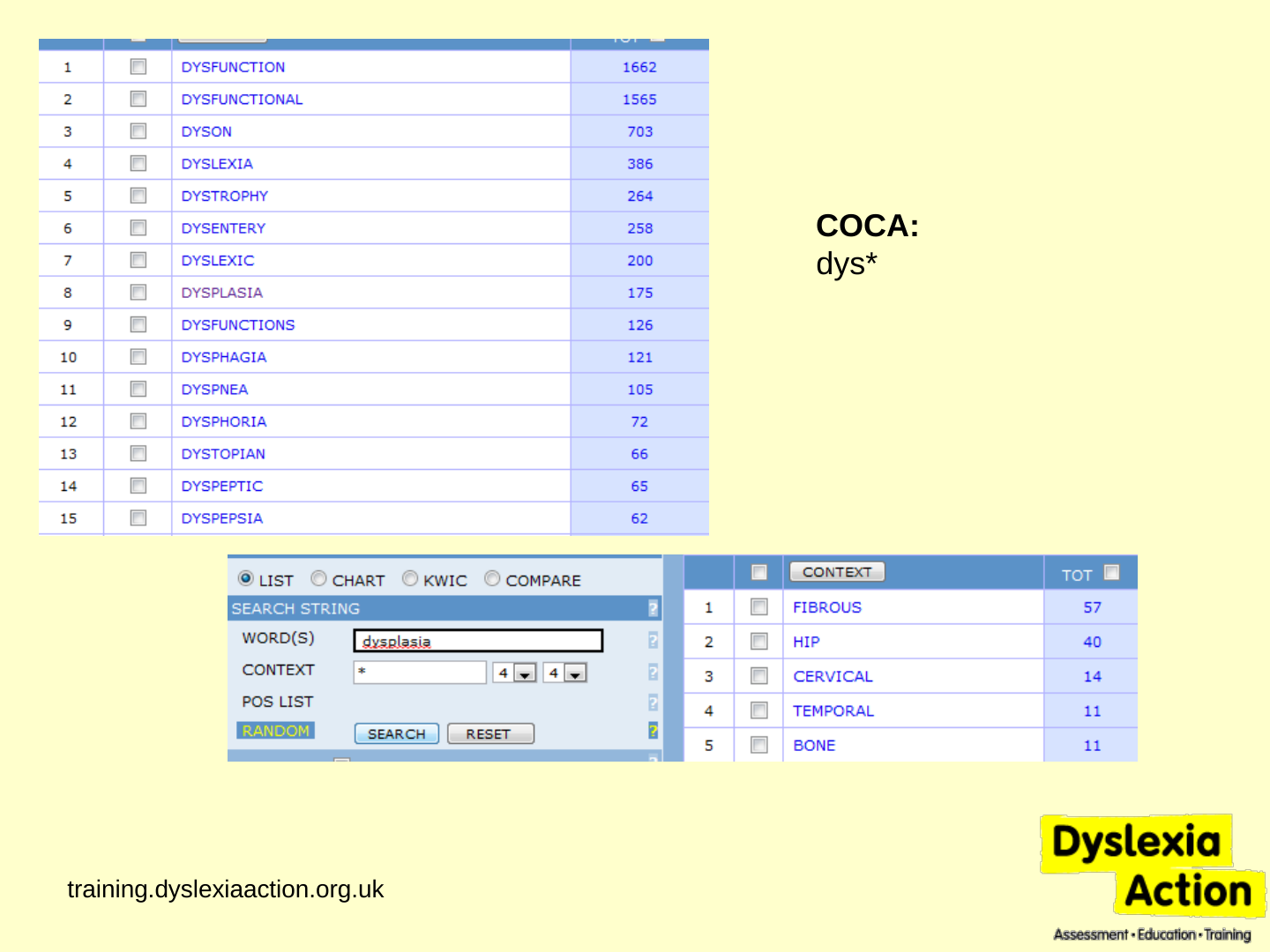
Screenshot of a COCA list, in order of frequency: DYSFUNCTION 1662, DYSFUNCTIONAL 1565, DYSON 703, DYSLEXIA 386, DYSTROPHY 264, DYSENTERY 258, DYSLEXIC 200, DYSPLASIA 175, DYSFUNCTIONS 126, DYSPHAGIA 121, DYSPNEA 105, DYSPHORIA 72, DYSTOPIA 66, DYSPEPTIC 65, DYSPEPSIA 62.

COCA: dys*

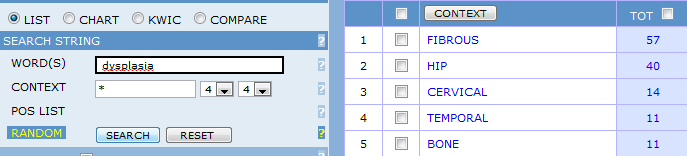
Screenshot of the COCA search form with the word “dysplasia” entered, and a list of words that occur next to it: FIBROUS 57, HIP 40, CERVICAL 14, TEMPORAL 11, BONE 11.

Original slide 23 (image)

Slide 24: Suffixing rules

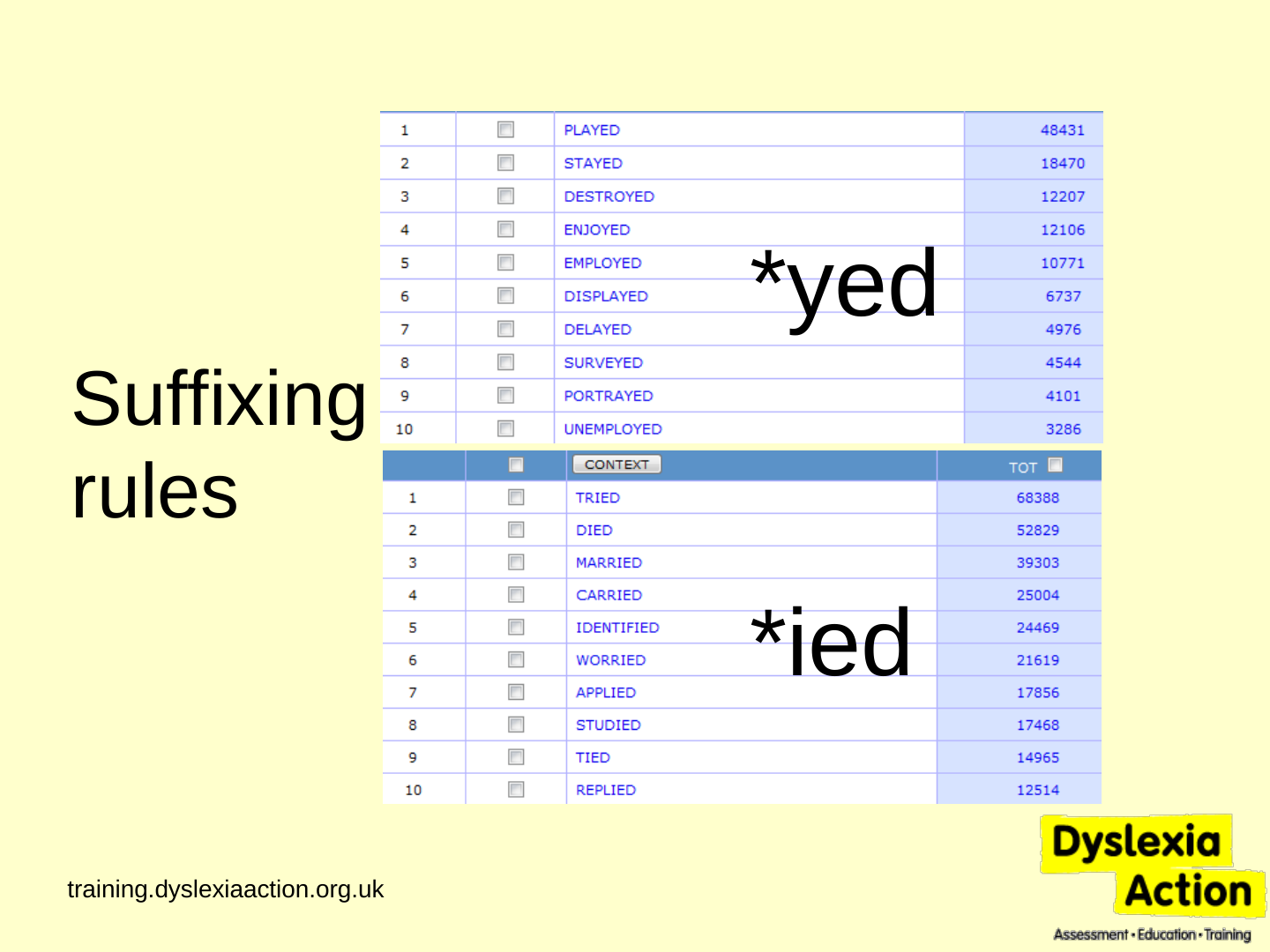
Suffixing rules

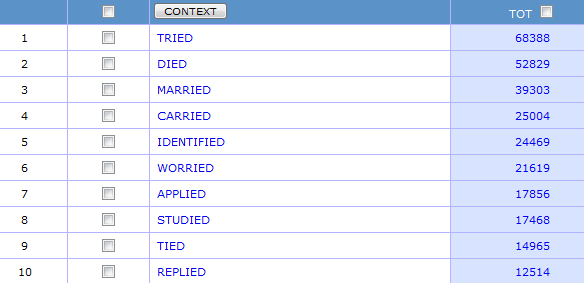
*yed
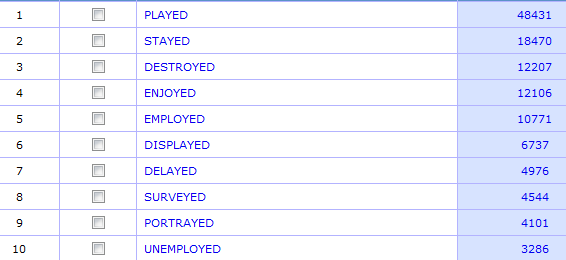
Screenshot of a list of words ending in -yed with their counts: PLAYED 48431, STAYED 18470, DESTROYED 12207, ENJOYED 12106, EMPLOYED 10771, DISPLAYED 6737, DELAYED 4976, SURVEYED 4544, PORTRAYED 4101, UNEMPLOYED 3286.

*ied

Screenshot of a list of words ending in -ied with their counts: TRIED 68388, DIED 52829, MARRIED 39303, CARRIED 25004, IDENTIFIED 24469, WORRIED 21619, APPLIED 17856, STUDIED 17468, TIED 14965, REPLIED 12514.

Original slide 24 (image)

Slide 25: Suffixing rules

Suffixing rules

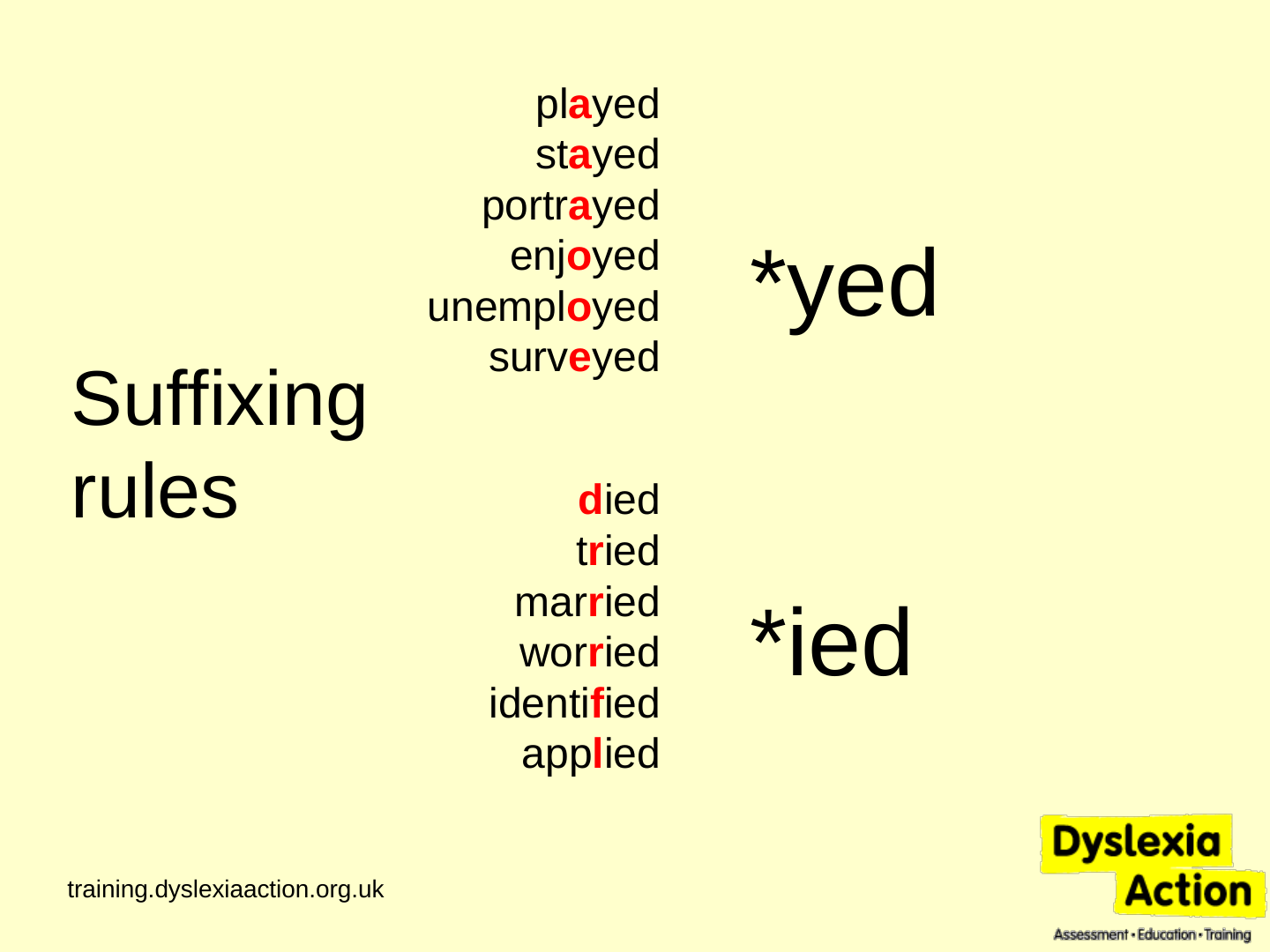
*yed

  • played
  • stayed
  • portrayed
  • enjoyed
  • unemployed
  • surveyed

*ied

  • died
  • tried
  • married
  • worried
  • identified
  • applied

Original slide 25 (image)

Slide 26: The Corpus Magic

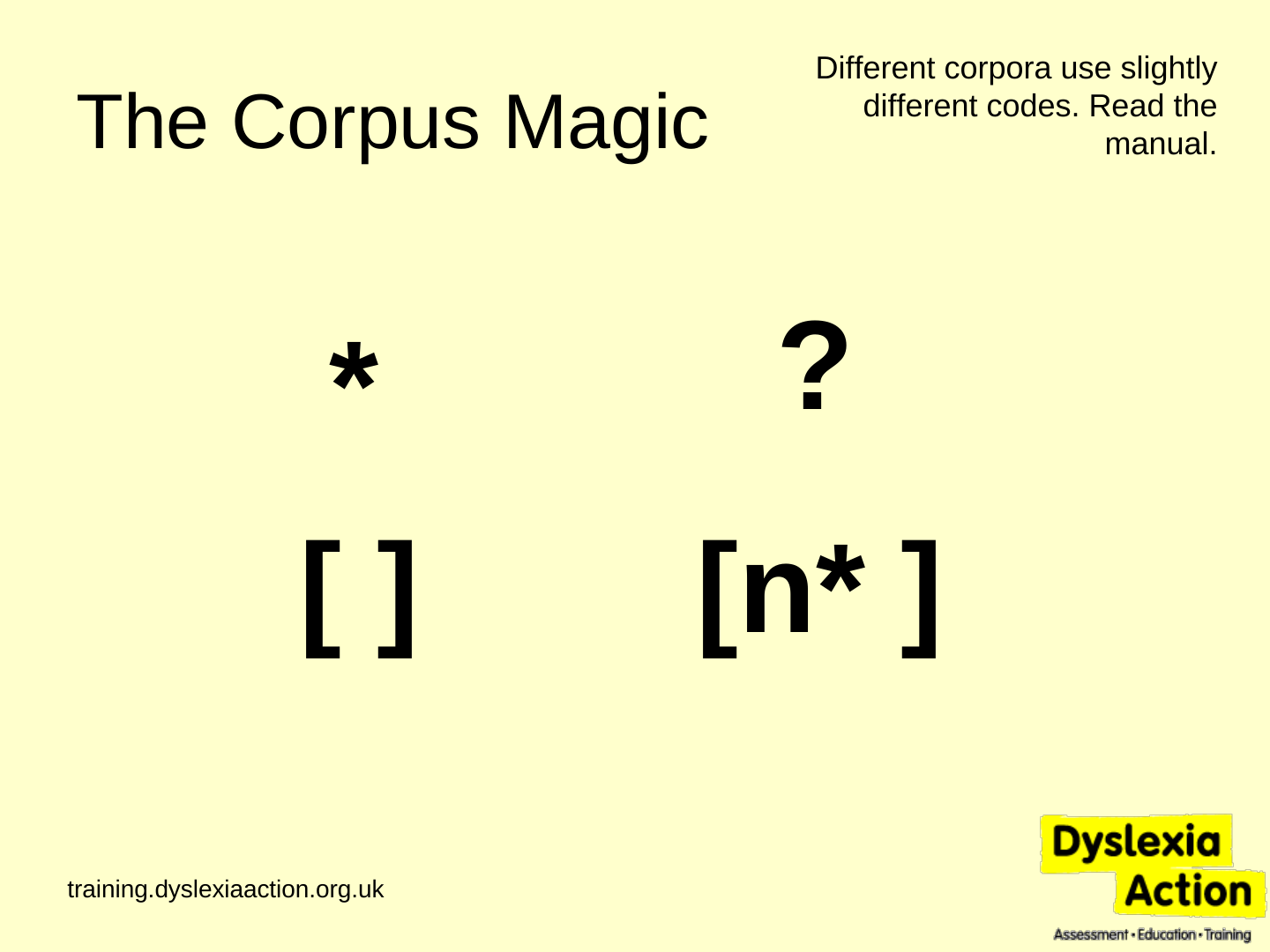
The Corpus Magic

  • *
  • [ ]
  • ?
  • [n* ]

Different corpora use slightly different codes. Read the manual.
Original slide 26 (image)

Slide 27: The Corpus Magic

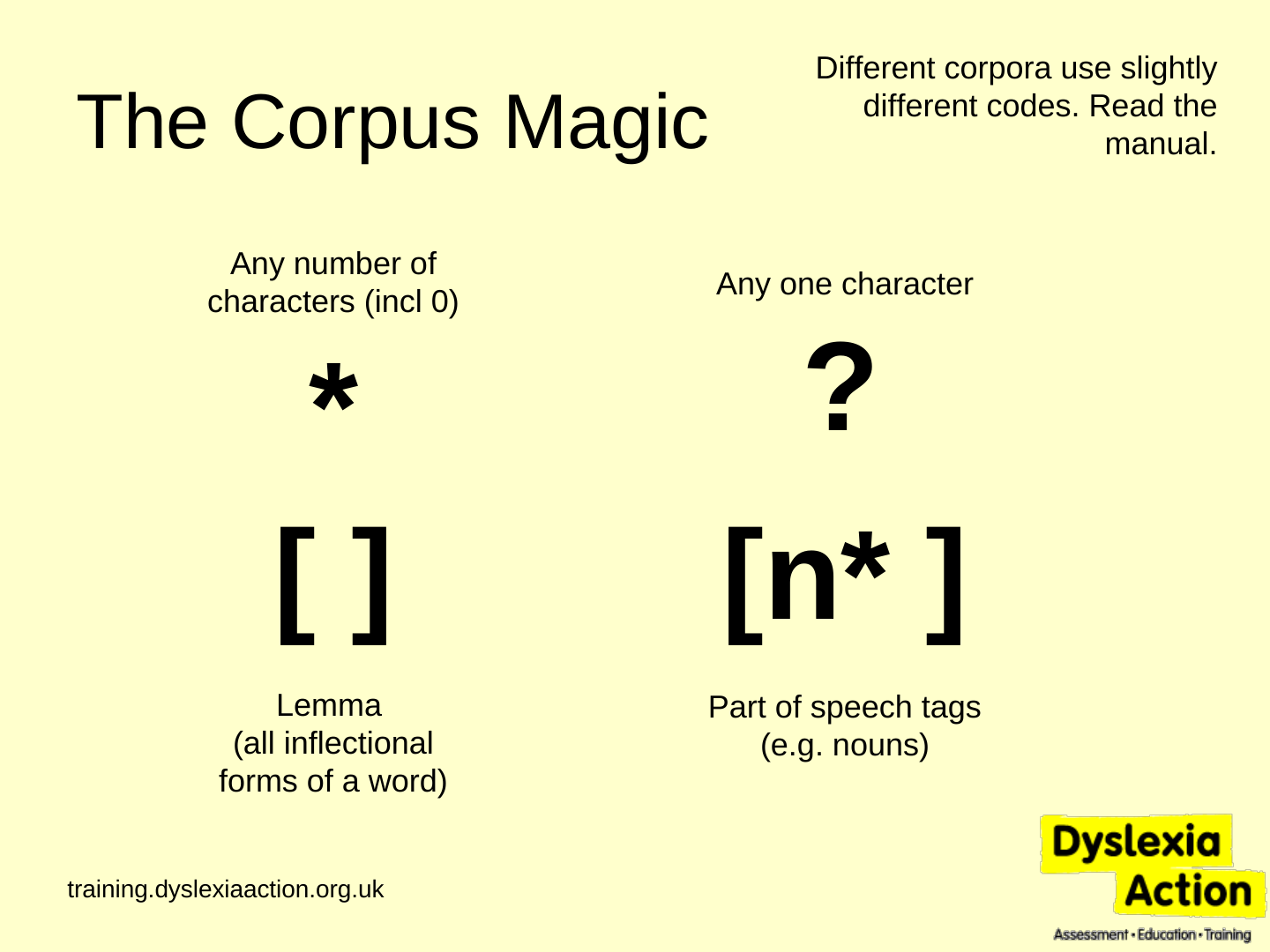
The Corpus Magic

  • * Any number of characters (incl 0)
  • ? Any one character
  • [ ] Lemma (all inflectional forms of a word)
  • [n* ] Part of speech tags (e.g. nouns)

Different corpora use slightly different codes. Read the manual.
Original slide 27 (image)

Slide 28: Slide 28

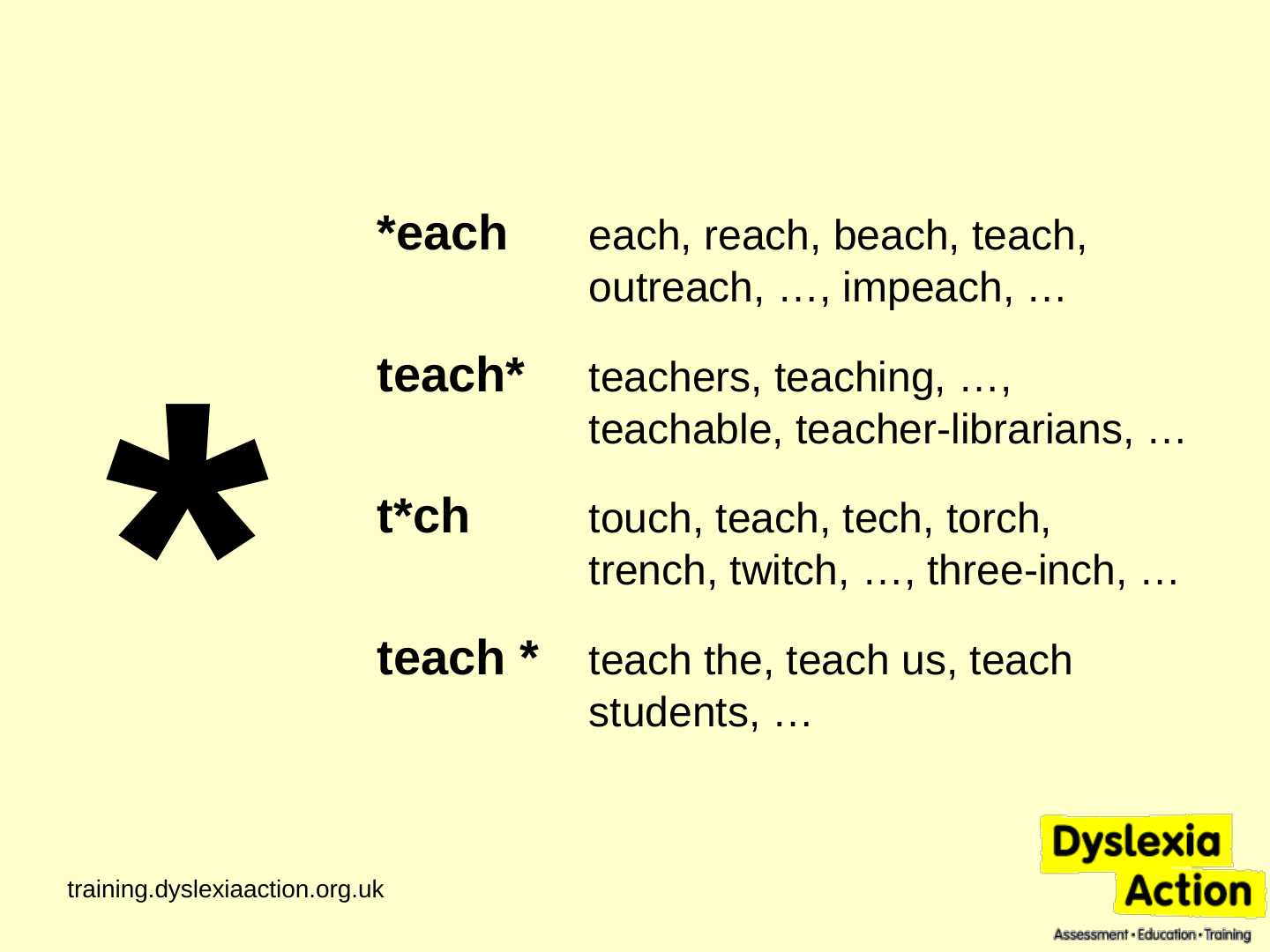
*

*eacheach, reach, beach, teach, outreach, …, impeach, …
teach*teachers, teaching, …, teachable, teacher-librarians, …
t*chtouch, teach, tech, torch, trench, twitch, …, three-inch, …
teach *teach the, teach us, teach students, …

Original slide 28 (image)

Slide 29: Slide 29

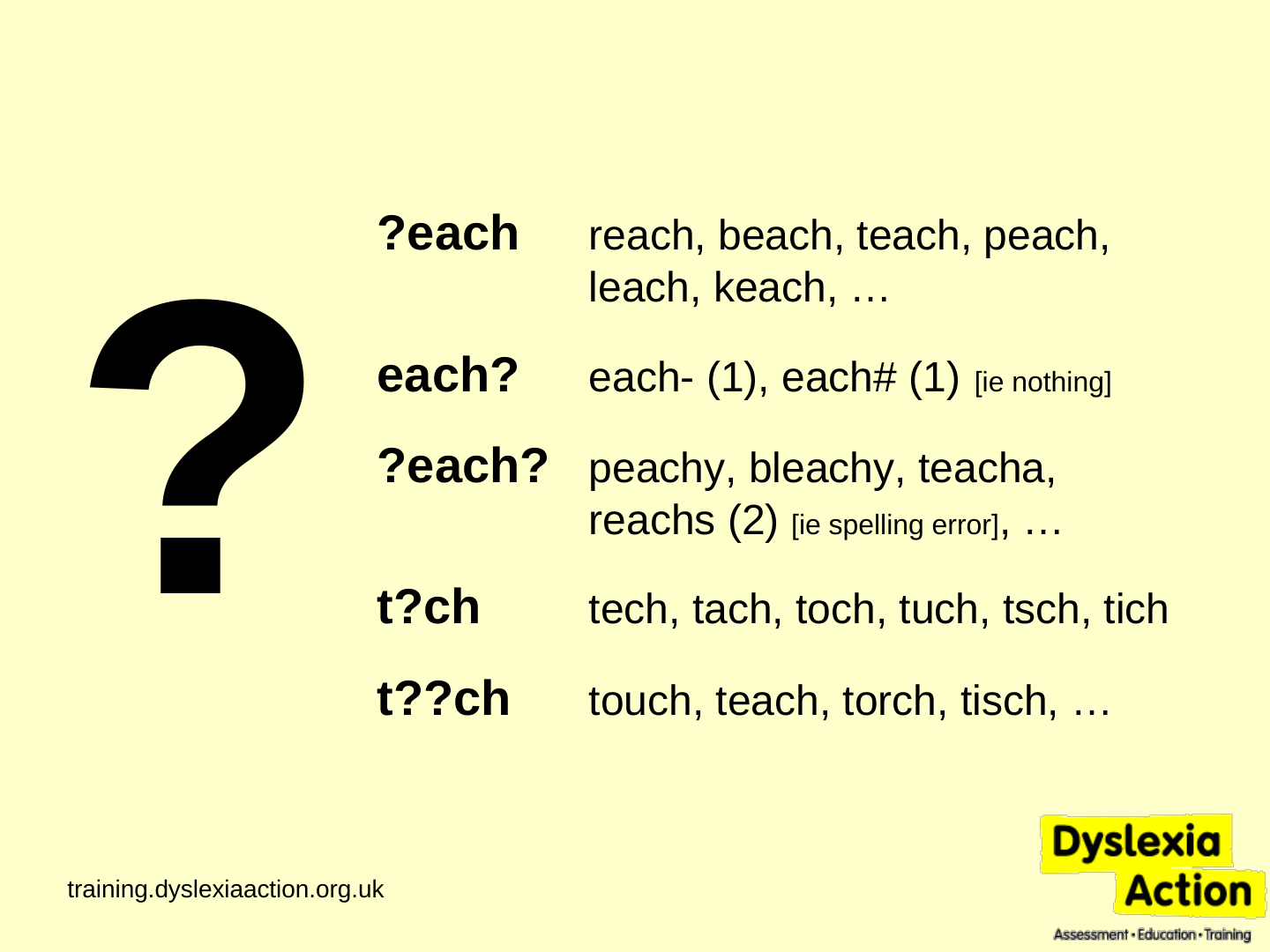
?

?eachreach, beach, teach, peach, leach, keach, …
each?each- (1), each# (1) [ie nothing]
?each?peachy, bleachy, teacha, reachs (2) [ie spelling error], …
t?chtech, tach, toch, tuch, tsch, tich
t??chtouch, teach, torch, tisch, …

Original slide 29 (image)

Slide 30: [Lemma]

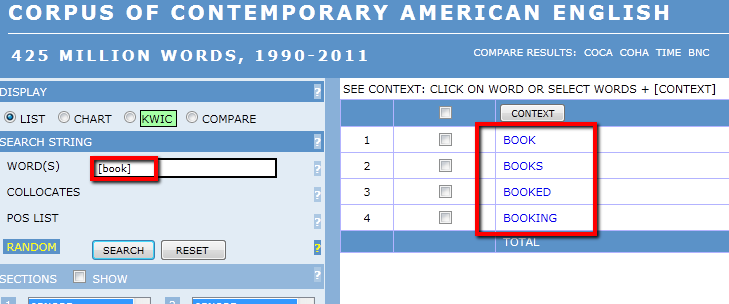
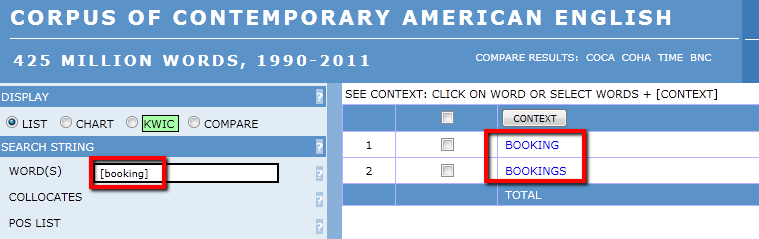
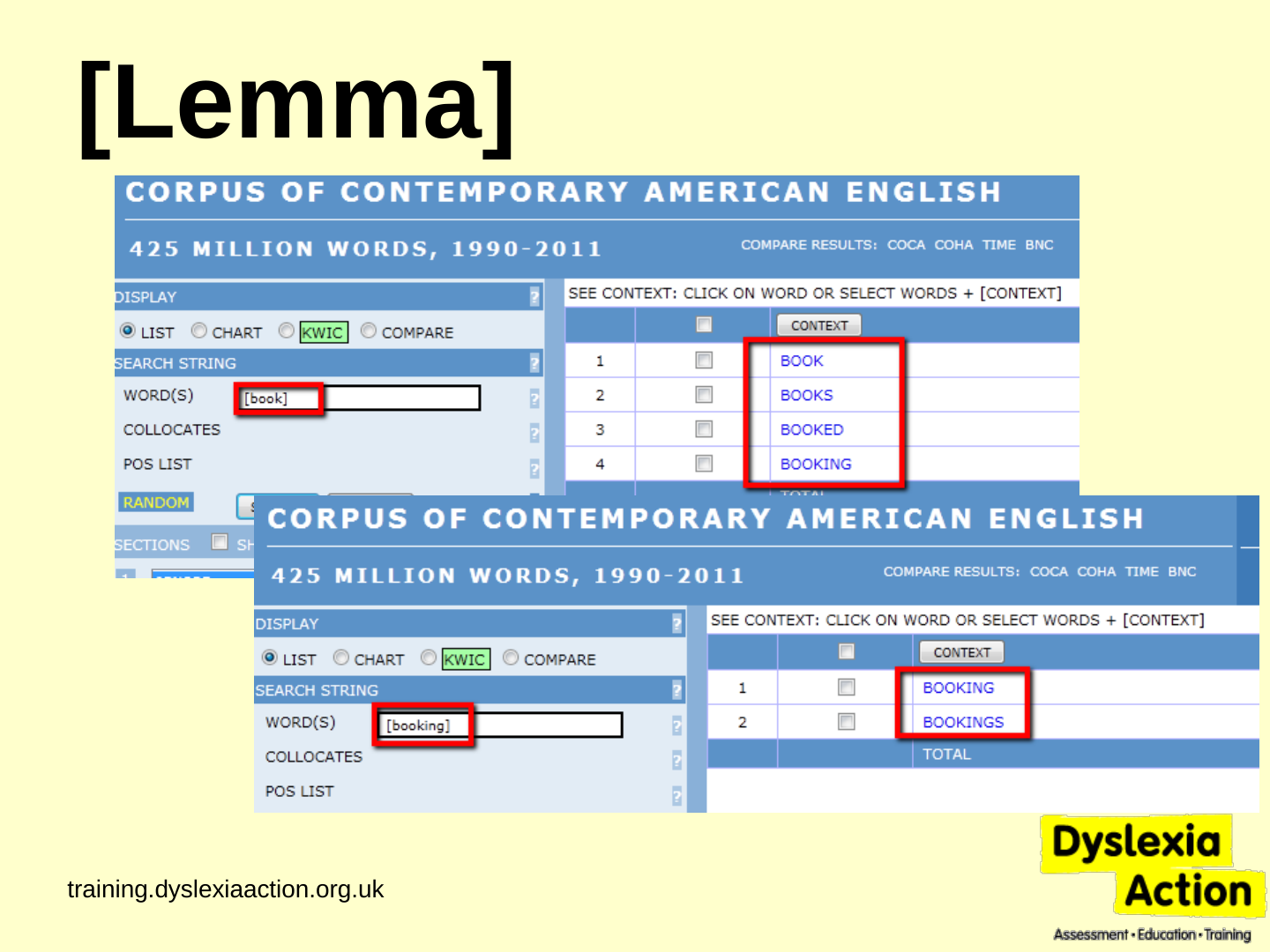
[Lemma]

Screenshot of a COCA search form with the word “book” entered in a red box and the results BOOK, BOOKS, BOOKED and BOOKING outlined in red.

Screenshot of a COCA search form with the word “booking” entered in a red box and the results BOOKING and BOOKINGS outlined in red.

Original slide 30 (image)

Slide 31: Part of speech tags

Part of speech tags

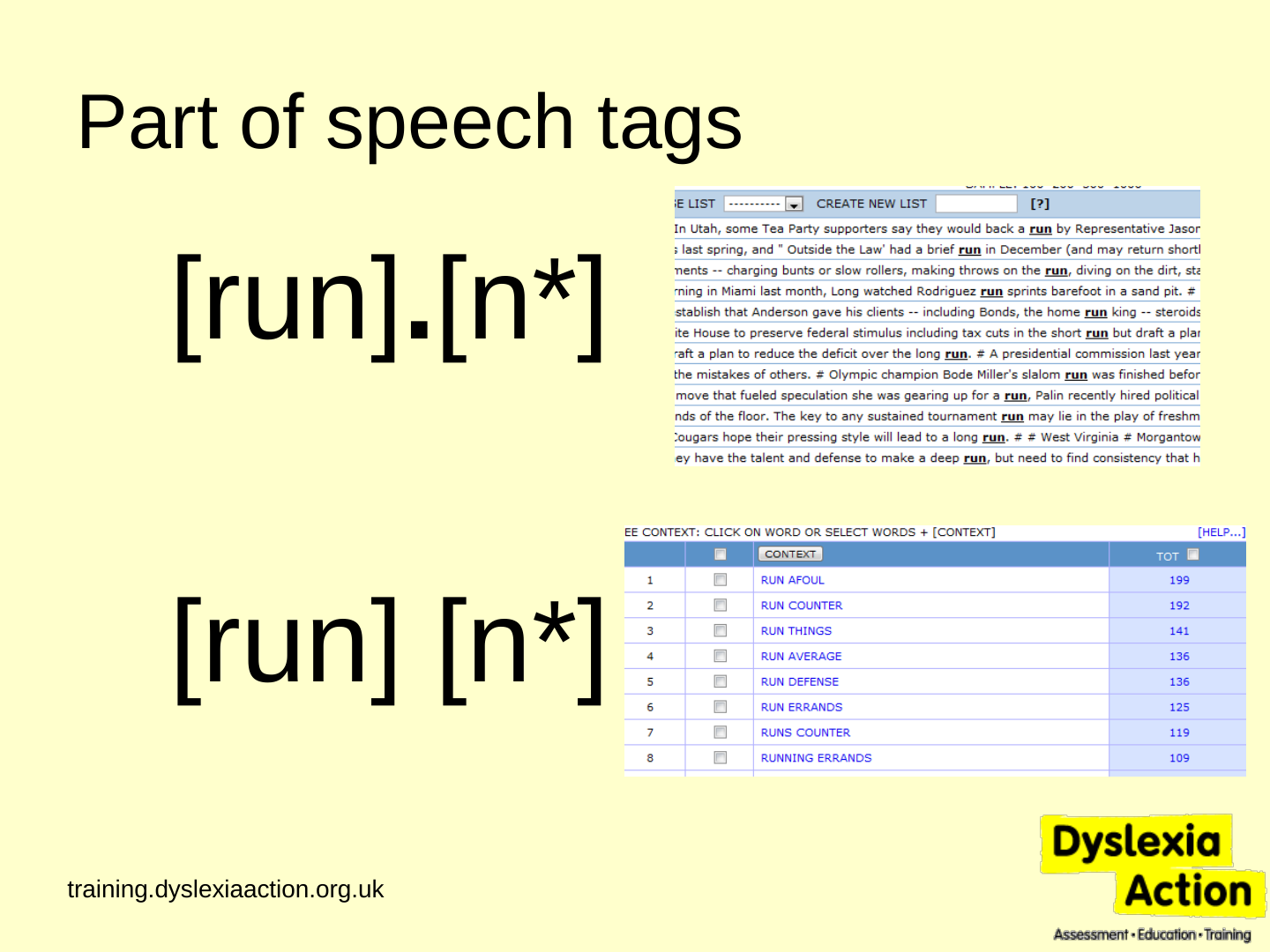
[run].[n*]
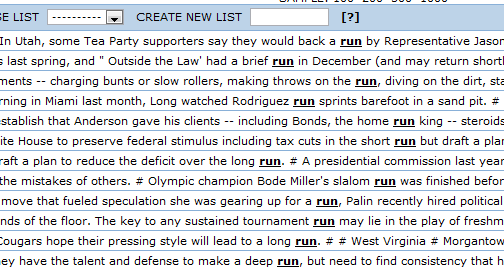
Screenshot of lines of text from COCA in which the word “run” appears as a noun, with some words in bold, for example “a run” and “the run”.

[run] [n*]

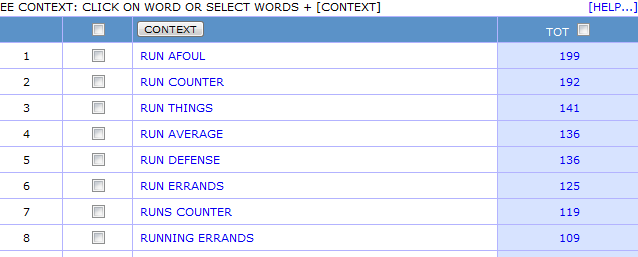
Screenshot of a COCA list of words that follow “run”: RUN AFOUL 199, RUN COUNTER 192, RUN THINGS 141, RUN AVERAGE 136, RUN DEFENSE 136, RUN ERRANDS 125, RUNS COUNTER 119, RUNNING ERRANDS 109.

Original slide 31 (image)

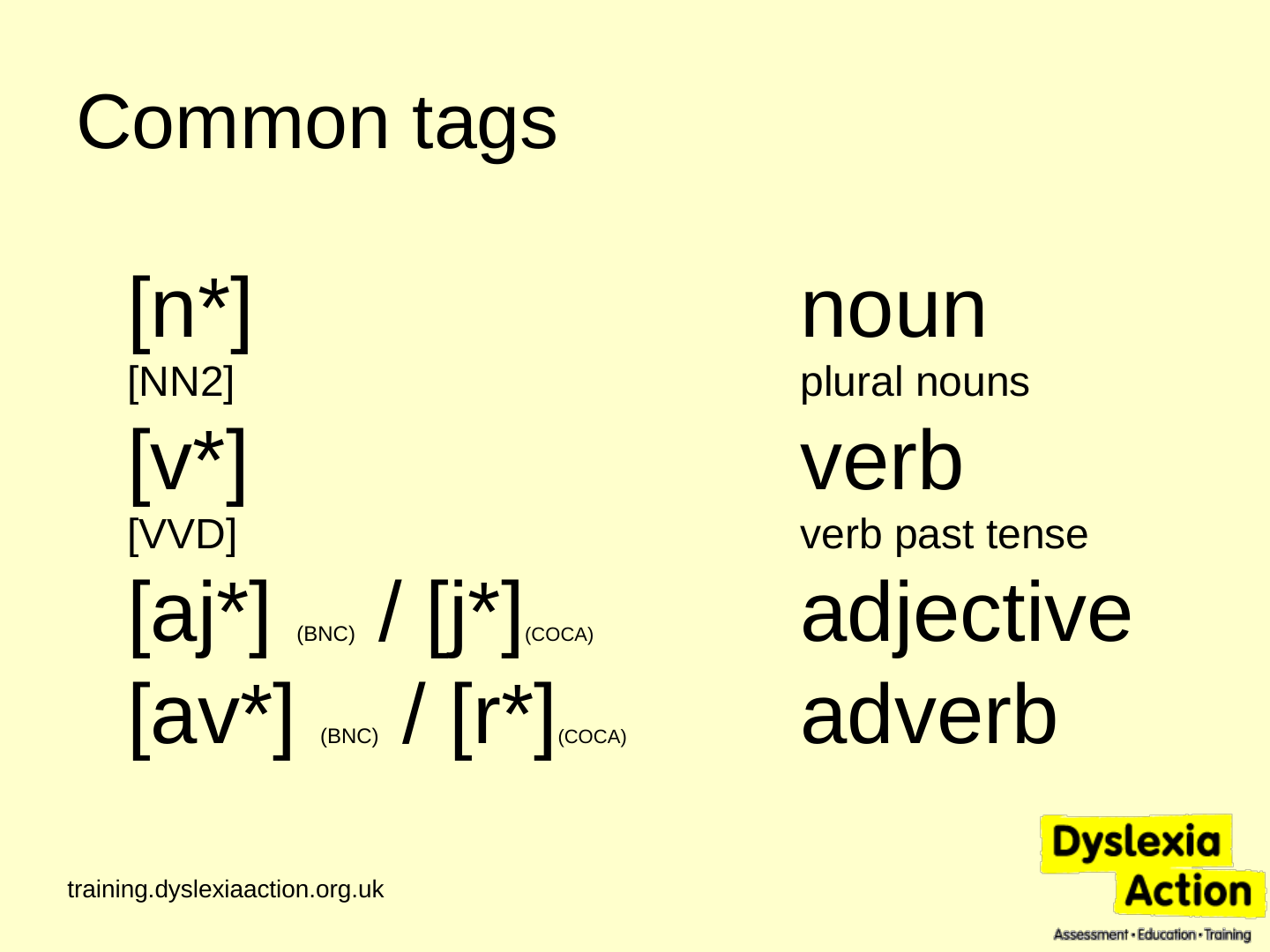
Slide 32: Common tags

Common tags

[n*]                         noun
[NN2]                        plural nouns
[v*]                         verb
[VVD]                        verb past tense
[aj*] (BNC) / [j*] (COCA)    adjective
[av*] (BNC) / [r*] (COCA)    adverb
Original slide 32 (image)

Slide 33: Help

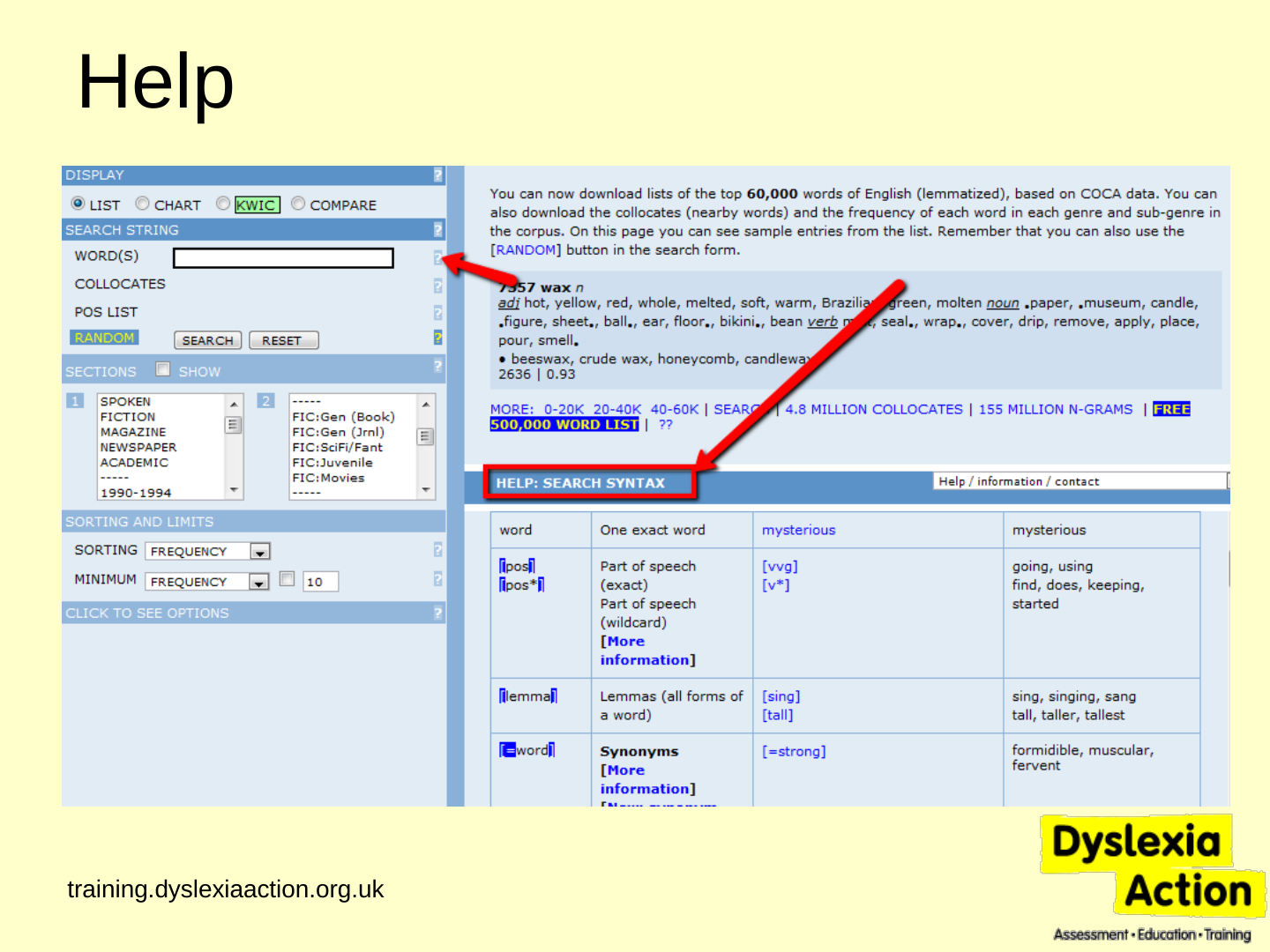
Help

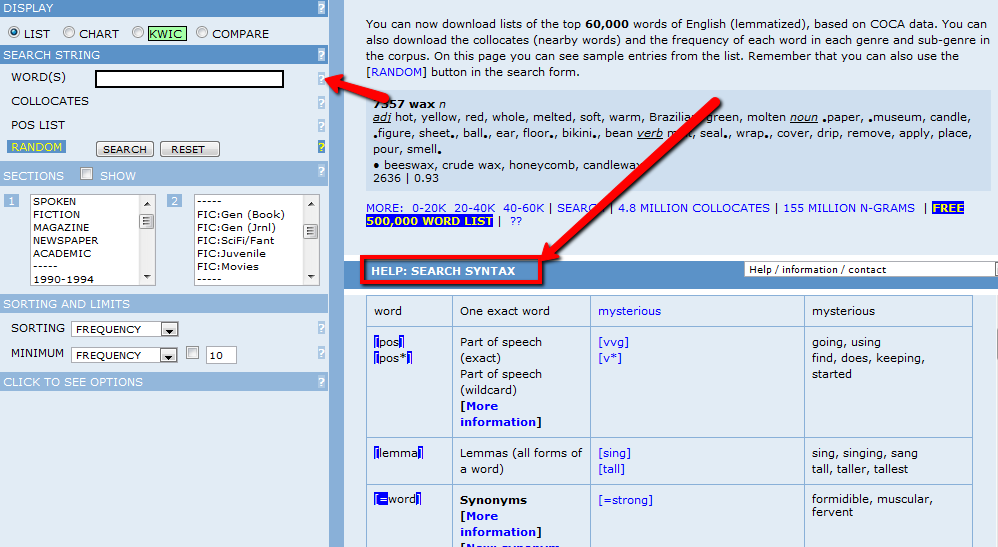
Screenshot of the COCA search form with a red arrow from the help icon beside the search box to a panel headed “Help: Search syntax”, which has a table of codes for a part of speech, a lemma and synonyms with examples.

Original slide 33 (image)

Slide 34: Slide 34

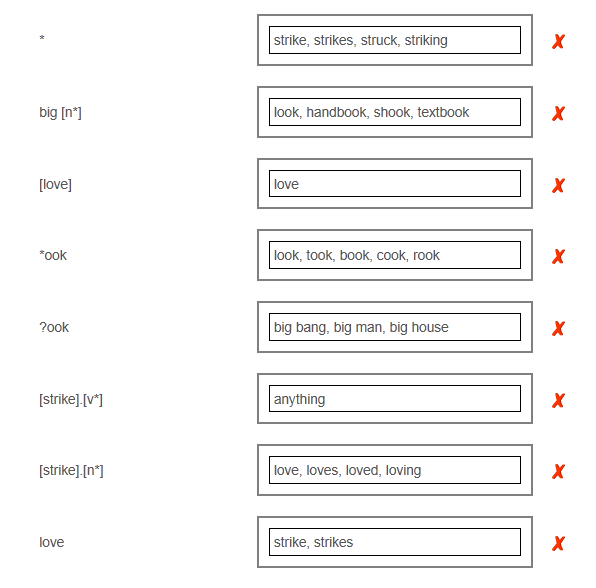
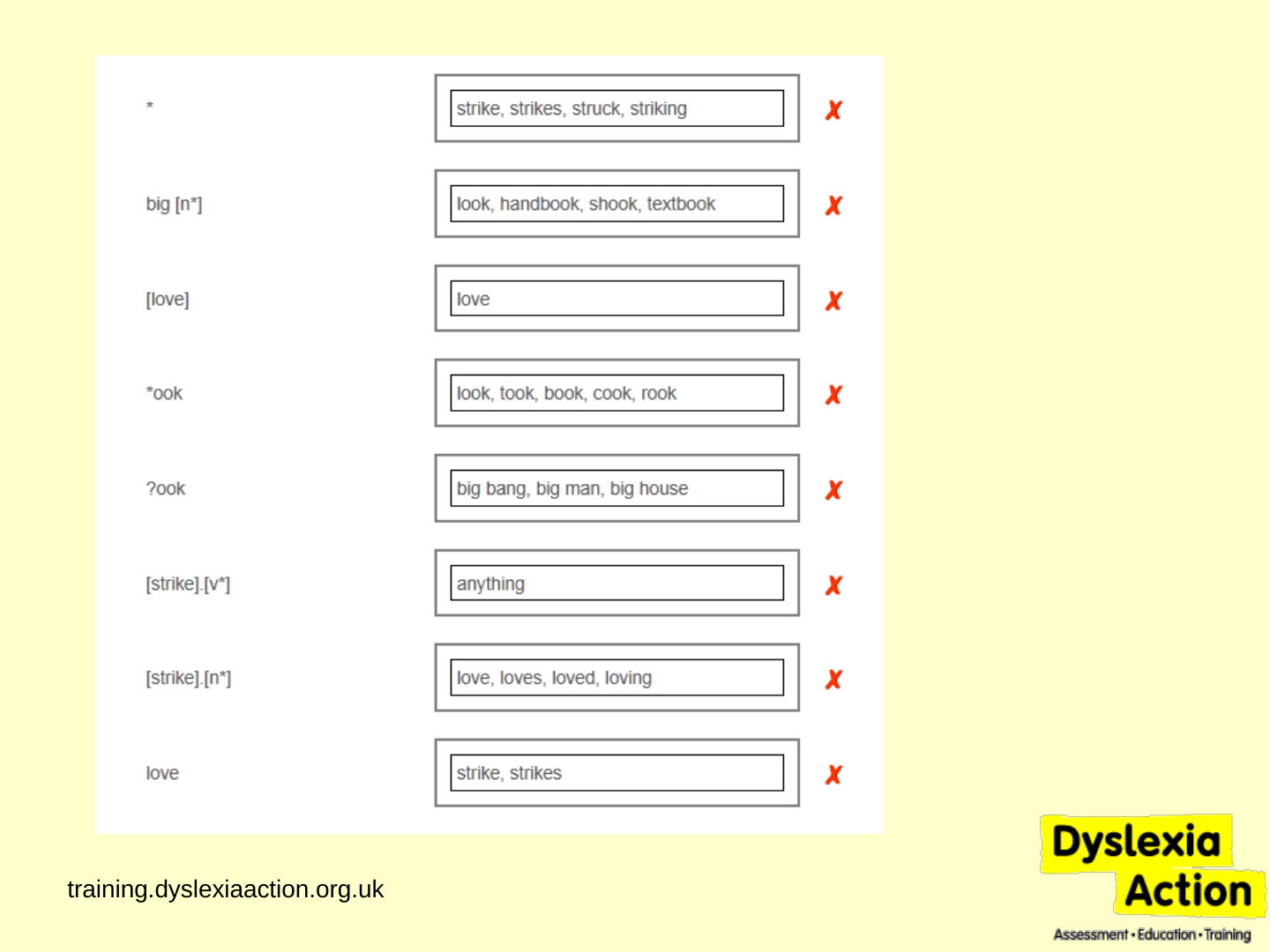
Screenshot of a quiz of seven search strings, each with an answer box and a red cross. The strings and their (wrong) answers are: * – strike, strikes, struck, striking; big n star in brackets – look, handbook, shook, textbook; love in brackets – love; *ook – look, took, book, cook, rook; ?ook – big bang, big man, big house; strike in brackets, dot, v star in brackets – anything; strike in brackets, dot, n star in brackets – love, loves, loved, loving; love – strike, strikes.

Original slide 34 (image)

Slide 35: Slide 35

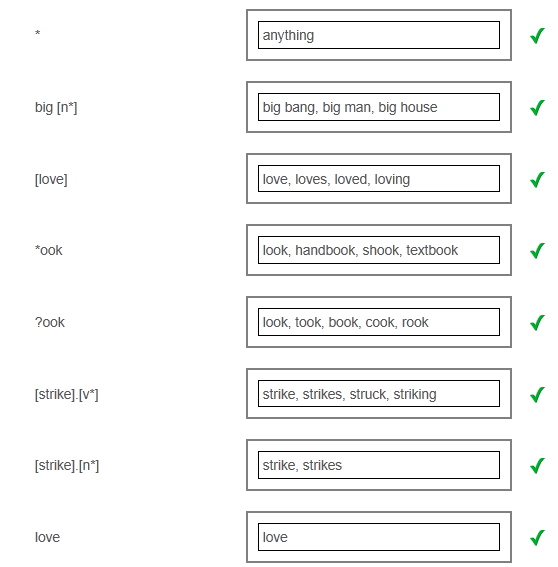
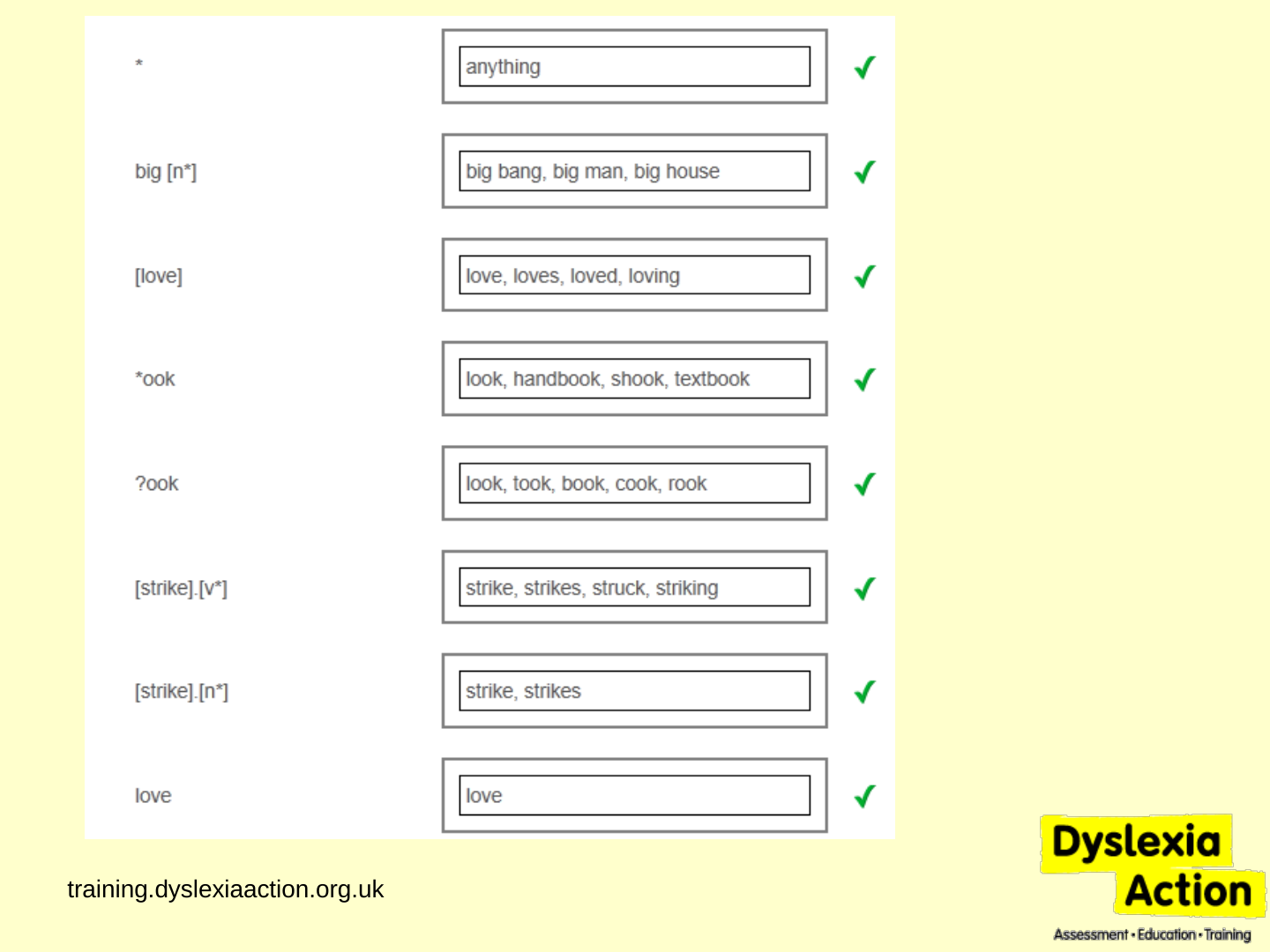
The same quiz with the answers matched correctly and a green tick against each: * – anything; big n star in brackets – big bang, big man, big house; love in brackets – love, loves, loved, loving; *ook – look, handbook, shook, textbook; ?ook – look, took, book, cook, rook; strike in brackets, dot, v star in brackets – strike, strikes, struck, striking; strike in brackets, dot, n star in brackets – strike, strikes; love – love.

Original slide 35 (image)

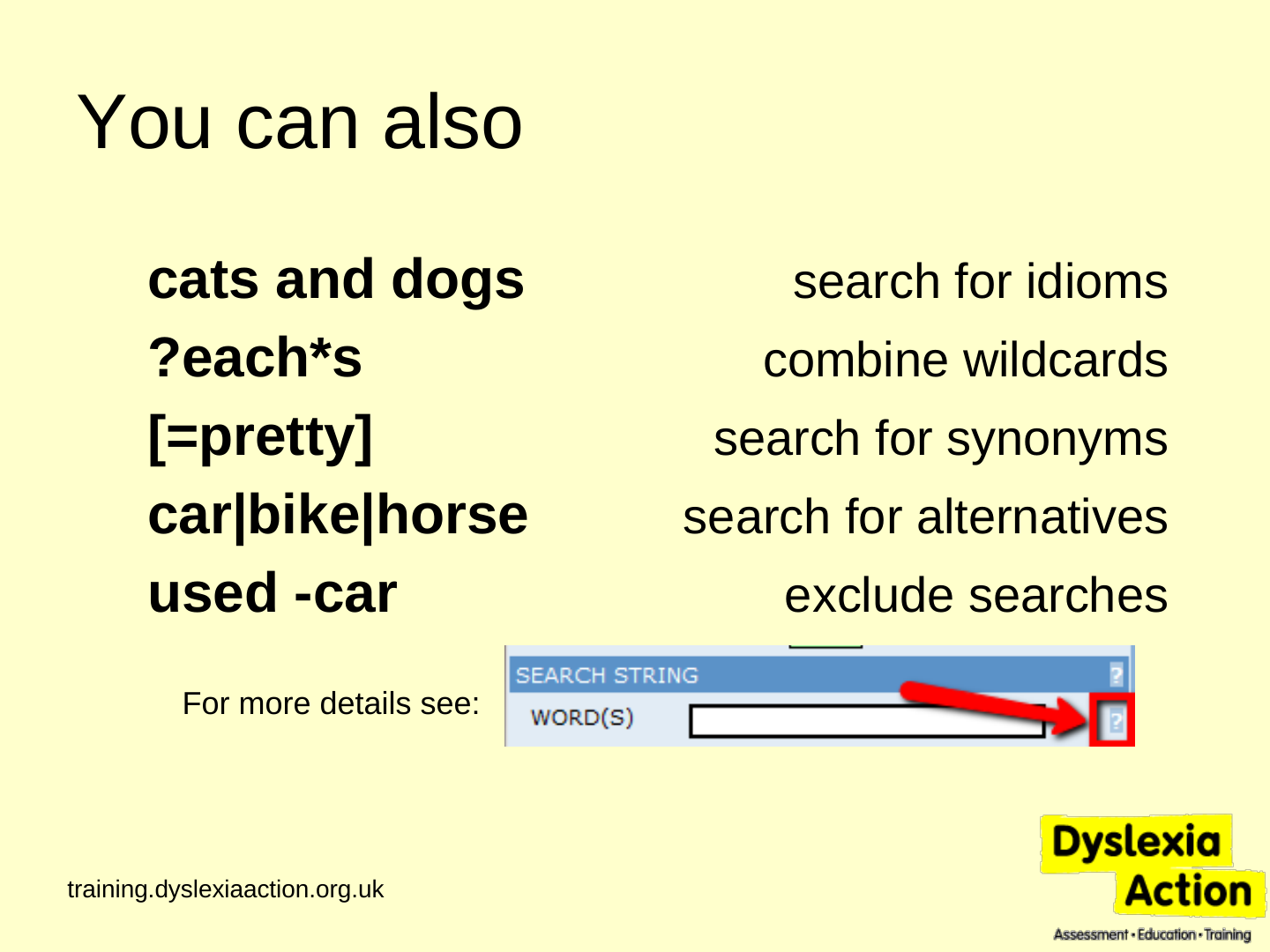
Slide 36: You can also

You can also

cats and dogs     search for idioms
?each*s           combine wildcards
[=pretty]         search for synonyms
car|bike|horse    search for alternatives
used -car         exclude searches

For more details see:

Screenshot of the “Search string” heading of the COCA form with the word box and a red arrow pointing to the small help icon at its right.

Original slide 36 (image)

Slide 37: Concordance + KWIC

Concordance + KWIC

*ies.[N*]
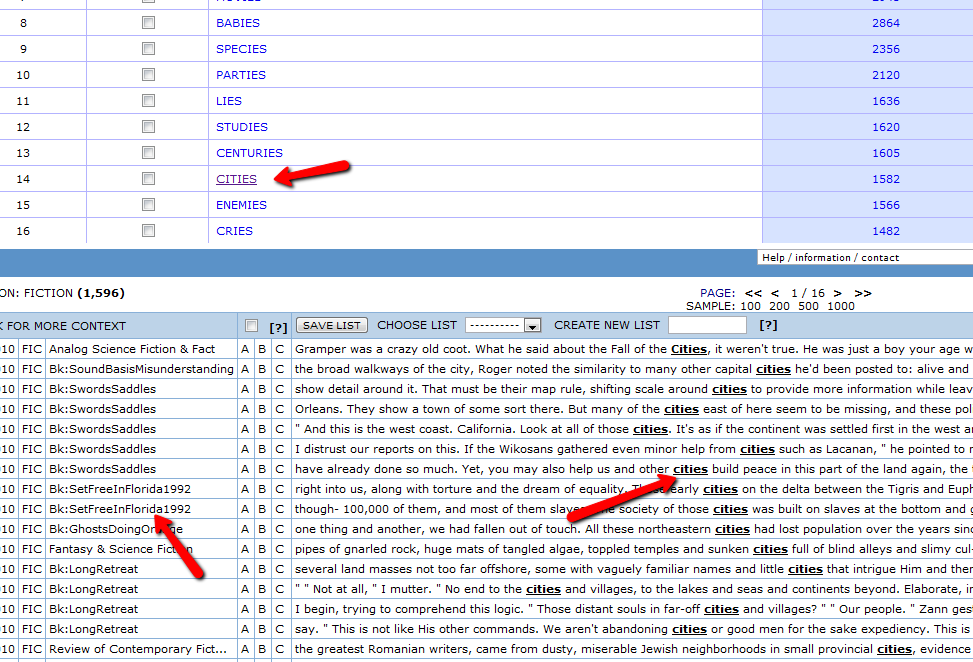
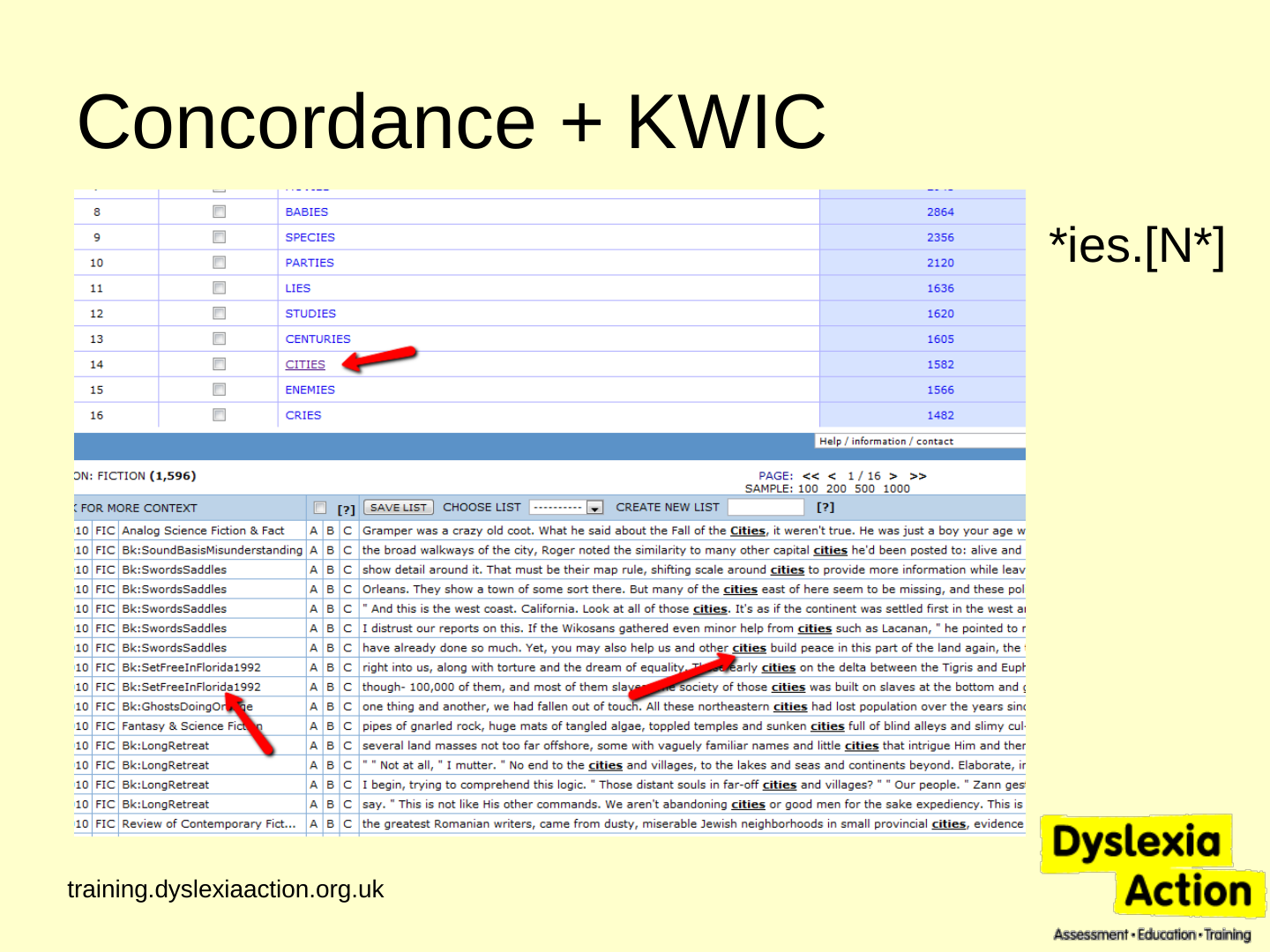
Screenshot of a COCA list of words ending in -ies, with a red arrow at CITIES (1582), and below it a keyword-in-context display of fiction lines containing “cities”, with two more red arrows.

Original slide 37 (image)

Slide 38: KWIC – Key-Word In Context

KWIC – Key-Word In Context

*ies.[N*]
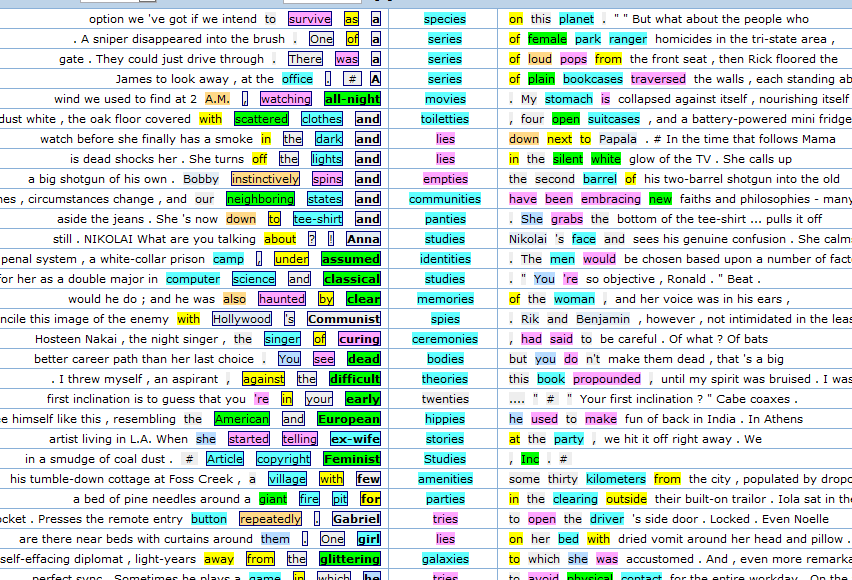
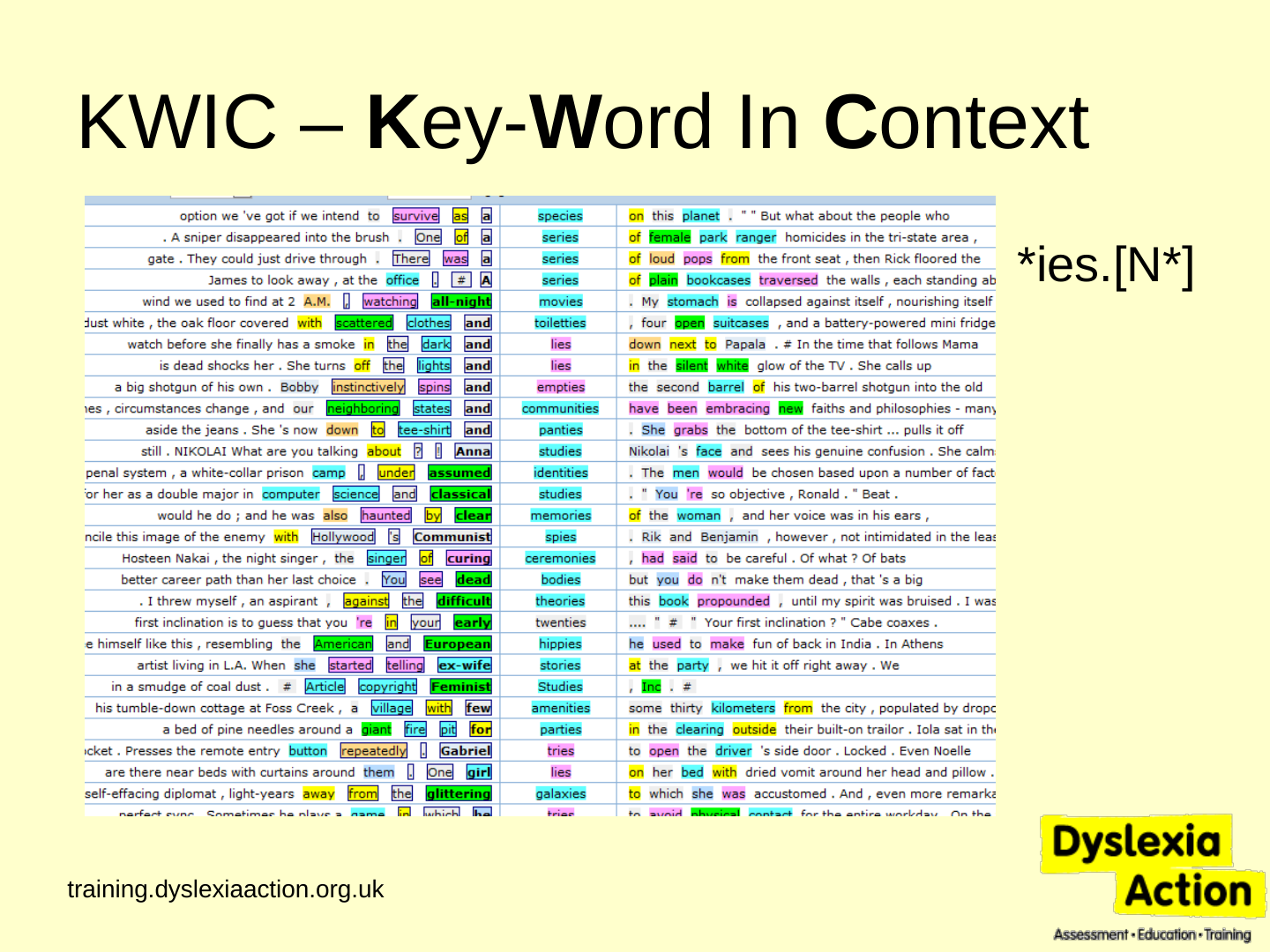
Screenshot of a colour-coded keyword-in-context display: lines of text with the words around each hit highlighted in green, blue, yellow and pink, such as “species”, “series”, “movies” and “identities”.

Original slide 38 (image)

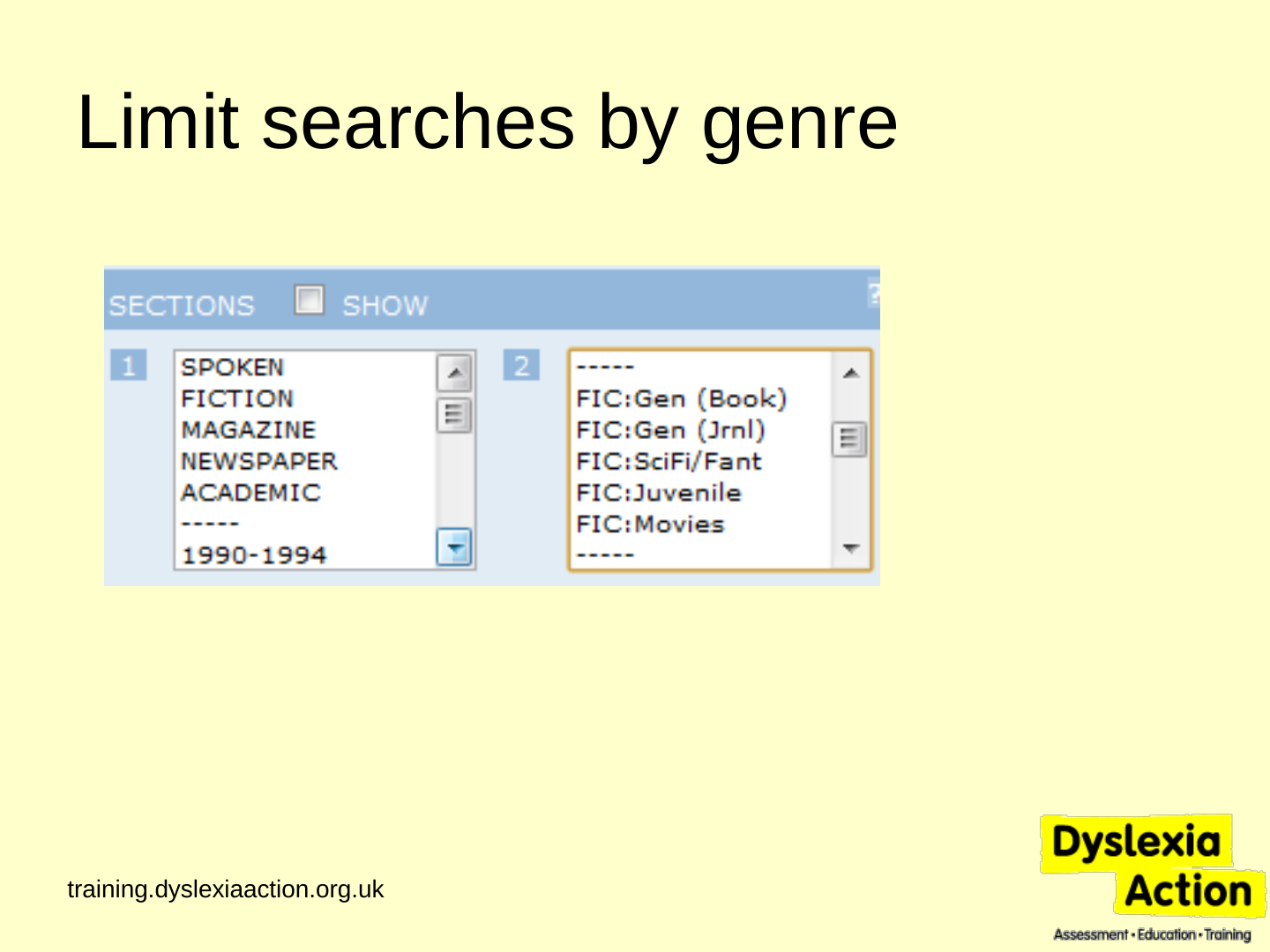
Slide 39: Limit searches by genre

Limit searches by genre
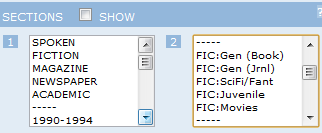
Screenshot of the sections menu of the COCA form: a left list of SPOKEN, FICTION, MAGAZINE, NEWSPAPER and ACADEMIC with the period 1990–1994, and a right list of the fiction sub-genres FIC:Gen (Book), FIC:Gen (Jrnl), FIC:SciFi/Fant, FIC:Juvenile and FIC:Movies.

Original slide 39 (image)

Slide 40: Other questions corpus can answer

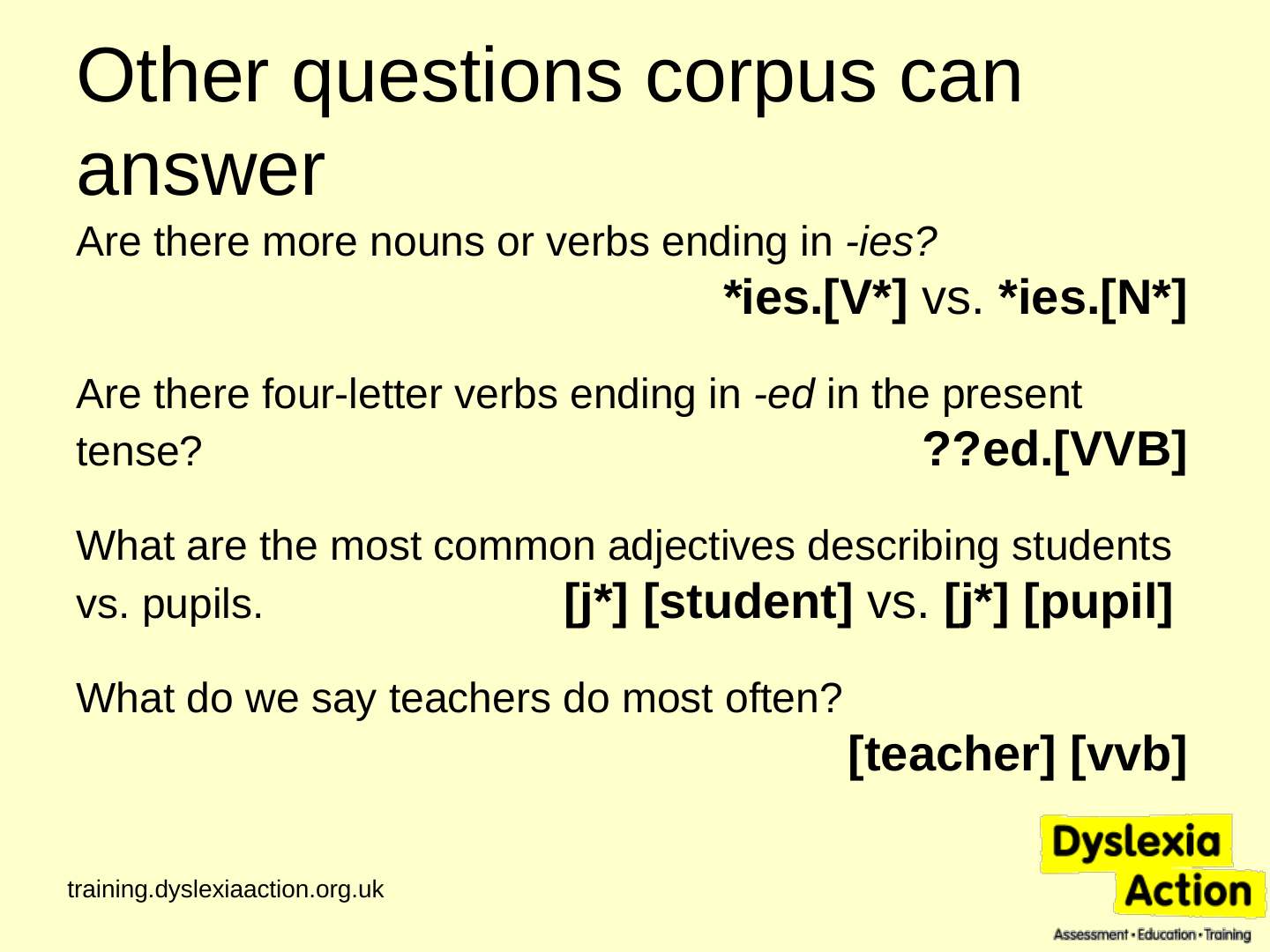
Other questions corpus can answer

Are there more nouns or verbs ending in -ies?

*ies.[V*]  vs.  *ies.[N*]

Are there four-letter verbs ending in -ed in the present tense?

??ed.[VVB]

What are the most common adjectives describing students vs. pupils.

[j*] [student]  vs.  [j*] [pupil]

What do we say teachers do most often?

[teacher] [vvb]
Original slide 40 (image)

Slide 41: Corpus, rules, and regularity

Corpus, rules, and regularity

pre*
*ed
*ies.[V*]

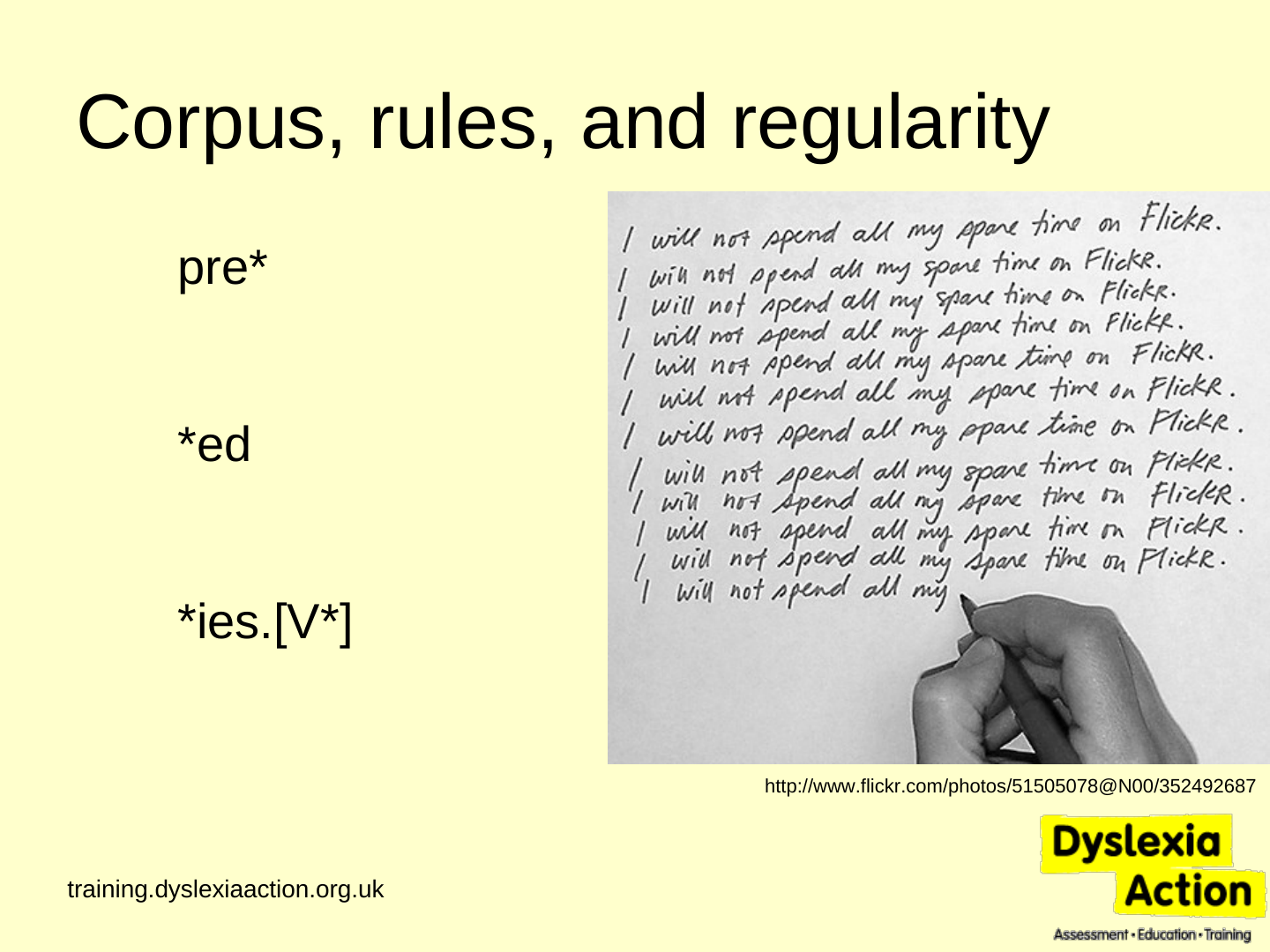
Photograph of a page of handwriting in a notebook, with the sentence “I will not spend all my spare time on Flickr.” written over and over down the page and a hand holding a pen at the bottom.

http://www.flickr.com/photos/51505078@N00/352492687

Original slide 41 (image)

Slide 42: Collocations: Limits on variability

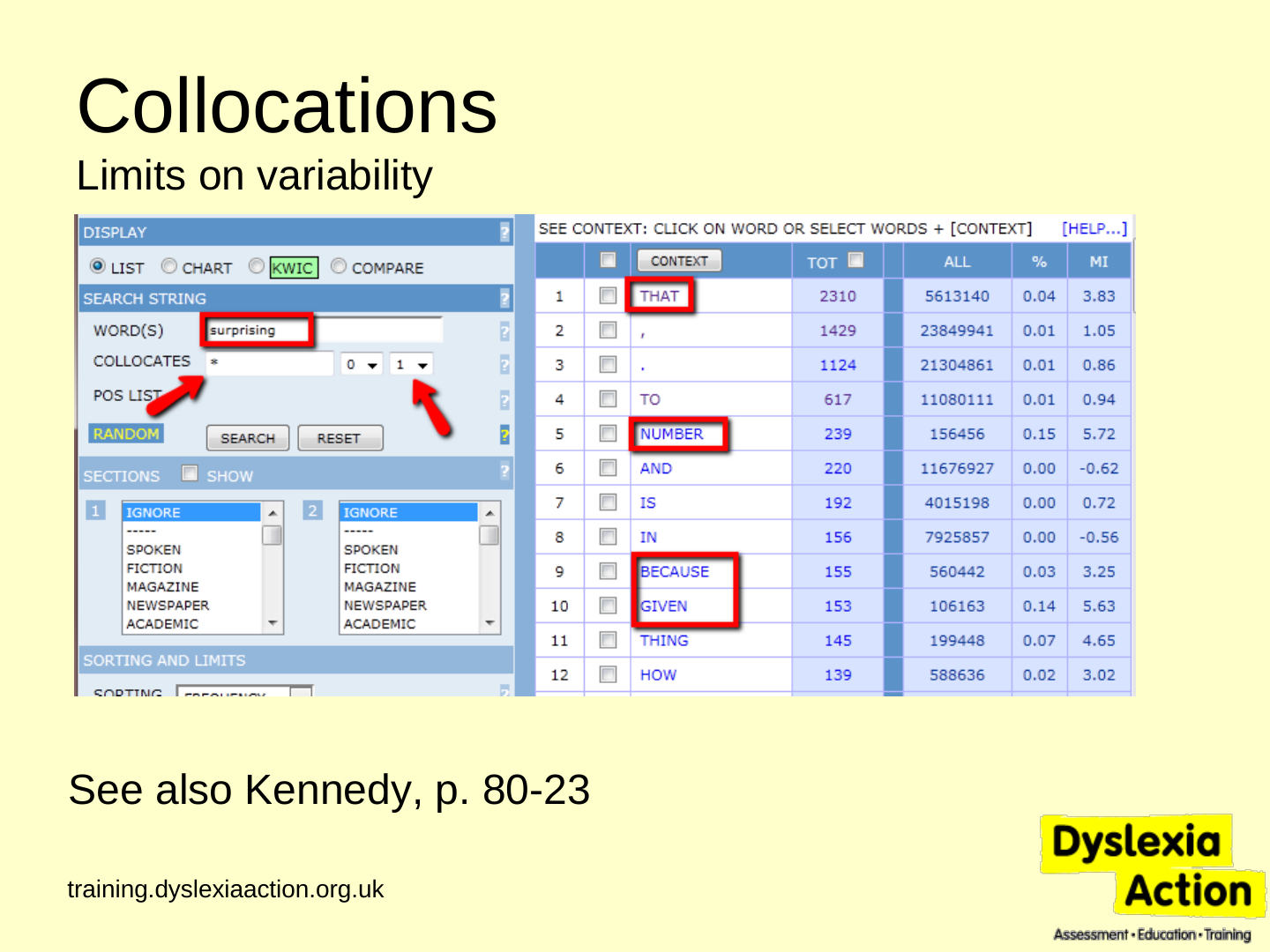
Collocations: Limits on variability
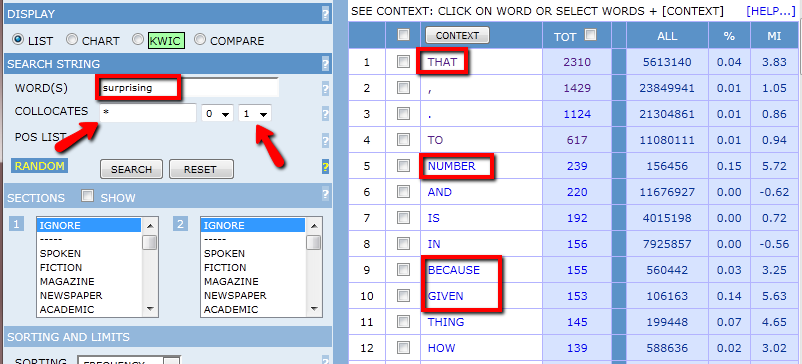
Screenshot of the COCA form with “surprising” in the word box and a list of words found next to it: THAT 2310, NUMBER 239, BECAUSE 155 and GIVEN 153 are outlined in red, among others such as TO, AND, IS and IN.

See also Kennedy, p. 80-23

Original slide 42 (image)

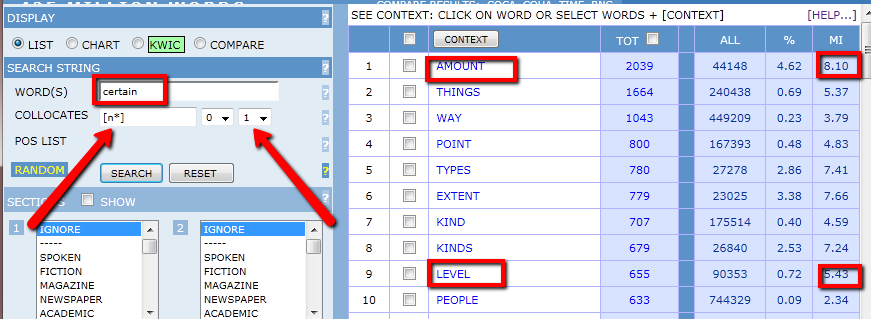
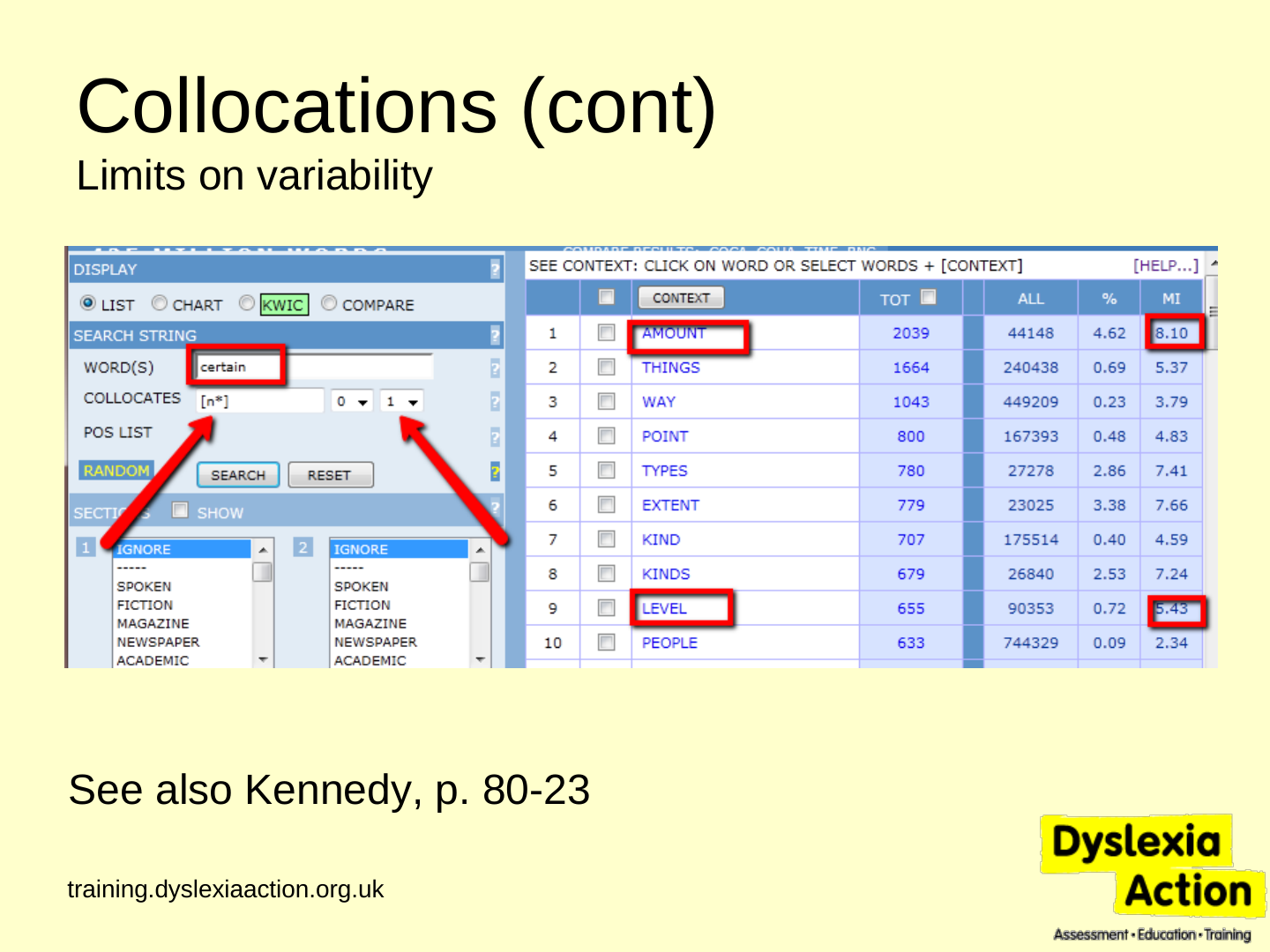
Slide 43: Collocations (cont): Limits on variability

Collocations (cont): Limits on variability

See also Kennedy, p. 80-23
Screenshot of the COCA form with “certain” in the word box and the noun collocates AMOUNT 2039, THINGS 1664, WAY 1043, POINT 800, TYPES 780, EXTENT 779, KIND 707, KINDS 679, LEVEL 655 and PEOPLE 633; AMOUNT and LEVEL, and their mutual-information scores 8.10 and 5.43, are outlined in red.

Original slide 43 (image)

Slide 44: Collocations (cont)

Collocations (cont)

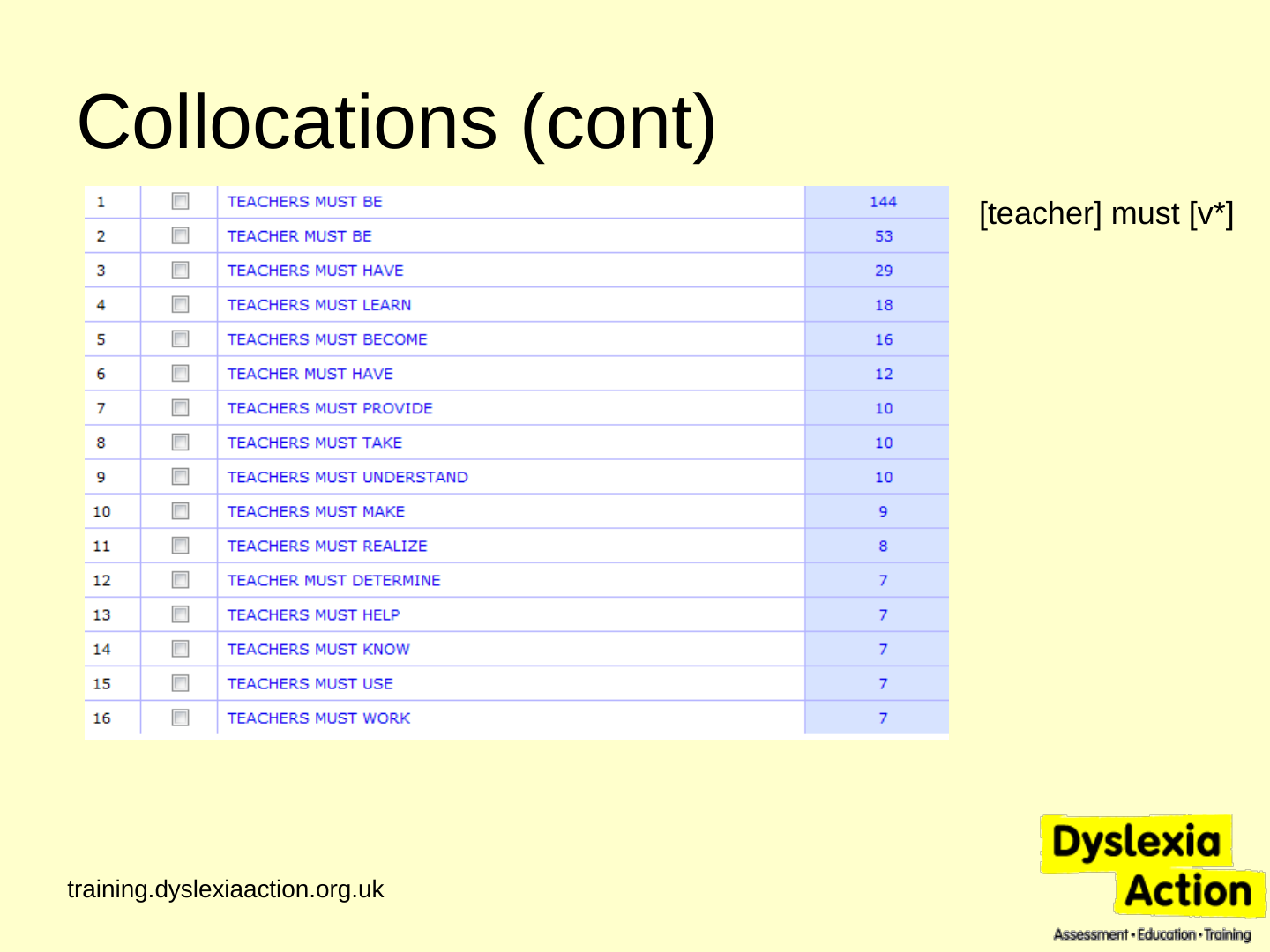
[teacher] must [v*]
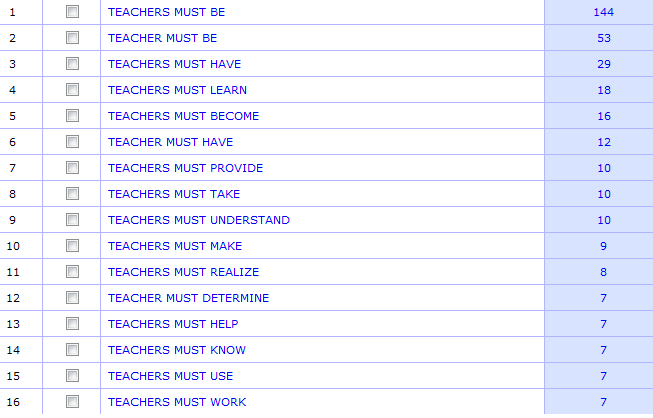
Screenshot of a COCA list of phrases with their counts for the query above, transcribed in the list below the image.

  • TEACHERS MUST BE 144
  • TEACHER MUST BE 53
  • TEACHERS MUST HAVE 29
  • TEACHERS MUST LEARN 18
  • TEACHERS MUST BECOME 16
  • TEACHER MUST HAVE 12
  • TEACHERS MUST PROVIDE 10
  • TEACHERS MUST TAKE 10
  • TEACHERS MUST UNDERSTAND 10
  • TEACHERS MUST MAKE 9
  • TEACHERS MUST REALIZE 8
  • TEACHER MUST DETERMINE 7
  • TEACHERS MUST HELP 7
  • TEACHERS MUST KNOW 7
  • TEACHERS MUST USE 7
  • TEACHERS MUST WORK 7

Original slide 44 (image)

Slide 45: Idioms and set phrases

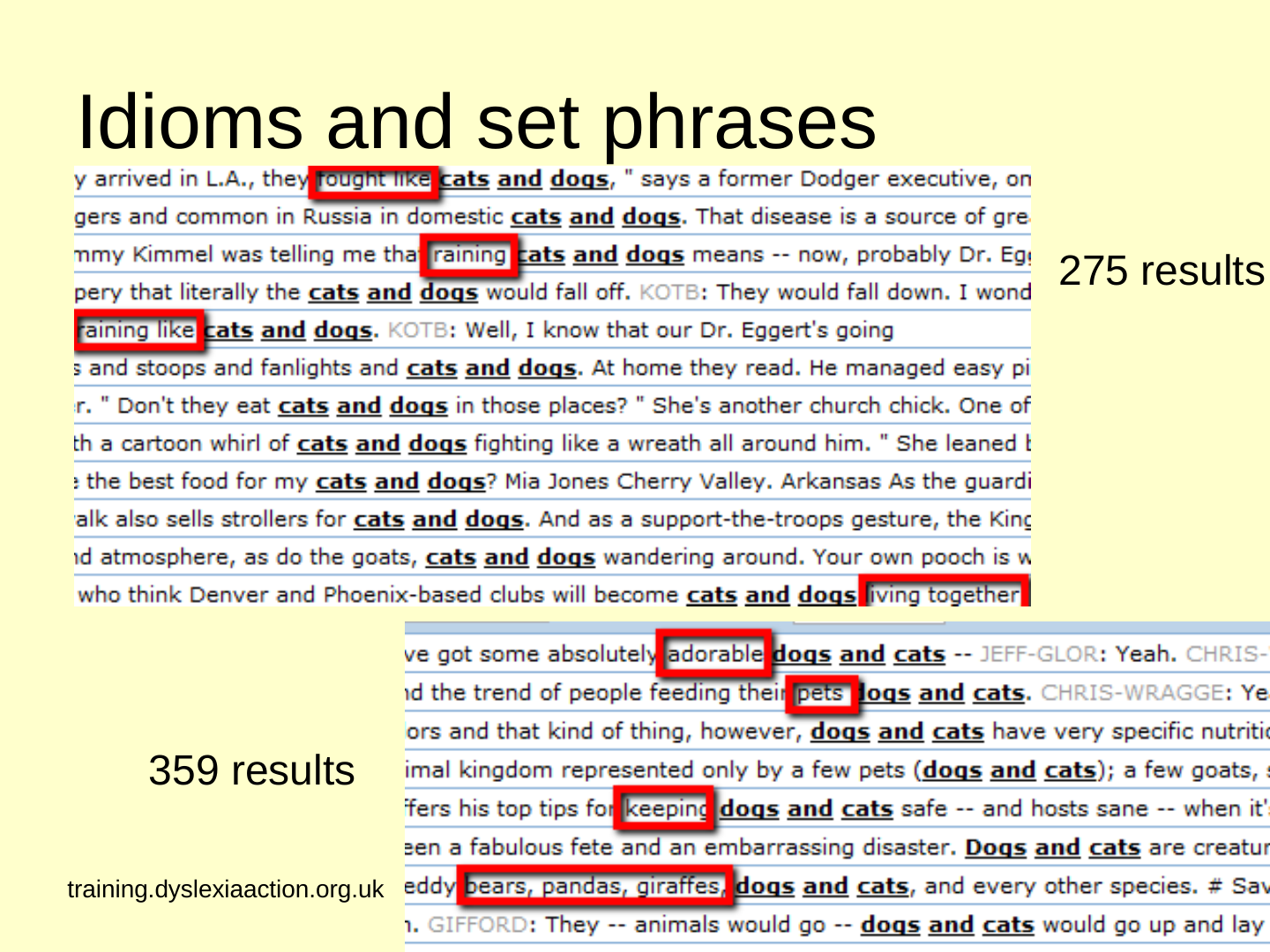
Idioms and set phrases
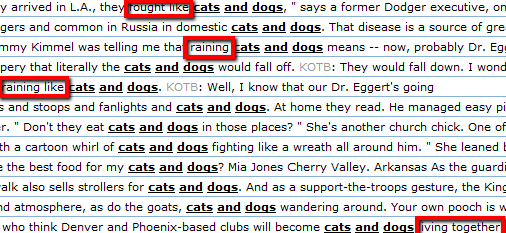
Screenshot of concordance lines for “cats and dogs”, with the words before it outlined in red, for example “fought like”, “raining” and “living together”.

275 results

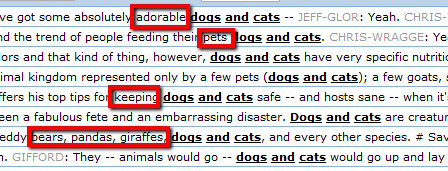
Screenshot of concordance lines for “dogs and cats”, with the words before it outlined in red, for example “adorable”, “pets”, “keeping” and “bears, pandas, giraffes”.

359 results

Original slide 45 (image)

Slide 46: Google as a Corpus

Google as a Corpus

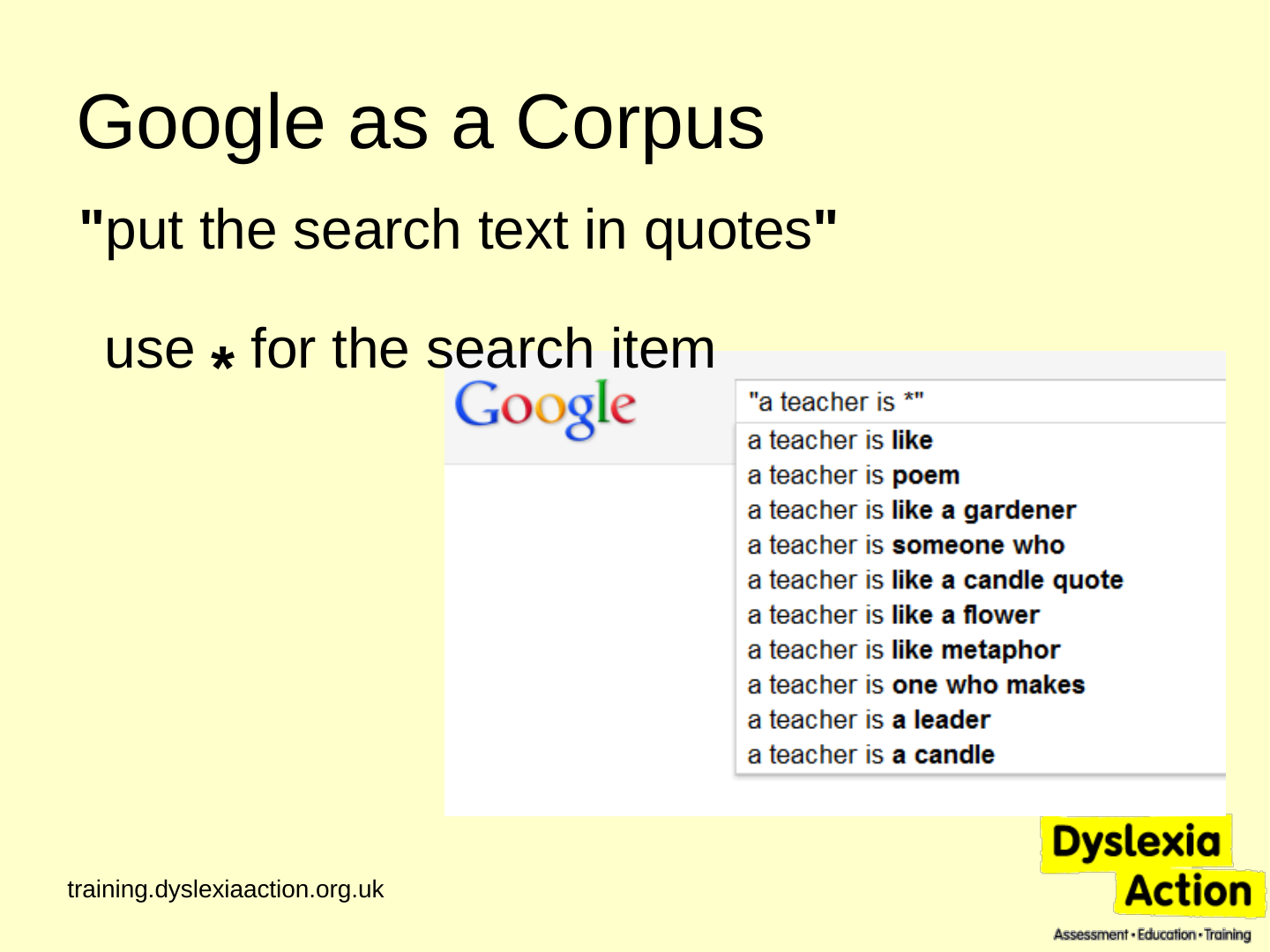
"put the search text in quotes"

use * for the search item
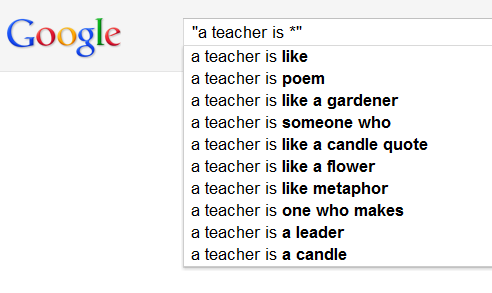
Screenshot of Google’s suggestions for the search “a teacher is *”: a teacher is like, a teacher is poem, a teacher is like a gardener, a teacher is someone who, a teacher is like a candle quote, a teacher is like a flower, a teacher is like metaphor, a teacher is one who makes, a teacher is a leader, a teacher is a candle.

Original slide 46 (image)

Slide 47: Slide 47

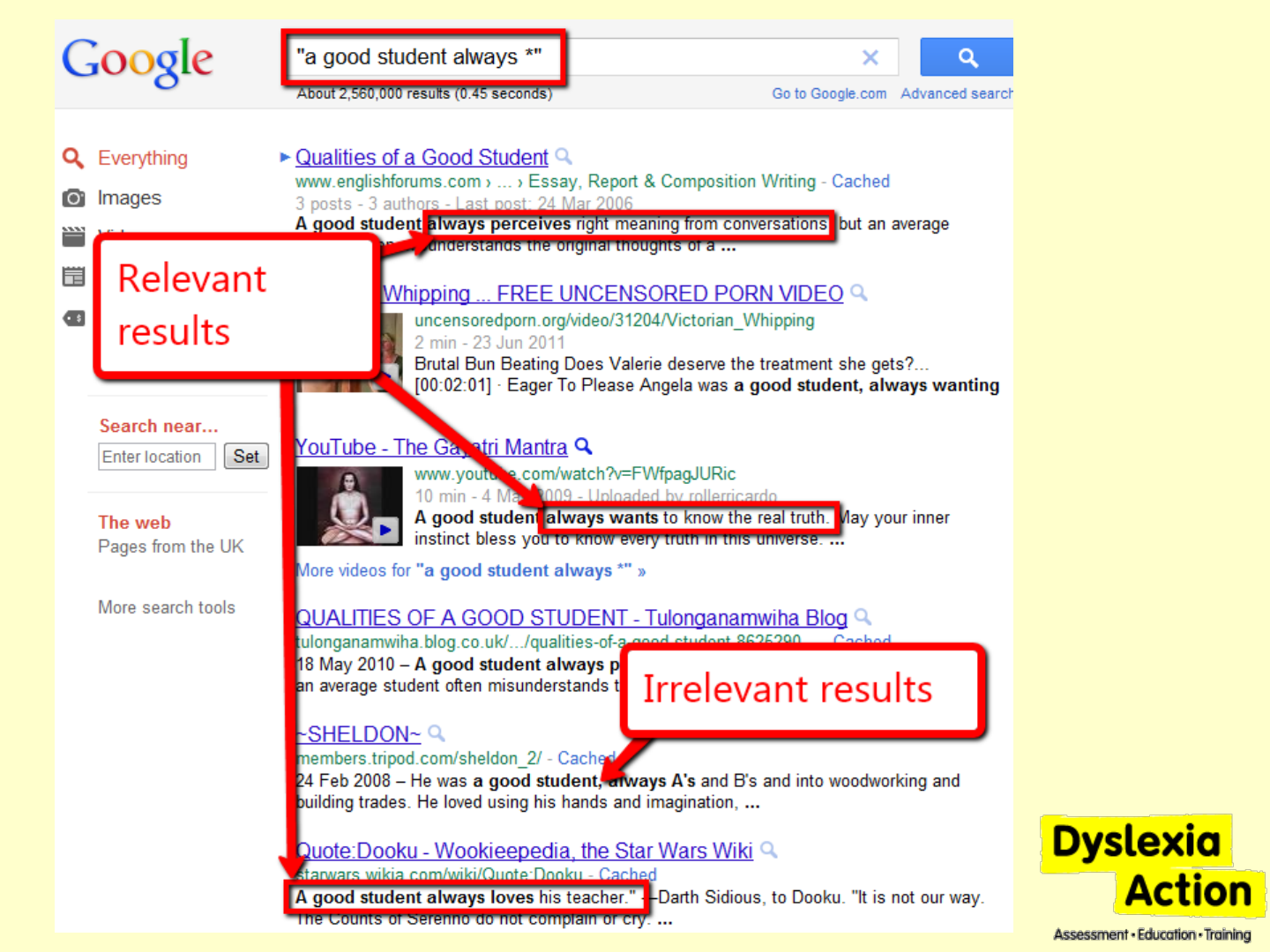
Google: "a good student always *" — about 2,560,000 results (0.45 seconds)
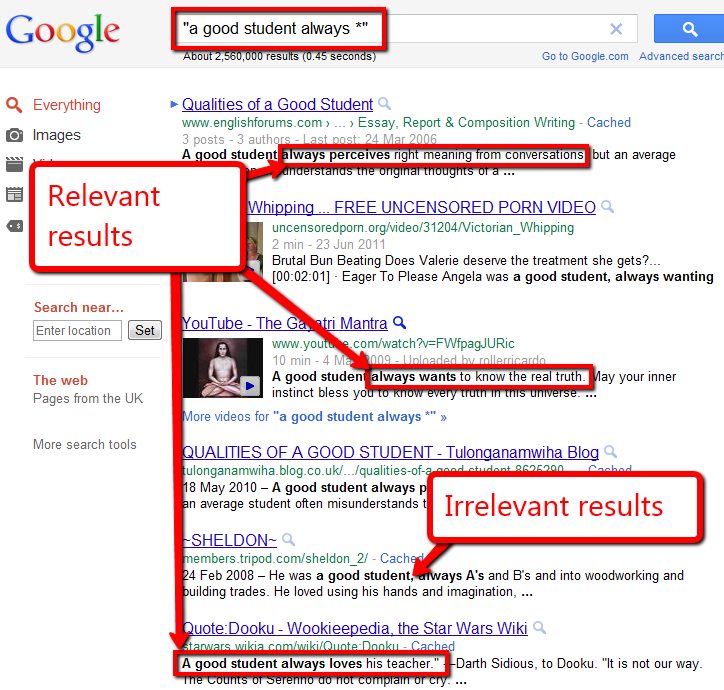
Screenshot of Google results for the search above. A red label “Relevant results” has red arrows to three phrases outlined in red, and a second red label “Irrelevant results” has an arrow to one result; all four are transcribed in the lists below the image. A result for an adult video, between the first and the YouTube result, and a blog result “QUALITIES OF A GOOD STUDENT” (tulonganamwiha.blog.co.uk) carry no arrow or outline. The Google controls around the results are not transcribed.

Relevant results (red label, with a red arrow to each outlined phrase):

  • “always perceives right meaning from conversations” — first result, “Qualities of a Good Student”, englishforums.com; snippet “A good student always perceives right meaning from conversations but an average …”
  • “always wants to know the real truth.” — a YouTube result for a Gayatri Mantra video; snippet “A good student always wants to know the real truth. May your inner instinct bless you to know every truth in this universe. …”
  • “A good student always loves his teacher.” — at the foot, result “Quote:Dooku - Wookieepedia, the Star Wars Wiki”, continuing “—Darth Sidious, to Dooku. “It is not our way.”

Irrelevant results (red label, with a red arrow to the result):

  • “~SHELDON~” (members.tripod.com/sheldon_2/, 24 Feb 2008); snippet “He was a good student, always A’s and B’s and into woodworking and building trades. He loved using his hands and imagination …”
Original slide 47 (image)

Slide 48: Google as a Corpus: Pros & Cons

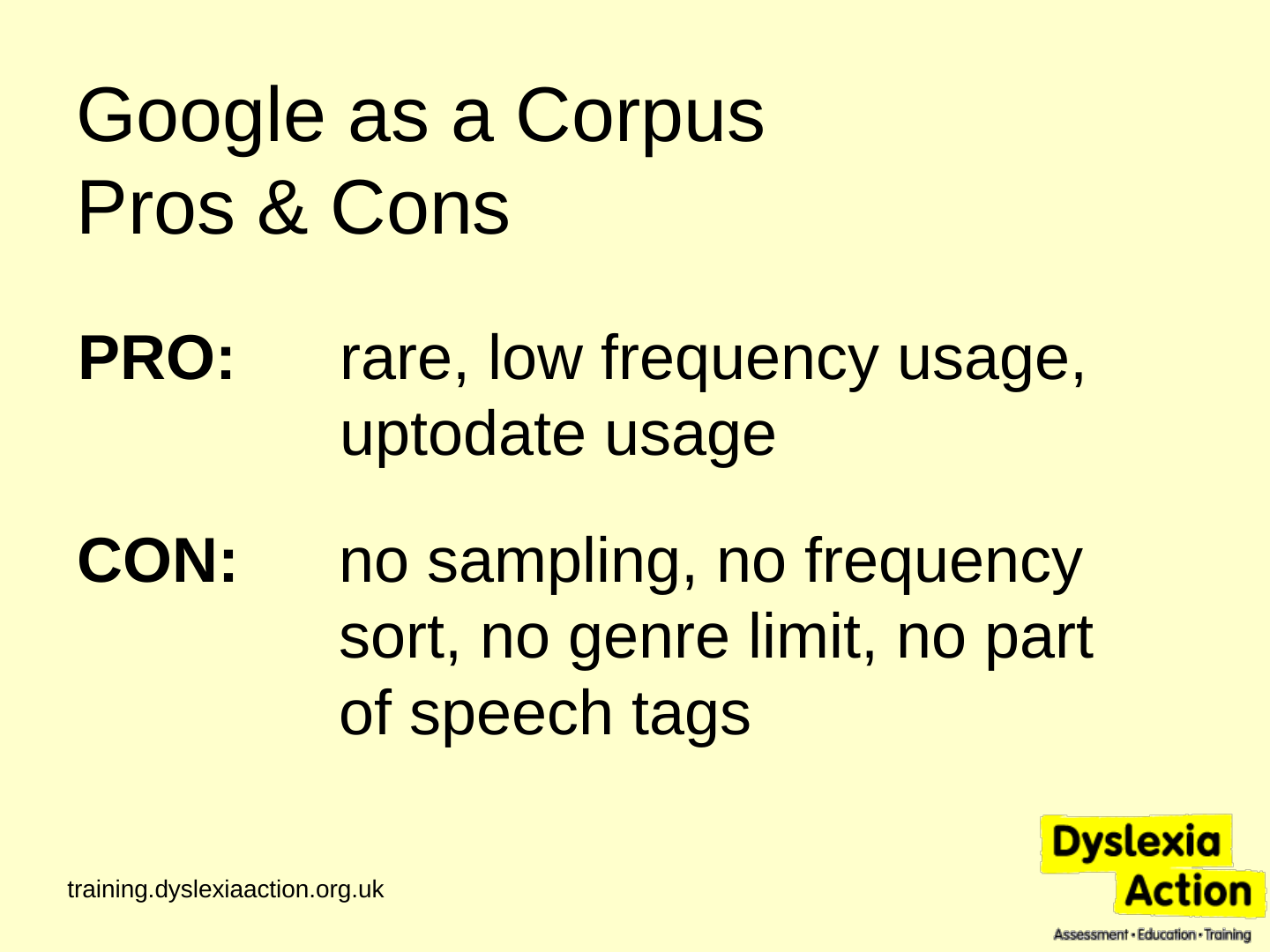
Google as a Corpus: Pros & Cons

PRO: rare, low frequency usage, uptodate usage

CON: no sampling, no frequency sort, no genre limit, no part of speech tags
Original slide 48 (image)

Slide 49: Google results counts are only rough estimates…

Google results counts are only rough estimates…

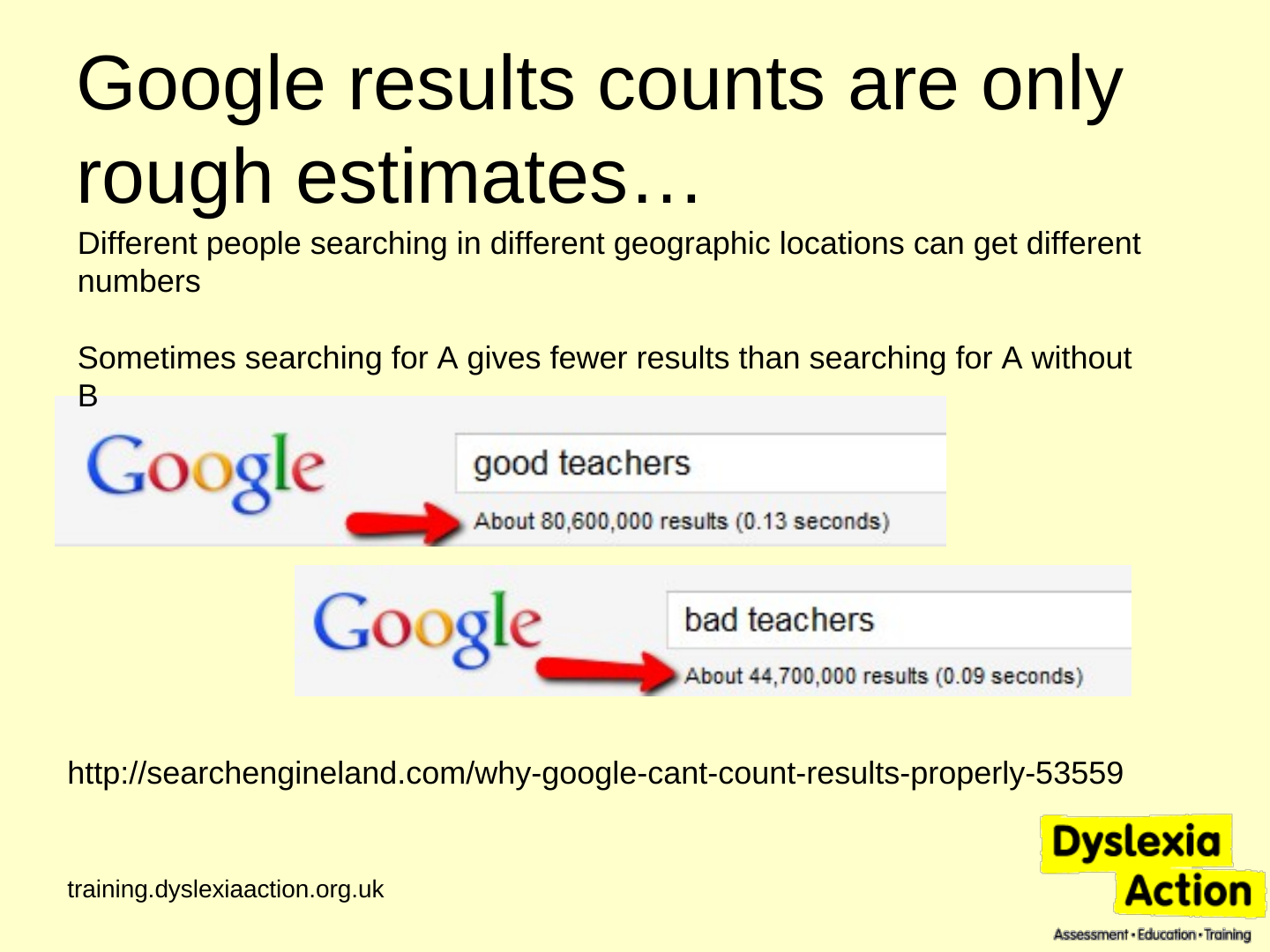
Different people searching in different geographic locations can get different numbers

Screenshot of a Google search for “good teachers”: about 80,600,000 results (0.13 seconds), with a red arrow.

Sometimes searching for A gives fewer results than searching for A without B

Screenshot of a Google search for “bad teachers”: about 44,700,000 results (0.09 seconds), with a red arrow.

http://searchengineland.com/why-google-cant-count-results-properly-53559
Original slide 49 (image)

Slide 50: …but Google fights can be fun

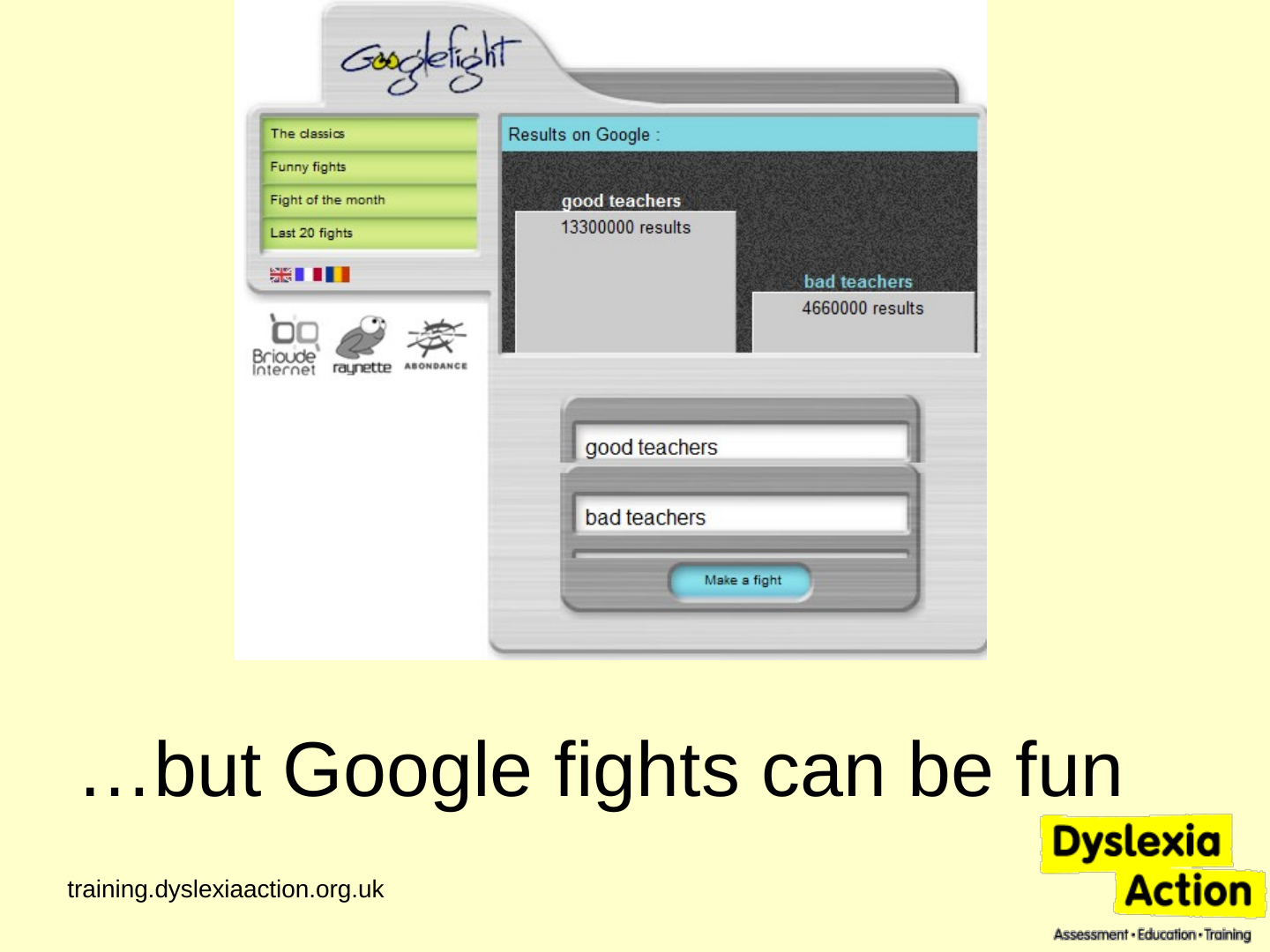
…but Google fights can be fun
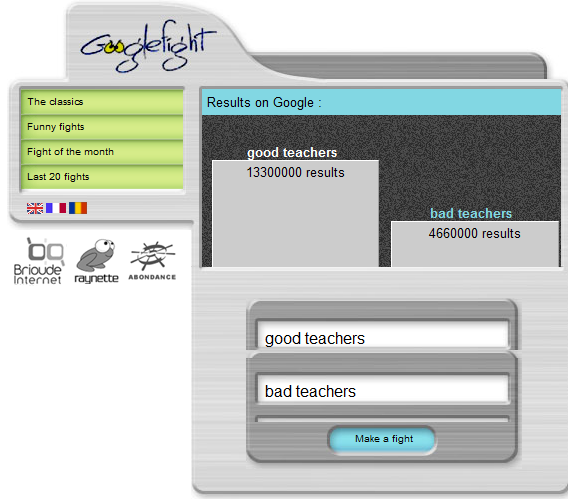
Screenshot of the Googlefight page comparing “good teachers” (13300000 results) with “bad teachers” (4660000 results).

Original slide 50 (image)

Slide 51: WebCorp is makes Google search results linguist-friendly

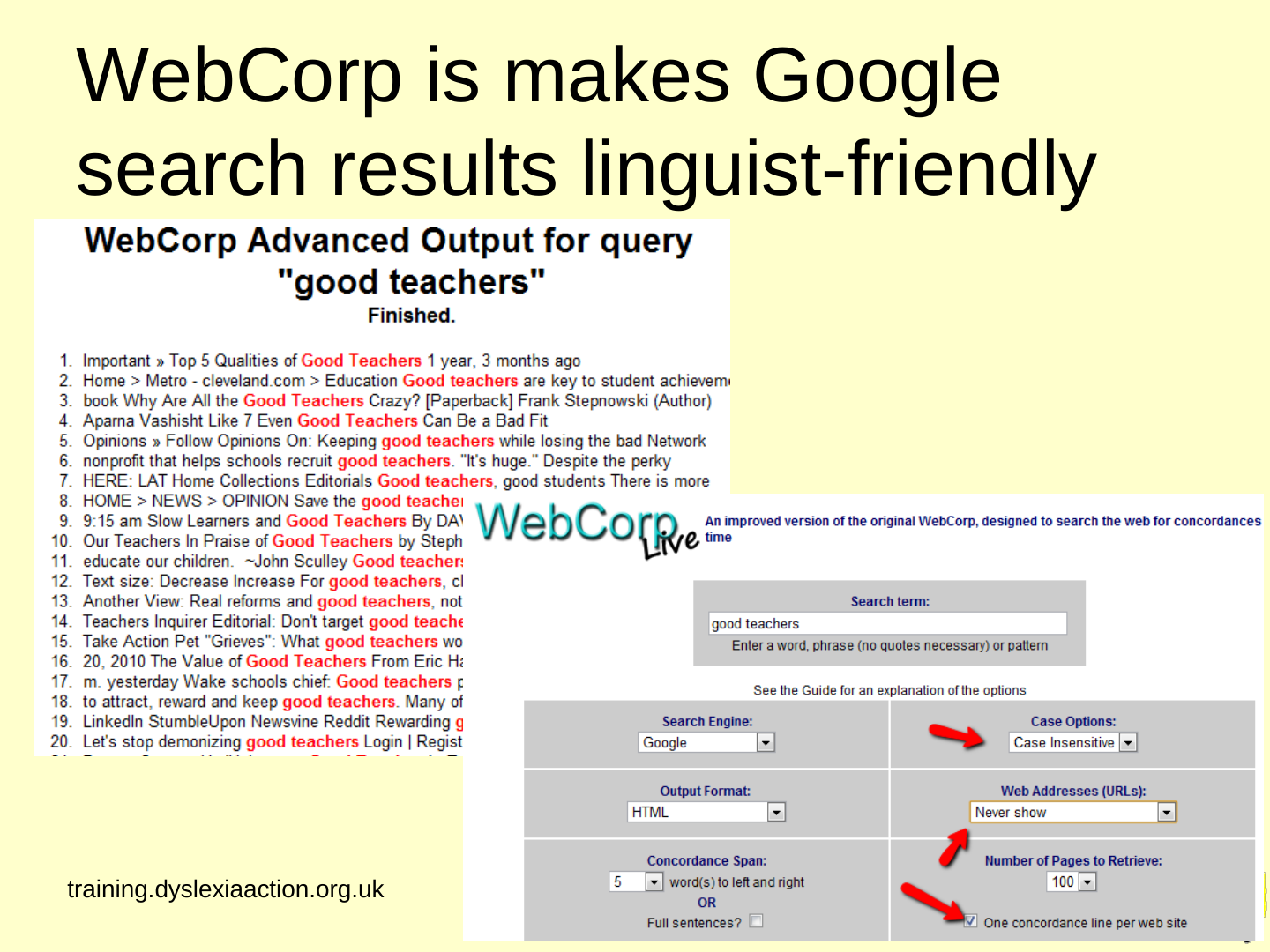
WebCorp is makes Google search results linguist-friendly
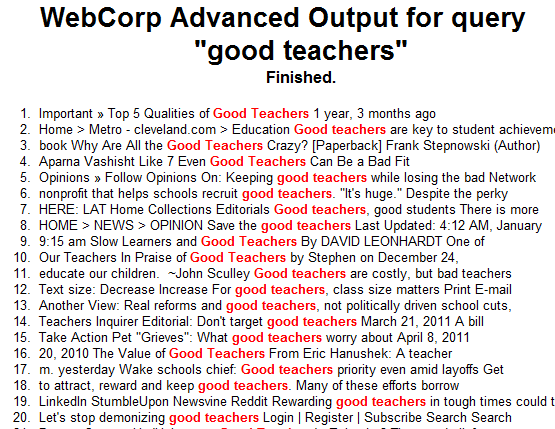
Screenshot of WebCorp output for the query “good teachers”: numbered lines of web text with the words “good teachers” highlighted in red.

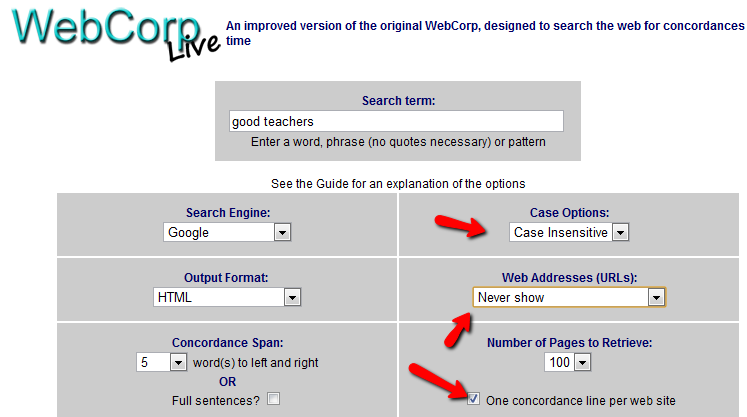
Screenshot of the WebCorp Live search form with the options for search engine, output format, web addresses, concordance span and number of pages, and red arrows at the case option and the page options.

Original slide 51 (image)

Slide 52: Avoid Common Corpus Errors

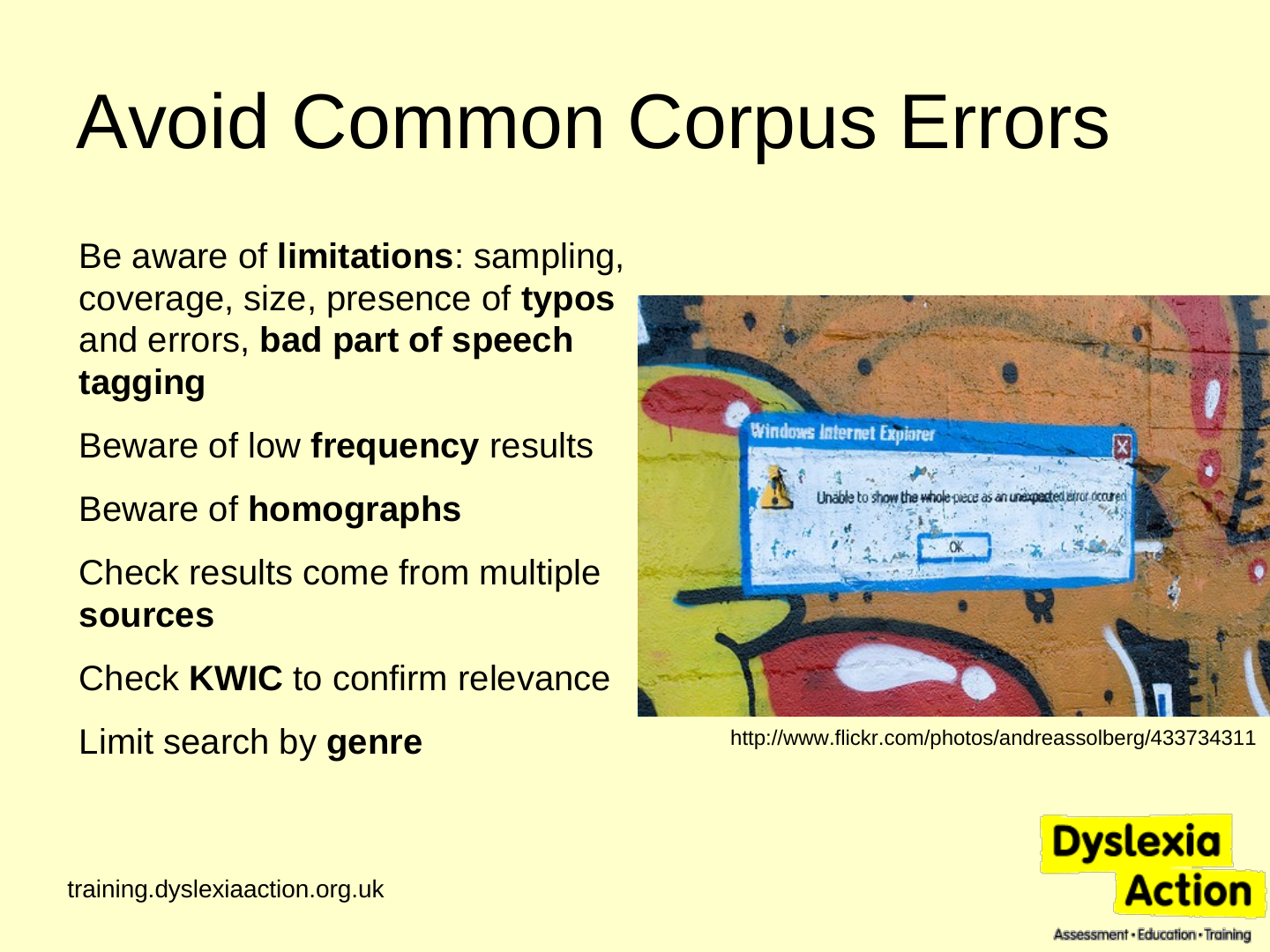
Avoid Common Corpus Errors

  • Be aware of limitations: sampling, coverage, size, presence of typos and errors, bad part of speech tagging
  • Beware of low frequency results
  • Beware of homographs
  • Check results come from multiple sources
  • Check KWIC to confirm relevance
  • Limit search by genre

Photograph of a graffiti-covered wall on which an error message box titled “Windows Internet Explorer”, with a warning symbol and an OK button, has been painted.

http://www.flickr.com/photos/andreassolberg/433734311

Original slide 52 (image)

Slide 53: Check examples and sources

Check examples and sources

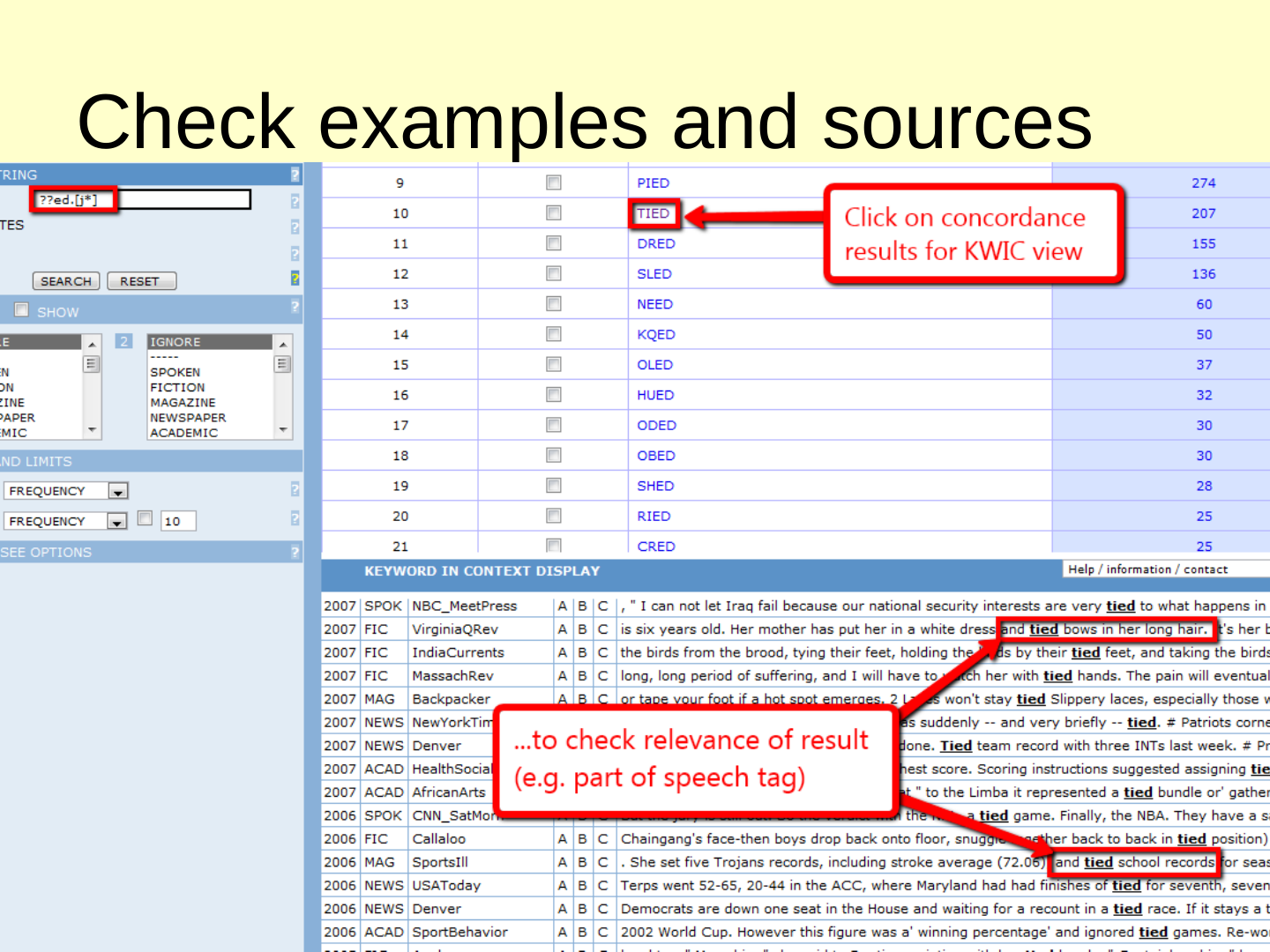
??ed.[j*]
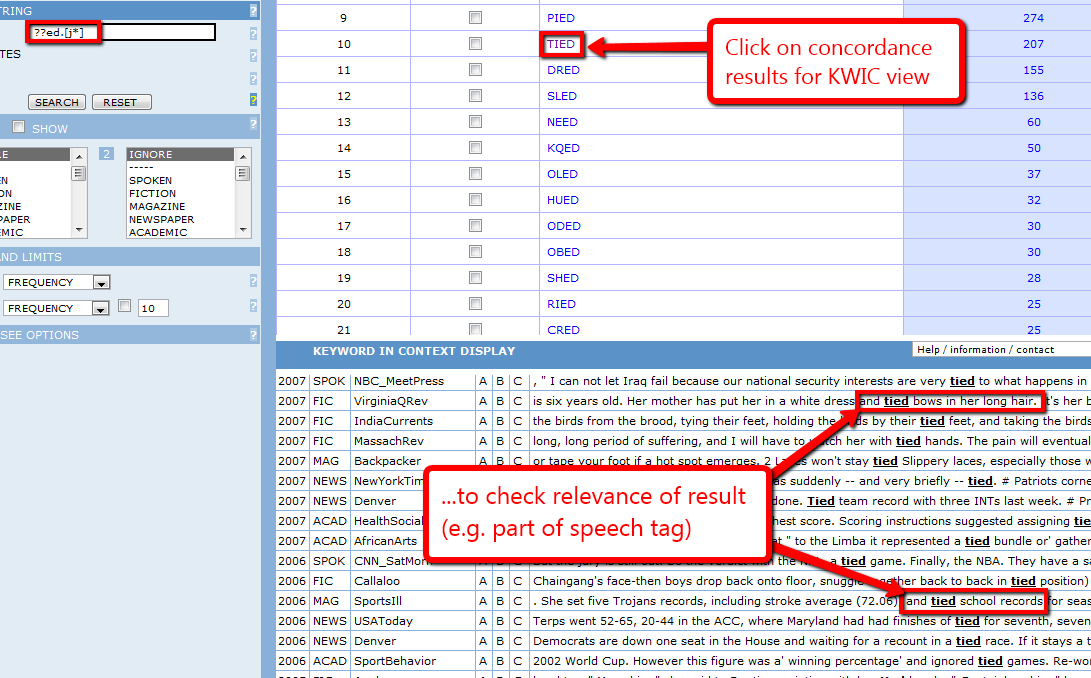
Screenshot of COCA results. The search string box, outlined in red, holds the query shown in the code line above. In the list of matching words below it, a red arrow from a red label points at one entry. Under the heading KEYWORD IN CONTEXT DISPLAY a table of lines (year, genre, source) follows; a second red label has two red arrows to phrases outlined in red, and the other lines in the display carry the word tied in bold and underlined without outline. The labels and the lines are transcribed in the text below the image.

Matching words: TIED — rank 10, 207 hits. Red label with a red arrow to it: “Click on concordance results for KWIC view”.

Concordance lines (red label: “…to check relevance of result (e.g. part of speech tag)”, with red arrows to the two outlined phrases):

  • 2007, FIC, VirginiaQRev: “is six years old. Her mother has put her in a white dress and tied bows in her long hair.” Outlined: “and tied bows in her long hair.”
  • 2006, MAG, SportsIll: “. She set five Trojans records, including stroke average (72.06) and tied school records for” (cut off at the image edge). Outlined: “and tied school records”
Original slide 53 (image)

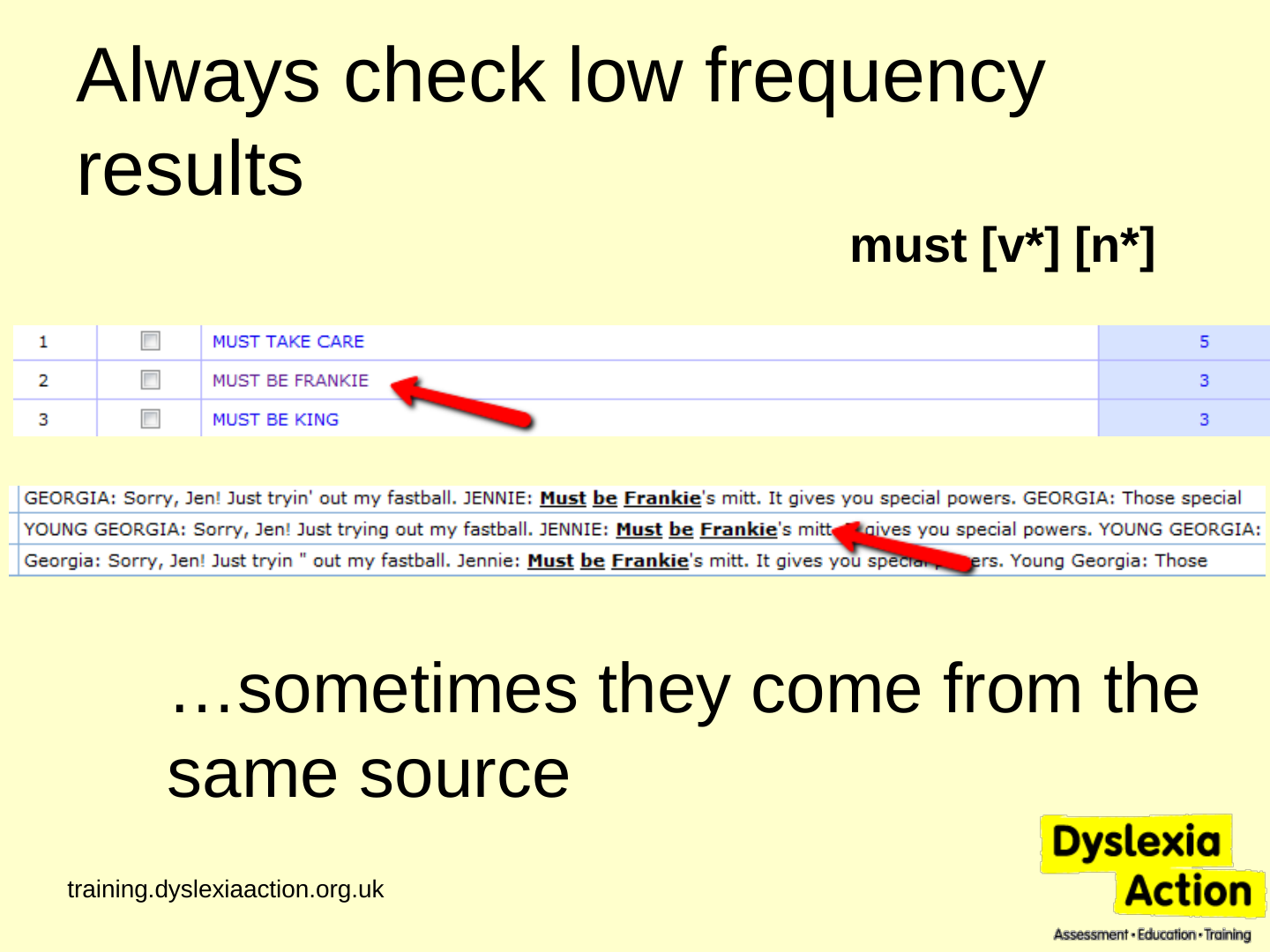
Slide 54: Always check low frequency results

Always check low frequency results

must [v*] [n*]

Screenshot of a COCA list: MUST TAKE CARE 5, MUST BE FRANKIE 3, MUST BE KING 3; a red arrow points at MUST BE FRANKIE.

…sometimes they come from the same source

Screenshot of three lines of a television script in which the same words are repeated: “Georgia: Sorry, Jen! Just tryin’ out my fastball. Jennie: Must be Frankie’s mitt. It gives you special powers.”; a red arrow points at “Must be Frankie’s mitt.”

Original slide 54 (image)

Slide 55: False roots

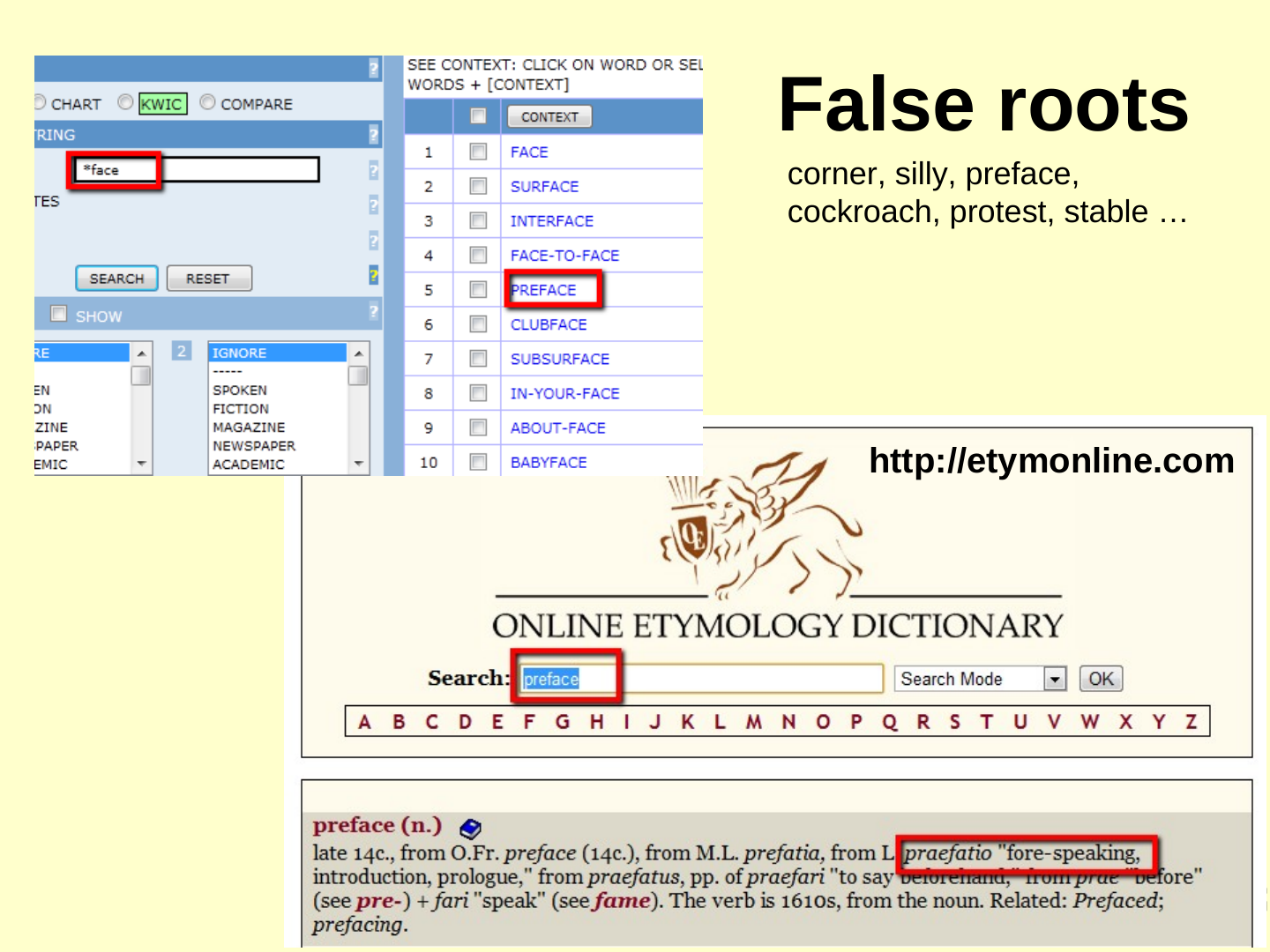
False roots

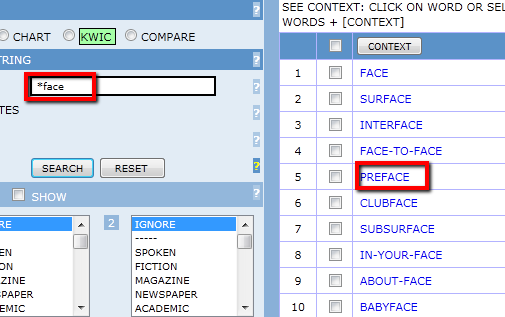
Screenshot of a COCA search for “*face” with the results FACE, SURFACE, INTERFACE, FACE-TO-FACE, PREFACE (outlined in red), CLUBFACE, SUBSURFACE, IN-YOUR-FACE, ABOUT-FACE and BABYFACE.

corner, silly, preface, cockroach, protest, stable …
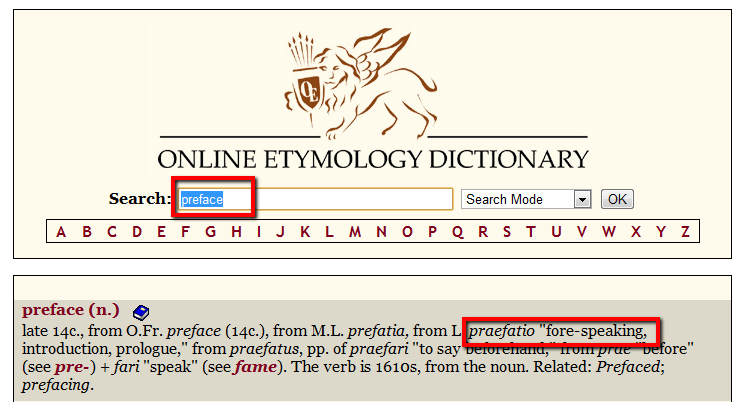
http://etymonline.com

Screenshot of the Online Etymology Dictionary with “preface” in the search box and the entry “preface (n.)”: “late 14c., from O.Fr. preface, from M.L. prefatia, from L. praefatio ‘fore-speaking, introduction’”, with “fore-speaking” outlined in red.

Original slide 55 (image)

Slide 56: Make your own corpus with TextSTAT

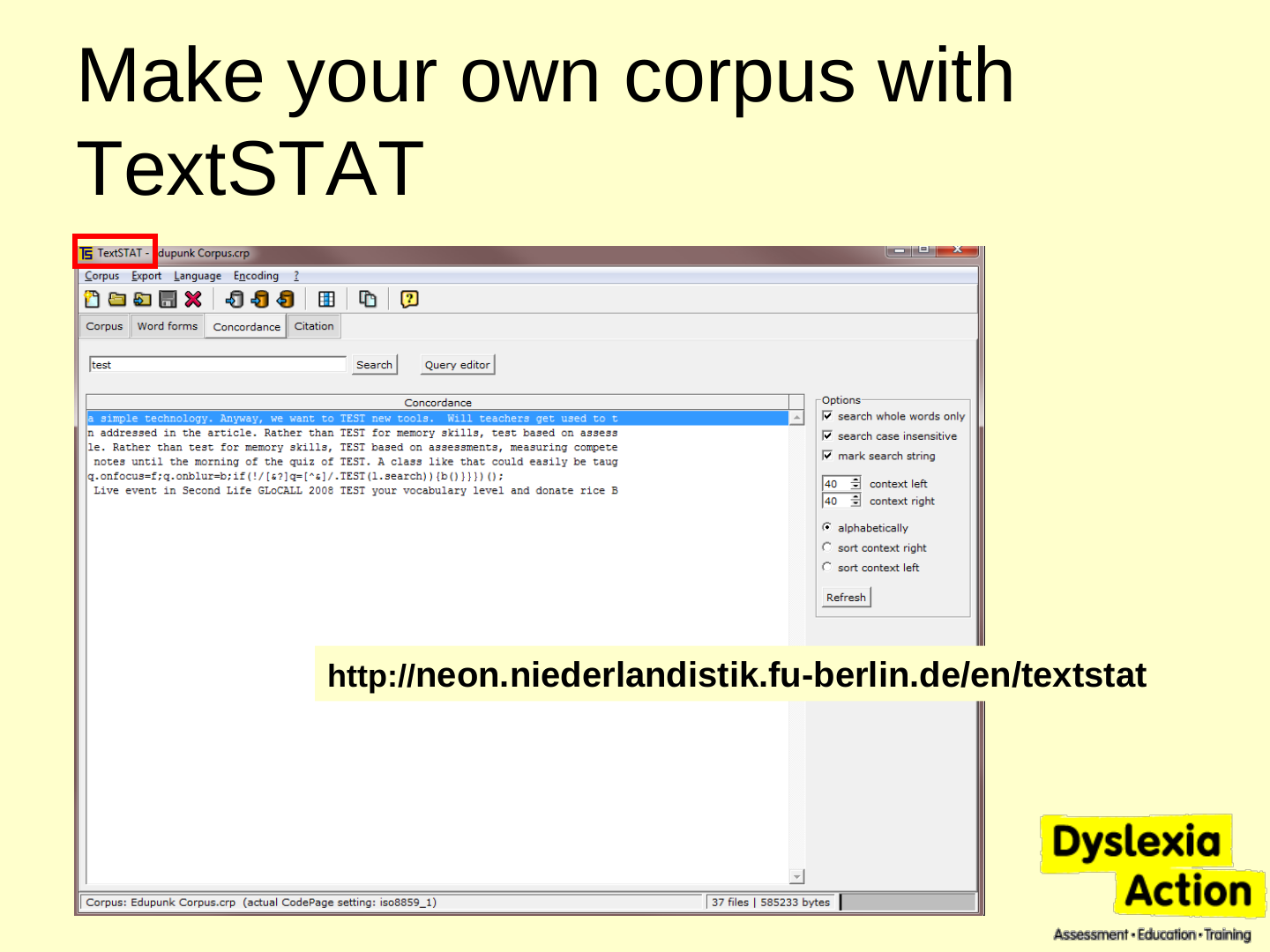
Make your own corpus with TextSTAT
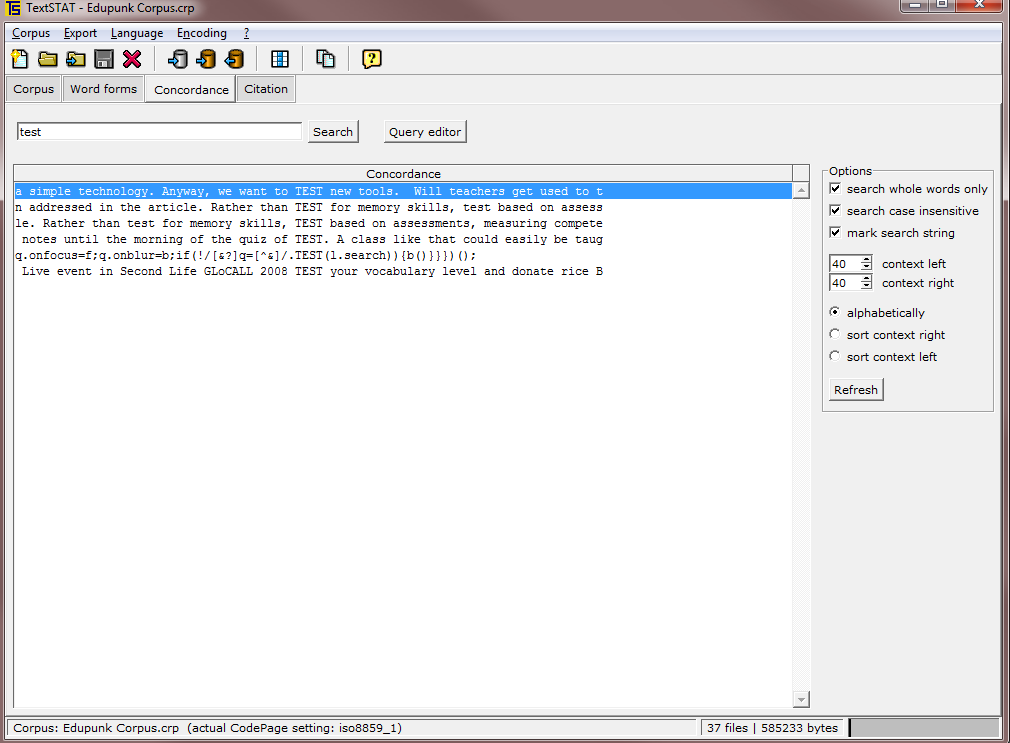
Screenshot of the TextSTAT program with a concordance of the word “test” found in a small text corpus.

http://neon.niederlandistik.fu-berlin.de/en/textstat

Original slide 56 (image)

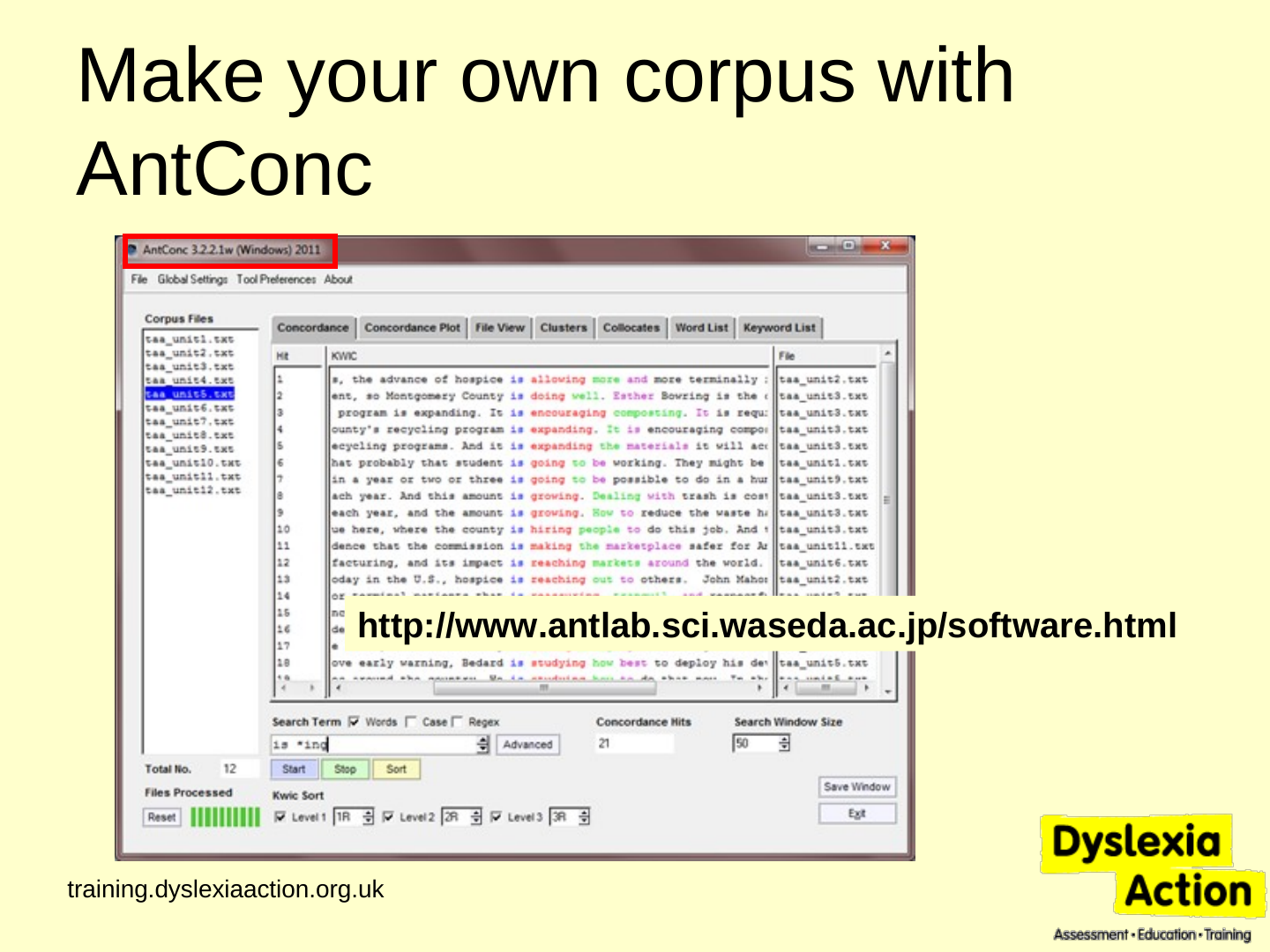
Slide 57: Make your own corpus with AntConc

Make your own corpus with AntConc
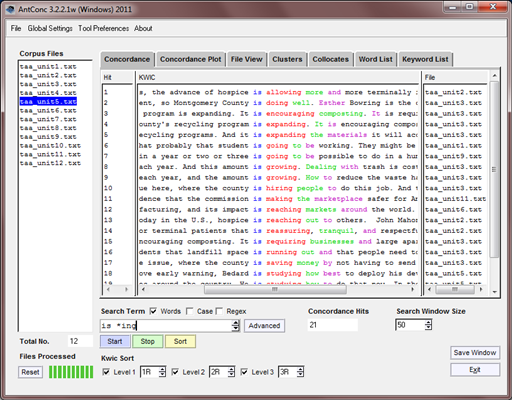
Screenshot of the AntConc program with a list of text files on the left and a concordance (keyword in context) for the search term “is *ing” on the right.

http://www.antlab.sci.waseda.ac.jp/software.html

Original slide 57 (image)

Slide 58: Corpus in the classroom

Corpus in the classroom

  • teacher preparation
  • student discovery

Original slide 58 (image)

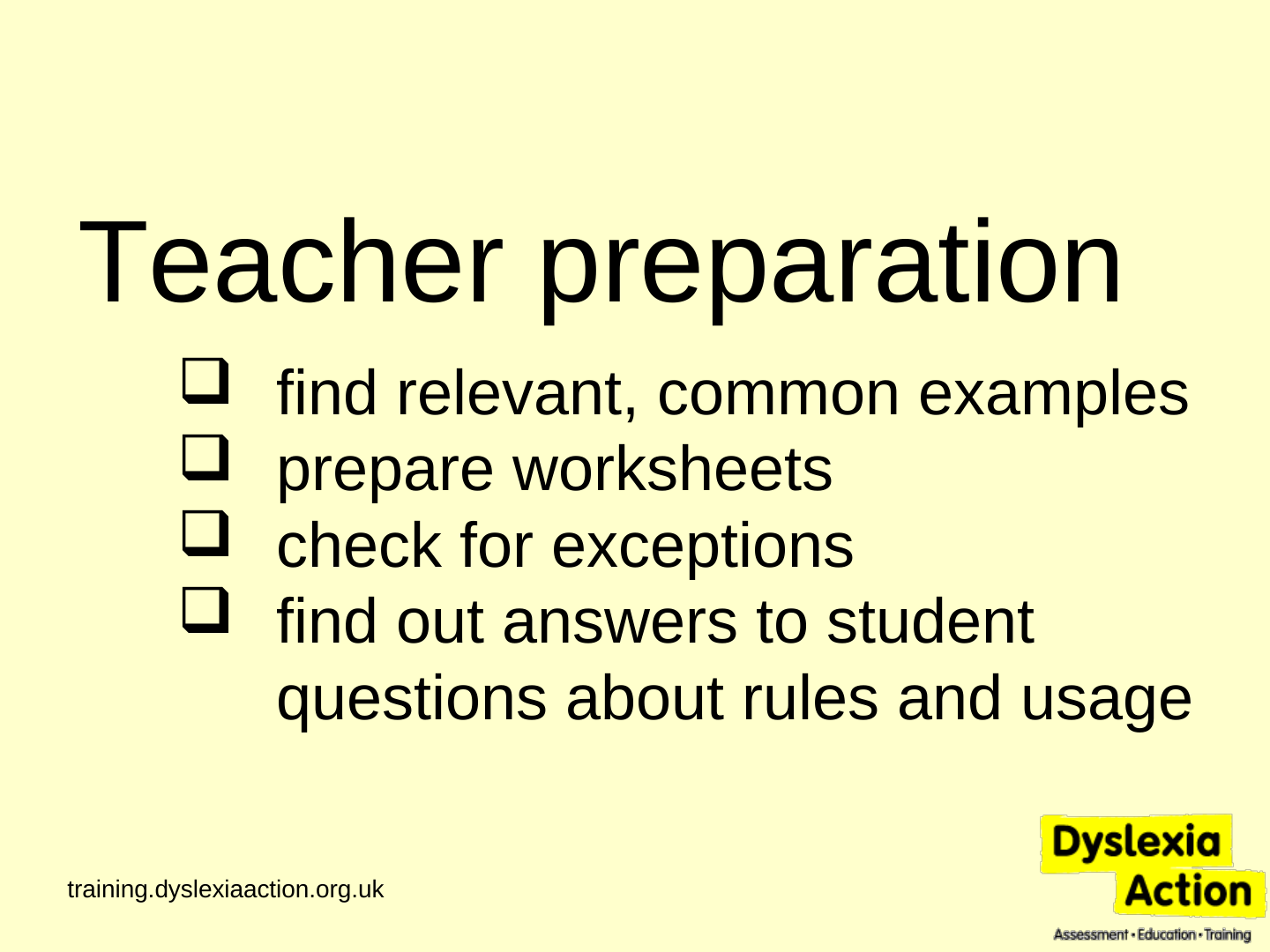
Slide 59: Teacher preparation

Teacher preparation

  • find relevant, common examples
  • prepare worksheets
  • check for exceptions
  • find out answers to student questions about rules and usage
Original slide 59 (image)

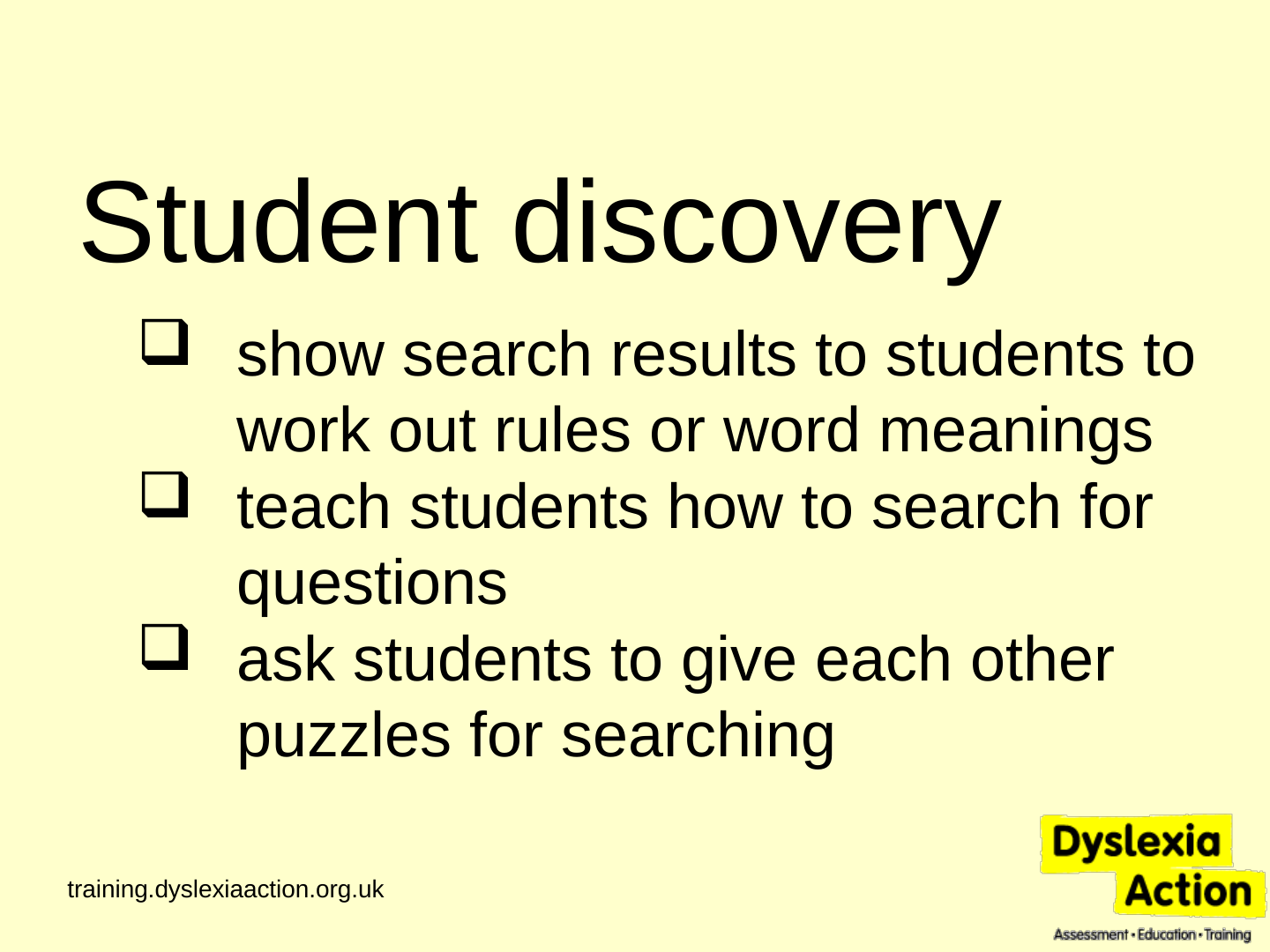
Slide 60: Student discovery

Student discovery

  • show search results to students to work out rules or word meanings
  • teach students how to search for questions
  • ask students to give each other puzzles for searching
Original slide 60 (image)

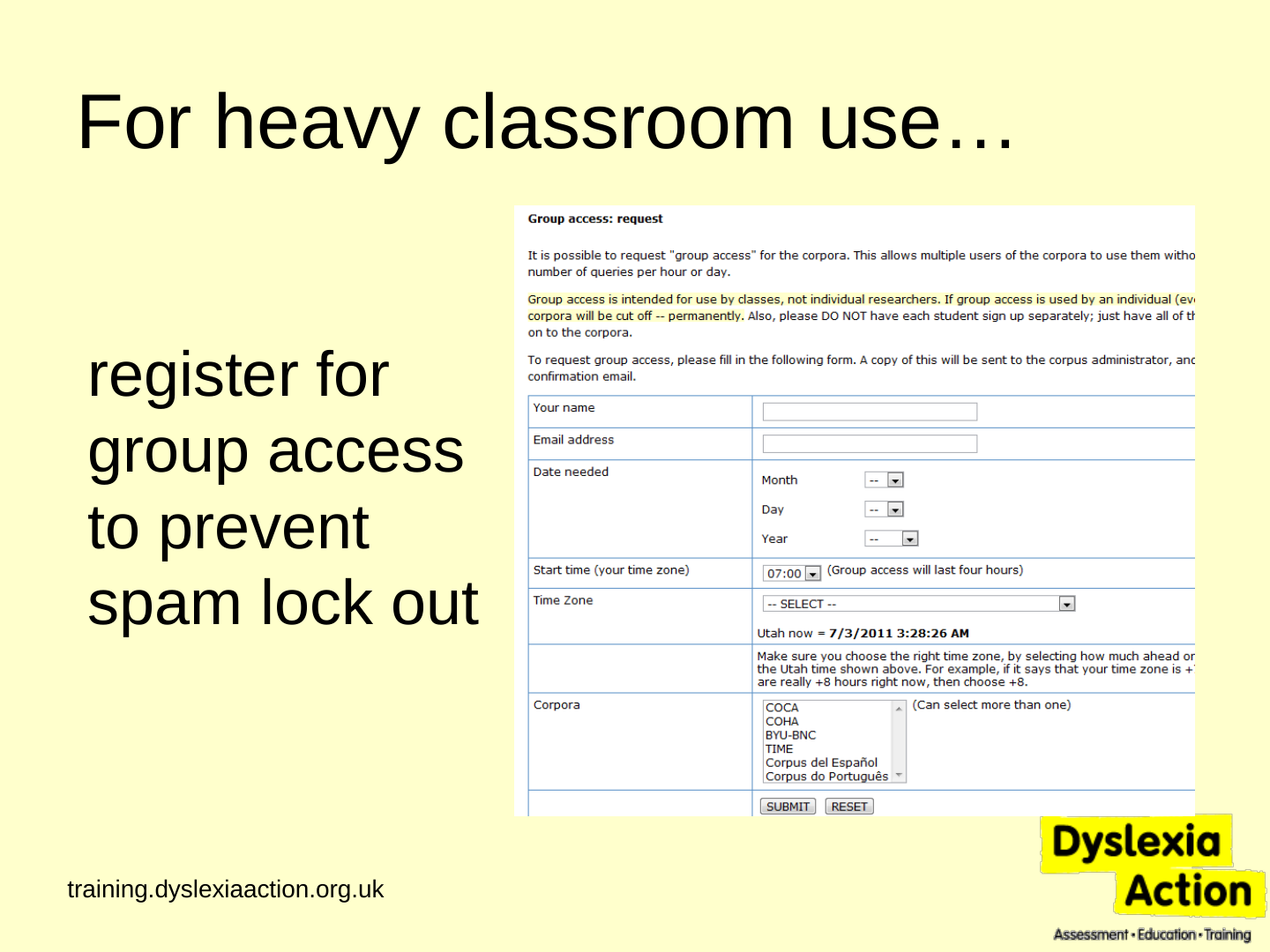
Slide 61: For heavy classroom use…

For heavy classroom use…

register for group access to prevent spam lock out
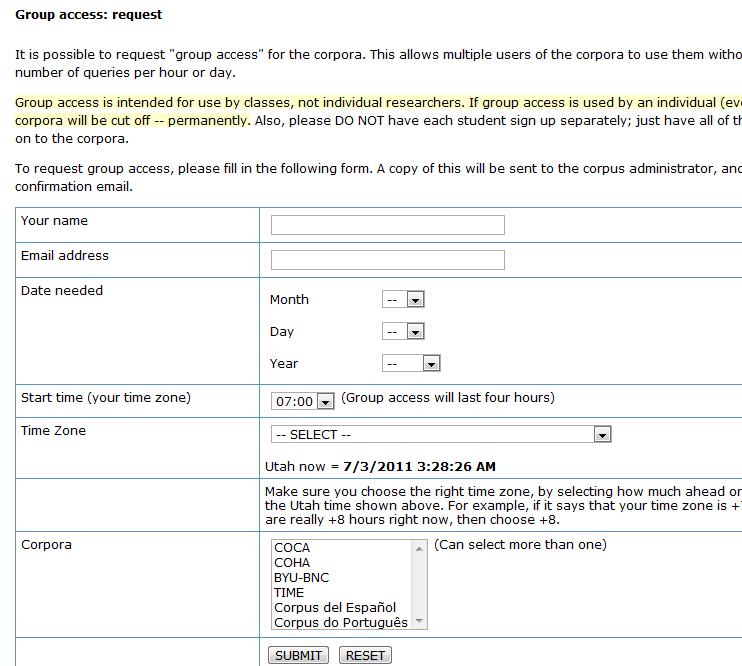
Screenshot of the corpus “Group access: request” form with fields for name, email, date, start time and time zone, and a list of corpora (COCA, COHA, BYU-BNC, TIME, Corpus del Español, Corpus do Português) with a Submit button.

Original slide 61 (image)

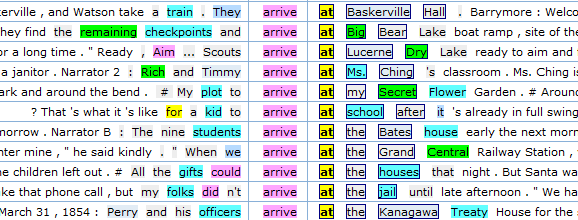
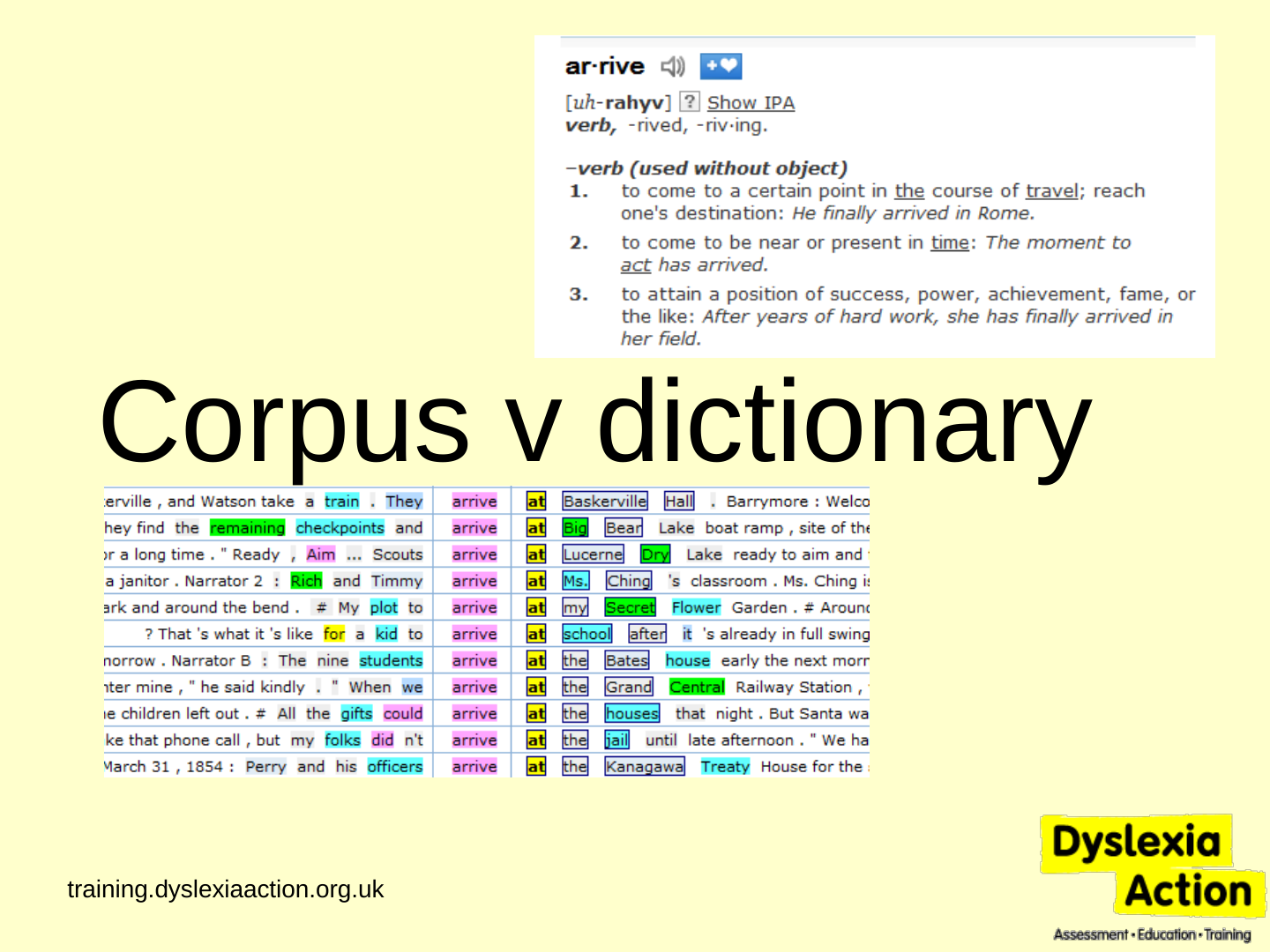
Slide 62: Corpus v dictionary

Corpus v dictionary
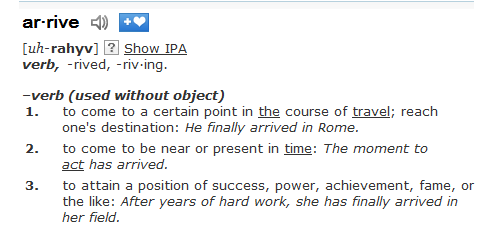
Screenshot of a dictionary entry for “arrive”: pronunciation, “verb (used without object)” and three numbered senses, such as “to come to a certain point in the course of travel; reach one’s destination”.

Screenshot of concordance lines for “arrive”, with the words before and after it highlighted in colours, for example “arrive at the Baskerville Hall” and “arrive at the school”.

Original slide 62 (image)

Slide 63: Non-classroom corpus use

Non-classroom corpus use

  • supplement dictionary
  • cross-word puzzles
  • check typical usage when writing

Original slide 63 (image)

Slide 64: Where to go next?

Where to go next?
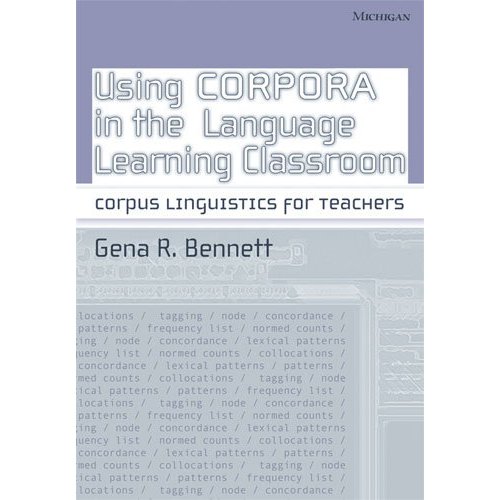
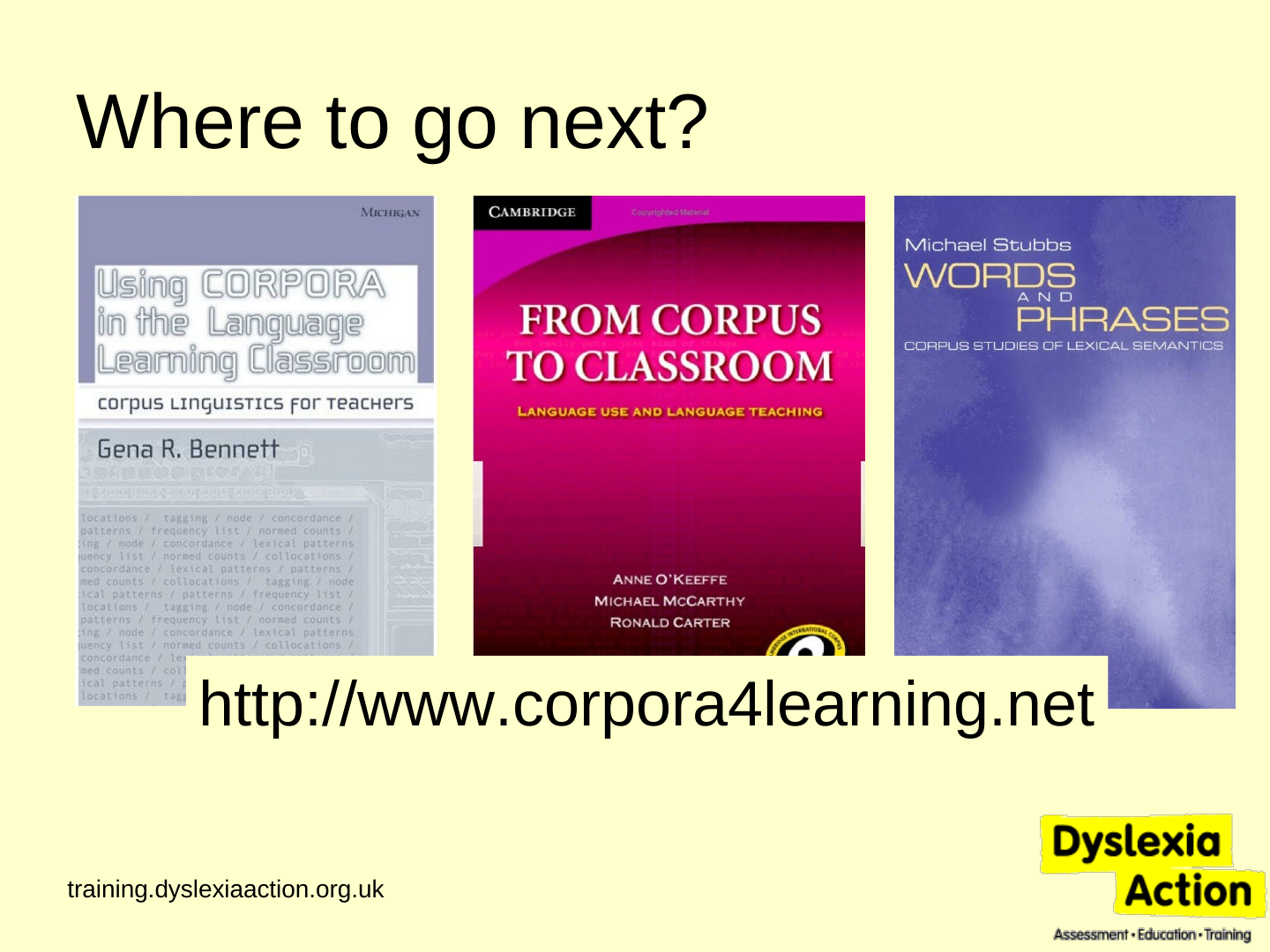
Cover of Using Corpora in the Language Classroom, Corpus Linguistics for Teachers, by Gena R. Bennett (Michigan): grey-blue with lines of concordance text.

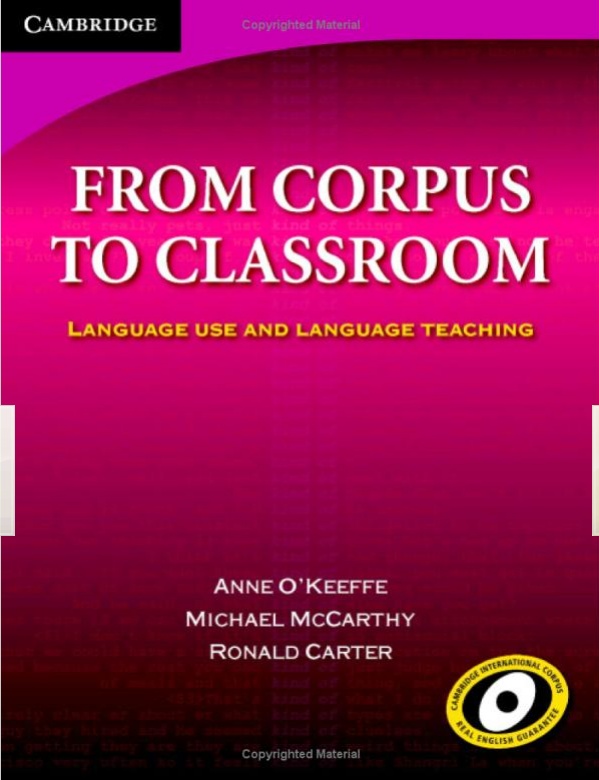
Cover of From Corpus to Classroom: Language Use and Language Teaching, by Anne O’Keeffe, Michael McCarthy and Ronald Carter (Cambridge): magenta.

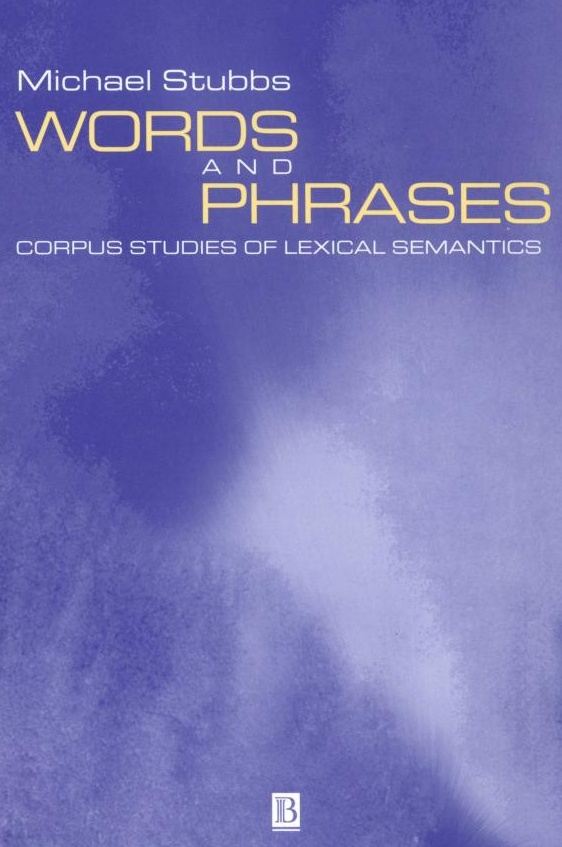
Cover of Words and Phrases: Corpus Studies of Lexical Semantics, by Michael Stubbs: blue and purple.

http://www.corpora4learning.net

Original slide 64 (image)

Slide 65: Thank you

Thank you

Contact http://dominiklukes.net

Original slide 65 (image)