Pardon my code mix: Hypostatic frame constructions in Czech
- Talk date: Not established
- SlideShare upload: 2019-10-15 (upload date, not the delivery date)
- Event: Not established
- Place: Not established
- Topics: Language & meaning
- Language: cs
- Slides in the original listing: 67
- Coverage: Full text of all 67 slides, each paired with its original slide image (slide N is section N).
- Original listing: https://www.slideshare.net/slideshow/pardon-my-code-mix-hypostatic-frame-constructions-in-czech/182207911
- Cover image: https://slides.dominiklukes.net/readers/pardon-my-code-mix-hypostatic-frame-constructions-in-czech/pages/page-01.png
- Reader data (JSON): https://slides.dominiklukes.net/readers/pardon-my-code-mix-hypostatic-frame-constructions-in-czech/presentation.json
- TalkWeaver package (outline and images, ZIP): https://slides.dominiklukes.net/pardon-my-code-mix-hypostatic-frame-constructions-in-czech/pardon-my-code-mix-hypostatic-frame-constructions-in-czech-talkweaver.zip
- TalkWeaver outline: https://slides.dominiklukes.net/pardon-my-code-mix-hypostatic-frame-constructions-in-czech/talkweaver/pardon-my-code-mix-hypostatic-frame-constructions-in-czech-outline.md
- Markdown copy: https://slides.dominiklukes.net/pardon-my-code-mix-hypostatic-frame-constructions-in-czech/index.md
Slide 1: Pardon my code mix: Hypostatic frame constructions in Czech
Pardon my code mix: Hypostatic frame constructions in Czech
Dominik Lukeš
MetaphorHacker.net
@TechCzech

Slide 2: A speculative inquiry into the nature of constructions with examples from Czech morphology in communicative context.
A speculative inquiry into the nature of constructions with examples from Czech morphology in communicative context.
Slide 3: Slide 3
- Constructional treatment of text-level phenomena
- Mental representations of schematic forms
- Hypostatic code switching
Slide 4: Case of the Czech “hypostatic frame construction”?
Case of the Czech “hypostatic frame construction”?
Slide 5: Assumptions about code-switching / Code mixing
Assumptions about code-switching / Code mixing
Slide 6: Slide 6
Code switching can apply to any systematic variation even in a ‘monolingual’ context.
There is a continuum between code switching and mixing (as well as borrowing).
There is a continuum of speakers’ conscious control over the process.
Slide 7: Hypostatic code-switching
Hypostatic code-switching
Slide 8: Slide 8
Often code-switching is ‘turned on’ in the conversation by some lexical / morphological means or signalled in another way.
Slide 9: Slide 9
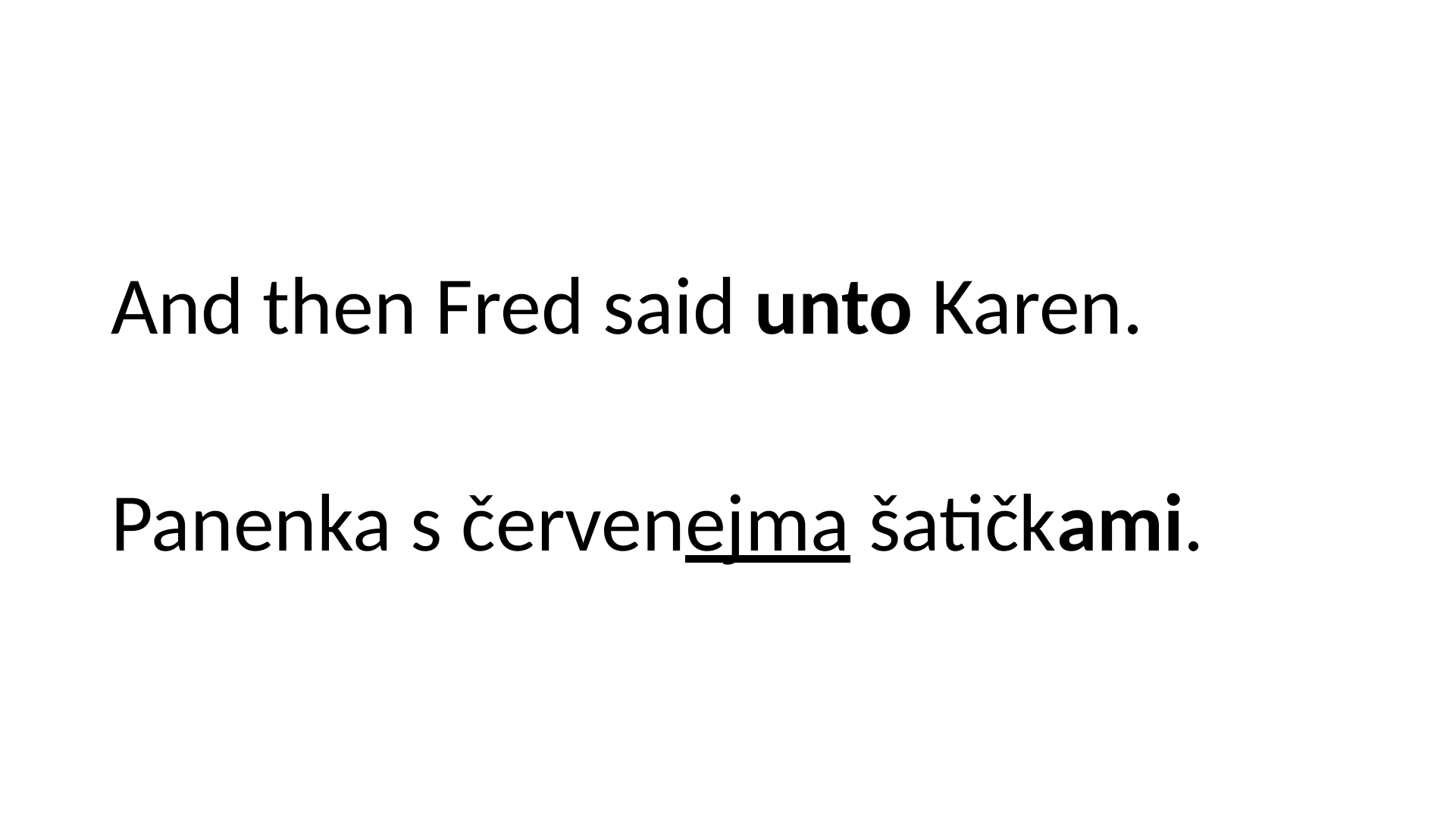
And then Fred said unto Karen.
Panenka s červenejma šatičkami.
Underline in the source slide, kept apart from the bold and italic shown above (the slide underlines these spans; this text has no underline mark): ejma in červenejma.
Slide 10: Slide 10
- “Pardon my French”
- “That’s what she said” jokes
- Intonation
- Characterisation in narrative
Slide 11: Code switching research has a tradition in Czech studies going back to at least the 1980s
Code switching research has a tradition in Czech studies going back to at least the 1980s
Slide 12: Slide 12
“The features which are marked as "bookish”, i.e. those which are usually found in the written form of the literary language, are often used in the colloquial language in an ironic way in order to foreground the particular idea or ideas which they express.”
— (Hammer, 1985)
Slide 13: Slide 13
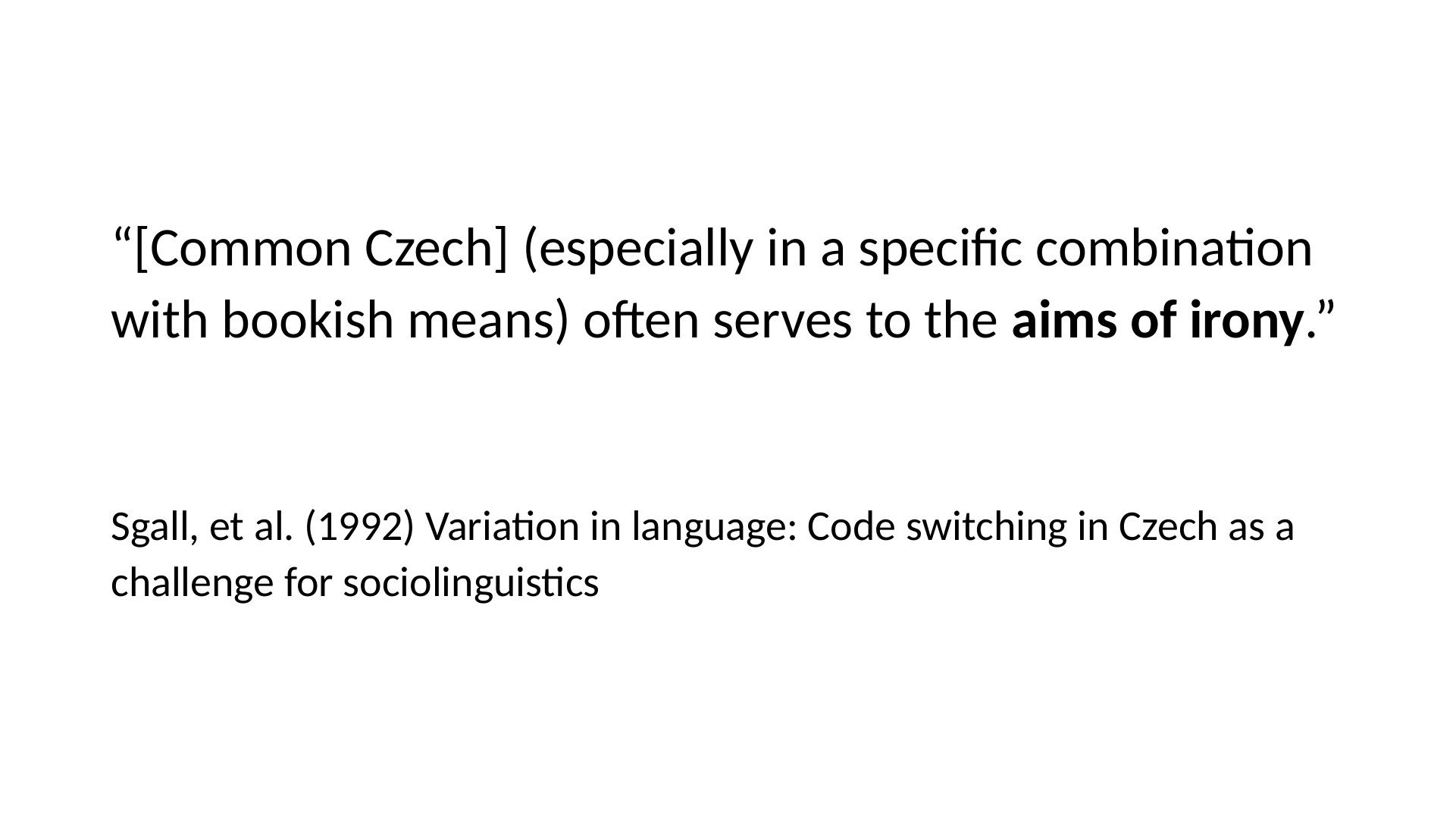
“[Common Czech] (especially in a specific combination with bookish means) often serves to the aims of irony.”
— Sgall, et al. (1992) Variation in language: Code switching in Czech as a challenge for sociolinguistics
Slide 14: Slide 14
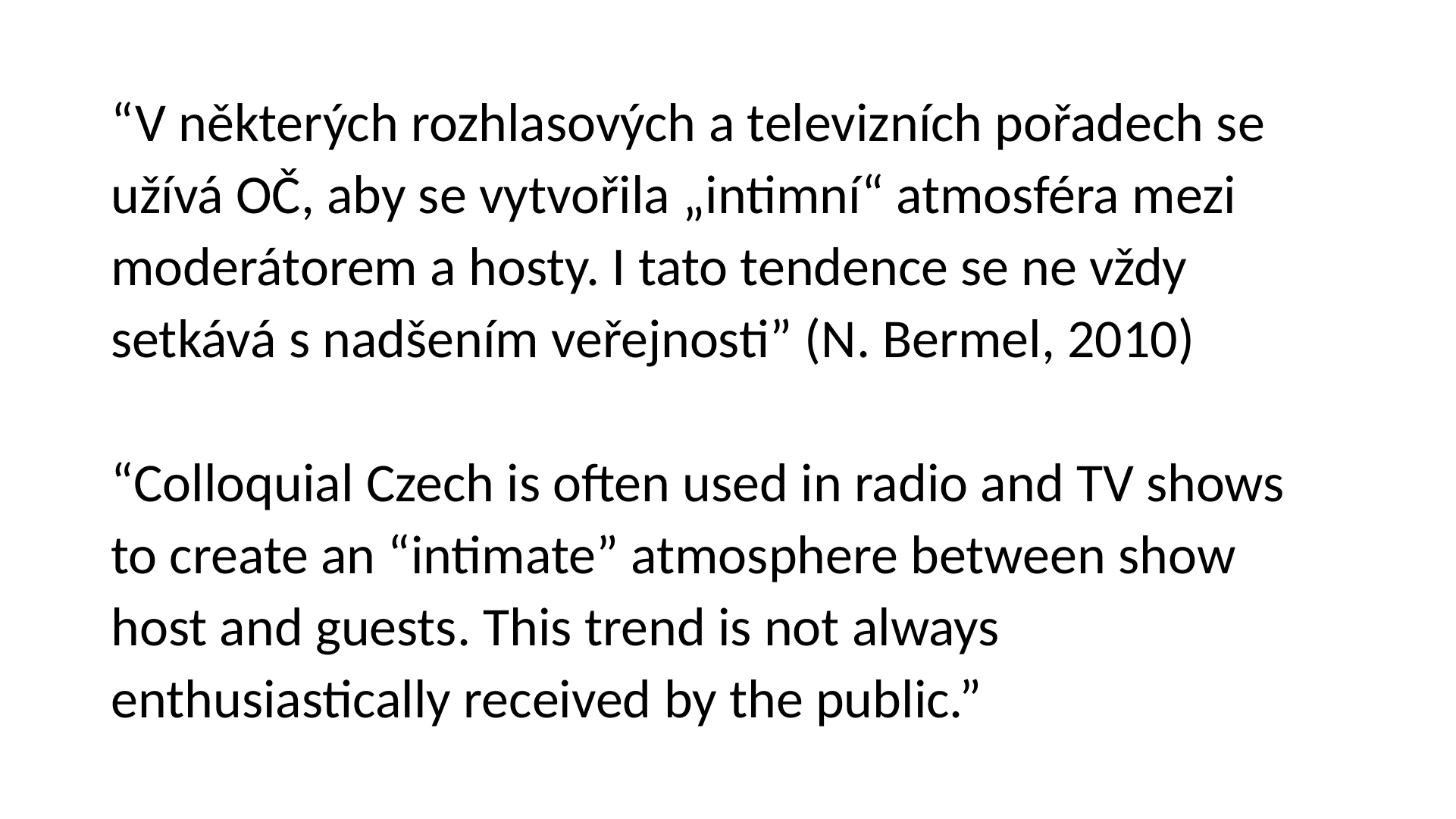
“V některých rozhlasových a televizních pořadech se užívá OČ, aby se vytvořila „intimní“ atmosféra mezi moderátorem a hosty. I tato tendence se ne vždy setkává s nadšením veřejnosti”
“Colloquial Czech is often used in radio and TV shows to create an “intimate” atmosphere between show host and guests. This trend is not always enthusiastically received by the public.”
— (N. Bermel, 2010)
Slide 15: Czech “diglossia”
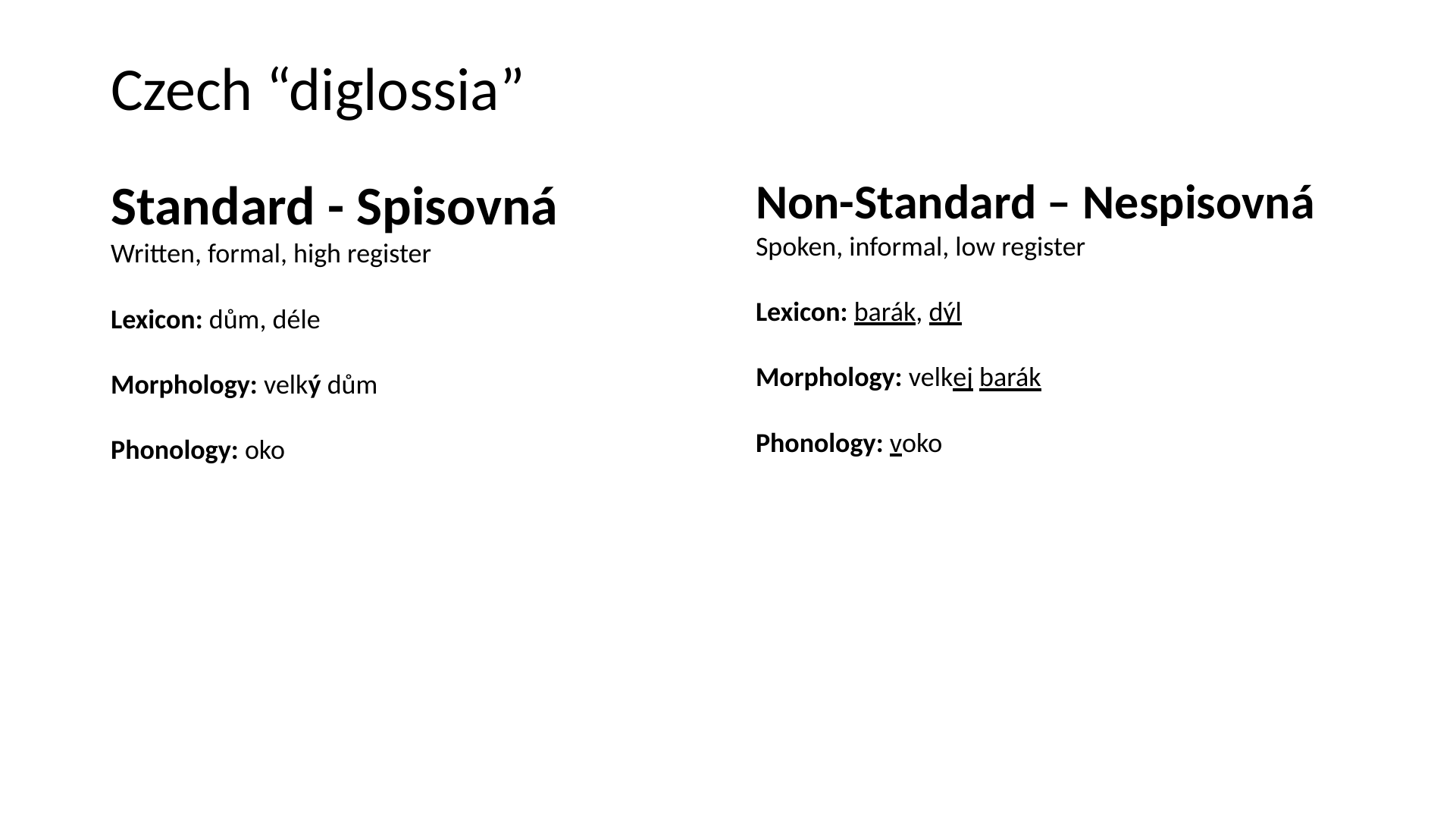
Czech “diglossia”
- Standard - Spisovná
- Written, formal, high register
- Lexicon: dům, déle
- Morphology: velký dům
- Phonology: oko
- Non-Standard – Nespisovná
- Spoken, informal, low register
- Lexicon: barák, dýl
- Morphology: velkej barák
- Phonology: voko
Underline in the source slide, kept apart from the bold and italic shown above (the slide underlines these spans; this text has no underline mark): in the Non-Standard column, barák and dýl (Lexicon), ej in velkej and barák (Morphology), v in voko (Phonology).
Slide 16: Adjectival declension, Sig, Masc
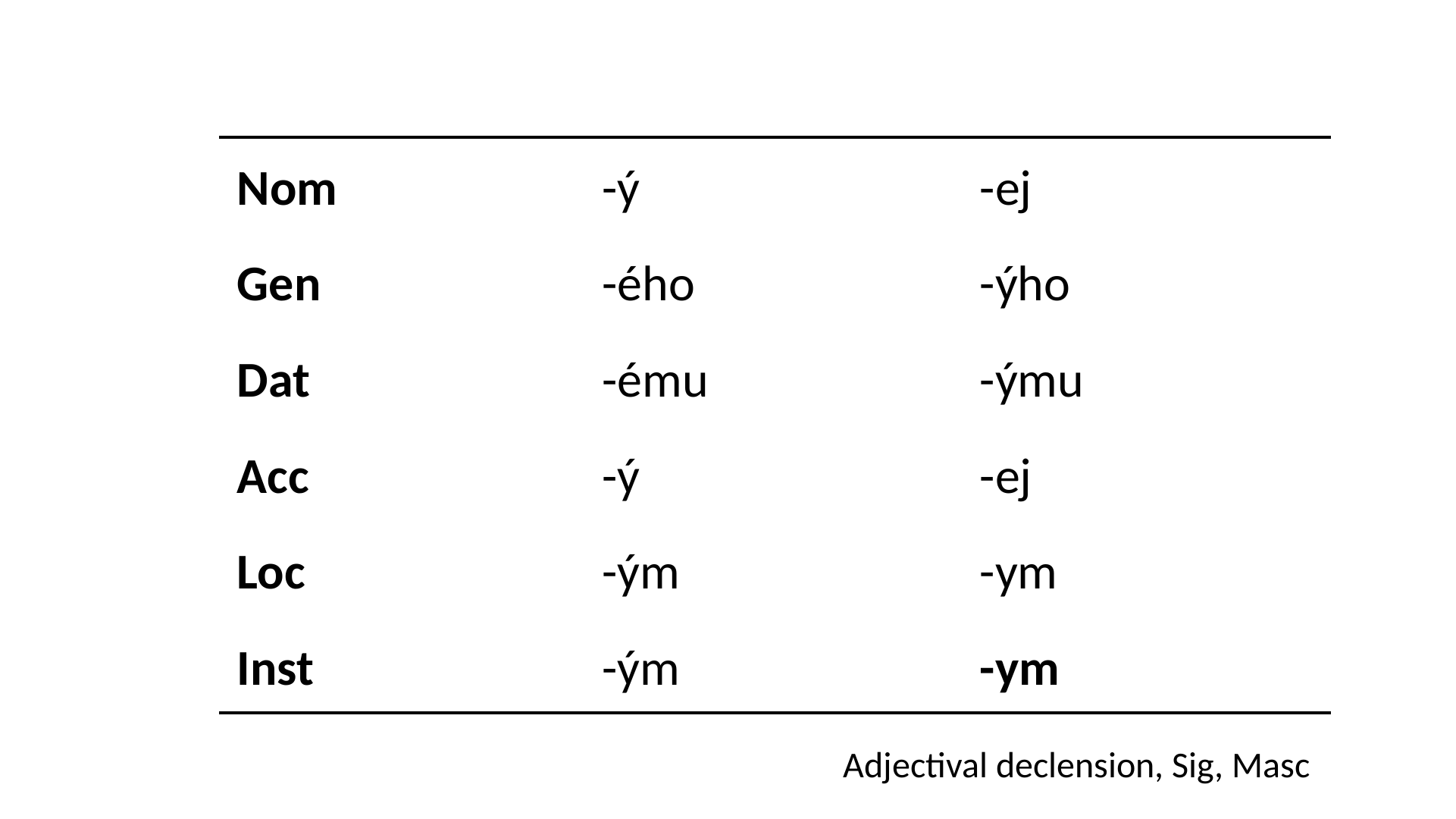
Adjectival declension, Sig, Masc
| Nom | -ý | -ej |
| Gen | -ého | -ýho |
| Dat | -ému | -ýmu |
| Acc | -ý | -ej |
| Loc | -ým | -ym |
| Inst | -ým | -ym |
Slide 17: In a Czech group discussing a project in a professional context. Switching is often not hypostesized but…
In a Czech group discussing a project in a professional context. Switching is often not hypostesized but…
Slide 18: Slide 18
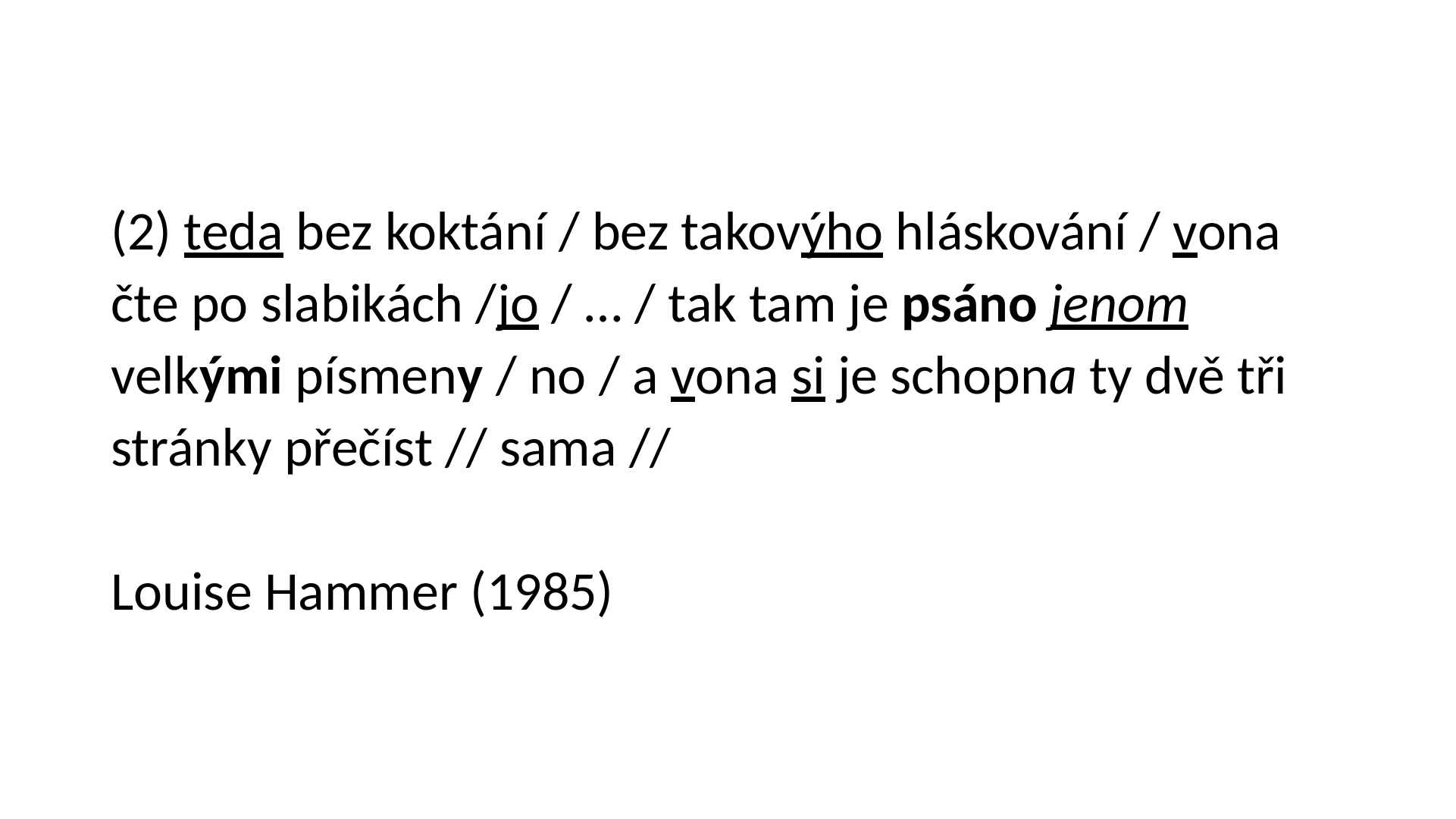
(2) teda bez koktání / bez takovýho hláskování / vona čte po slabikách /jo / … / tak tam je psáno jenom velkými písmeny / no / a vona si je schopna ty dvě tři stránky přečíst // sama //
Louise Hammer (1985)
Underline in the source slide, kept apart from the bold and italic shown above (the slide underlines these spans; this text has no underline mark): teda; ýho in takovýho; v in the first vona; jo; jenom (also italic); v in the second vona; si.
Slide 19: Slide 19
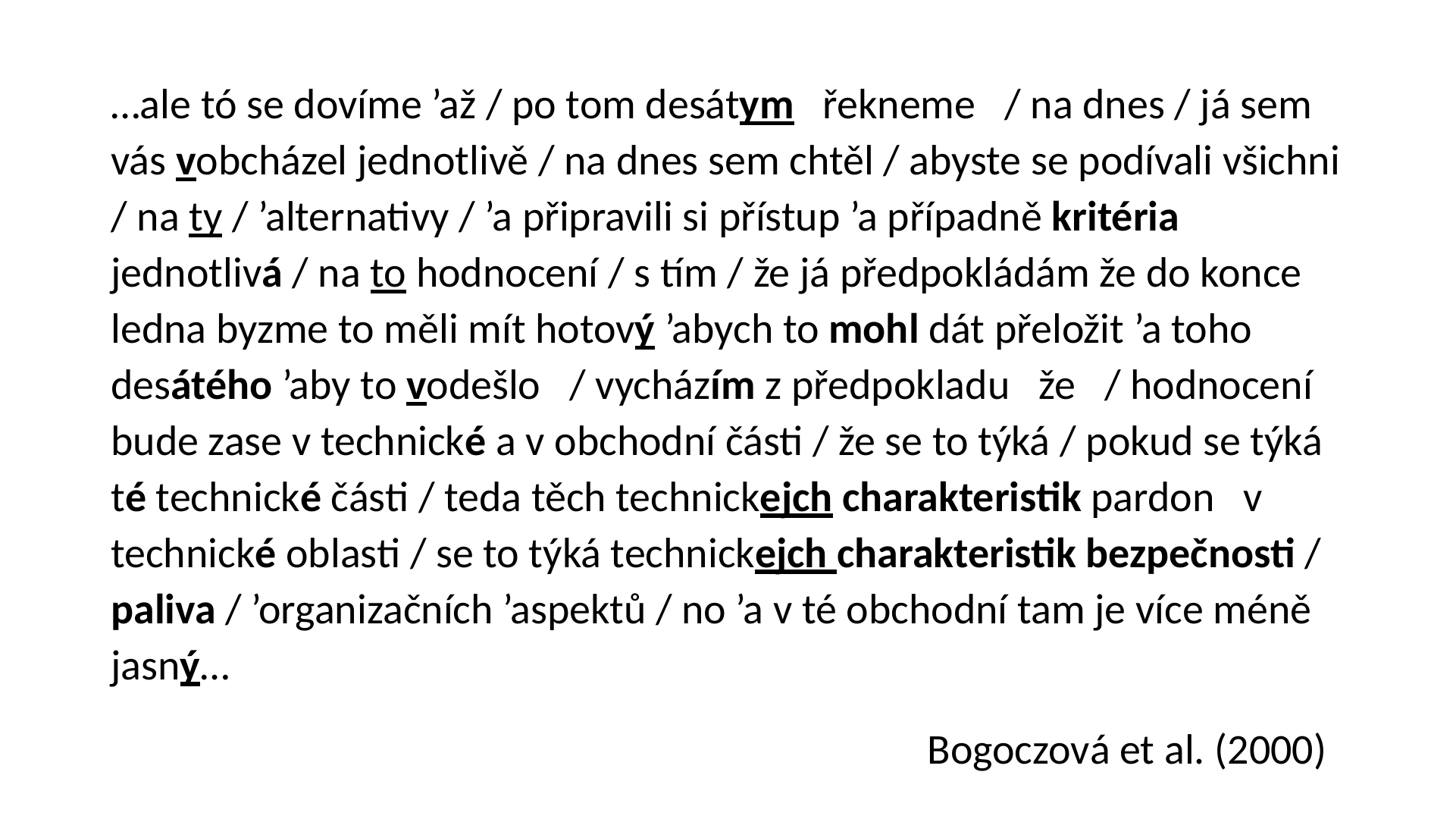
…ale tó se dovíme ’až / po tom desátym řekneme / na dnes / já sem vás vobcházel jednotlivě / na dnes sem chtěl / abyste se podívali všichni / na ty / ’alternativy / ’a připravili si přístup ’a případně kritéria jednotlivá / na to hodnocení / s tím / že já předpokládám že do konce ledna byzme to měli mít hotový ’abych to mohl dát přeložit ’a toho desátého ’aby to vodešlo / vycházím z předpokladu že / hodnocení bude zase v technické a v obchodní části / že se to týká / pokud se týká té technické části / teda těch technickejch charakteristik pardon v technické oblasti / se to týká technickejch charakteristik bezpečnosti / paliva / ’organizačních ’aspektů / no ’a v té obchodní tam je více méně jasný…
Bogoczová et al. (2000)
Underline in the source slide, kept apart from the bold and italic shown above (the slide underlines these spans; this text has no underline mark): ym in desátym; v in vobcházel; ty (in “na ty”); to (in “na to hodnocení”); ý in hotový; v in vodešlo; ejch in technickejch (both times); ý in jasný.
Slide 20: Code switching signal into project language:
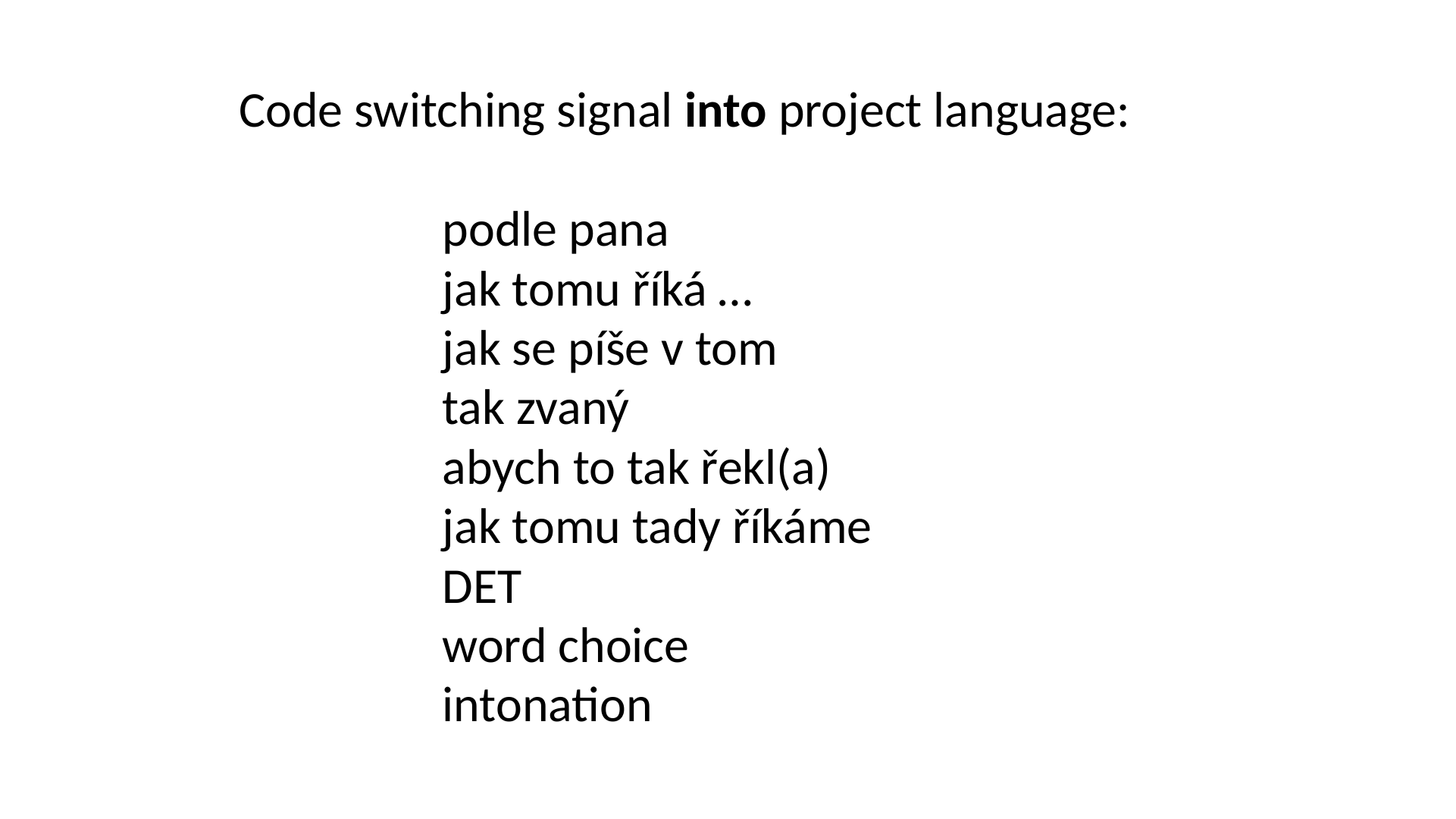
Code switching signal into project language:
- podle pana
- jak tomu říká …
- jak se píše v tom
- tak zvaný
- abych to tak řekl(a)
- jak tomu tady říkáme
- DET
- word choice
- intonation
Slide 21: Code switching signal from project language:
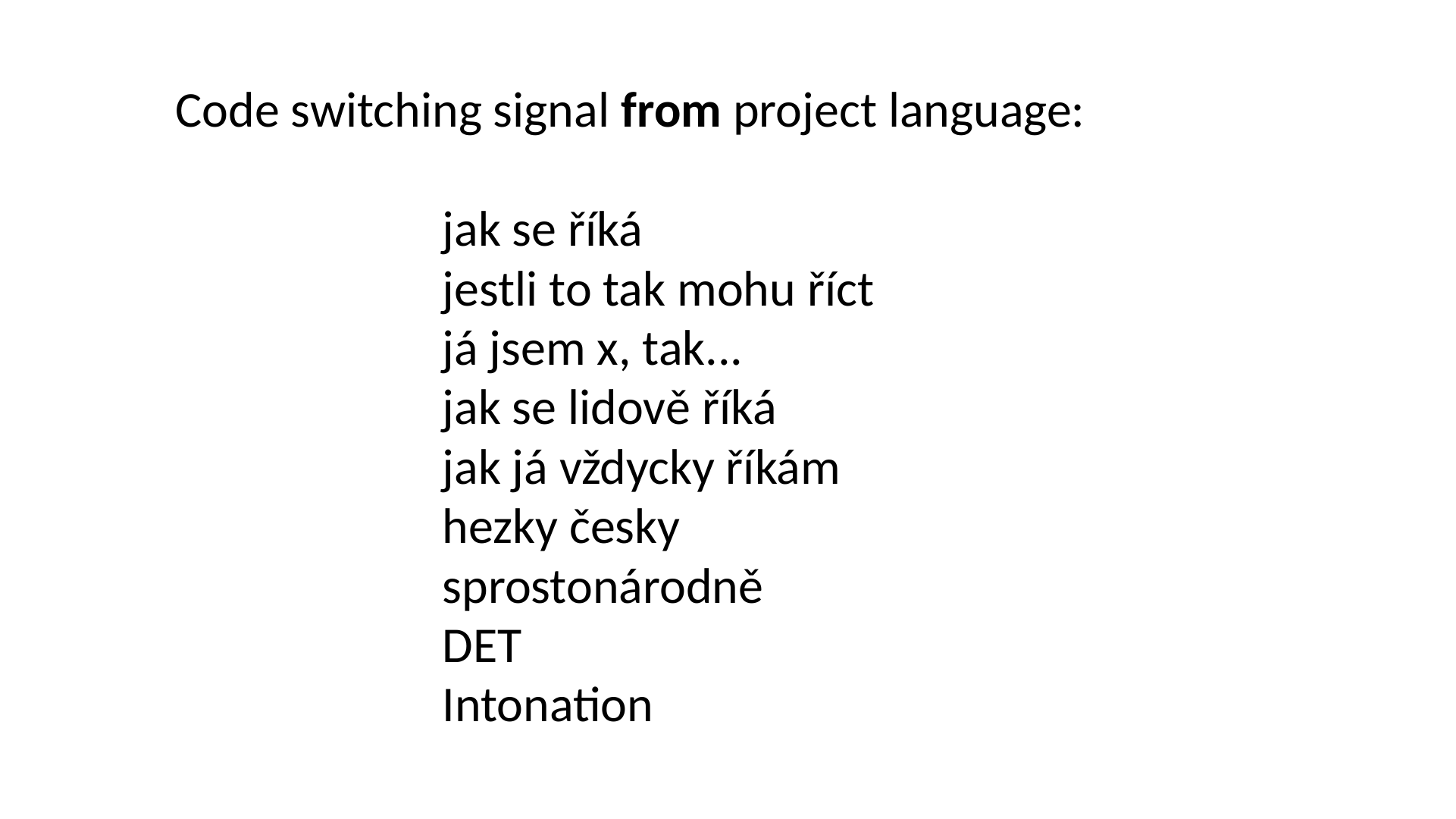
Code switching signal from project language:
- jak se říká
- jestli to tak mohu říct
- já jsem x, tak...
- jak se lidově říká
- jak já vždycky říkám
- hezky česky
- sprostonárodně
- DET
- Intonation
Slide 22: Code switching in informal conversations
Code switching in informal conversations
Oral v1, 6 mil, conversational spoken corpus, 2017
Slide 23: Slide 23
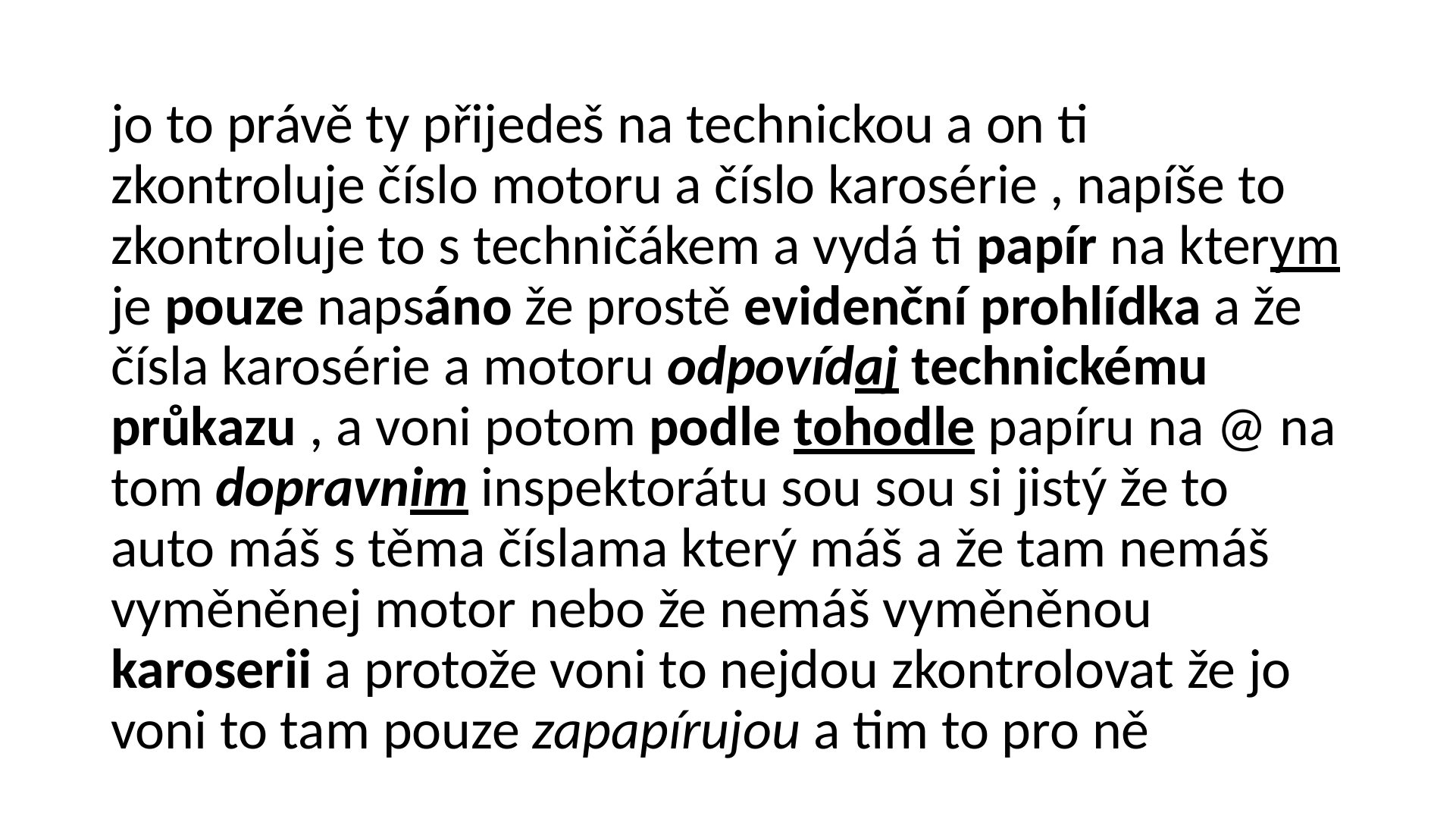
jo to právě ty přijedeš na technickou a on ti zkontroluje číslo motoru a číslo karosérie , napíše to zkontroluje to s techničákem a vydá ti papír na kterym je pouze napsáno že prostě evidenční prohlídka a že čísla karosérie a motoru odpovídaj technickému průkazu , a voni potom podle tohodle papíru na @ na tom dopravnim inspektorátu sou sou si jistý že to auto máš s těma číslama který máš a že tam nemáš vyměněnej motor nebo že nemáš vyměněnou karoserii a protože voni to nejdou zkontrolovat že jo voni to tam pouze zapapírujou a tim to pro ně
Underline in the source slide, kept apart from the bold and italic shown above (the slide underlines these spans; this text has no underline mark): ym in kterym; aj in odpovídaj (also bold and italic); tohodle (also bold); im in dopravnim (also bold and italic).
Slide 24: Slide 24
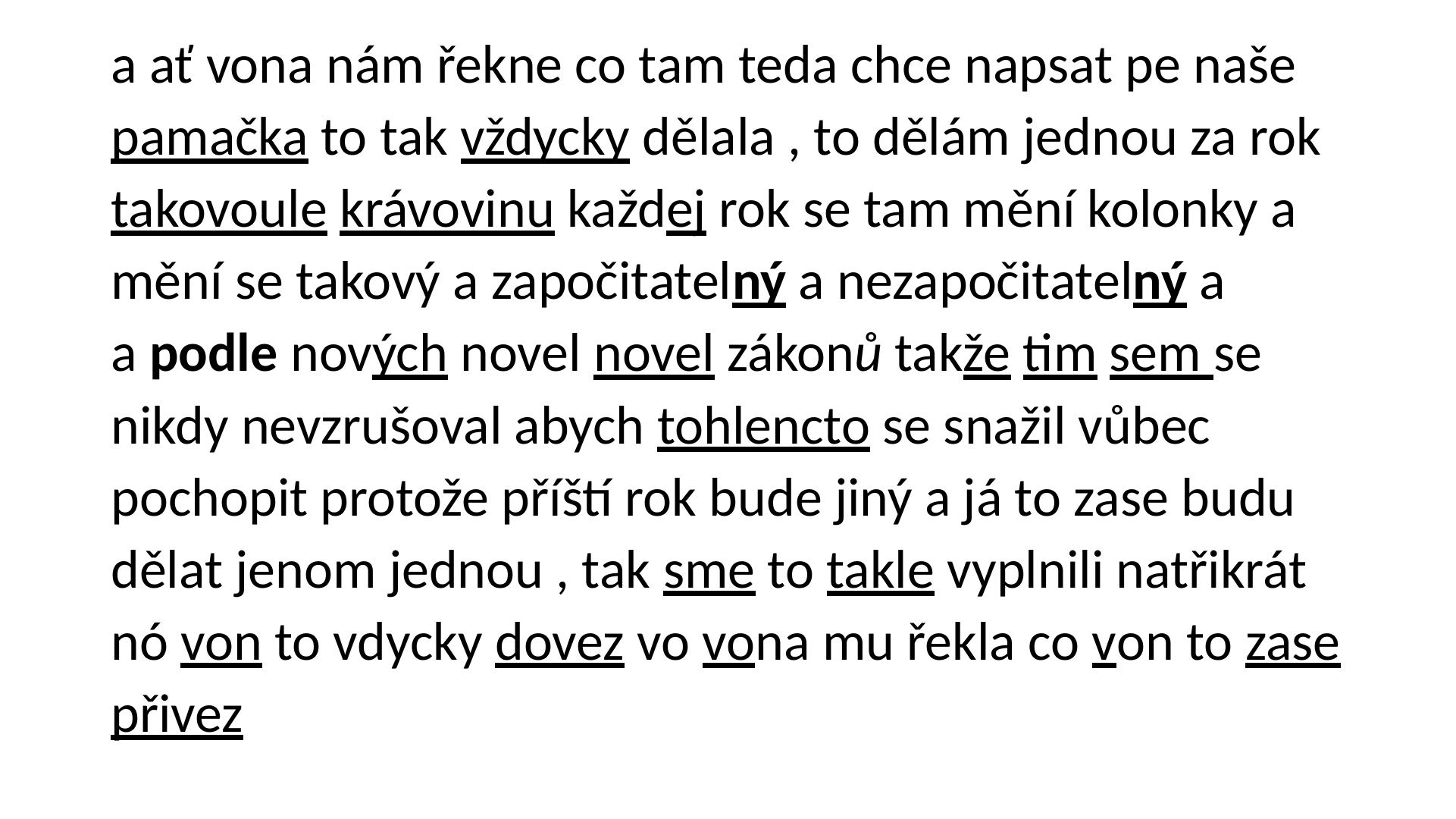
a ať vona nám řekne co tam teda chce napsat pe naše pamačka to tak vždycky dělala , to dělám jednou za rok takovoule krávovinu každej rok se tam mění kolonky a mění se takový a započitatelný a nezapočitatelný a a podle nových novel novel zákonů takže tim sem se nikdy nevzrušoval abych tohlencto se snažil vůbec pochopit protože příští rok bude jiný a já to zase budu dělat jenom jednou , tak sme to takle vyplnili natřikrát nó von to vdycky dovez vo vona mu řekla co von to zase přivez
Underline in the source slide, kept apart from the bold and italic shown above (the slide underlines these spans; this text has no underline mark): pamačka; vždycky; takovoule; krávovinu; ej in každej; ný in započitatelný and in nezapočitatelný (also bold); ých in nových; the second novel; že in takže; tim; sem; tohlencto; sme; takle; von; dovez; vo in vona; v in von; zase; přivez.
Slide 25: spisovně
spisovně
Slide 26: Slide 26
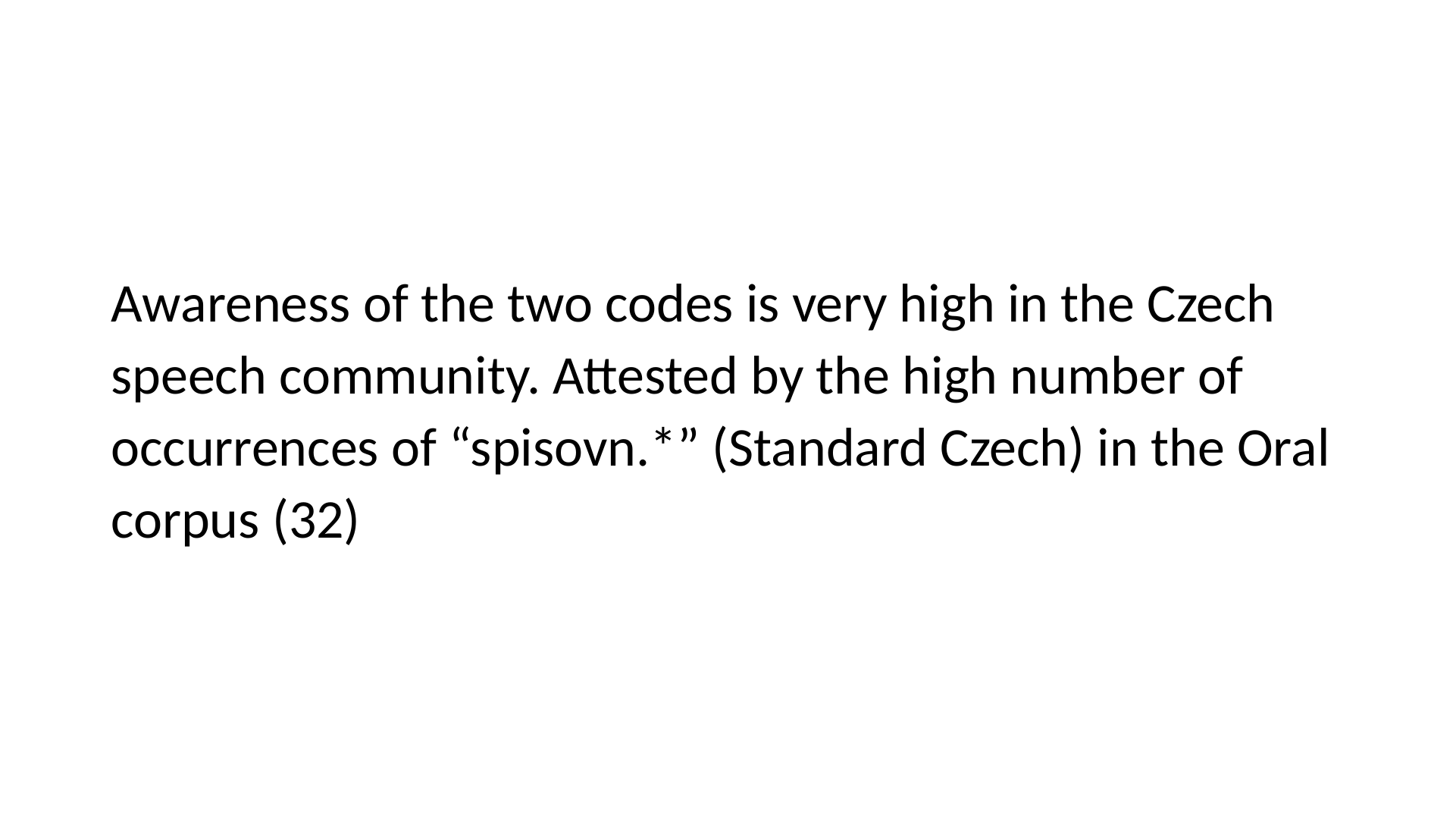
Awareness of the two codes is very high in the Czech speech community. Attested by the high number of occurrences of “spisovn.*” (Standard Czech) in the Oral corpus (32)
Slide 27: Slide 27
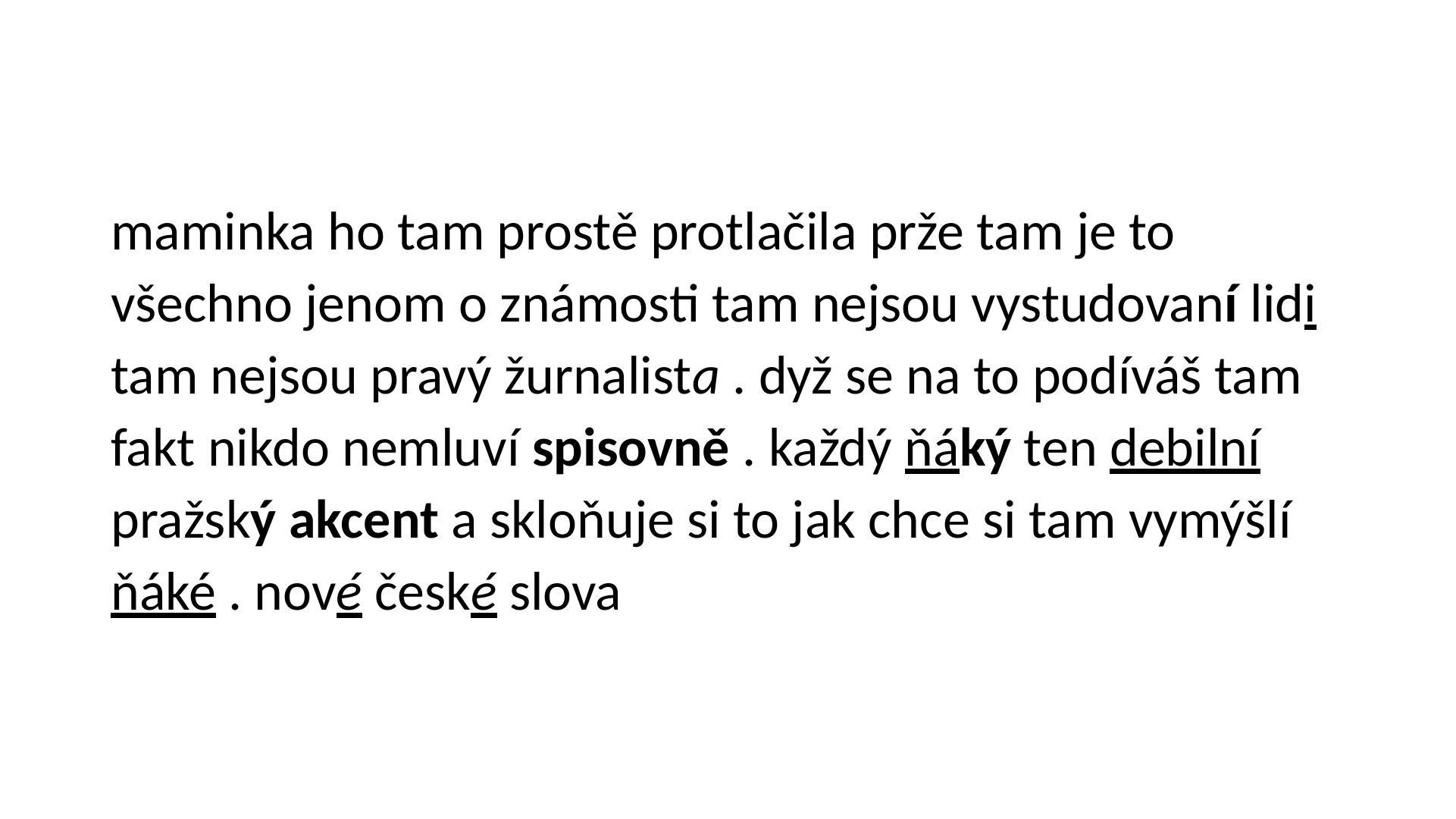
maminka ho tam prostě protlačila prže tam je to všechno jenom o známosti tam nejsou vystudovaní lidi tam nejsou pravý žurnalista . dyž se na to podíváš tam fakt nikdo nemluví spisovně . každý ňáký ten debilní pražský akcent a skloňuje si to jak chce si tam vymýšlí ňáké . nové české slova
Underline in the source slide, kept apart from the bold and italic shown above (the slide underlines these spans; this text has no underline mark): i in lidi; ňá in ňáký; debilní; ňáké; é in nové and in české (also italic).
Slide 28: Slide 28
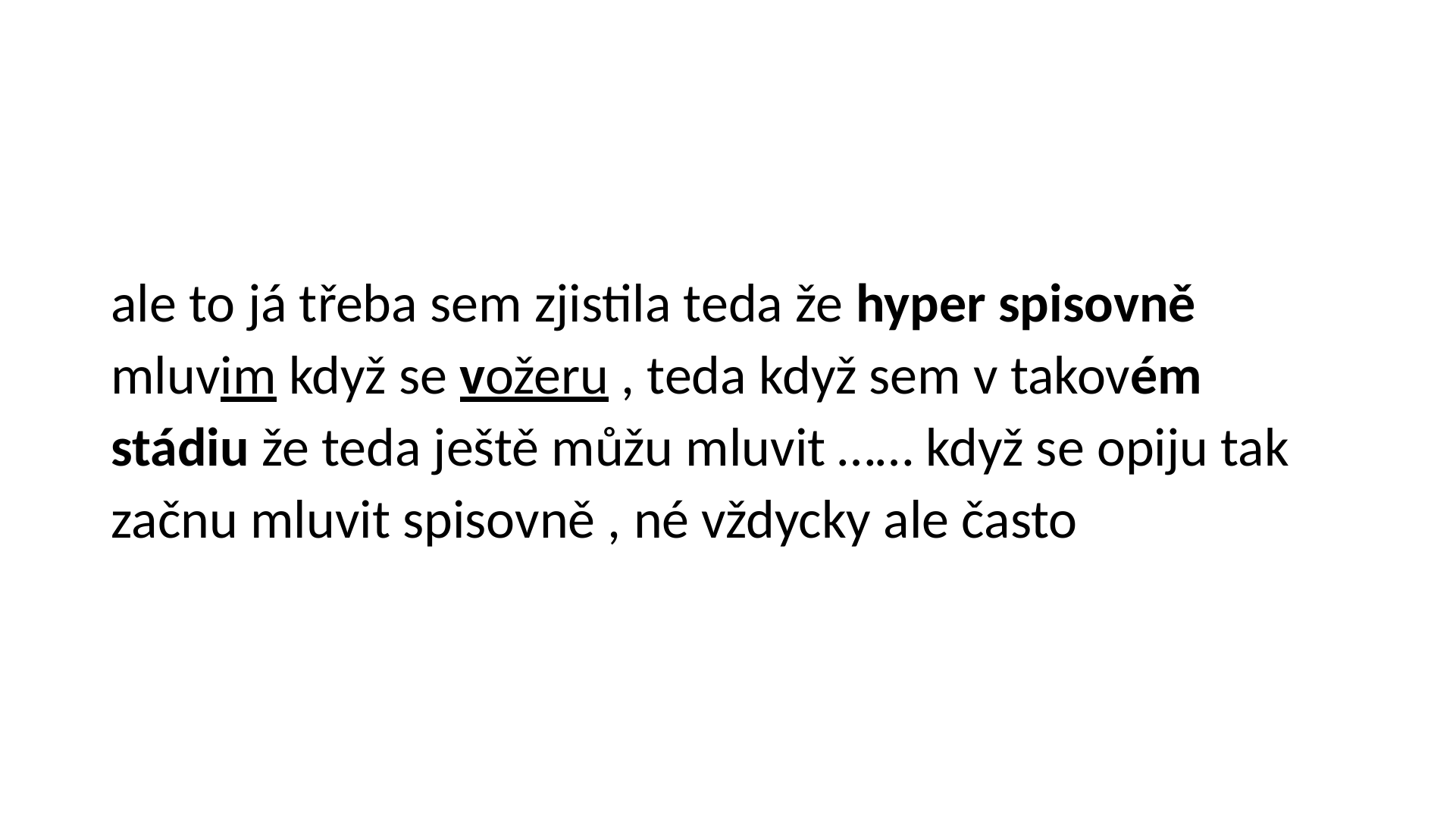
ale to já třeba sem zjistila teda že hyper spisovně mluvim když se vožeru , teda když sem v takovém stádiu že teda ještě můžu mluvit …… když se opiju tak začnu mluvit spisovně , né vždycky ale často
Underline in the source slide, kept apart from the bold and italic shown above (the slide underlines these spans; this text has no underline mark): im in mluvim; vožeru (also bold on the v).
Slide 29: Slide 29
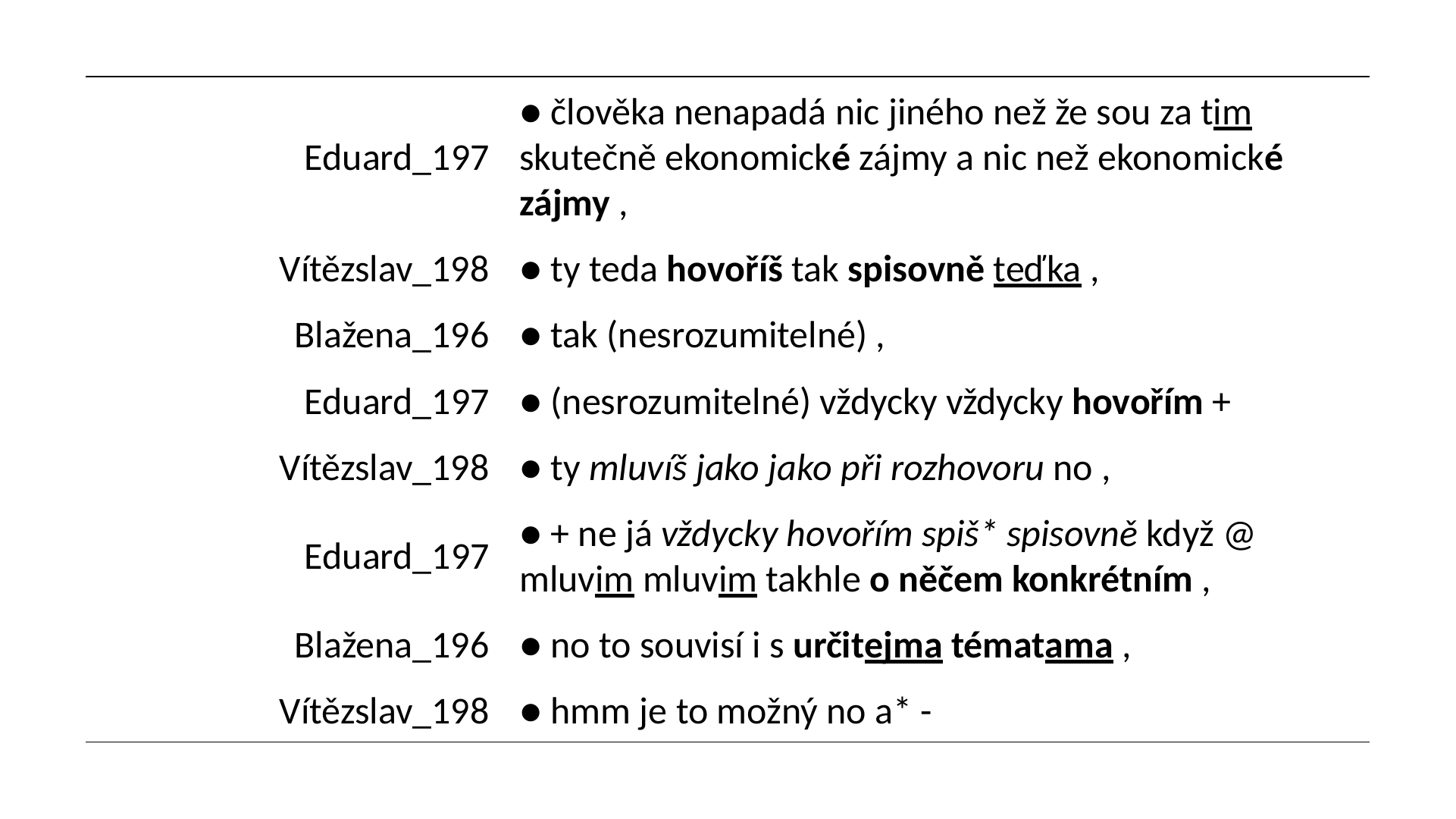
| Eduard_197 | ● člověka nenapadá nic jiného než že sou za tim skutečně ekonomické zájmy a nic než ekonomické zájmy , |
| Vítězslav_198 | ● ty teda hovoříš tak spisovně teďka , |
| Blažena_196 | ● tak (nesrozumitelné) , |
| Eduard_197 | ● (nesrozumitelné) vždycky vždycky hovořím + |
| Vítězslav_198 | ● ty mluvíš jako jako při rozhovoru no , |
| Eduard_197 | ● + ne já vždycky hovořím spiš* spisovně když @ mluvim mluvim takhle o něčem konkrétním , |
| Blažena_196 | ● no to souvisí i s určitejma tématama , |
| Vítězslav_198 | ● hmm je to možný no a* - |
Underline in the source slide, kept apart from the bold and italic shown above (the slide underlines these spans; this text has no underline mark): im in tim; teďka; im in each of the two mluvim; ejma in určitejma (also bold); ama in tématama (also bold).
Slide 30: hezky česky
hezky česky
Slide 31: Slide 31
Jestliže si národ dokáže bez váhání odpovědět na klasické Gercenovo Kto vinovat ? , pak je přece jen složitější najít rozumnou odpověď na Černyševského Što dělať ? , tedy kromě Uljanovova velmi nedemokraticky zjednodušujícího Streljať . Část odpovědi nabízejí takzvaní whistlebloweři , hezky česky „ píšťalkáři “ , kteří se neváhají vzepřít zaběhlému „ modu vivendi “ a jít proti proudu tím , že ohlásí případy korupce ve svém okolí .
Underline in the source slide, kept apart from the bold and italic shown above (the slide underlines these spans; this text has no underline mark): whistlebloweři.
Slide 32: Slide 32
Netvařme se , jako že je všechno v pořádku a že v této zemi všichni žijí šťastné životy . Právě na takové pokrytectví dojela – jak se hezky česky říká – většina tzv. komunistických režimů . S tím pak bezprostředně souvisí můj druhý návrh . Přestaňme se bát levicové literatury ! Levicoví , opoziční autoři nejsou v této republice – na rozdíl od disidentů normalizačních let – mocensky nijak pronásledováni .
Slide 33: Slide 33
Režisérka Andrea Sedláčková režíruje Vojtěcha Dyka v roli tak trochu jiného Dannyho Smiřického . Ať žijí hudební paraziti Přiživování se na popularitě jiných , nebo tvůrčí posun nabízející nový pohled ? Coververze neboli nehezky česky "předělávky" jsou příjemným zpestřením populární hudby . Ve světě coververzí se fantazii meze nekladou . Existují country úpravy punkových Sex Pistols i překopané skladby Rolling Stones hrané na ukulele .
Underline in the source slide, kept apart from the bold and italic shown above (the slide underlines these spans; this text has no underline mark): ne in nehezky (also bold).
Slide 34: Can we think of this phenomenon constructionally?
Can we think of this phenomenon constructionally?
Slide 35: Slide 35
At first blush, the data does not appear have enough formal regularity to be described within the framework of construction grammar.
Slide 36: Slide 36
To adopt a constructional approach is to undertake a commitment in principle to account for the entirety of each language.
— (Fillmore and Kay, 1999)
Slide 37: What do constructions “look” like?
What do constructions “look” like?
Slide 38: Slide 38
- form:meaning pairing
- organized in an inventory
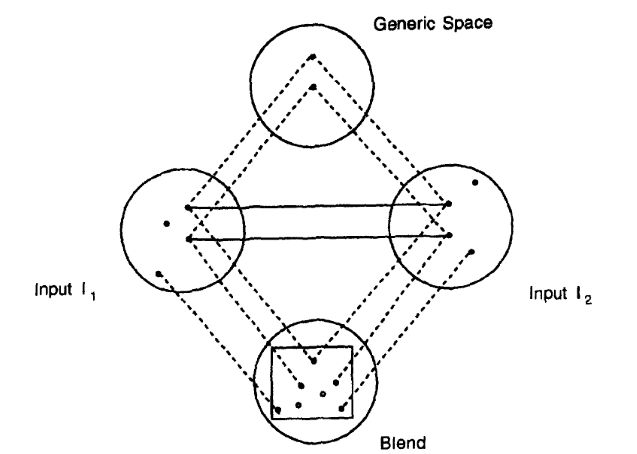
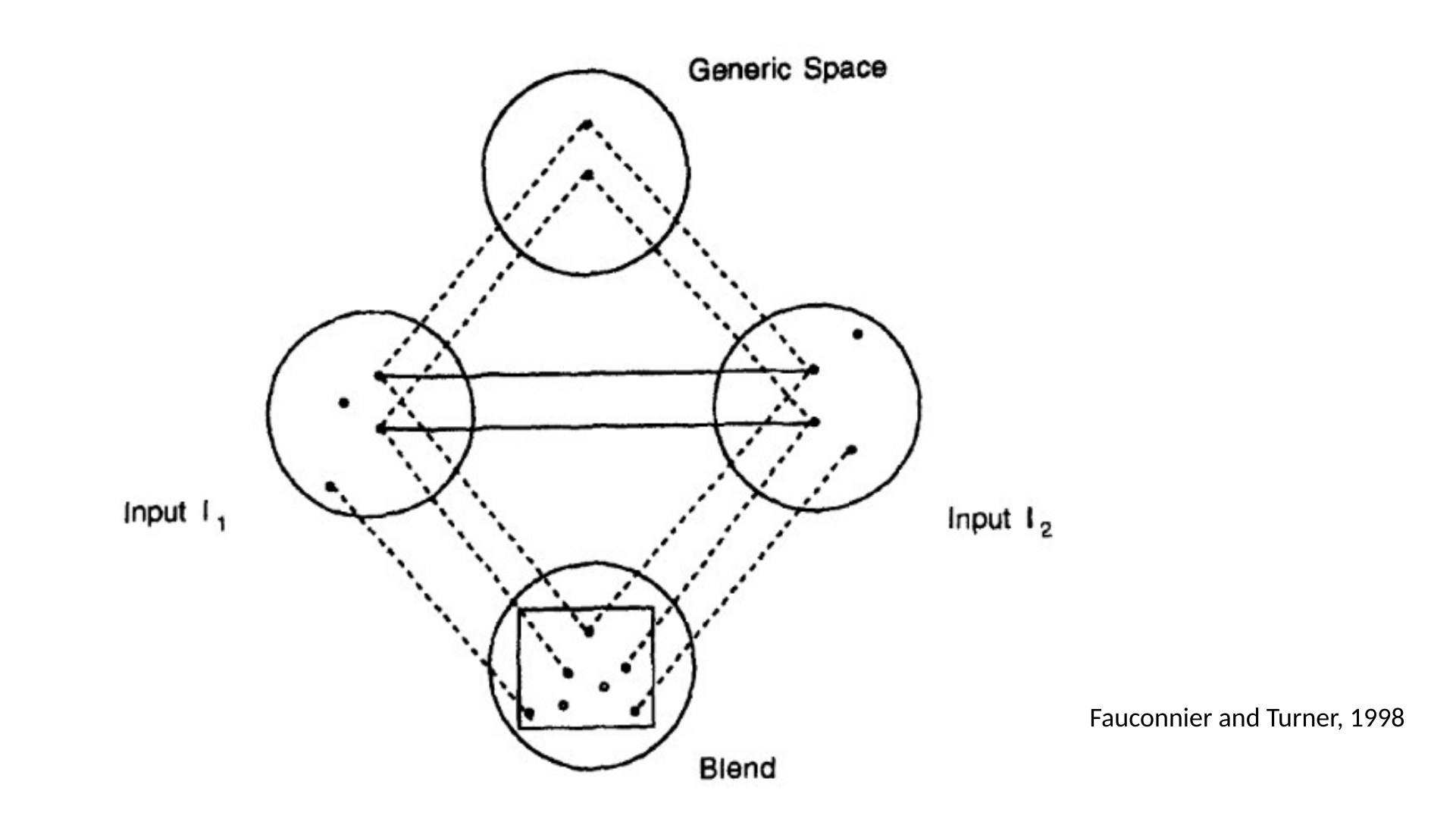
- processed through the process of blending
Slide 39: Slide 39
On the semantic pole meanings are organized through frames (schemas, metaphors, rich images, scenarios, etc.).
Different levels of schematicity and knowledge of the world are required.
Slide 40: What does semantic schematicity look like?
What does semantic schematicity look like?
Slide 41: Slide 41
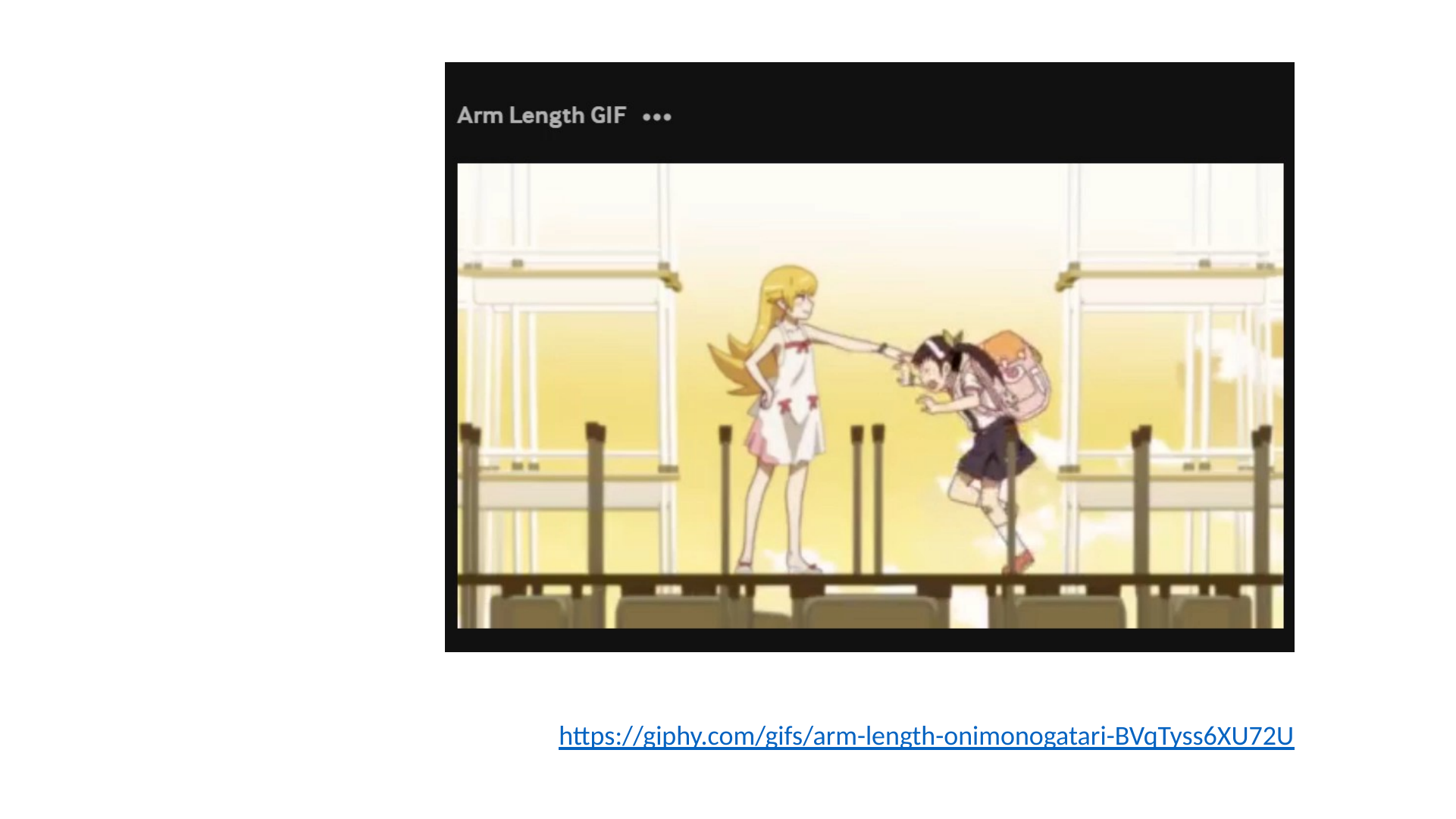
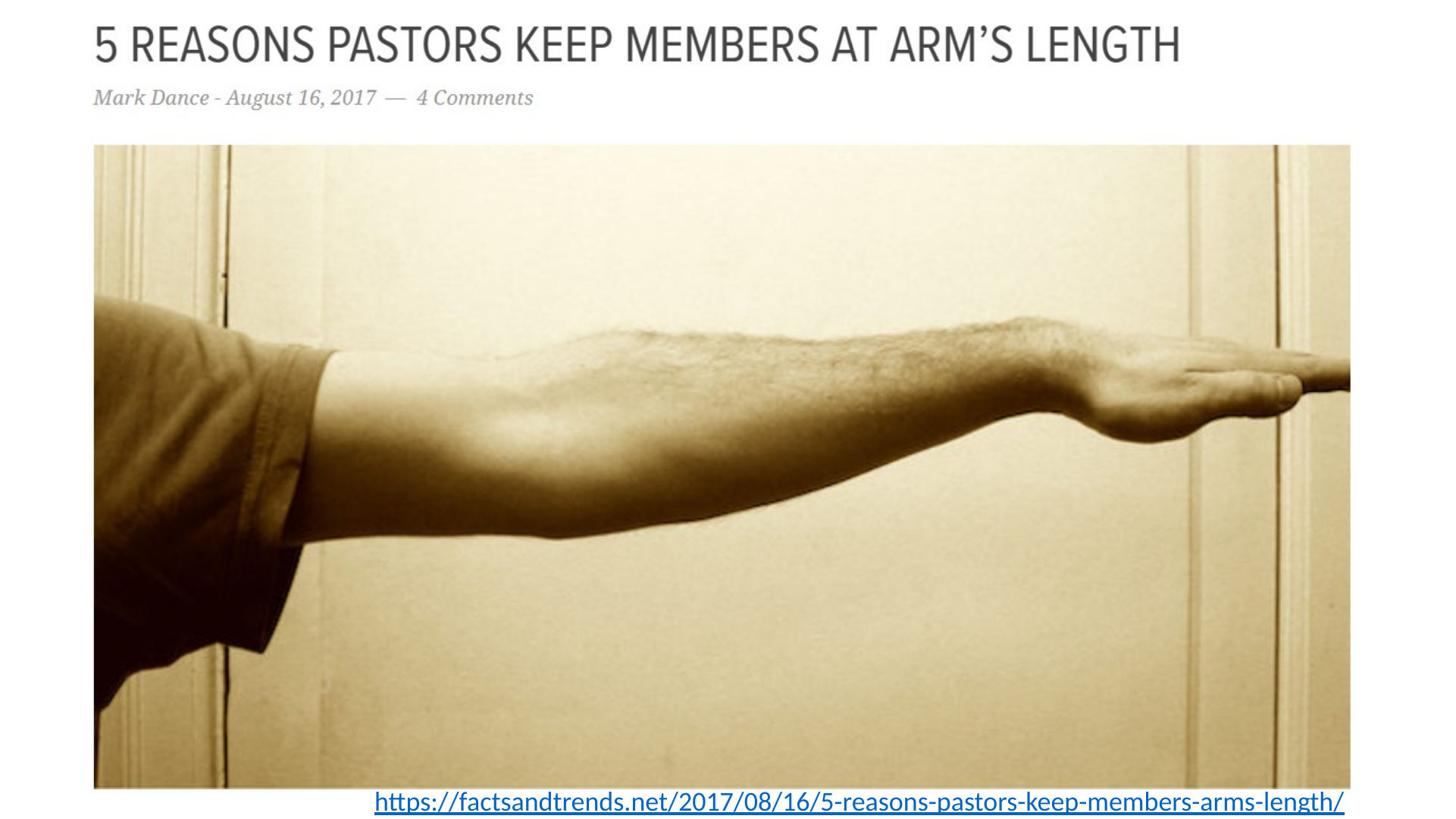
“Consider the idiom to keep someone at arm's length. I have asked hundreds of people if they have an image associated with this idiom. Almost everyone does, and it is almost always the same image.”
— (Lakoff 1987)
Slide 42: Slide 42
“The arm is oriented forward with respect to the body, perhaps a little to the side. It is never oriented backward. or upward. or downward, though these are all logical possibilities.
The arm is chest high.
The hand is usually open (though some have it making a fist).
The open palm is facing away from the subject; it is never facing toward the subject.
The angle of the hand relative to the forearm is roughly 90 to 135 degrees.
The arm muscles are tense, not lax. The person being kept at arm's length is facing toward the subject.”
— (Lakoff 1987)
Slide 43: At arm’s length
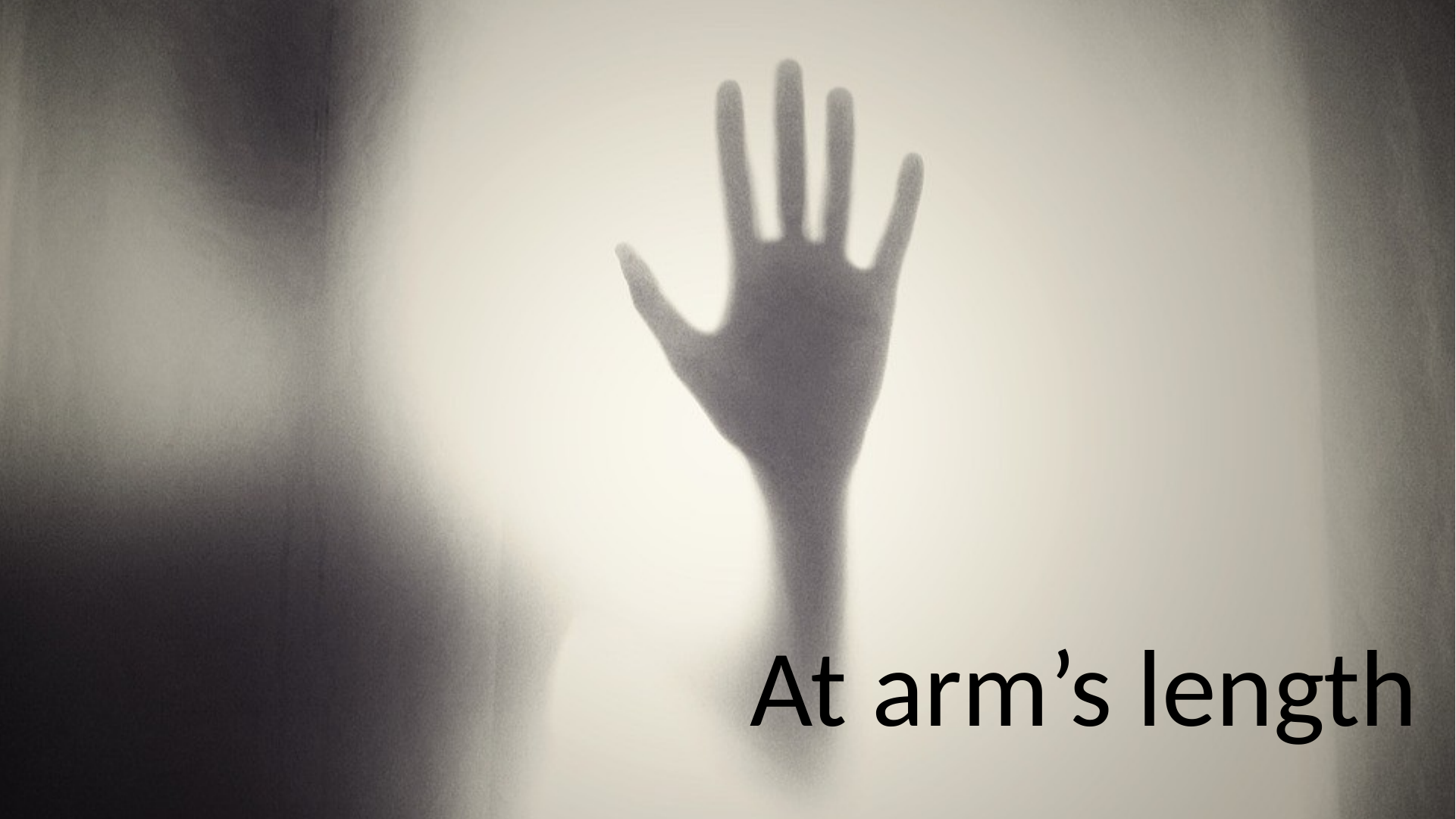
At arm’s length

Slide 44: Slide 44


Slide 45: Slide 45
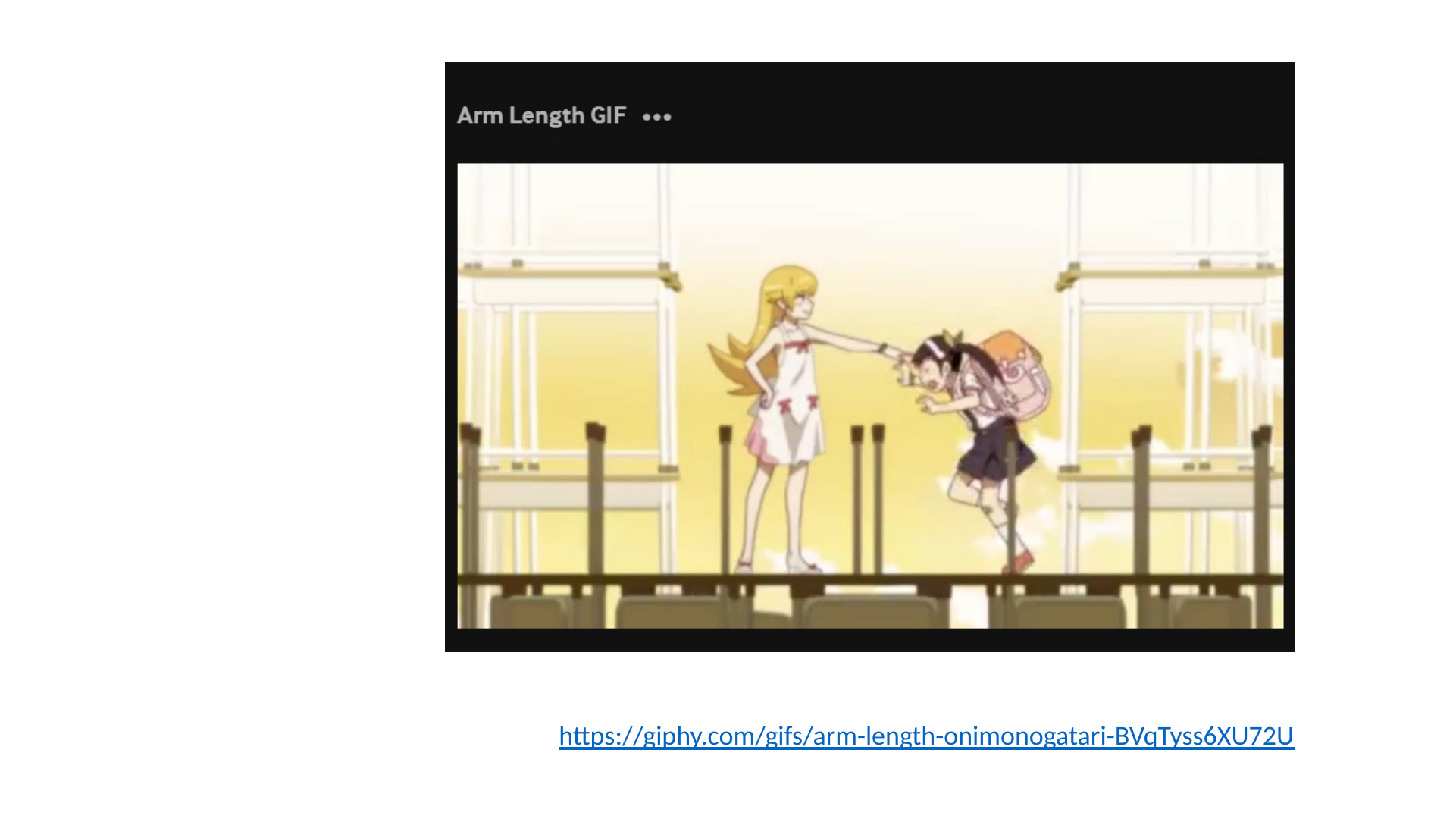
https://giphy.com/gifs/arm-length-onimonogatari-BVqTyss6XU72U
Slide 46: Slide 46
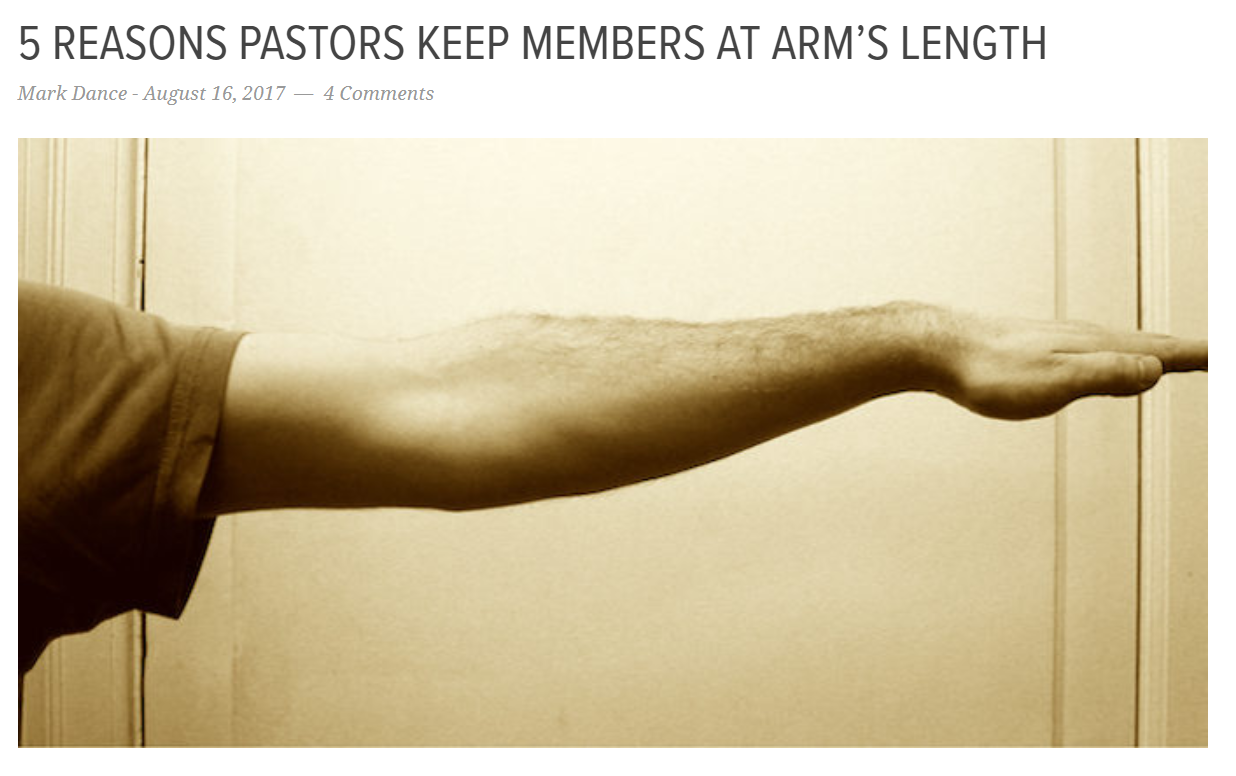
https://factsandtrends.net/2017/08/16/5-reasons-pastors-keep-members-arms-length/
Slide 47: Slide 47
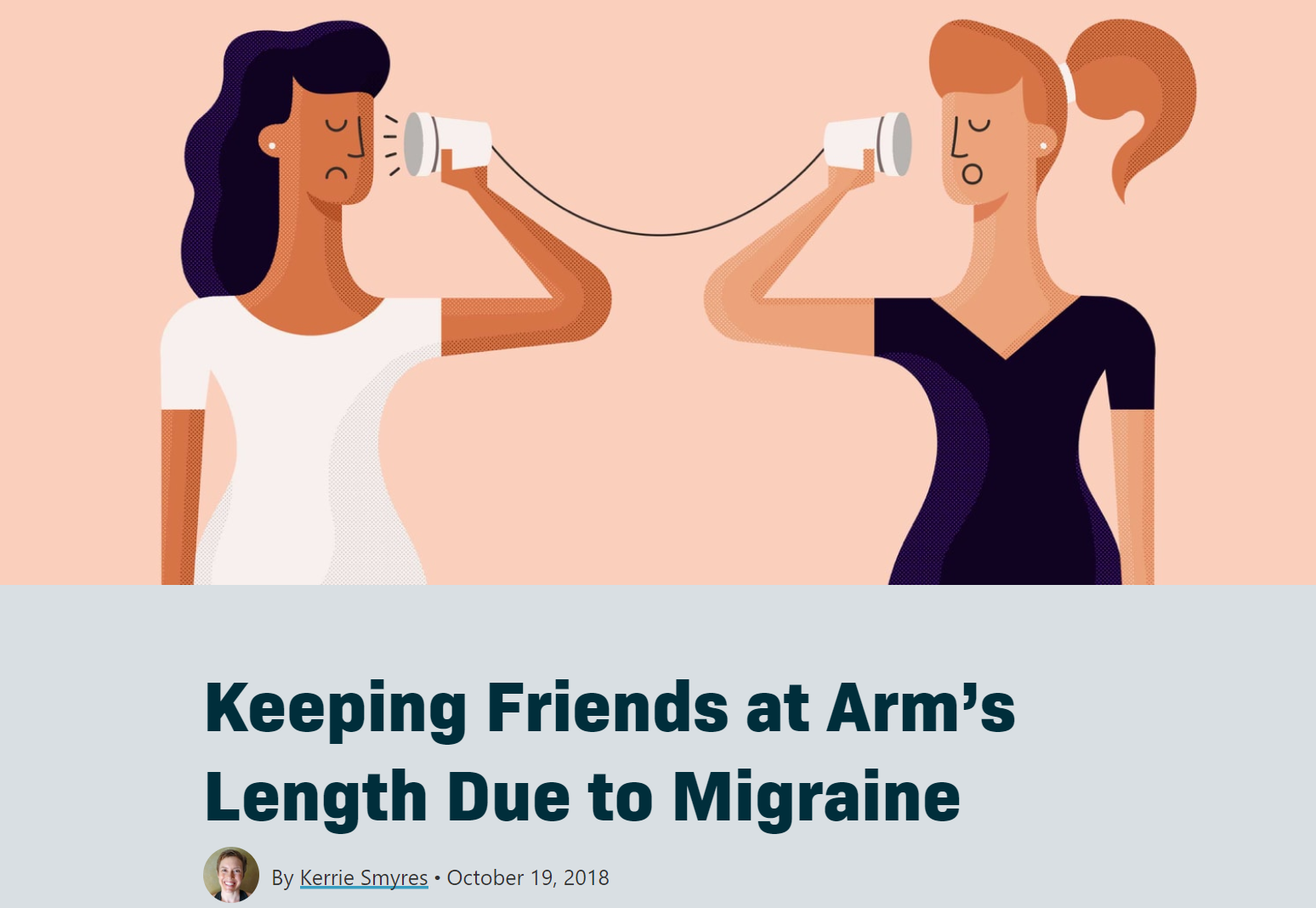
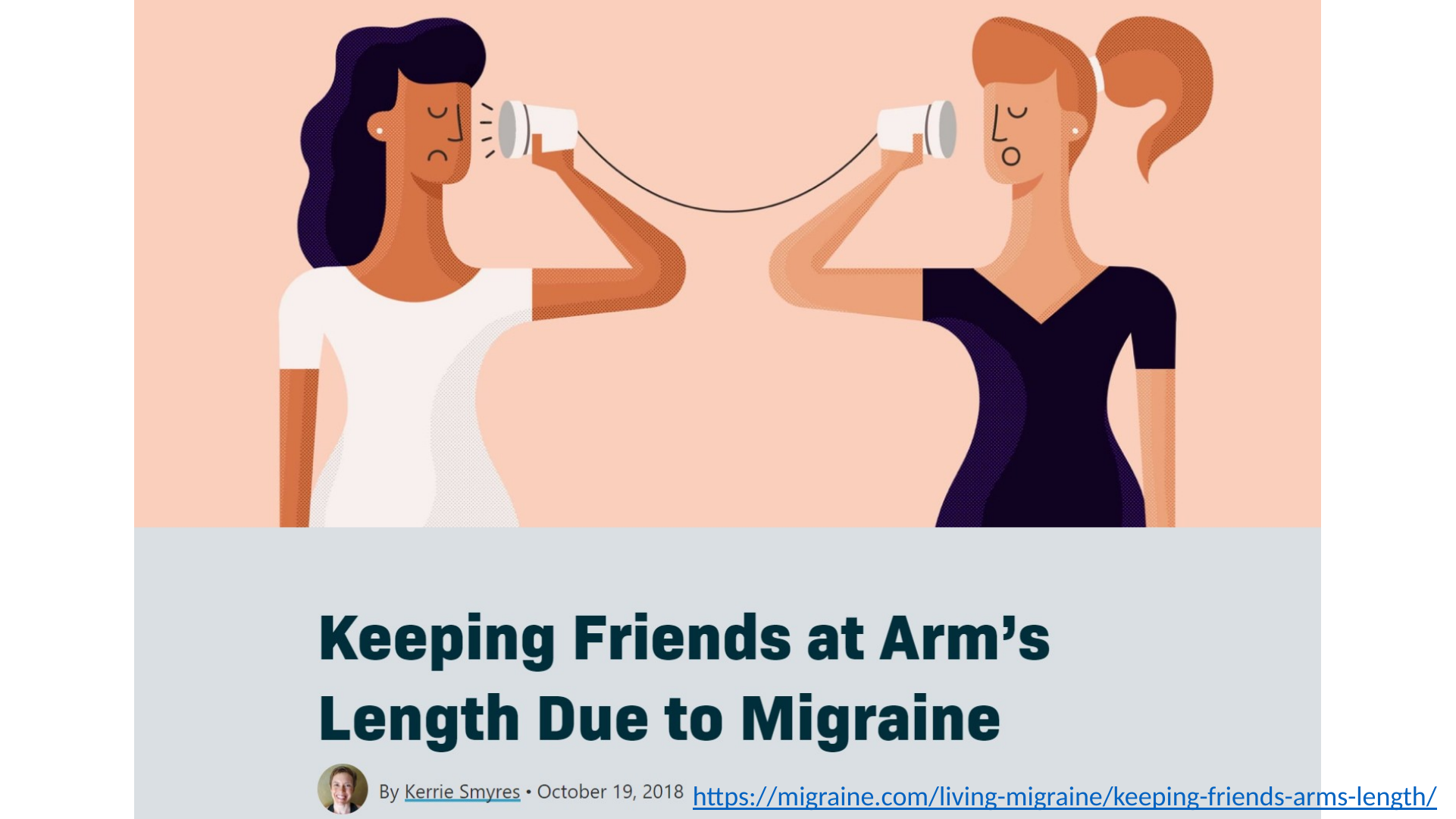
https://migraine.com/living-migraine/keeping-friends-arms-length/
Slide 48: What does a ‘formal’ schema look like?
What does a ‘formal’ schema look like?
Slide 49: Slide 49
the construction grammarian is required to develop an explicit system of representation, capable of encoding economically and without loss of generalization all the constructions (or patterns) of the language, from the most idiomatic to the most general.
— (Fillmore and Kay, 1999)
Slide 50: Slide 50
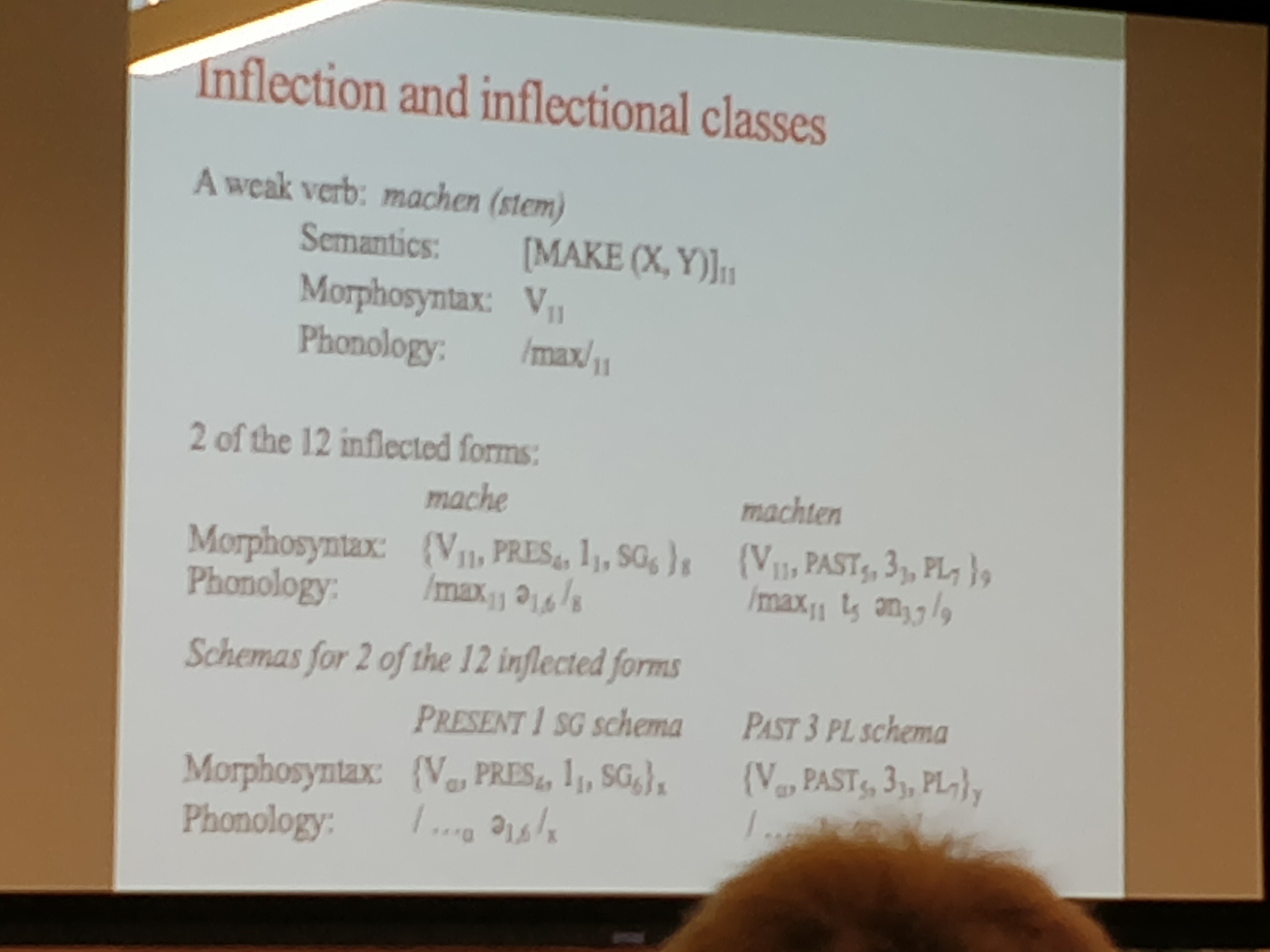
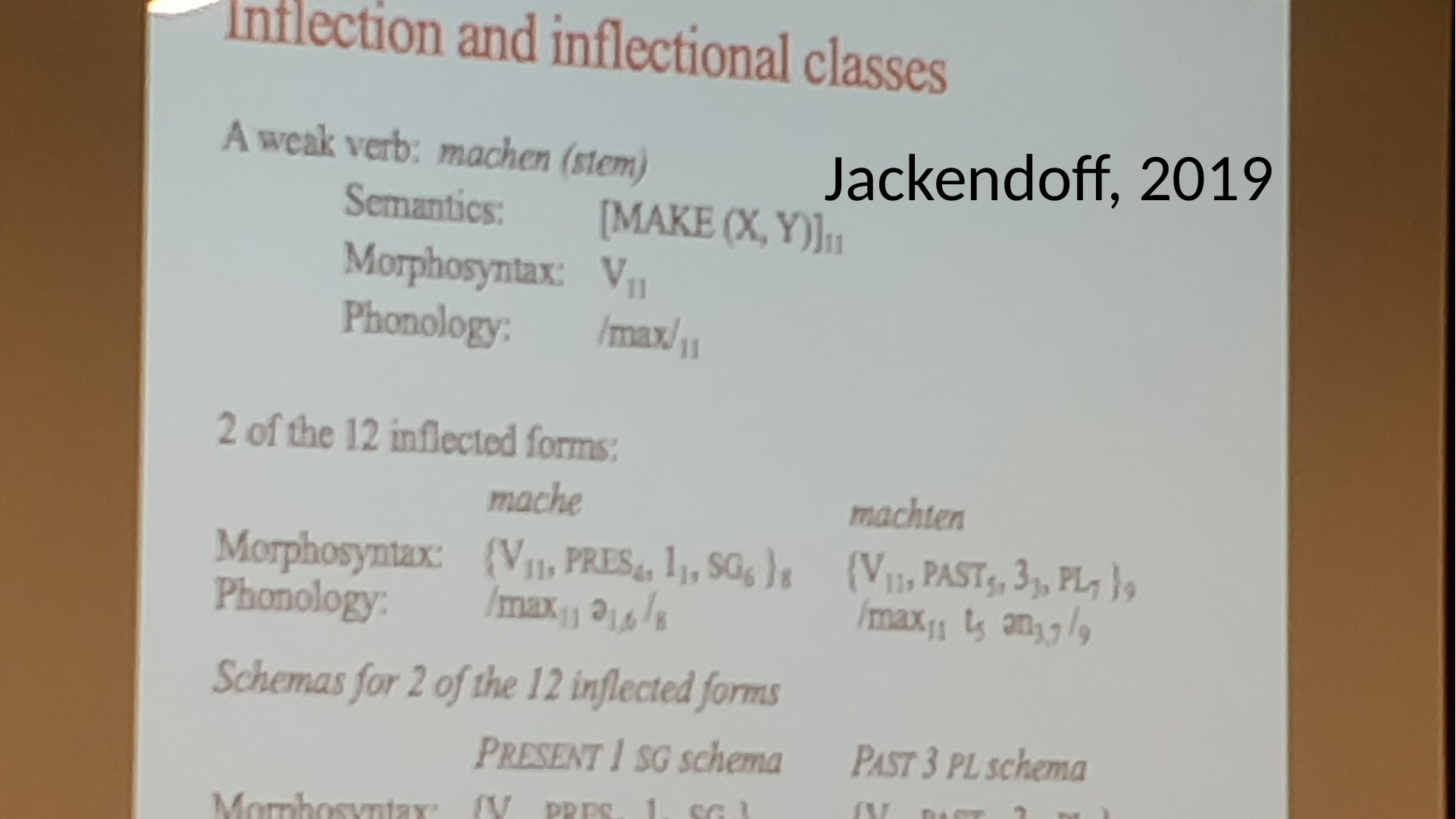
There is a conflict between the constructional commitment to describe the entirety of each language and the scientific notion of descriptive parsimony when expressed through formalisms and ‘machine readable’ notations.
Slide 51: Jackendoff, 2019
Jackendoff, 2019
Slide 52: Fauconnier and Turner, 1998
Fauconnier and Turner, 1998
Slide 53: What does this look like for constructional forms?
What does this look like for constructional forms?
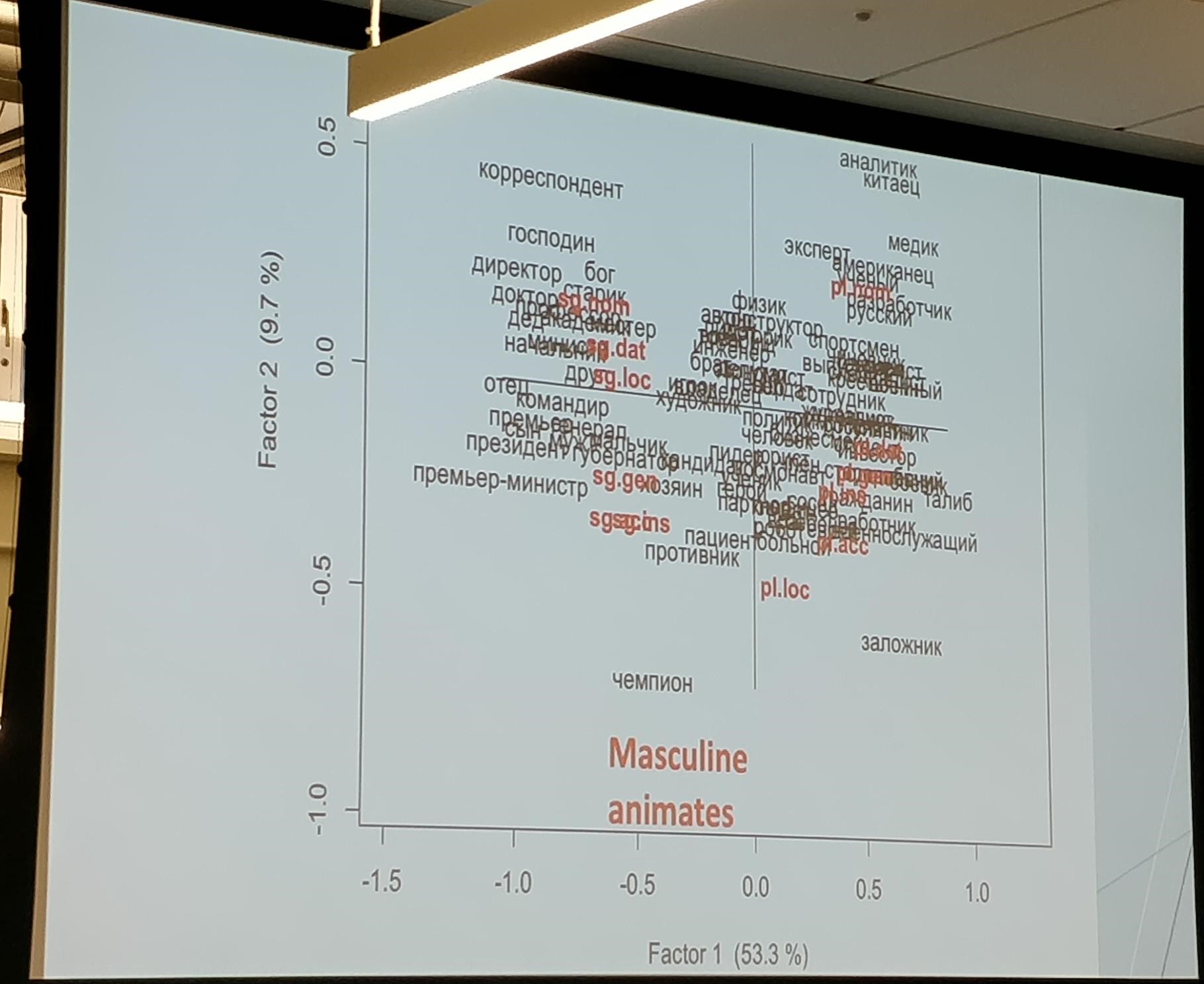
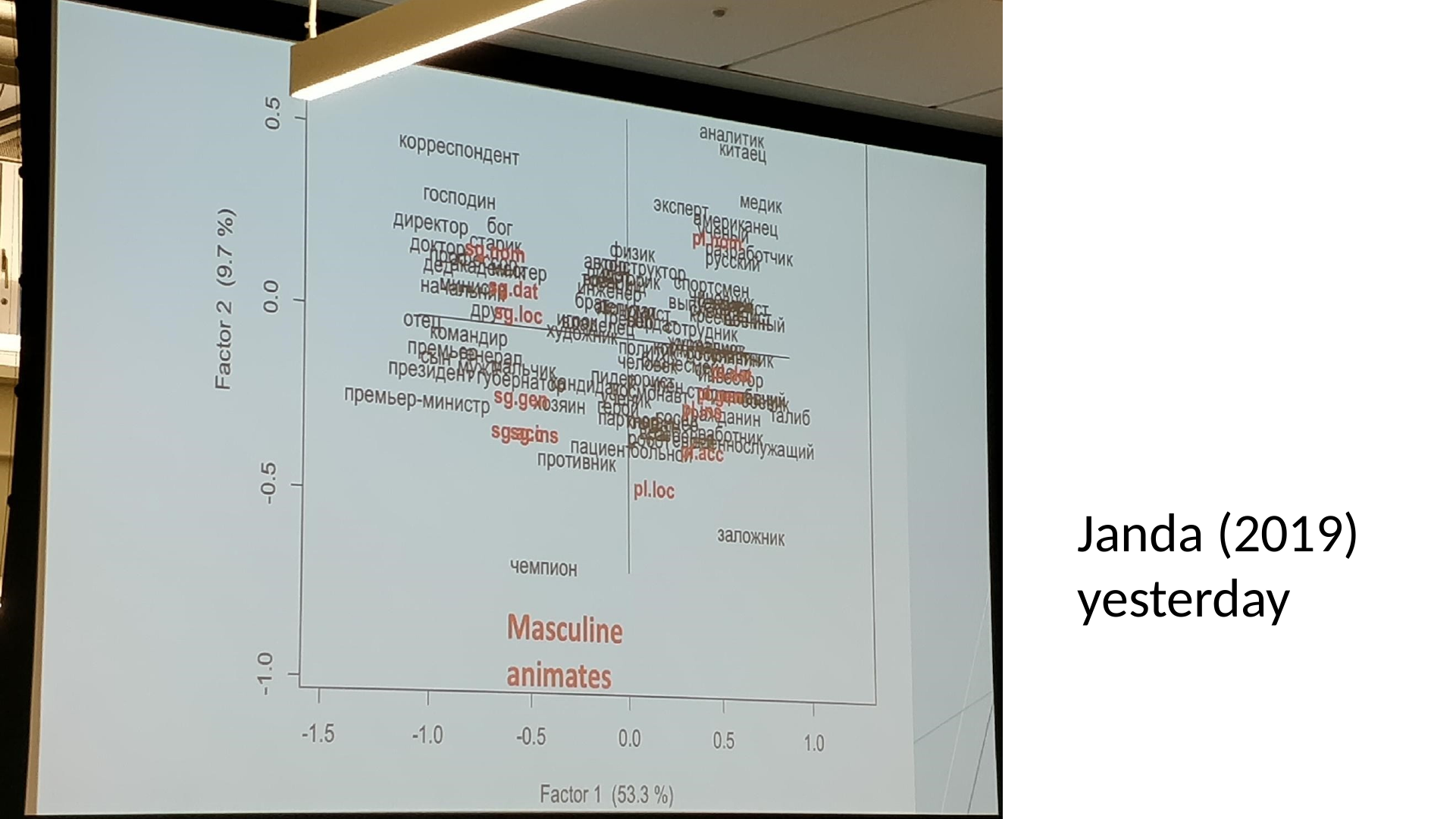
Slide 54: Janda (2019)
Janda (2019)
yesterday
Slide 55: Slide 55
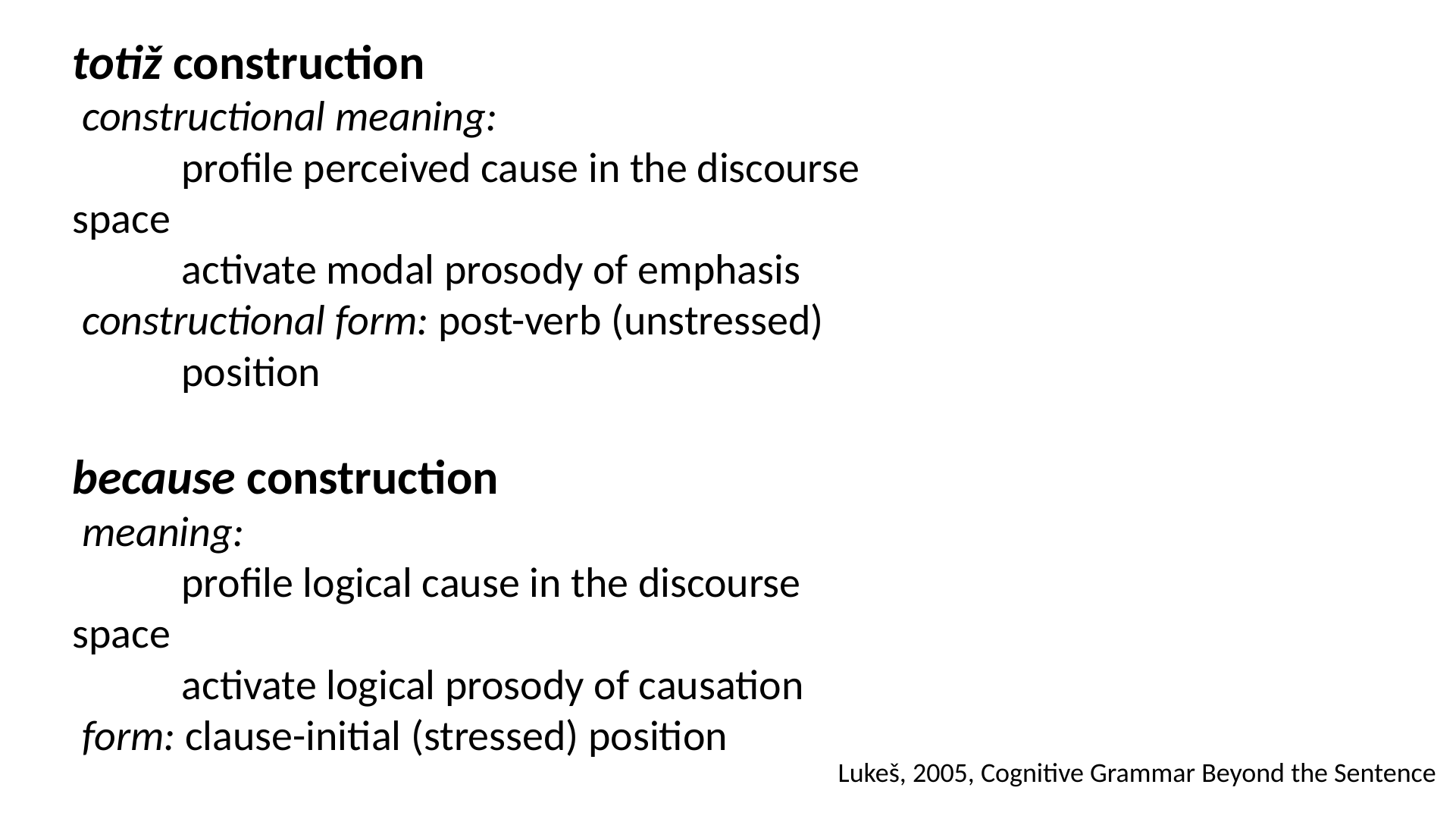
- totiž construction
- constructional meaning:
- profile perceived cause in the discourse space
- activate modal prosody of emphasis
- constructional form: post-verb (unstressed) position
- constructional meaning:
- because construction
- meaning:
- profile logical cause in the discourse space
- activate logical prosody of causation
- form: clause-initial (stressed) position
- meaning:
Lukeš, 2005, Cognitive Grammar Beyond the Sentence
Slide 56: Slide 56
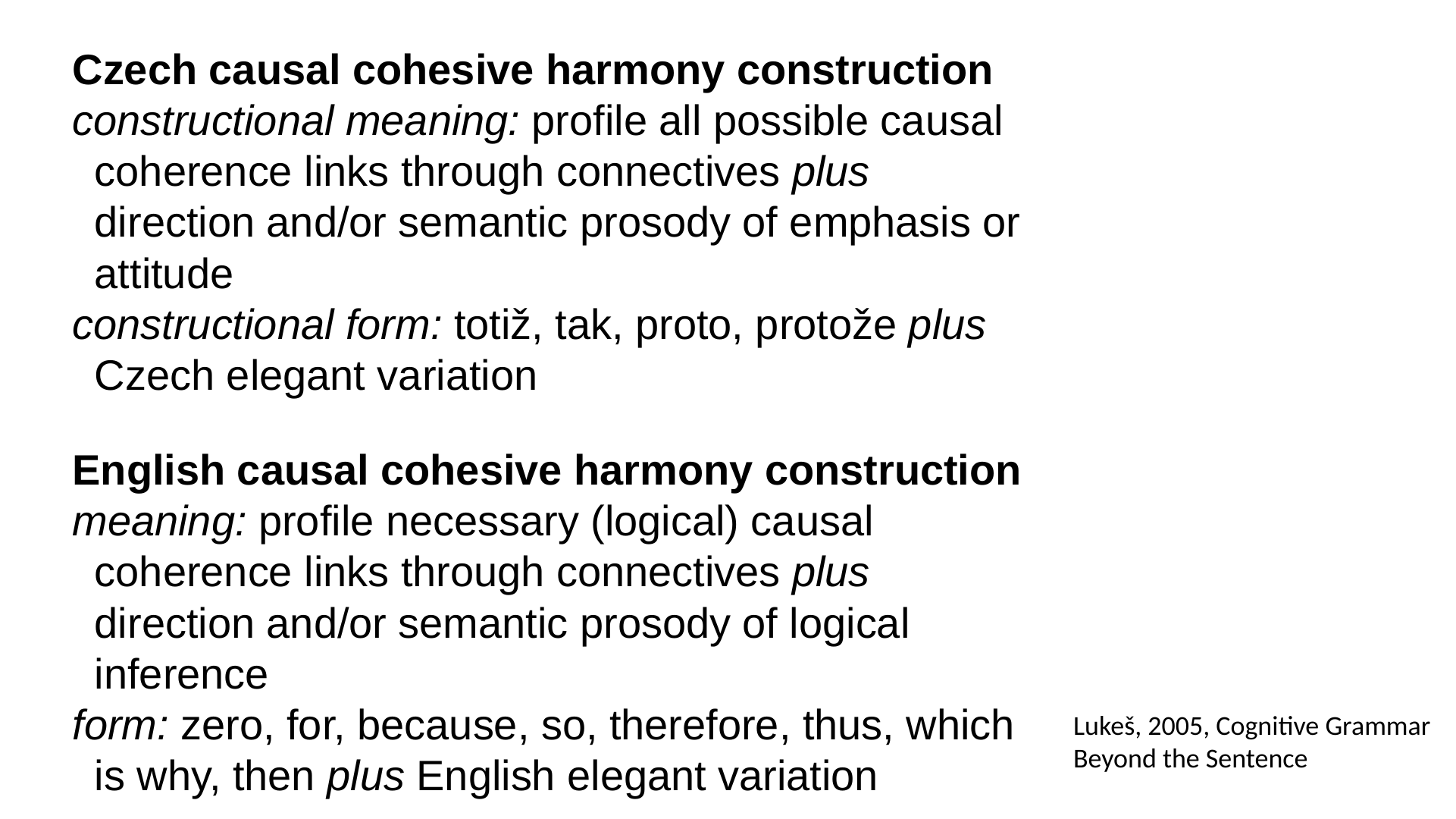
- Czech causal cohesive harmony construction
- constructional meaning: profile all possible causal coherence links through connectives plus direction and/or semantic prosody of emphasis or attitude
- constructional form: totiž, tak, proto, protože plus Czech elegant variation
- English causal cohesive harmony construction
- meaning: profile necessary (logical) causal coherence links through connectives plus direction and/or semantic prosody of logical inference
- form: zero, for, because, so, therefore, thus, which is why, then plus English elegant variation
Lukeš, 2005, Cognitive Grammar Beyond the Sentence
Slide 57: Slide 57
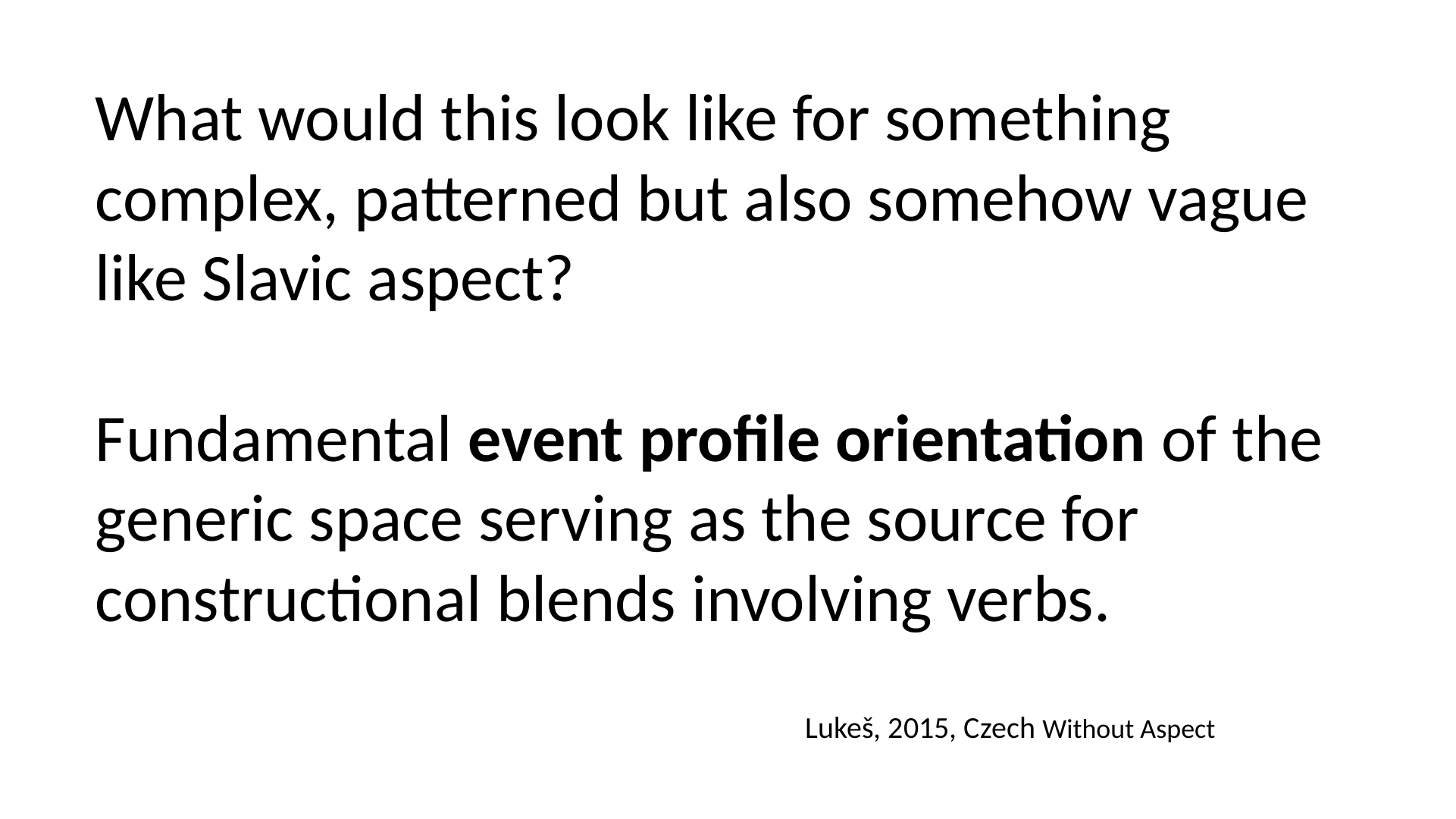
What would this look like for something complex, patterned but also somehow vague like Slavic aspect?
Fundamental event profile orientation of the generic space serving as the source for constructional blends involving verbs.
Lukeš, 2015, Czech Without Aspect
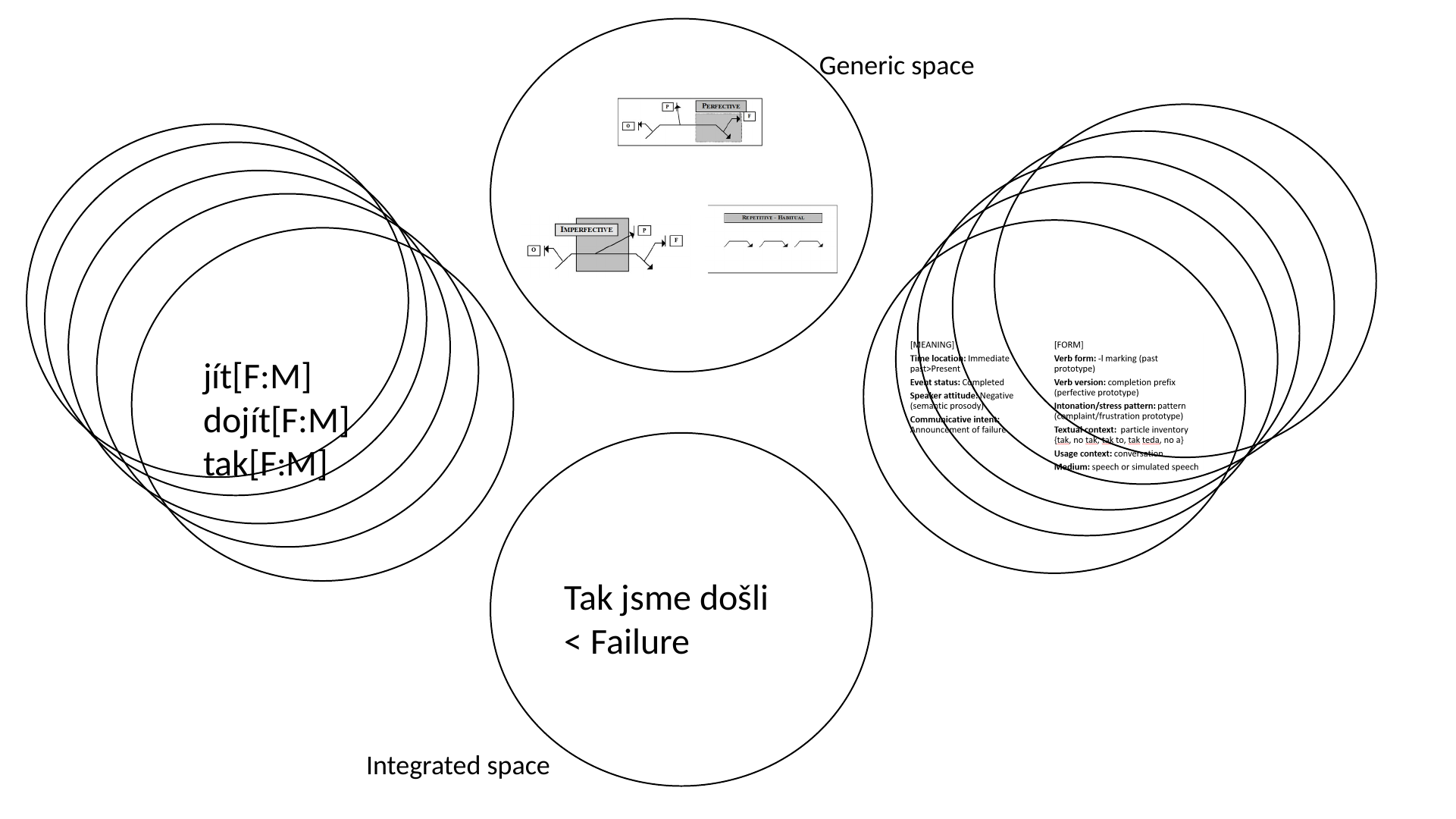
Slide 58: Tak jsme došli. < Failure
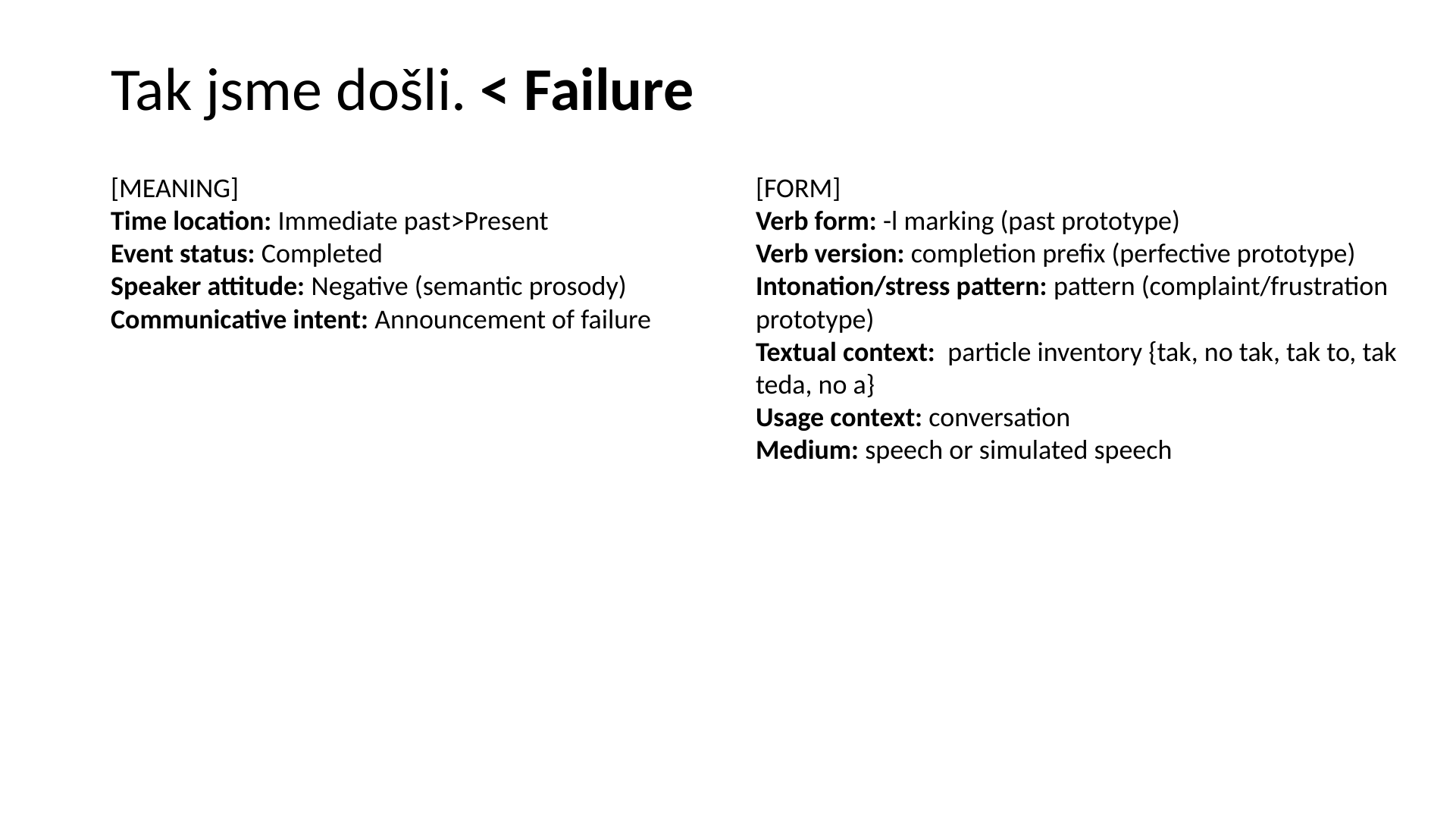
Tak jsme došli. < Failure
- [MEANING]
- Time location: Immediate past>Present
- Event status: Completed
- Speaker attitude: Negative (semantic prosody)
- Communicative intent: Announcement of failure
- [FORM]
- Verb form: -l marking (past prototype)
- Verb version: completion prefix (perfective prototype)
- Intonation/stress pattern: pattern (complaint/frustration prototype)
- Textual context: particle inventory {tak, no tak, tak to, tak teda, no a}
- Usage context: conversation
- Medium: speech or simulated speech
Slide 59: Slide 59
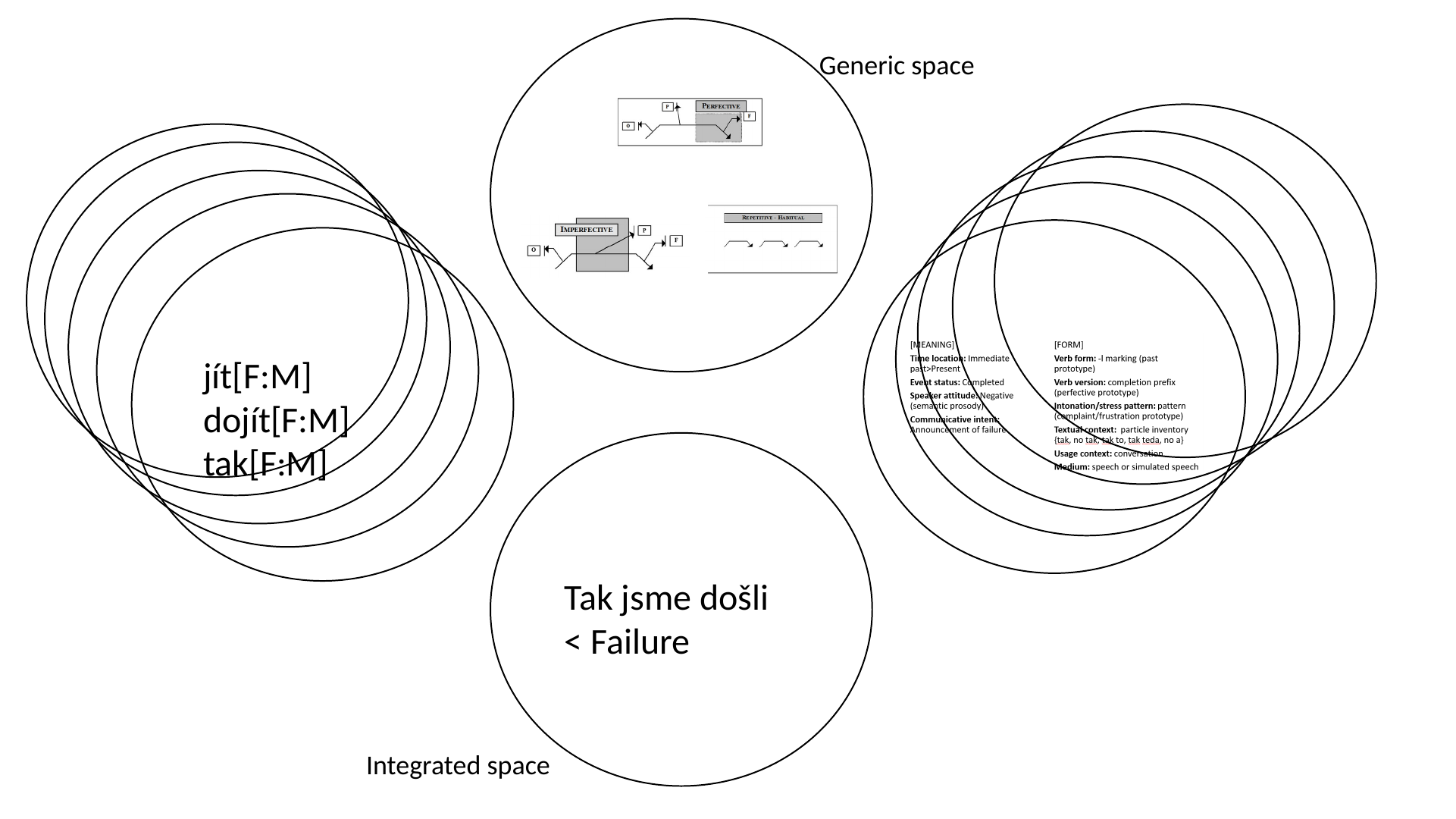
- Generic space
- Perfective: path with arrows to boxes O, P and F; the shaded area covers the end of the path and the arrow to F
- Imperfective: path with arrows to boxes O, P and F; the shaded area covers the middle of the path and the arrow to P
- Repetitive - Habitual: three identical short paths in a row, no shading
- Integrated space
- Tak jsme došli < Failure
jít[F:M]dojít[F:M]tak[F:M]
Slide 60: Would would this work for code switching
Would would this work for code switching
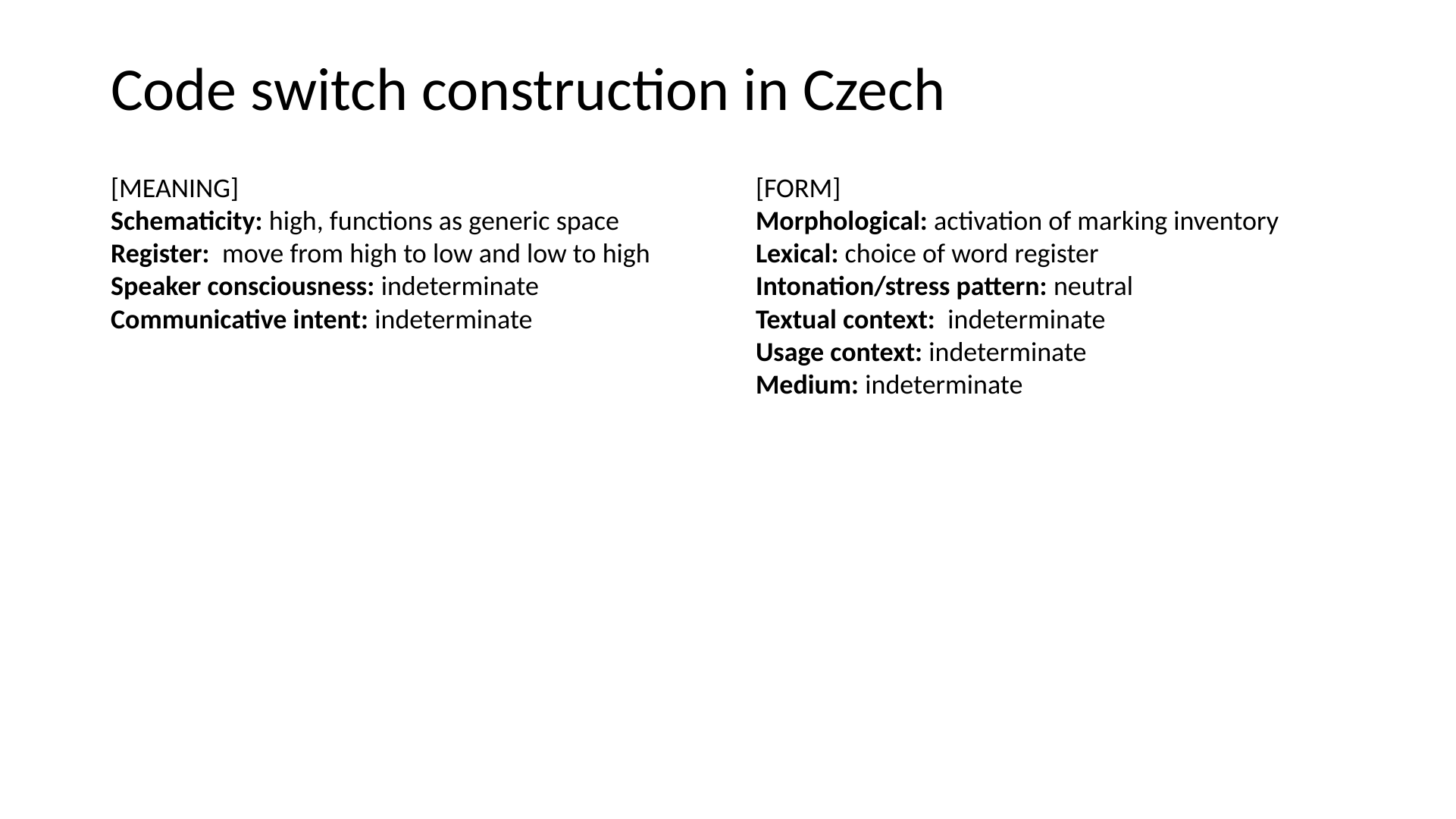
Slide 61: Code switch construction in Czech
Code switch construction in Czech
- [MEANING]
- Schematicity: high, functions as generic space
- Register: move from high to low and low to high
- Speaker consciousness: indeterminate
- Communicative intent: indeterminate
- [FORM]
- Morphological: activation of marking inventory
- Lexical: choice of word register
- Intonation/stress pattern: neutral
- Textual context: indeterminate
- Usage context: indeterminate
- Medium: indeterminate
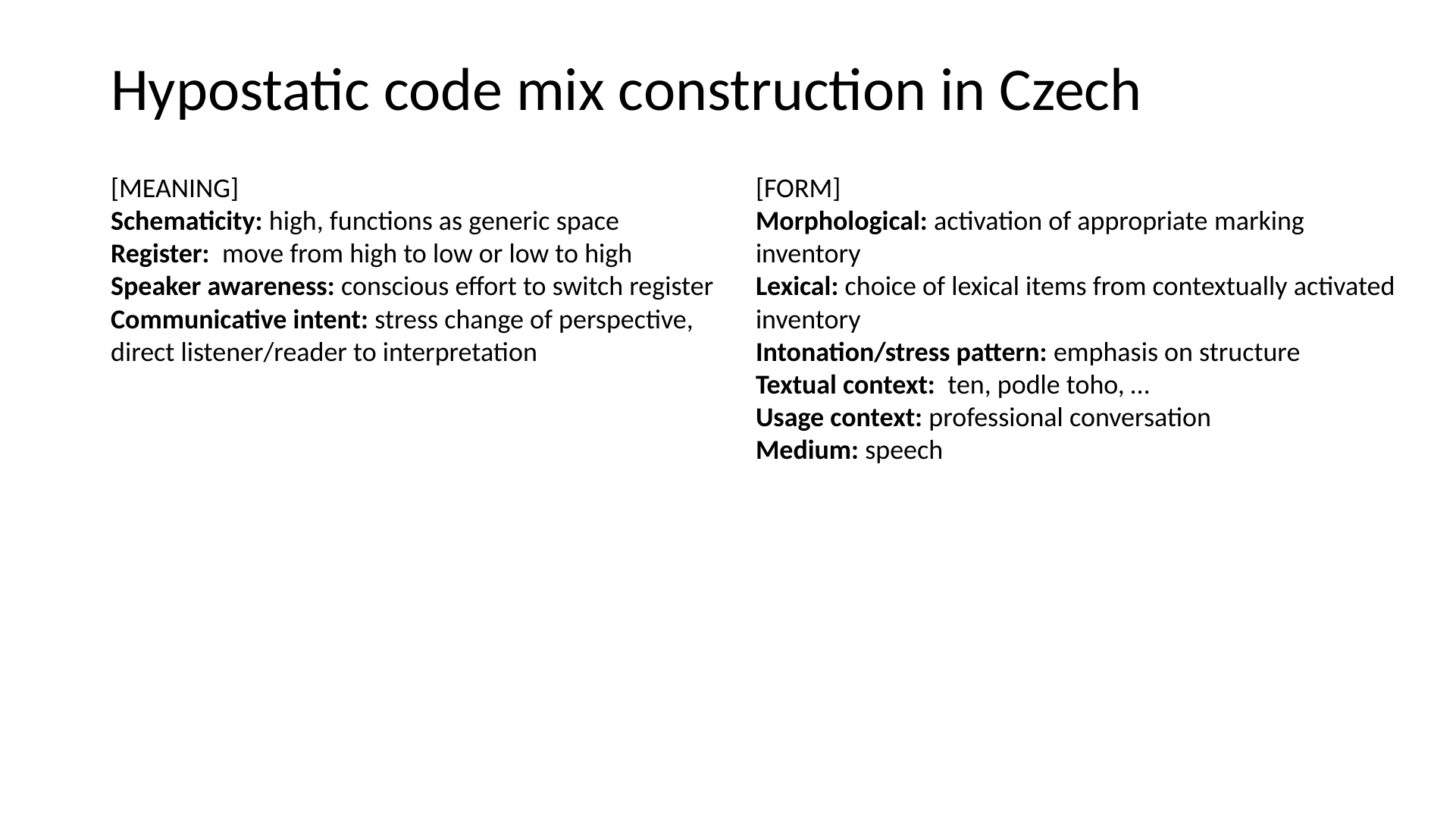
Slide 62: Hypostatic code mix construction in Czech
Hypostatic code mix construction in Czech
- [MEANING]
- Schematicity: high, functions as generic space
- Register: move from high to low or low to high
- Speaker awareness: conscious effort to switch register
- Communicative intent: stress change of perspective, direct listener/reader to interpretation
- [FORM]
- Morphological: activation of appropriate marking inventory
- Lexical: choice of lexical items from contextually activated inventory
- Intonation/stress pattern: emphasis on structure
- Textual context: ten, podle toho, …
- Usage context: professional conversation
- Medium: speech
Slide 63: Slide 63
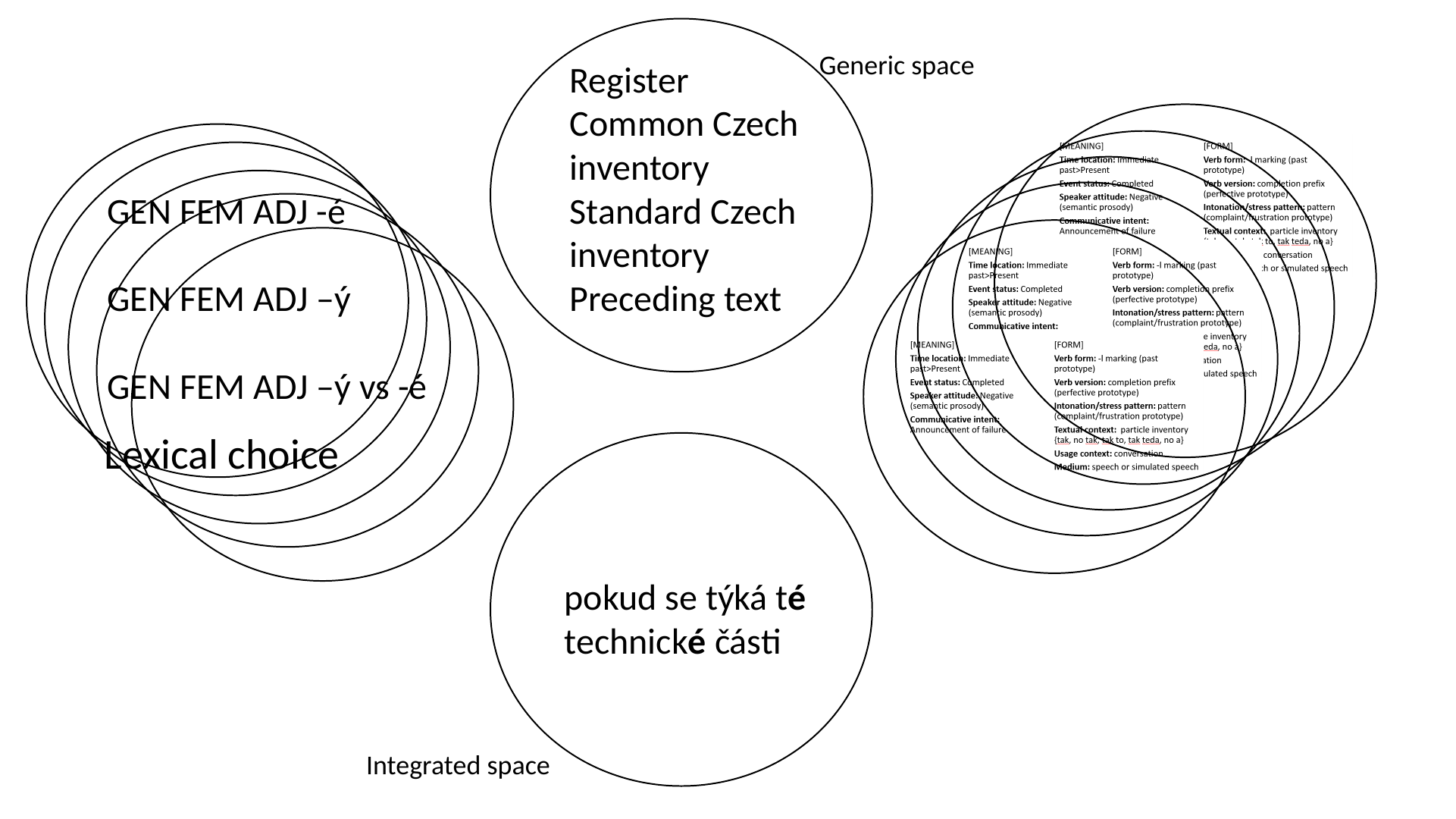
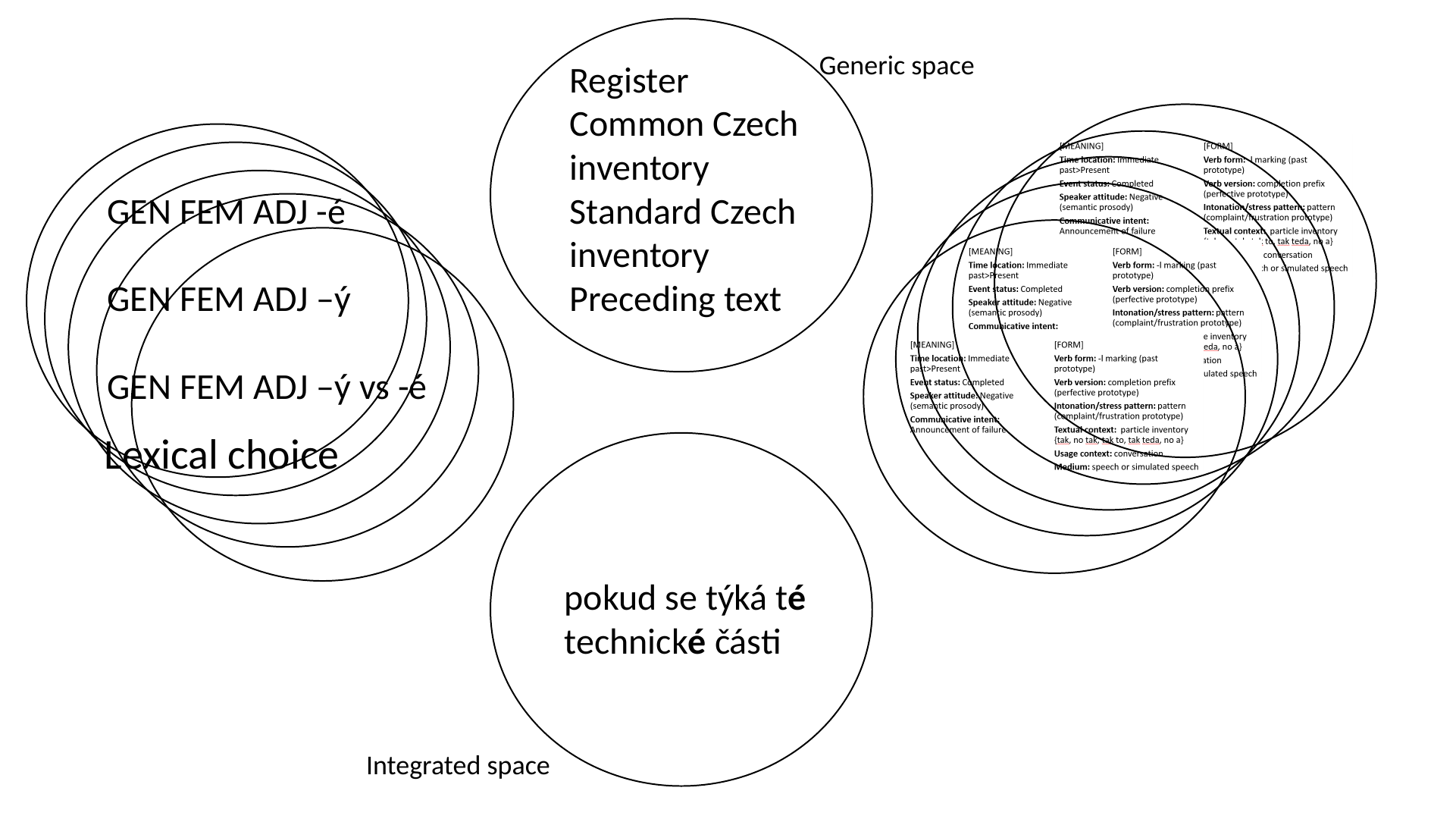
- Generic space
- Integrated space
- pokud se týká té technické části
- GEN FEM ADJ -é
- GEN FEM ADJ –ý
- GEN FEM ADJ –ý vs -é
- Register
- Common Czech inventory
- Standard Czech inventory
- Preceding text
- Lexical choice
Slide 64: Concluding thought
Concluding thought
Slide 65: Slide 65
If we are to take the constructional commitment to accounting for the “entirety of each language” seriously in the usage-based linguistics paradigm, we have to find ways dealing with entire text and conversation even when they remain outside the traditional linguistic formalism.
Slide 66: Slide 66
This Photo by Unknown Author is licensed under CC BY-SA
Slide 67: Thank you
Thank you
@techczech