Presenting Aspect as Tense: A Case of the Verbs of Motion Made Simple
- SlideShare title: Presenting Aspect As Tense
- Talk date: Not established
- SlideShare upload: 2007-08-18 (upload date, not the delivery date)
- Event: Not established
- Place: Not established
- Topics: Language & meaning
- Language: en
- Slides in the original listing: 24
- Coverage: Full text of all 24 slides, each paired with its original slide image (slide N is section N).
- Original listing: https://www.slideshare.net/slideshow/presenting-aspect-as-tense/93766
- Cover image: https://slides.dominiklukes.net/readers/presenting-aspect-as-tense/pages/page-01.png
- Reader data (JSON): https://slides.dominiklukes.net/readers/presenting-aspect-as-tense/presentation.json
- TalkWeaver package (outline and images, ZIP): https://slides.dominiklukes.net/presenting-aspect-as-tense/presenting-aspect-as-tense-talkweaver.zip
- TalkWeaver outline: https://slides.dominiklukes.net/presenting-aspect-as-tense/talkweaver/presenting-aspect-as-tense-outline.md
- Markdown copy: https://slides.dominiklukes.net/presenting-aspect-as-tense/index.md
Slide 1: Presenting Aspect as Tense: A Case of the Verbs of Motion Made Simple
Presenting Aspect as Tense: A Case of the Verbs of Motion Made Simple
Dominik Lukeš

Slide 2: Aspect Quiz
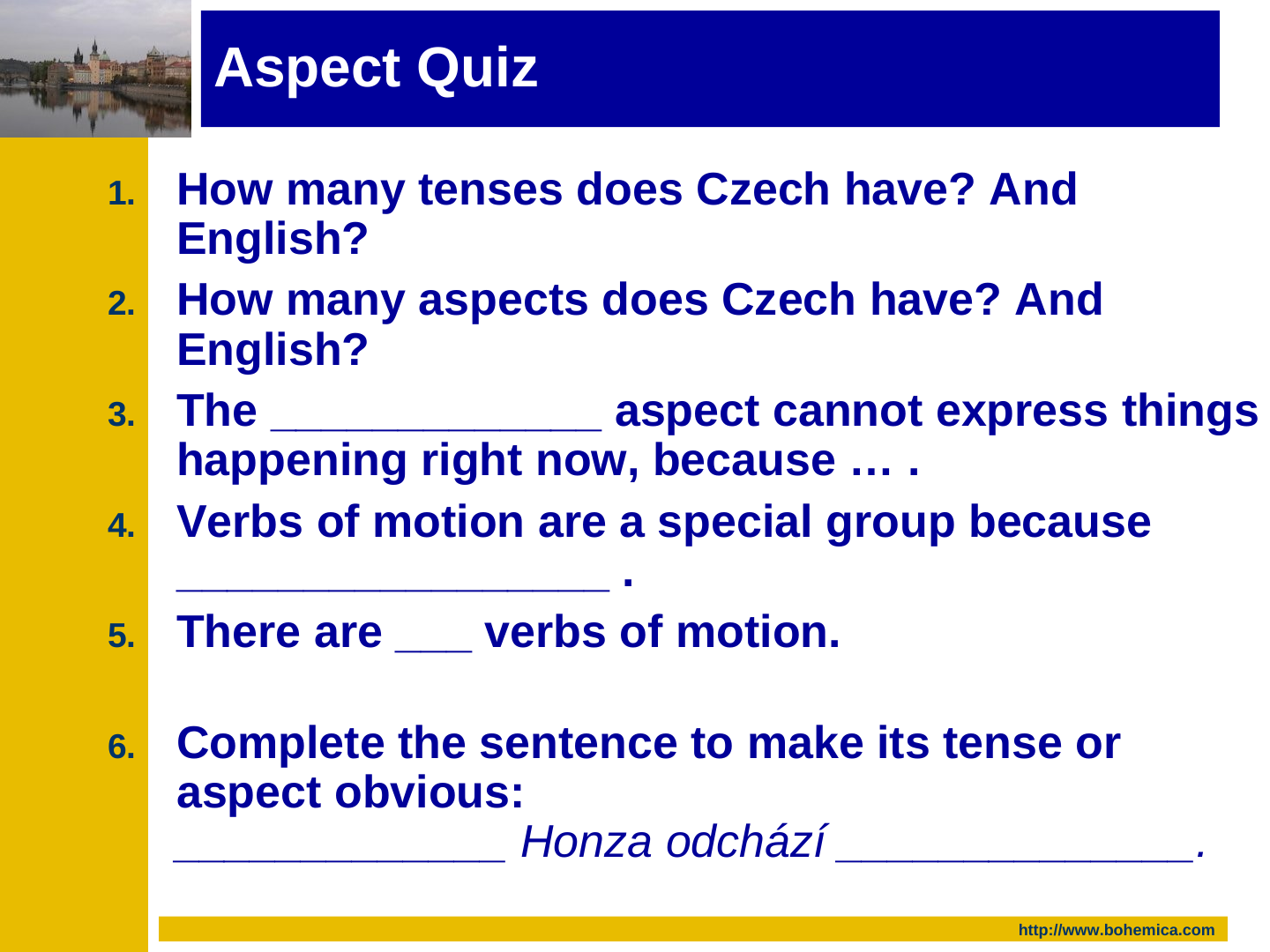
Aspect Quiz
- How many tenses does Czech have? And English?
- How many aspects does Czech have? And English?
- The _____________ aspect cannot express things happening right now, because … .
- Verbs of motion are a special group because _________________ .
- There are
___verbs of motion. - Complete the sentence to make its tense or aspect obvious: _____________ Honza odchází ______________.
Slide 3: The New Aspect/Tense
The New Aspect/Tense
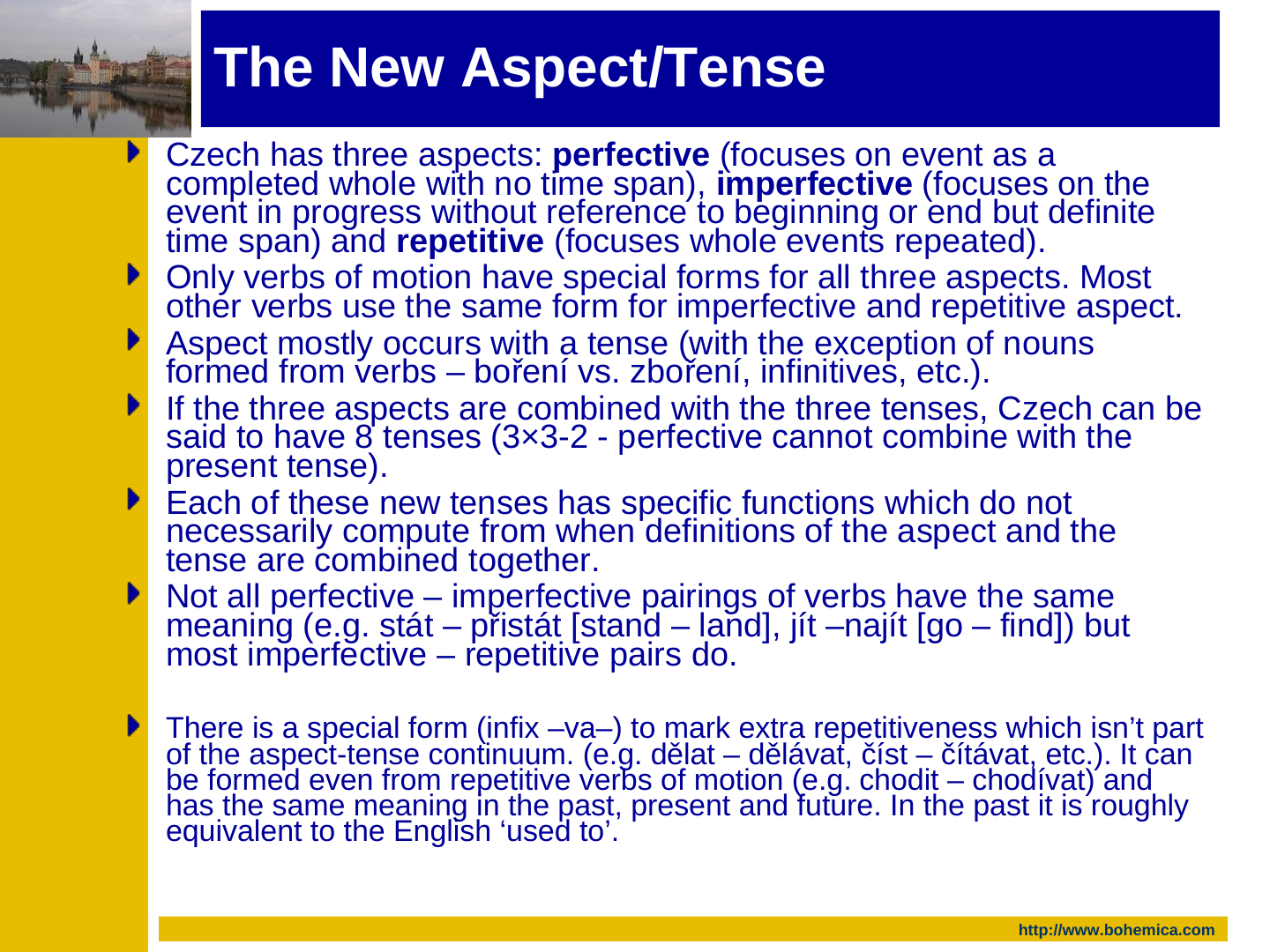
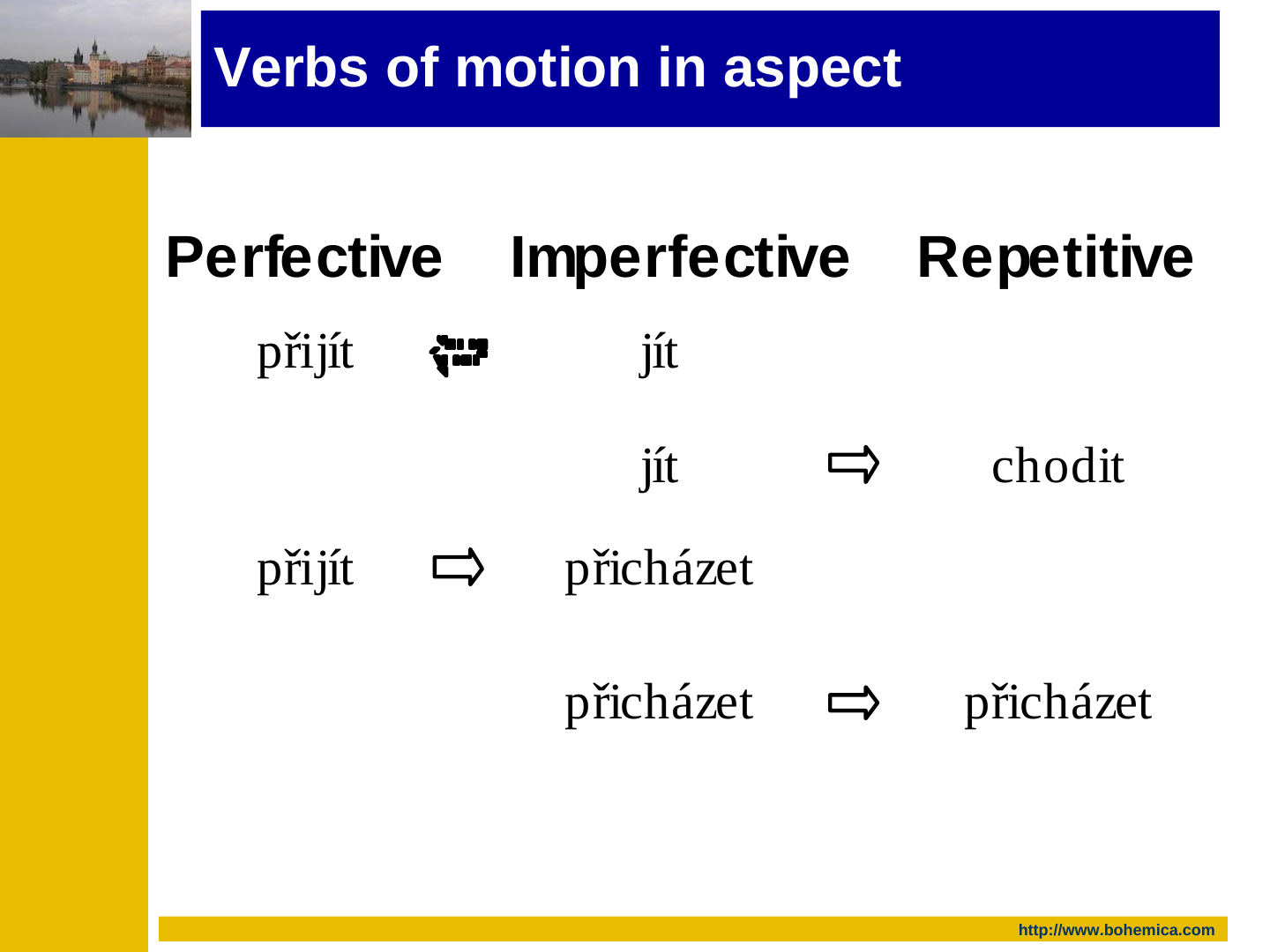
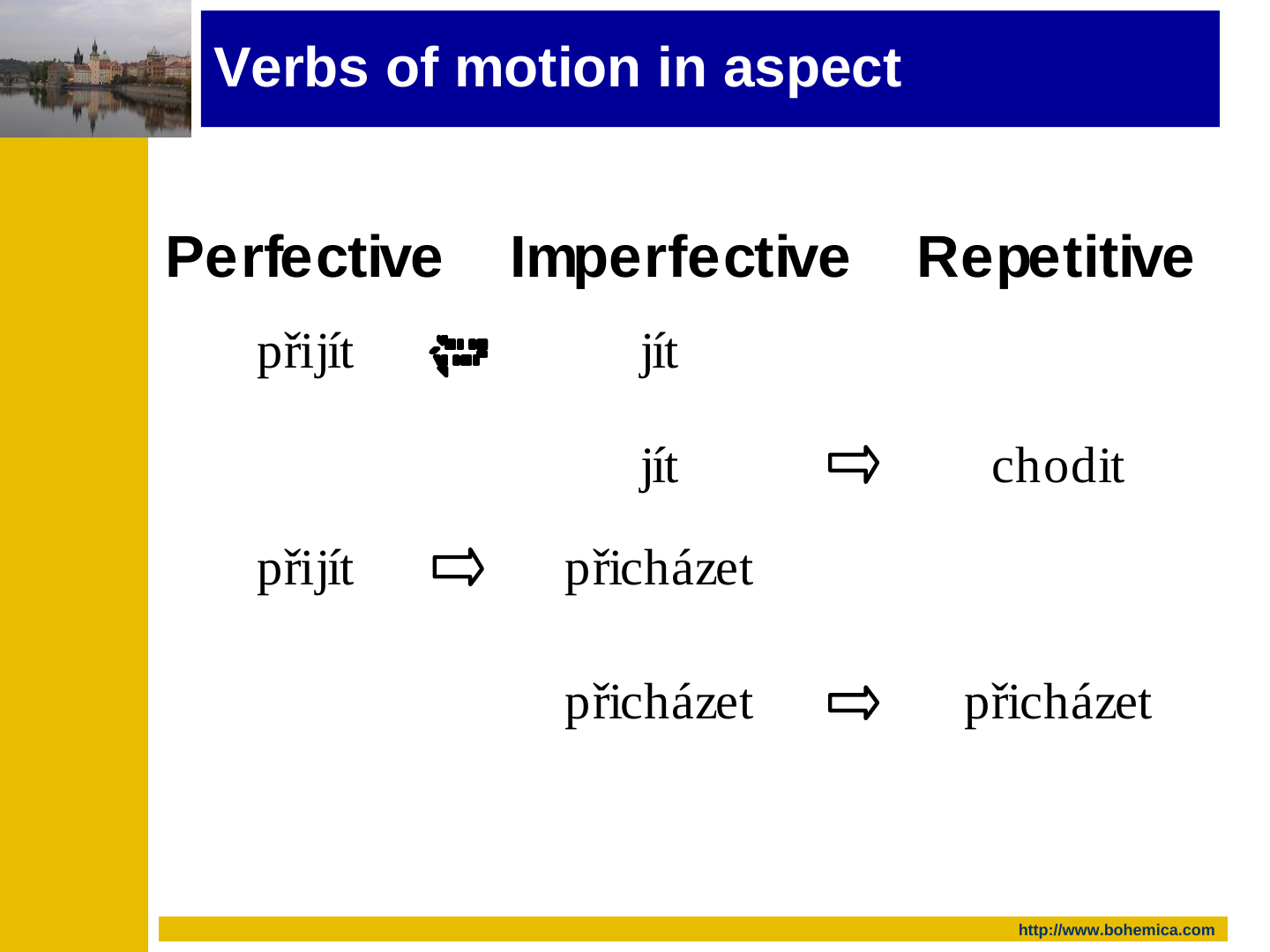
Czech has three aspects: perfective (focuses on event as a completed whole with no time span), imperfective (focuses on the event in progress without reference to beginning or end but definite time span) and repetitive (focuses whole events repeated).
Only verbs of motion have special forms for all three aspects. Most other verbs use the same form for imperfective and repetitive aspect.
Aspect mostly occurs with a tense (with the exception of nouns formed from verbs – boření vs. zboření, infinitives, etc.).
If the three aspects are combined with the three tenses, Czech can be said to have 8 tenses (3×3‑2 - perfective cannot combine with the present tense).
Each of these new tenses has specific functions which do not necessarily compute from when definitions of the aspect and the tense are combined together.
Not all perfective – imperfective pairings of verbs have the same meaning (e.g. stát – přistát [stand – land], jít –najít [go – find]) but most imperfective – repetitive pairs do.
There is a special form (infix –va–) to mark extra repetitiveness which isn’t part of the aspect-tense continuum. (e.g. dělat – dělávat, číst – čítávat, etc.). It can be formed even from repetitive verbs of motion (e.g. chodit – chodívat) and has the same meaning in the past, present and future. In the past it is roughly equivalent to the English ‘used to’.
Slide 4: Summary of Tense/Aspect
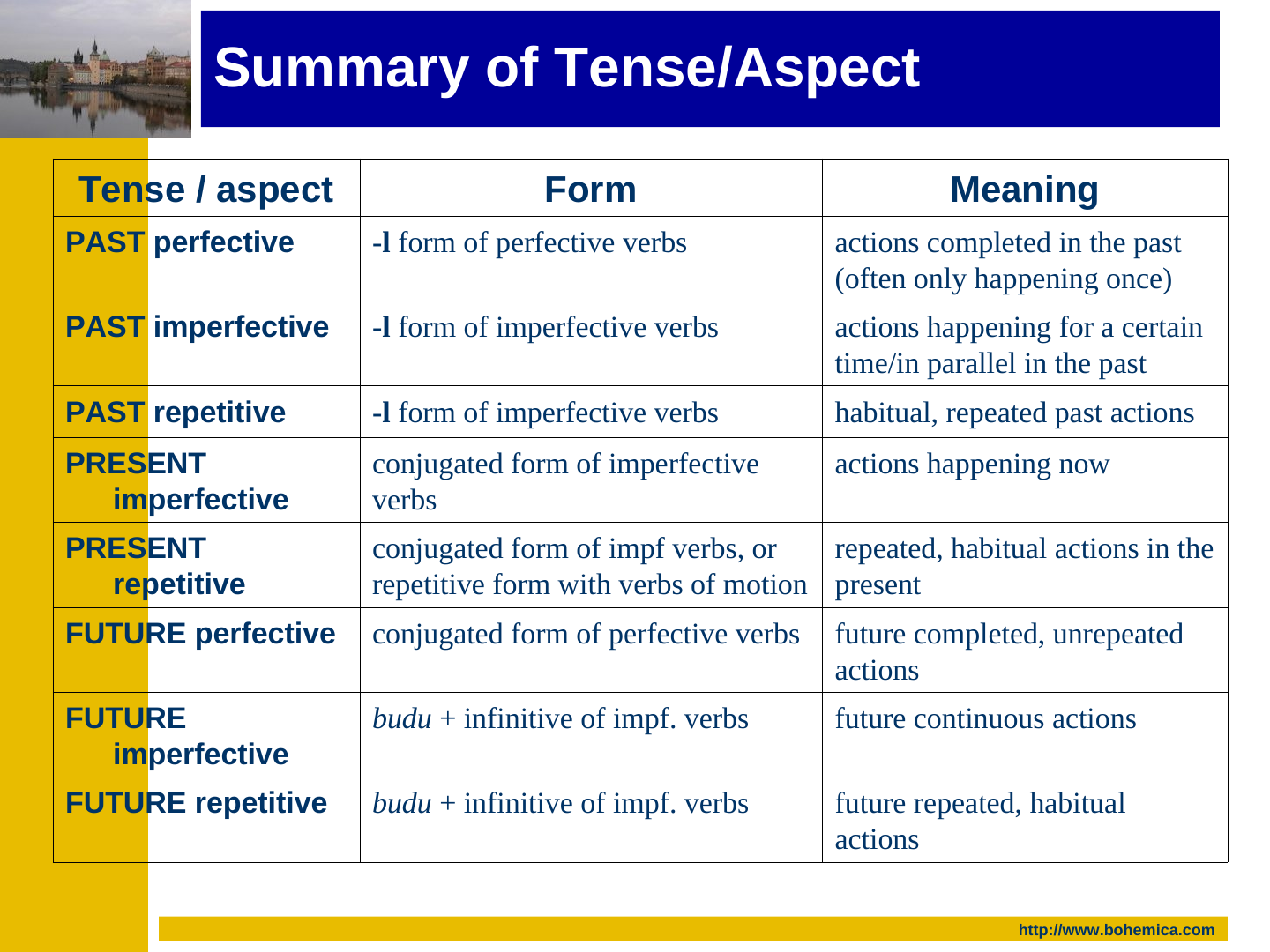
Summary of Tense/Aspect
| Tense / aspect | Form | Meaning |
|---|---|---|
| PAST perfective | -l form of perfective verbs | actions completed in the past (often only happening once) |
| PAST imperfective | -l form of imperfective verbs | actions happening for a certain time/in parallel in the past |
| PAST repetitive | -l form of imperfective verbs | habitual, repeated past actions |
| PRESENT imperfective | conjugated form of imperfective verbs | actions happening now |
| PRESENT repetitive | conjugated form of impf verbs, or repetitive form with verbs of motion | repeated, habitual actions in the present |
| FUTURE perfective | conjugated form of perfective verbs | future completed, unrepeated actions |
| FUTURE imperfective | budu + infinitive of impf. verbs | future continuous actions |
| FUTURE repetitive | budu + infinitive of impf. verbs | future repeated, habitual actions |
Slide 5: Pros and Cons
Pros and Cons
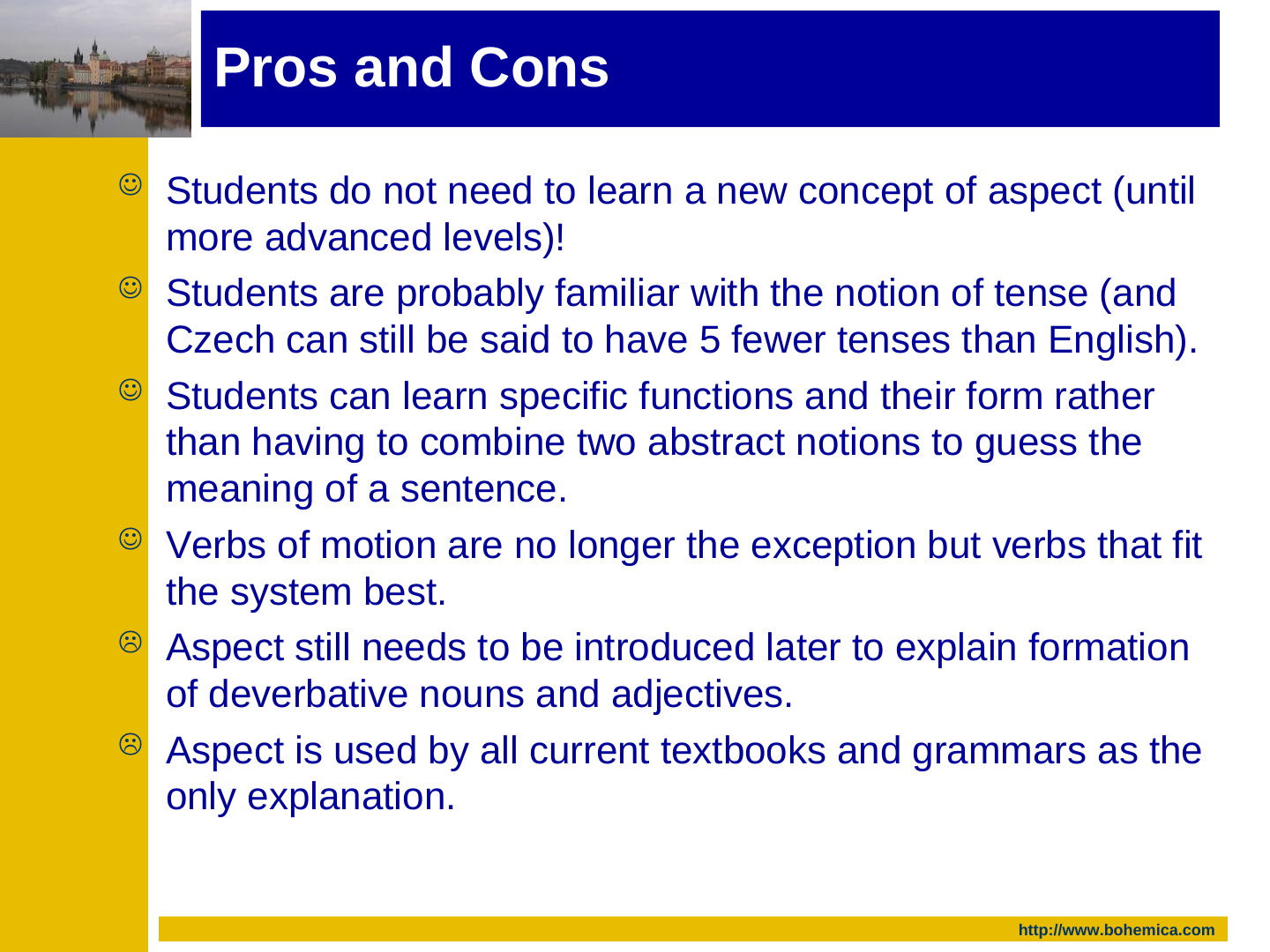
- ☺ Students do not need to learn a new concept of aspect (until more advanced levels)!
- ☺ Students are probably familiar with the notion of tense (and Czech can still be said to have 5 fewer tenses than English).
- ☺ Students can learn specific functions and their form rather than having to combine two abstract notions to guess the meaning of a sentence.
- ☺ Verbs of motion are no longer the exception but verbs that fit the system best.
- ☹ Aspect still needs to be introduced later to explain formation of deverbative nouns and adjectives.
- ☹ Aspect is used by all current textbooks and grammars as the only explanation.
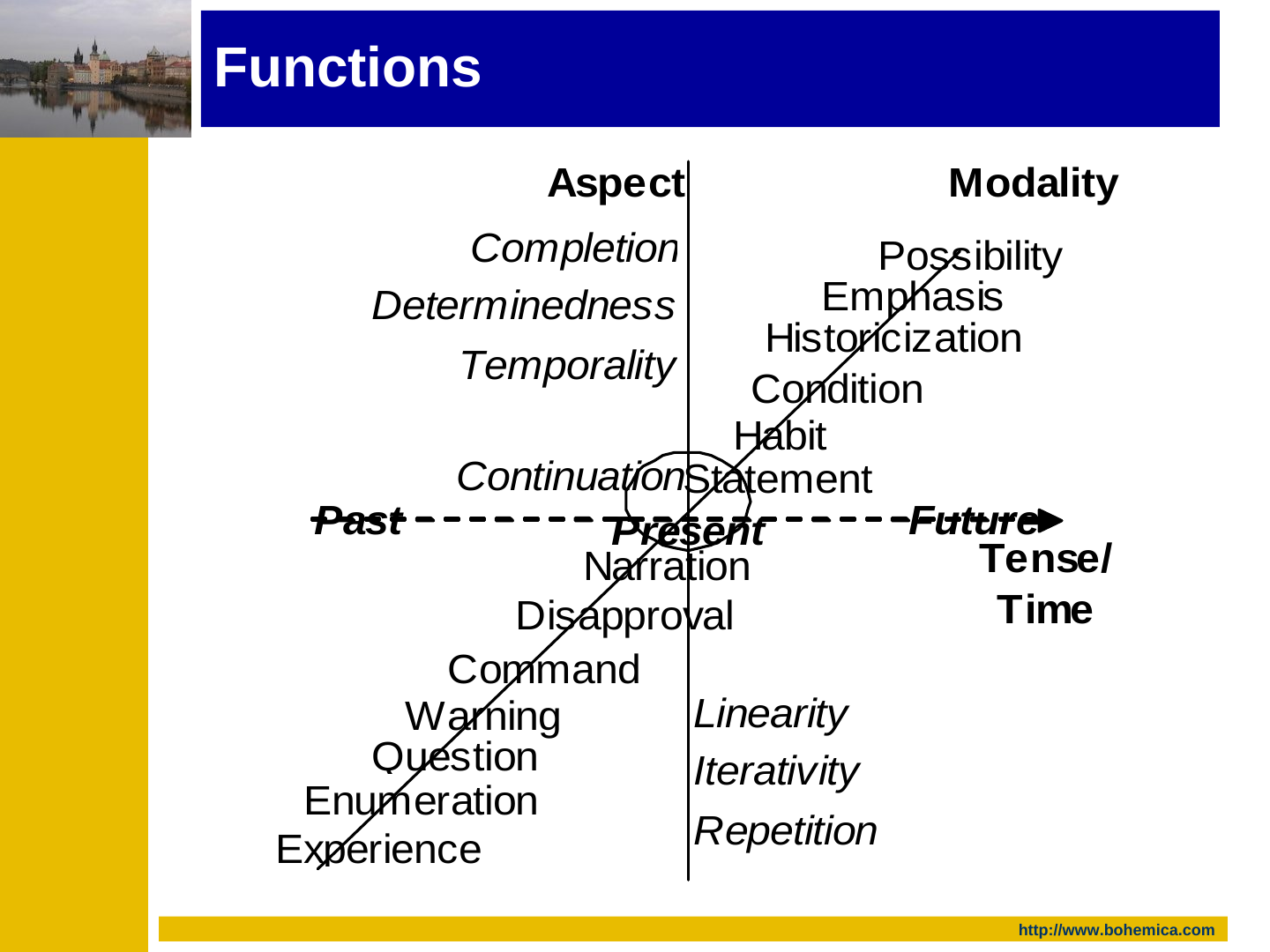
Slide 6: Functions
Functions
Slide 7: Aspect/Tense Timelines
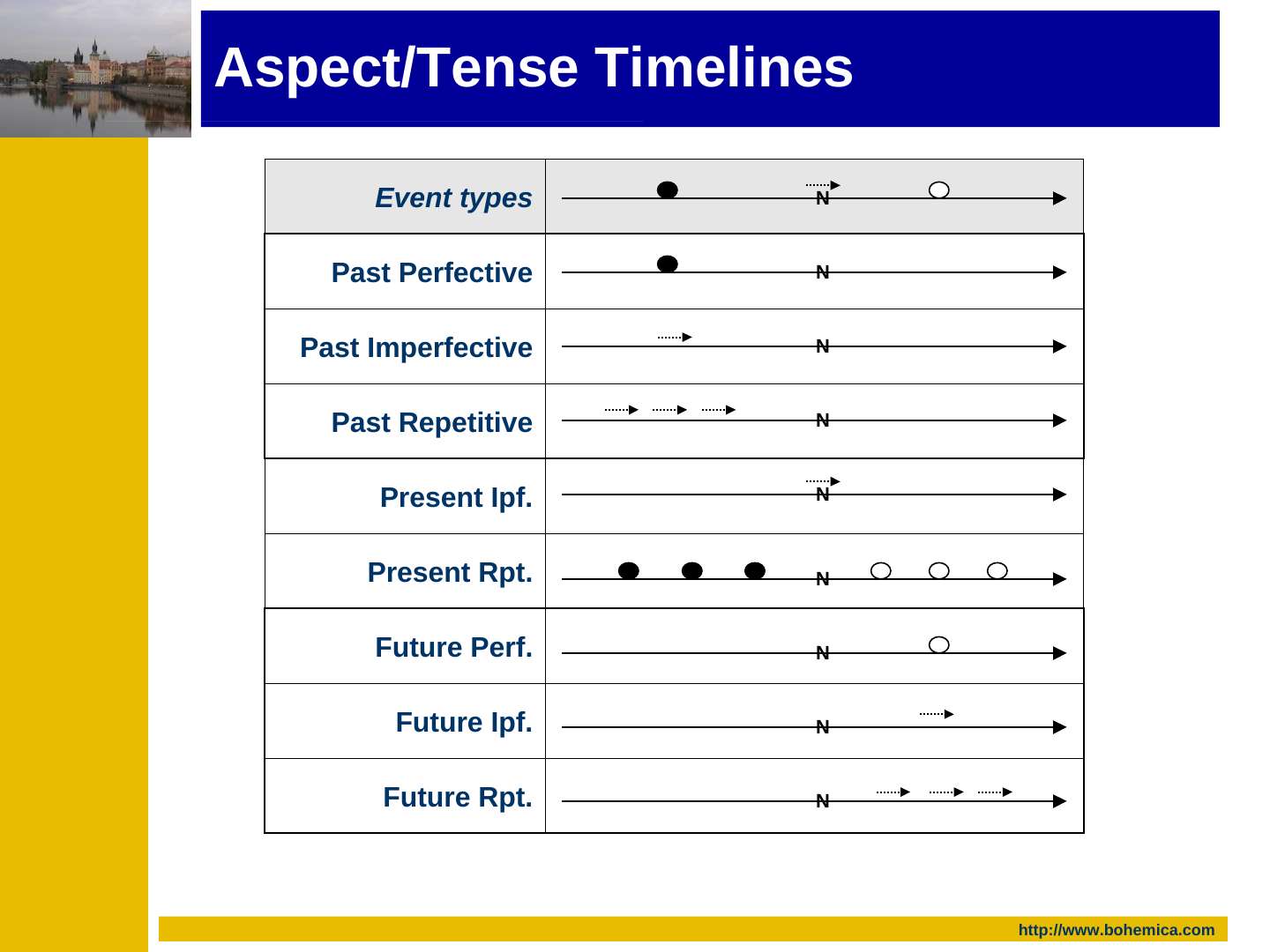
Aspect/Tense Timelines
- Event types
- Past Perfective
- Past Imperfective
- Past Repetitive
- Present Ipf.
- Present Rpt.
- Future Perf.
- Future Ipf.
- Future Rpt.
Slide 8: PAST Perfective
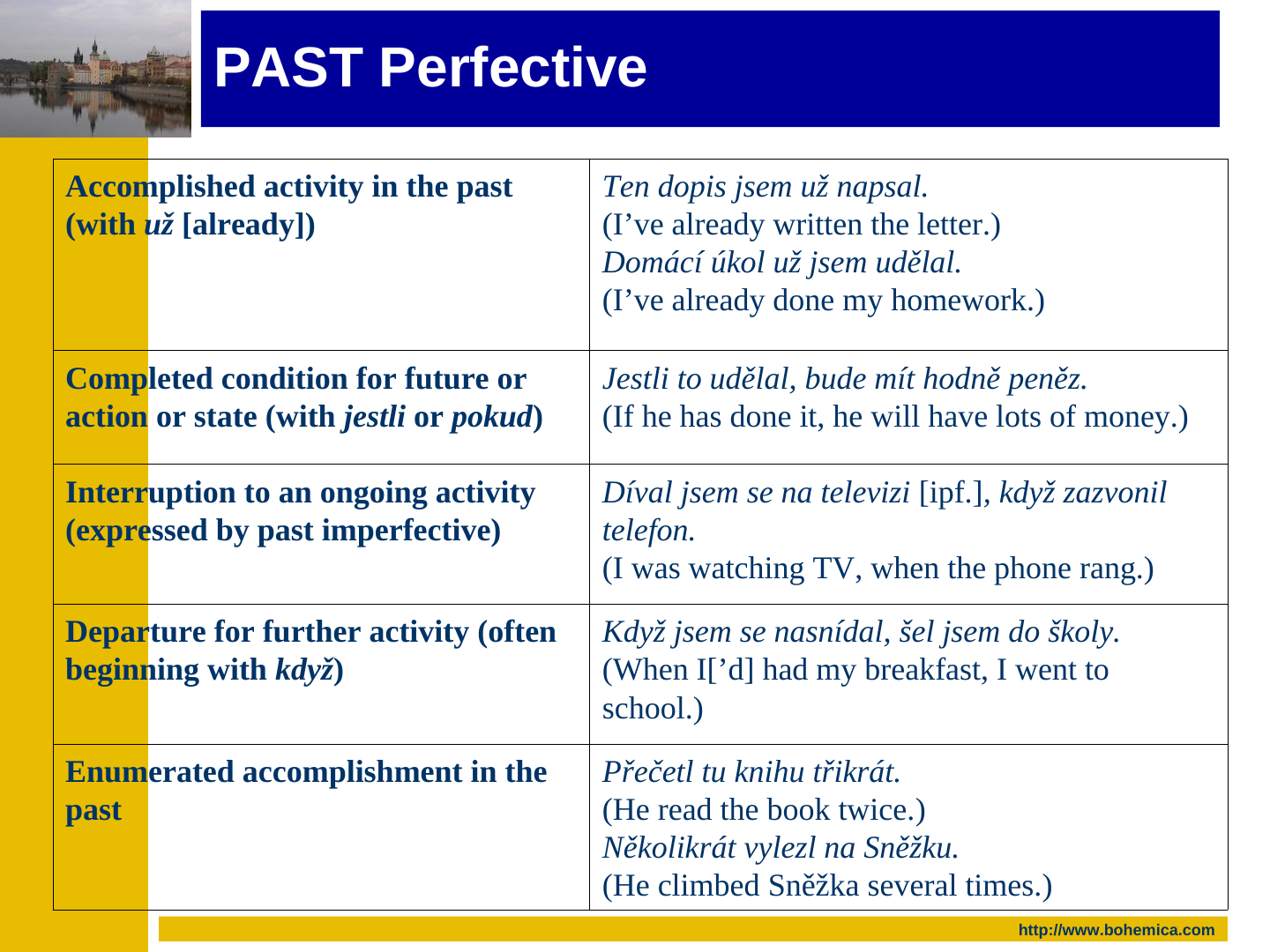
PAST Perfective
| Accomplished activity in the past (with už [already]) | Ten dopis jsem už napsal. / (I’ve already written the letter.) / Domácí úkol už jsem udělal. / (I’ve already done my homework.) |
| Completed condition for future or action or state (with jestli or pokud) | Jestli to udělal, bude mít hodně peněz. / (If he has done it, he will have lots of money.) |
| Interruption to an ongoing activity (expressed by past imperfective) | Díval jsem se na televizi [ipf.], když zazvonil telefon. / (I was watching TV, when the phone rang.) |
| Departure for further activity (often beginning with když) | Když jsem se nasnídal, šel jsem do školy. / (When I[’d] had my breakfast, I went to school.) |
| Enumerated accomplishment in the past | Přečetl tu knihu třikrát. / (He read the book twice.) / Několikrát vylezl na Sněžku. / (He climbed Sněžka several times.) |
Slide 9: PAST Imperfective
PAST Imperfective
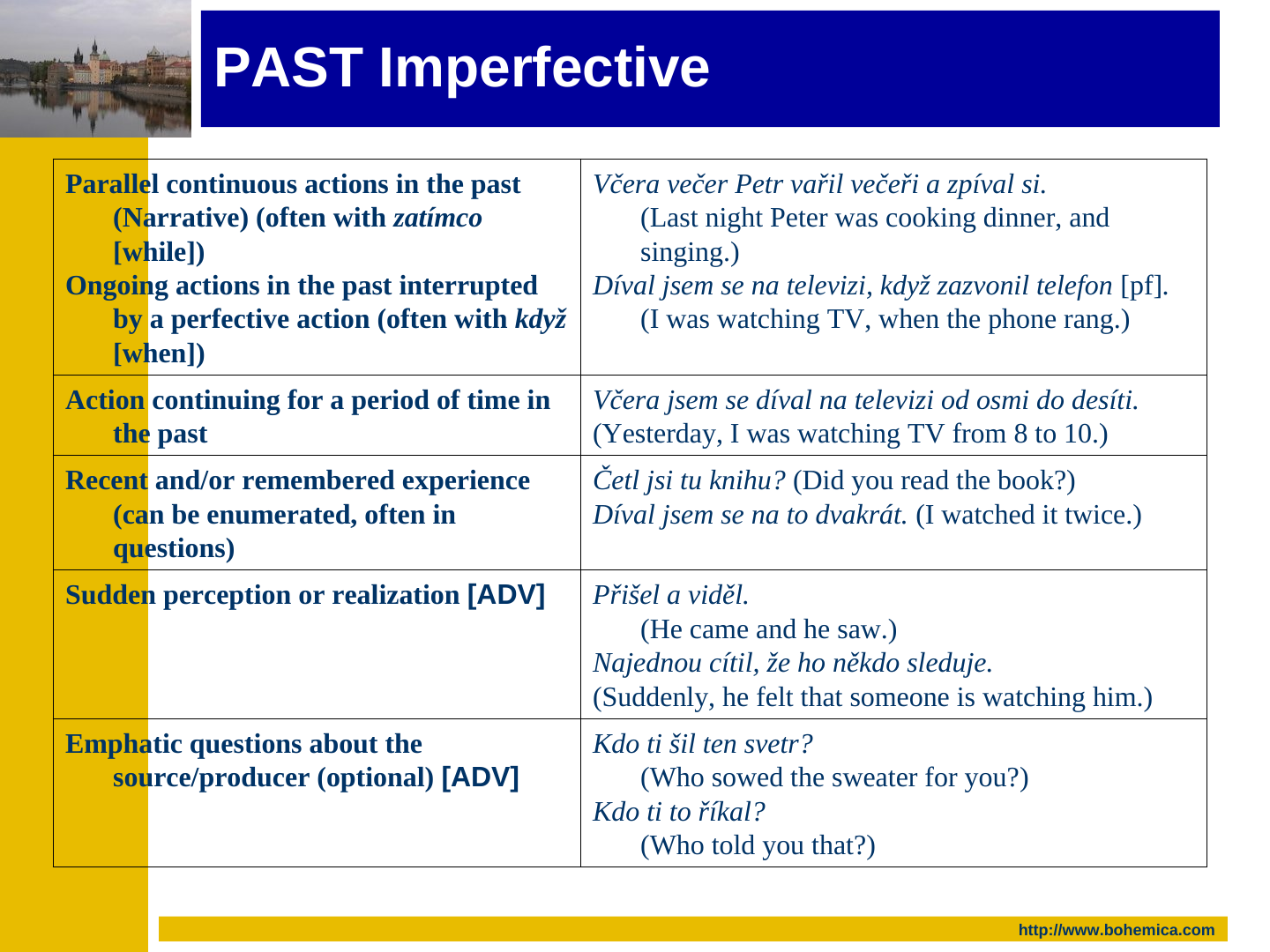
| Parallel continuous actions in the past (Narrative) (often with zatímco [while]) / Ongoing actions in the past interrupted by a perfective action (often with když [when]) | Včera večer Petr vařil večeři a zpíval si. / (Last night Peter was cooking dinner, and singing.) / Díval jsem se na televizi, když zazvonil telefon [pf]. / (I was watching TV, when the phone rang.) |
| Action continuing for a period of time in the past | Včera jsem se díval na televizi od osmi do desíti. / (Yesterday, I was watching TV from 8 to 10.) |
| Recent and/or remembered experience (can be enumerated, often in questions) | Četl jsi tu knihu? (Did you read the book?) / Díval jsem se na to dvakrát. (I watched it twice.) |
| Sudden perception or realization [ADV] | Přišel a viděl. / (He came and he saw.) / Najednou cítil, že ho někdo sleduje. / (Suddenly, he felt that someone is watching him.) |
| Emphatic questions about the source/producer (optional) [ADV] | Kdo ti šil ten svetr? / (Who sowed the sweater for you?) / Kdo ti to říkal? / (Who told you that?) |
Slide 10: PAST Repetitive
PAST Repetitive
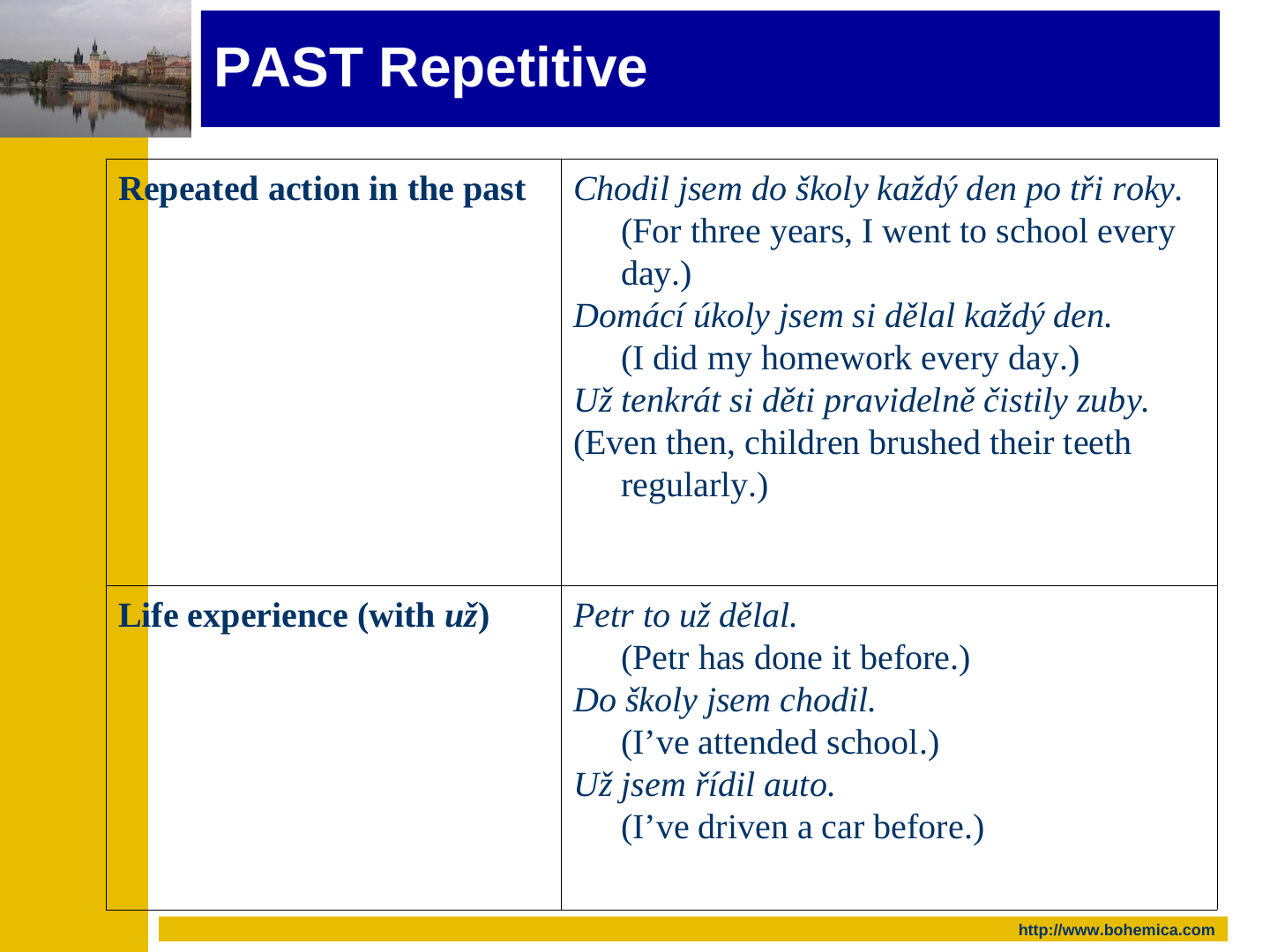
| Repeated action in the past | Chodil jsem do školy každý den po tři roky. / (For three years, I went to school every day.) / Domácí úkoly jsem si dělal každý den. / (I did my homework every day.) / Už tenkrát si děti pravidelně čistily zuby. / (Even then, children brushed their teeth regularly.) |
| Life experience (with už) | Petr to už dělal. / (Petr has done it before.) / Do školy jsem chodil. / (I’ve attended school.) / Už jsem řídil auto. / (I’ve driven a car before.) |
Slide 11: PRESENT Imperfective
PRESENT Imperfective
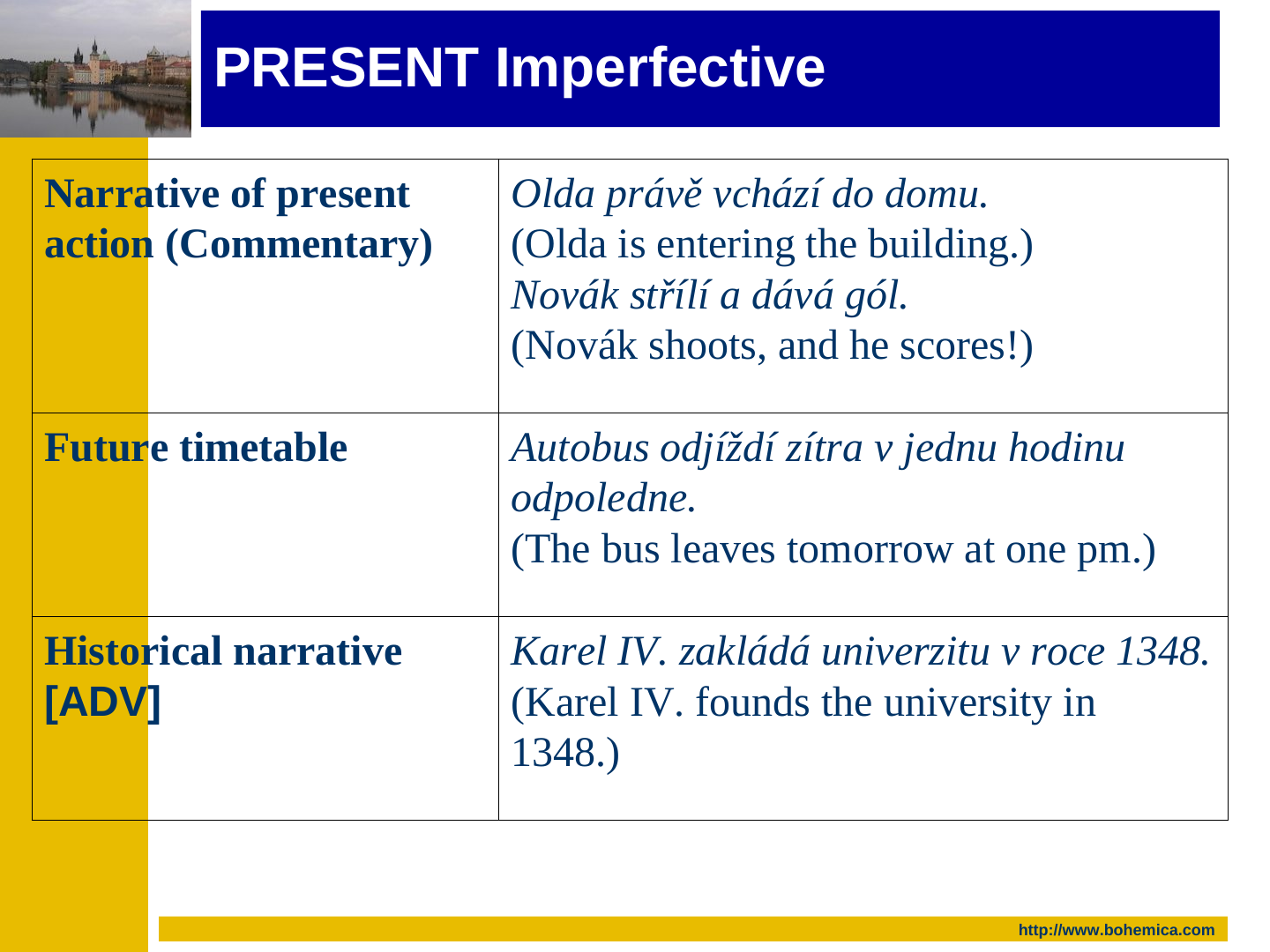
| Narrative of present action (Commentary) | Olda právě vchází do domu. / (Olda is entering the building.) / Novák střílí a dává gól. / (Novák shoots, and he scores!) |
| Future timetable | Autobus odjíždí zítra v jednu hodinu odpoledne. / (The bus leaves tomorrow at one pm.) |
| Historical narrative [ADV] | Karel IV. zakládá univerzitu v roce 1348. / (Karel IV. founds the university in 1348.) |
Slide 12: PRESENT Repetitive
PRESENT Repetitive
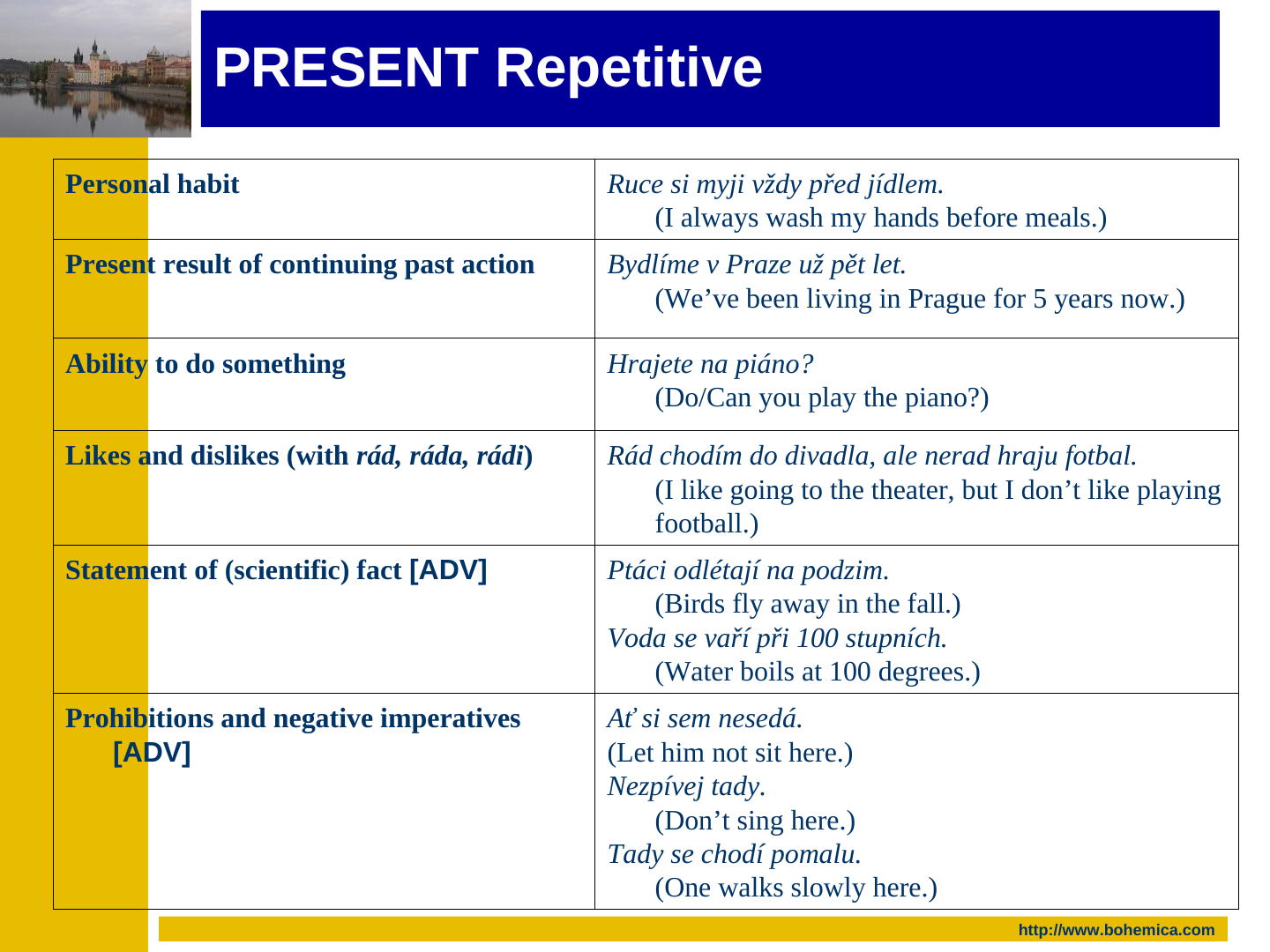
| Personal habit | Ruce si myji vždy před jídlem. / (I always wash my hands before meals.) |
| Present result of continuing past action | Bydlíme v Praze už pět let. / (We’ve been living in Prague for 5 years now.) |
| Ability to do something | Hrajete na piáno? / (Do/Can you play the piano?) |
| Likes and dislikes (with rád, ráda, rádi) | Rád chodím do divadla, ale nerad hraju fotbal. / (I like going to the theater, but I don’t like playing football.) |
| Statement of (scientific) fact [ADV] | Ptáci odlétají na podzim. / (Birds fly away in the fall.) / Voda se vaří při 100 stupních. / (Water boils at 100 degrees.) |
| Prohibitions and negative imperatives [ADV] | Ať si sem nesedá. / (Let him not sit here.) / Nezpívej tady. / (Don’t sing here.) / Tady se chodí pomalu. / (One walks slowly here.) |
Slide 13: FUTURE Perfective
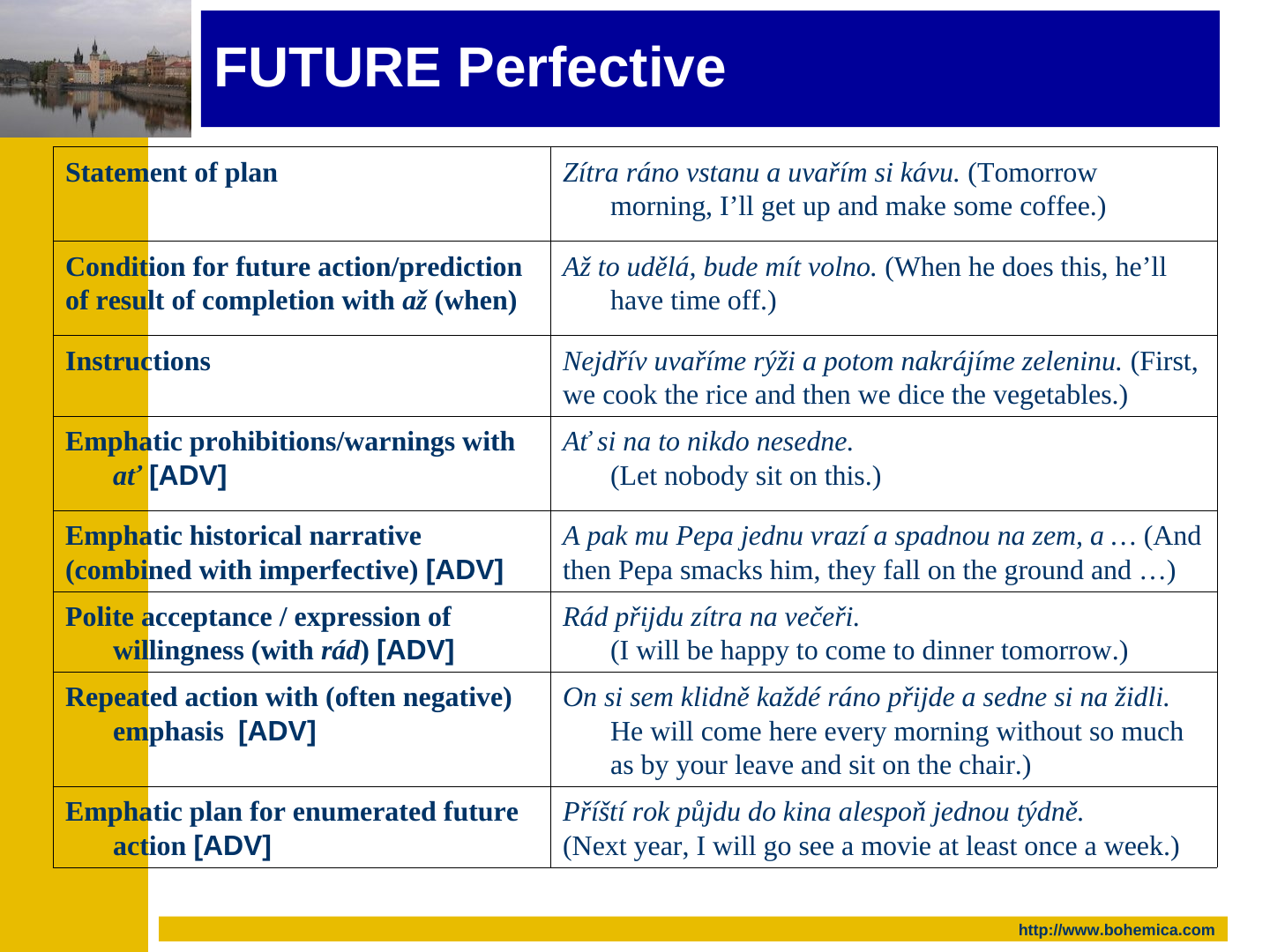
FUTURE Perfective
| Statement of plan | Zítra ráno vstanu a uvařím si kávu. (Tomorrow morning, I’ll get up and make some coffee.) |
| Condition for future action/prediction of result of completion with až (when) | Až to udělá, bude mít volno. (When he does this, he’ll have time off.) |
| Instructions | Nejdřív uvaříme rýži a potom nakrájíme zeleninu. (First, we cook the rice and then we dice the vegetables.) |
| Emphatic prohibitions/warnings with ať [ADV] | Ať si na to nikdo nesedne. / (Let nobody sit on this.) |
| Emphatic historical narrative (combined with imperfective) [ADV] | A pak mu Pepa jednu vrazí a spadnou na zem, a … (And then Pepa smacks him, they fall on the ground and …) |
| Polite acceptance / expression of willingness (with rád) [ADV] | Rád přijdu zítra na večeři. / (I will be happy to come to dinner tomorrow.) |
| Repeated action with (often negative) emphasis [ADV] | On si sem klidně každé ráno přijde a sedne si na židli. He will come here every morning without so much as by your leave and sit on the chair.) |
| Emphatic plan for enumerated future action [ADV] | Příští rok půjdu do kina alespoň jednou týdně. / (Next year, I will go see a movie at least once a week.) |
Slide 14: FUTURE Imperfective
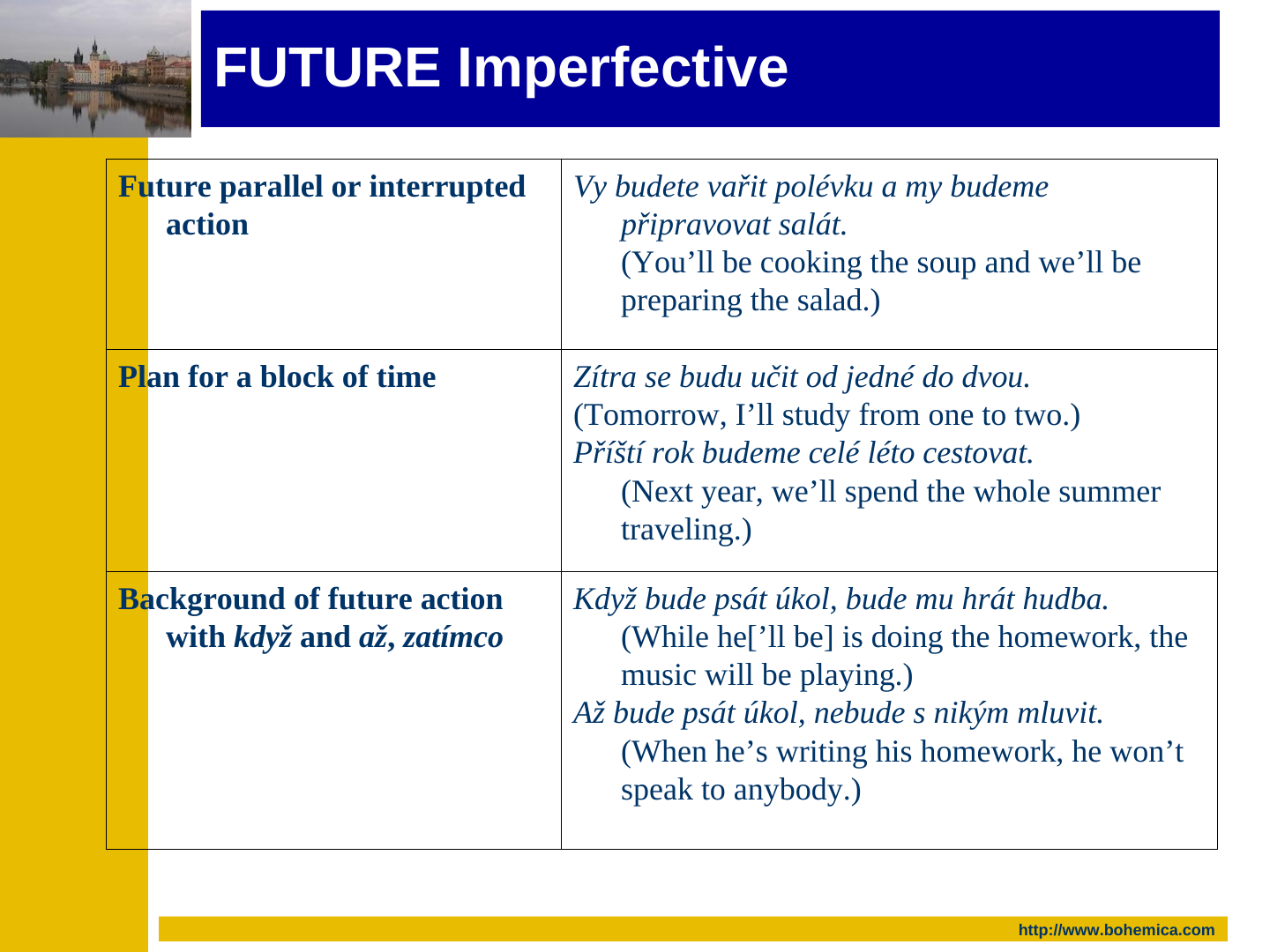
FUTURE Imperfective
| Future parallel or interrupted action | Vy budete vařit polévku a my budeme připravovat salát. / (You’ll be cooking the soup and we’ll be preparing the salad.) |
| Plan for a block of time | Zítra se budu učit od jedné do dvou. / (Tomorrow, I’ll study from one to two.) / Příští rok budeme celé léto cestovat. / (Next year, we’ll spend the whole summer traveling.) |
| Background of future action with když and až, zatímco | Když bude psát úkol, bude mu hrát hudba. / (While he[’ll be] is doing the homework, the music will be playing.) / Až bude psát úkol, nebude s nikým mluvit. / (When he’s writing his homework, he won’t speak to anybody.) |
Slide 15: FUTURE Repetitive
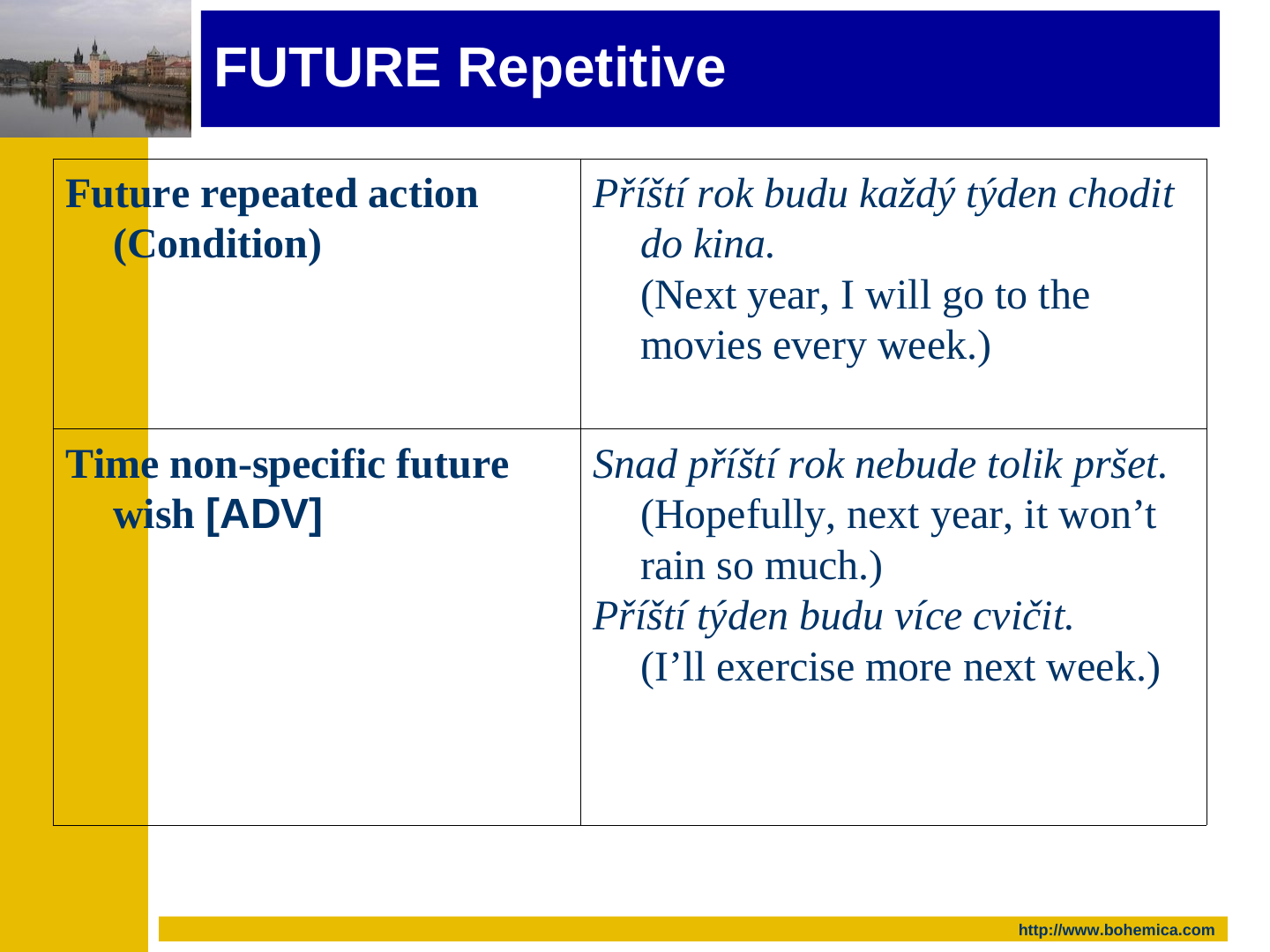
FUTURE Repetitive
| Future repeated action (Condition) | Příští rok budu každý týden chodit do kina. / (Next year, I will go to the movies every week.) |
| Time non-specific future wish [ADV] | Snad příští rok nebude tolik pršet. / (Hopefully, next year, it won’t rain so much.) / Příští týden budu více cvičit. / (I’ll exercise more next week.) |
Slide 16: How is it in English
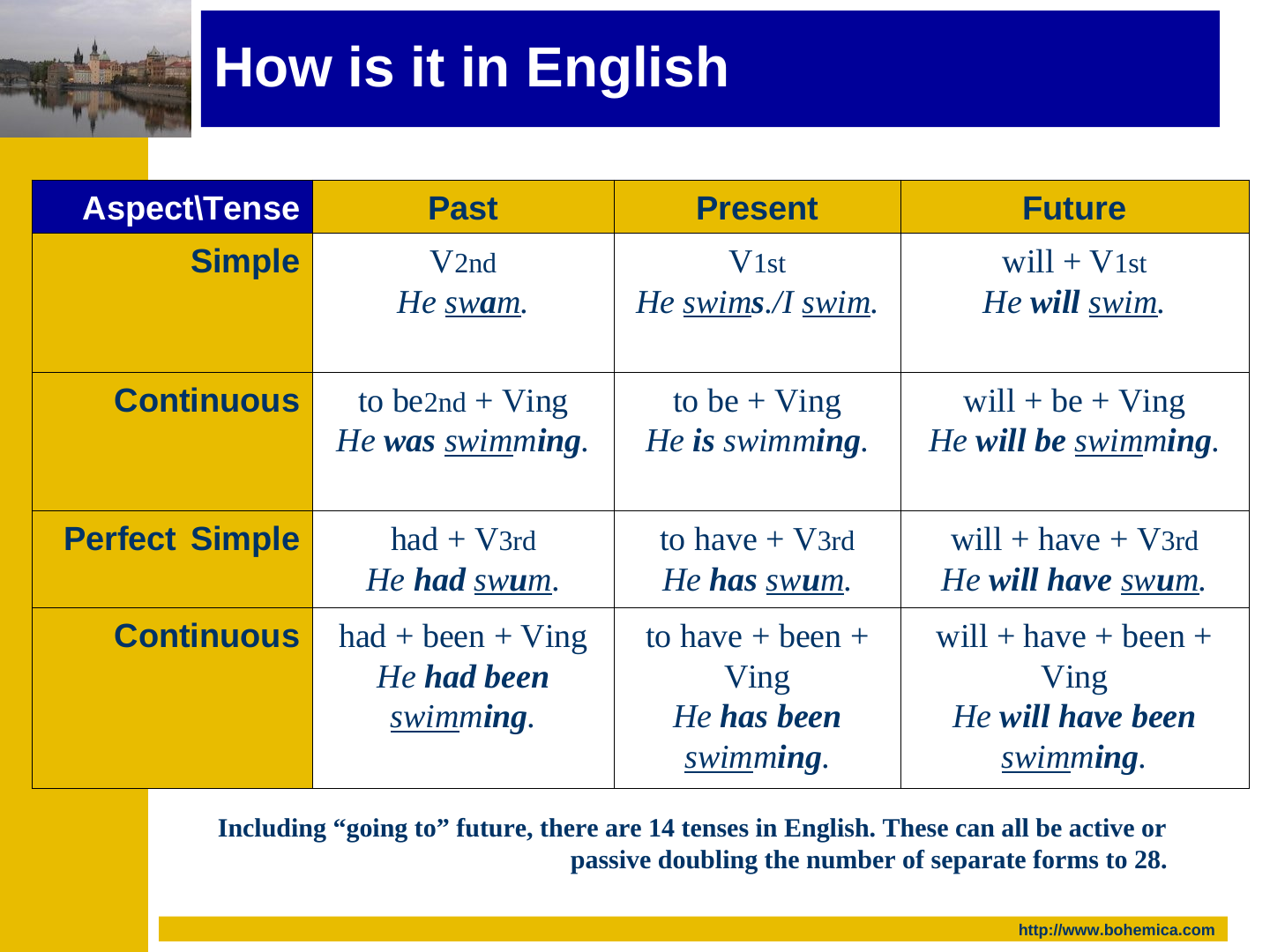
How is it in English
| Aspect\Tense | Past | Present | Future |
|---|---|---|---|
| Simple | V2nd / He swam. | V1st / He swims./I swim. | will + V1st / He will swim. |
| Continuous | to be2nd + Ving / He was swimming. | to be + Ving / He is swimming. | will + be + Ving / He will be swimming. |
| Perfect Simple | had + V3rd / He had swum. | to have + V3rd / He has swum. | will + have + V3rd / He will have swum. |
| Continuous | had + been + Ving / He had been swimming. | to have + been + Ving / He has been swimming. | will + have + been + Ving / He will have been swimming. |
Including “going to” future, there are 14 tenses in English. These can all be active or passive doubling the number of separate forms to 28.
Slide 17: Czech → English correspondence
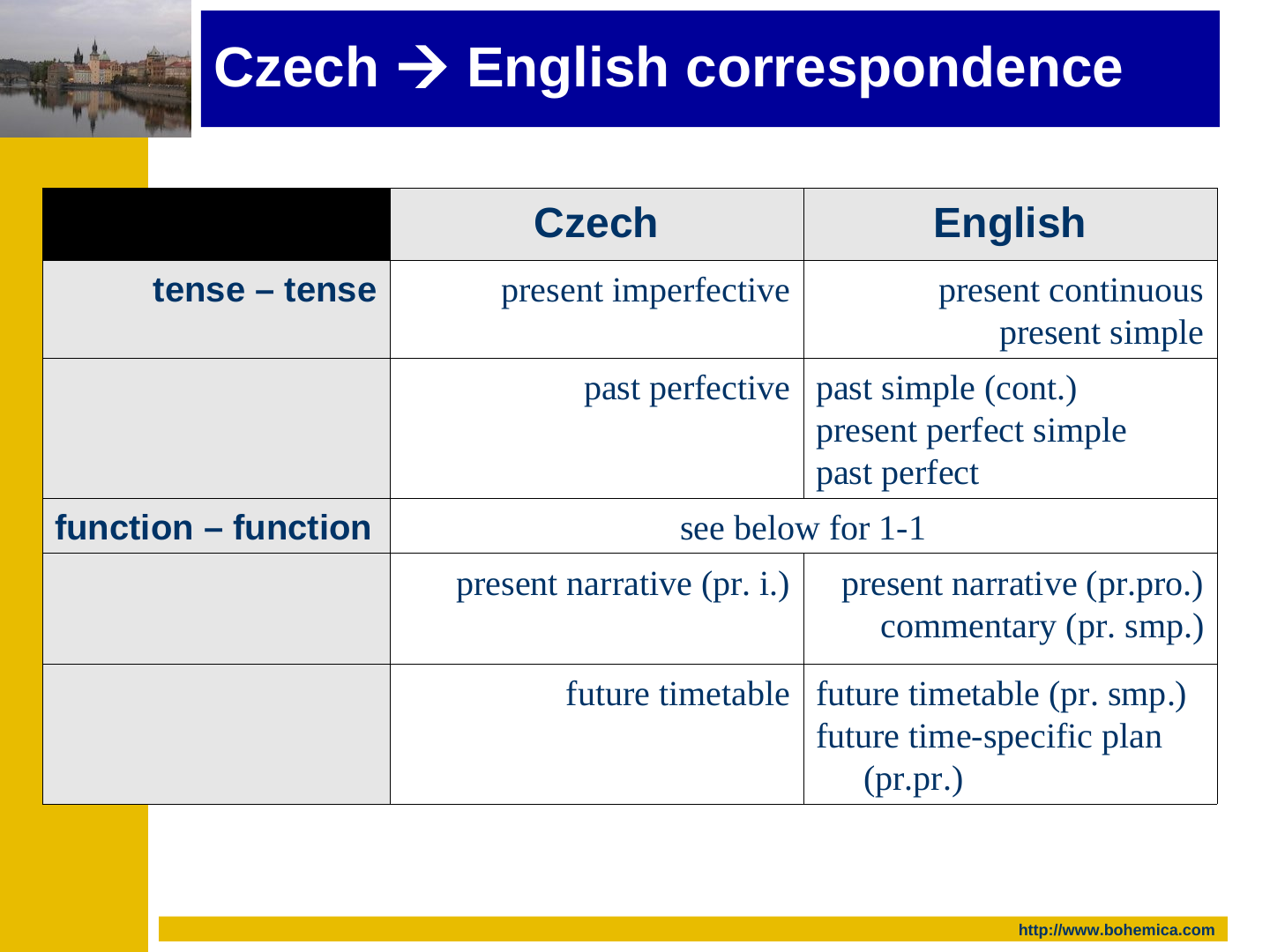
Czech → English correspondence
| Czech | English | |
|---|---|---|
| tense – tense | present imperfective | present continuous / present simple |
| past perfective | past simple (cont.) / present perfect simple / past perfect | |
| function – function | see below for 1-1 | |
| present narrative (pr. i.) | present narrative (pr.pro.) / commentary (pr. smp.) | |
| future timetable | future timetable (pr. smp.) / future time-specific plan (pr.pr.) |
Slide 18: English → Czech correspondence
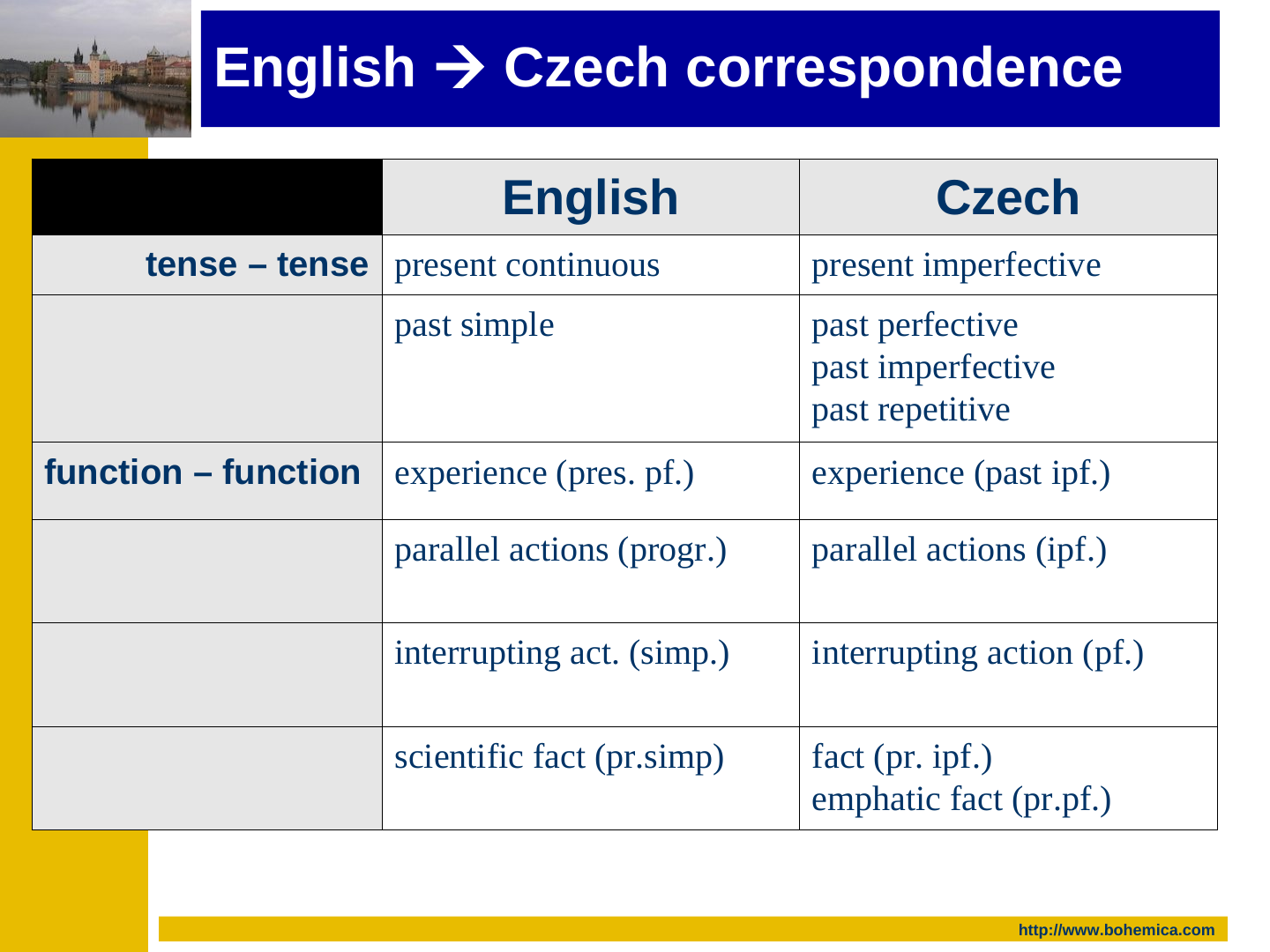
English → Czech correspondence
| English | Czech | |
|---|---|---|
| tense – tense | present continuous | present imperfective |
| past simple | past perfective / past imperfective / past repetitive | |
| function – function | experience (pres. pf.) | experience (past ipf.) |
| parallel actions (progr.) | parallel actions (ipf.) | |
| interrupting act. (simp.) | interrupting action (pf.) | |
| scientific fact (pr.simp) | fact (pr. ipf.) / emphatic fact (pr.pf.) |
Slide 19: Verbs of Motion
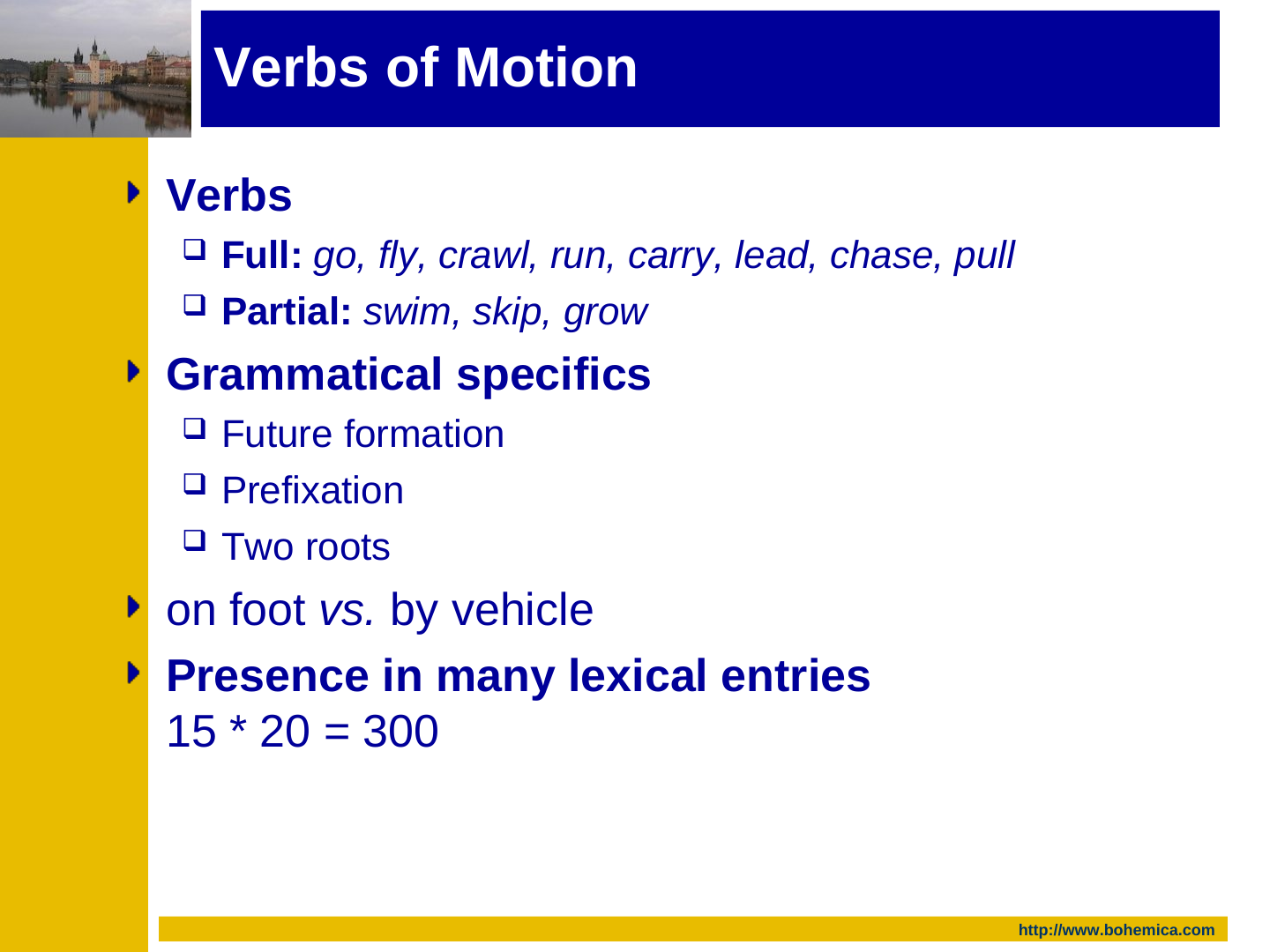
Verbs of Motion
- Verbs
- Full: go, fly, crawl, run, carry, lead, chase, pull
- Partial: swim, skip, grow
- Grammatical specifics
- Future formation
- Prefixation
- Two roots
- on foot vs. by vehicle
- Presence in many lexical entries 15 * 20 = 300
Slide 20: Verbs of Motion
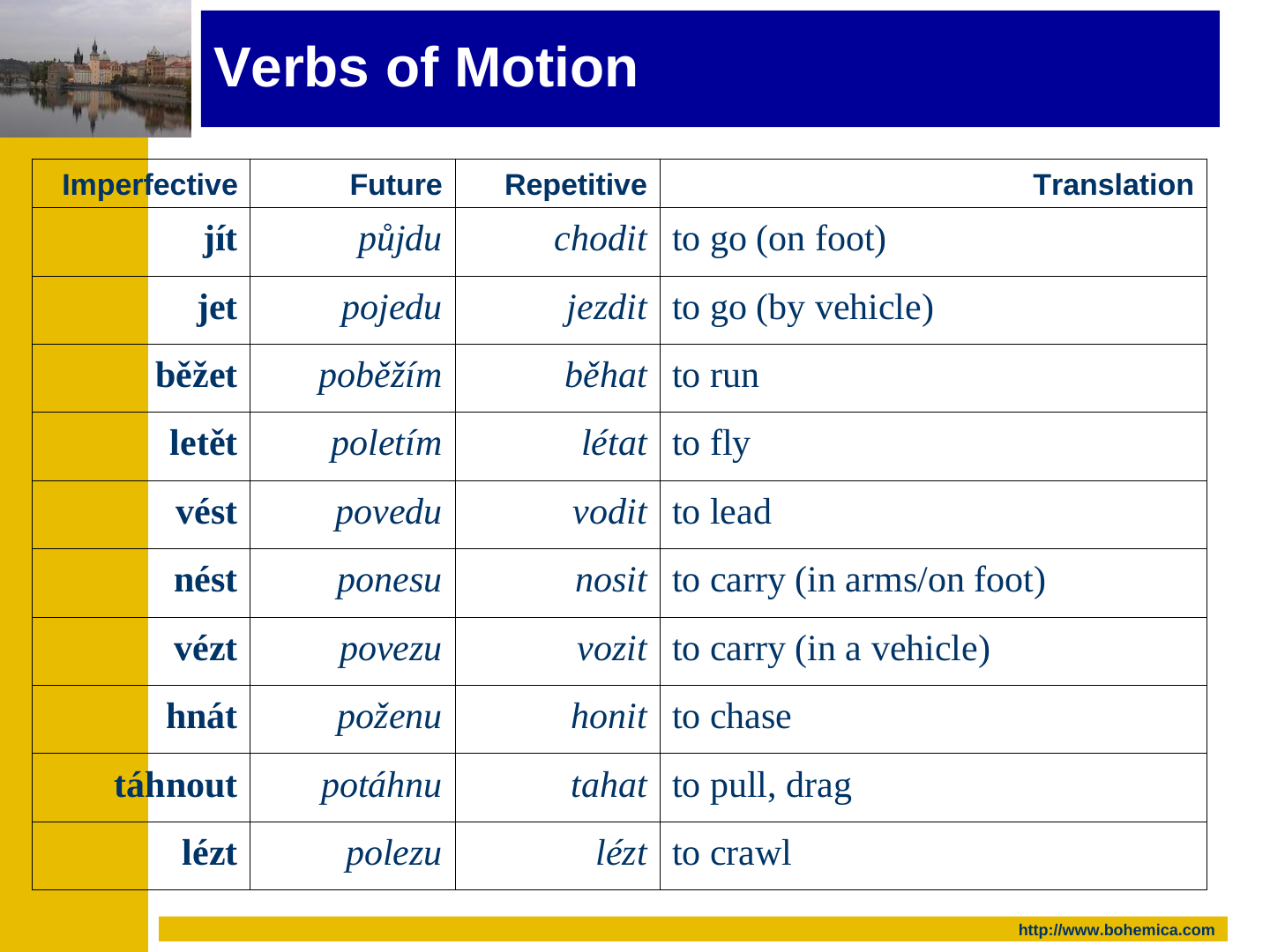
Verbs of Motion
| Imperfective | Future | Repetitive | Translation |
|---|---|---|---|
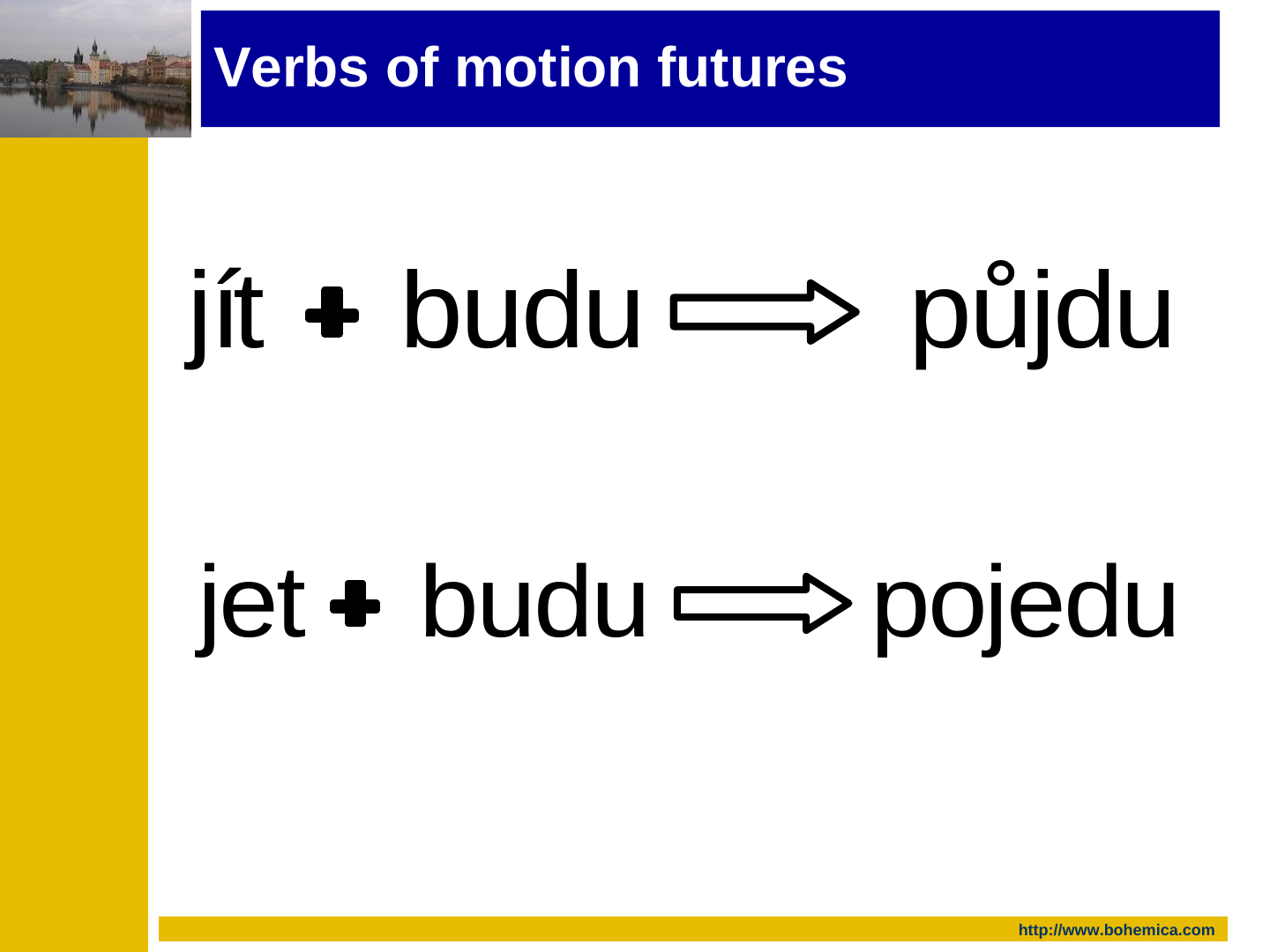
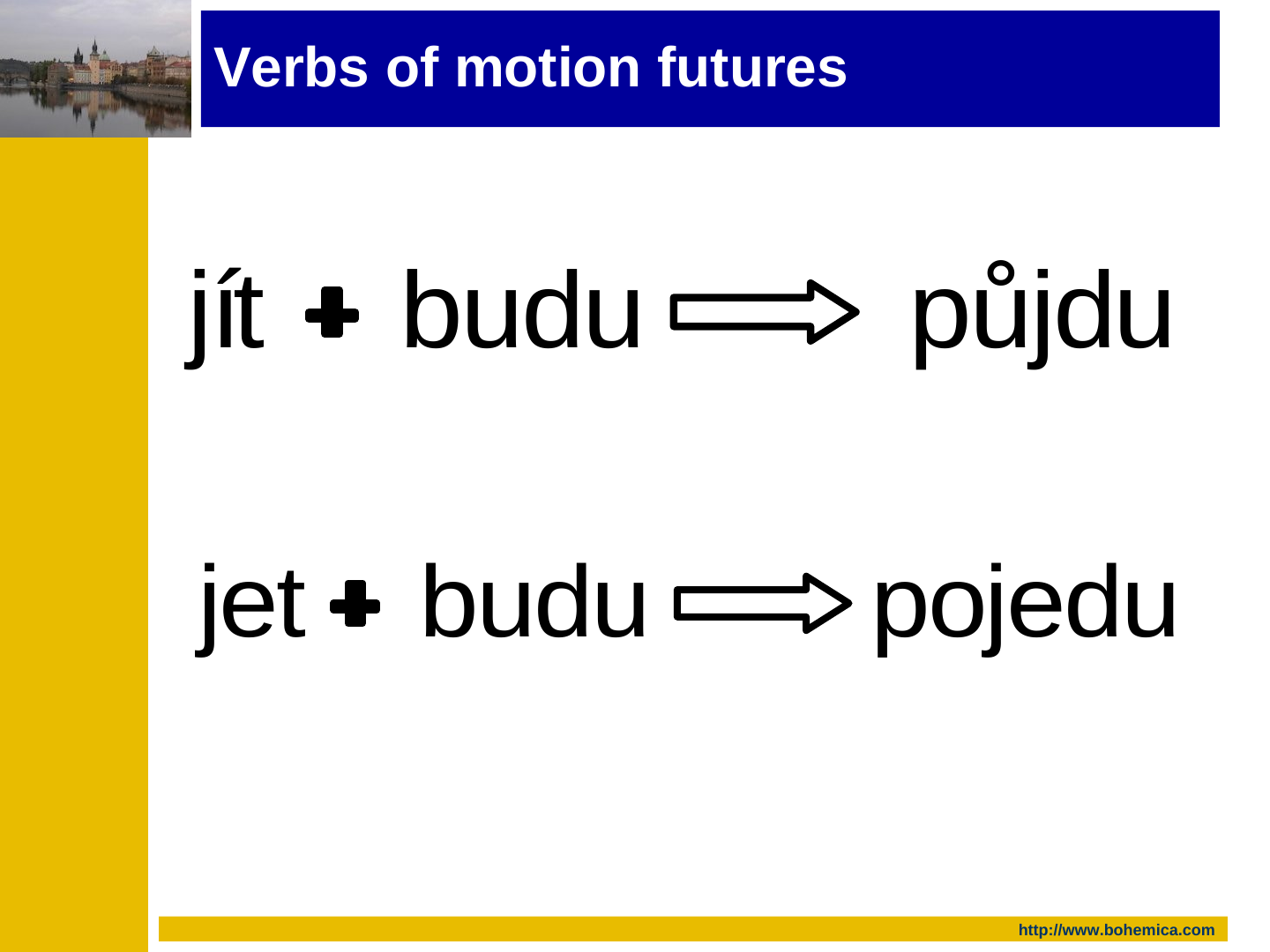
| jít | půjdu | chodit | to go (on foot) |
| jet | pojedu | jezdit | to go (by vehicle) |
| běžet | poběžím | běhat | to run |
| letět | poletím | létat | to fly |
| vést | povedu | vodit | to lead |
| nést | ponesu | nosit | to carry (in arms/on foot) |
| vézt | povezu | vozit | to carry (in a vehicle) |
| hnát | poženu | honit | to chase |
| táhnout | potáhnu | tahat | to pull, drag |
| lézt | polezu | lézt | to crawl |
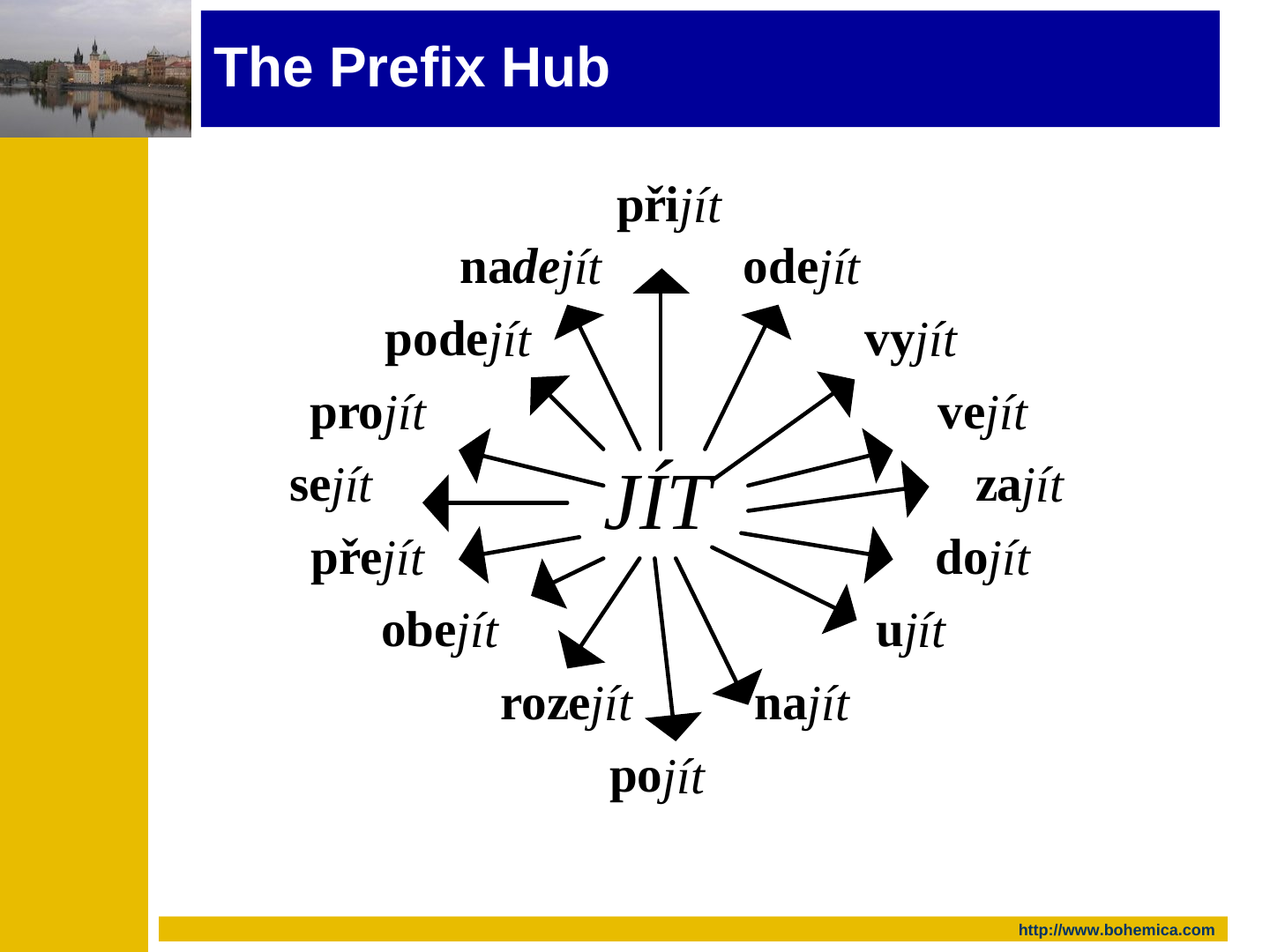
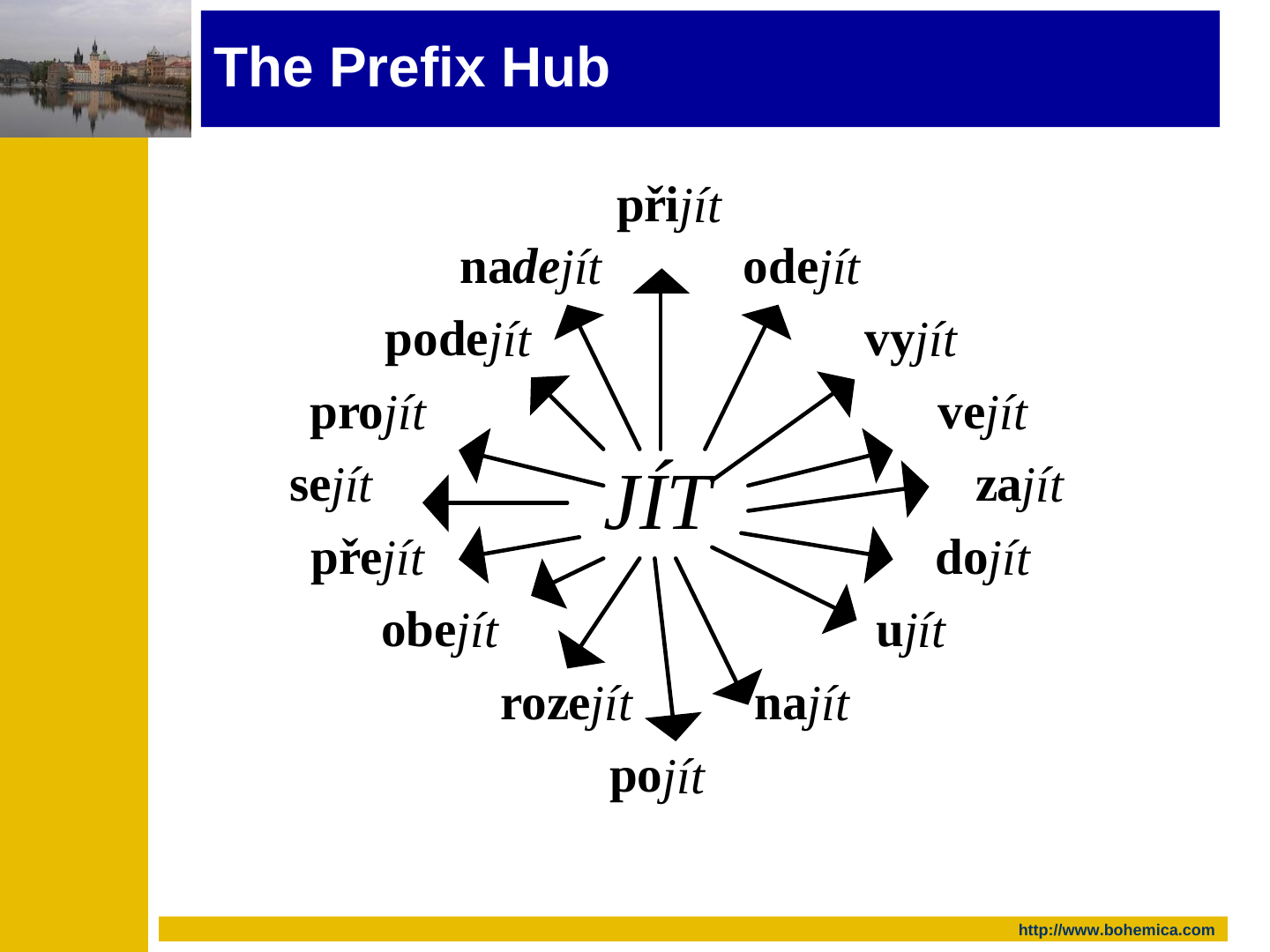
Slide 21: The Prefix Hub
The Prefix Hub
Slide 22: Verbs of motion futures
Verbs of motion futures
Slide 23: Verbs of motion in aspect
Verbs of motion in aspect
Slide 24: Putting it into practice
Putting it into practice
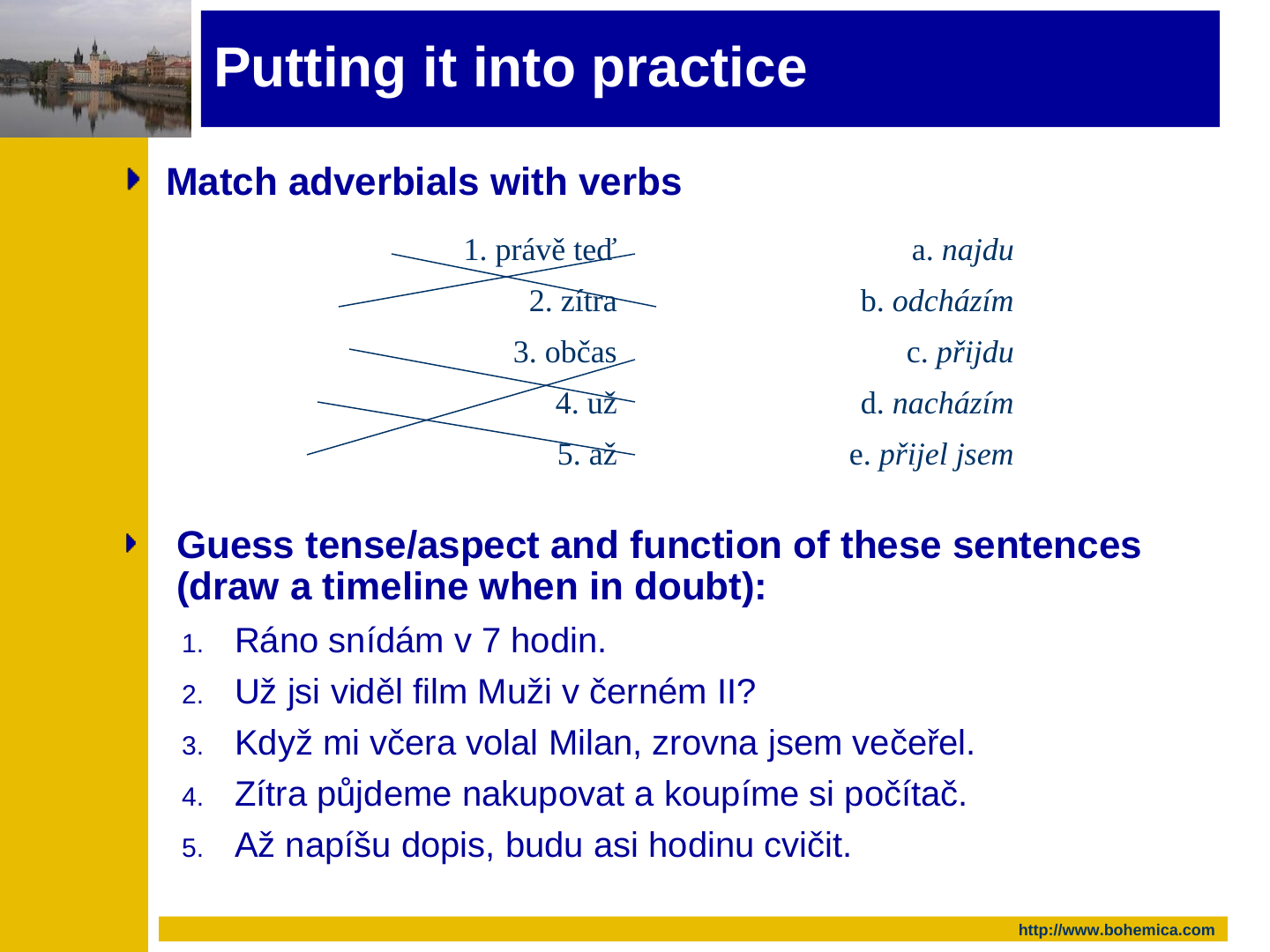
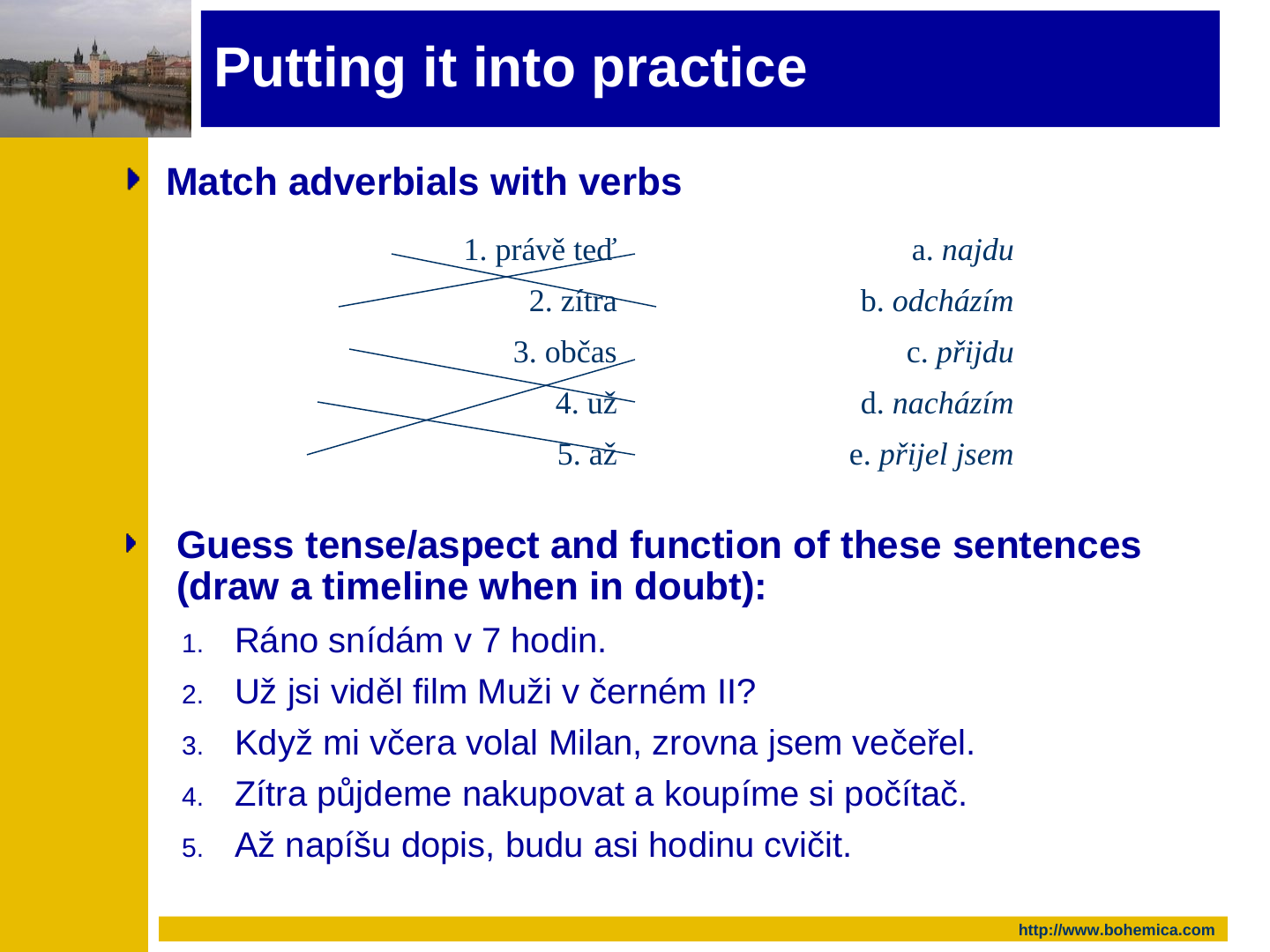
- Match adverbials with verbs
| 1. právě teď | a. najdu |
| 2. zítra | b. odcházím |
| 3. občas | c. přijdu |
| 4. už | d. nacházím |
| 5. až | e. přijel jsem |
Guess tense/aspect and function of these sentences (draw a timeline when in doubt):
- Ráno snídám v 7 hodin.
- Už jsi viděl film Muži v černém II?
- Když mi včera volal Milan, zrovna jsem večeřel.
- Zítra půjdeme nakupovat a koupíme si počítač.
- Až napíšu dopis, budu asi hodinu cvičit.