If Levi-Strauss met Langacker: Constructional foundations of cultural patterns
- SlideShare title: If Levi-Strauss had met Langacker: Constructional foundations of cultural pat...
- Talk date: Not established
- SlideShare upload: 2013-04-06 (upload date, not the delivery date)
- Event: Not established
- Place: Not established
- Topics: Language & meaning
- Language: en
- Slides in the original listing: 55
- Coverage: Full text of all 55 slides, each paired with its original slide image (slide N is section N).
- Original listing: https://www.slideshare.net/slideshow/constructional-foundations-of-cultural-patterns/18288671
- Cover image: https://slides.dominiklukes.net/readers/constructional-foundations-of-cultural-patterns/pages/page-01.png
- Reader data (JSON): https://slides.dominiklukes.net/readers/constructional-foundations-of-cultural-patterns/presentation.json
- TalkWeaver package (outline and images, ZIP): https://slides.dominiklukes.net/constructional-foundations-of-cultural-patterns/constructional-foundations-of-cultural-patterns-talkweaver.zip
- TalkWeaver outline: https://slides.dominiklukes.net/constructional-foundations-of-cultural-patterns/talkweaver/constructional-foundations-of-cultural-patterns-outline.md
- Markdown copy: https://slides.dominiklukes.net/constructional-foundations-of-cultural-patterns/index.md
Slide 1: If Levi-Strauss met Langacker: Constructional foundations of cultural patterns
If Levi-Strauss met Langacker: Constructional foundations of cultural patterns
Dominik Lukeš
@techczech

Slide 2: Preliminaries
Preliminaries

Slide 3: Preliminaries
Can culture be taught the same way that language can?
Culture is more like language than we assume in that language is more like culture than we assume.
Slide 4: Preliminaries
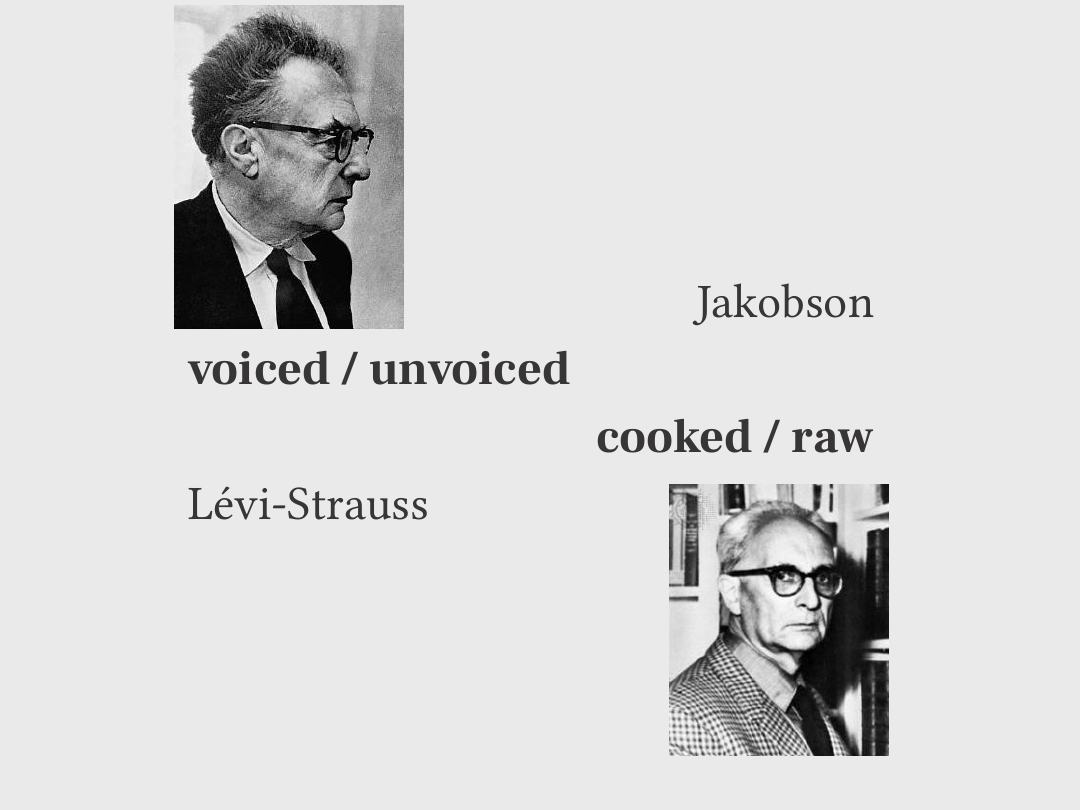
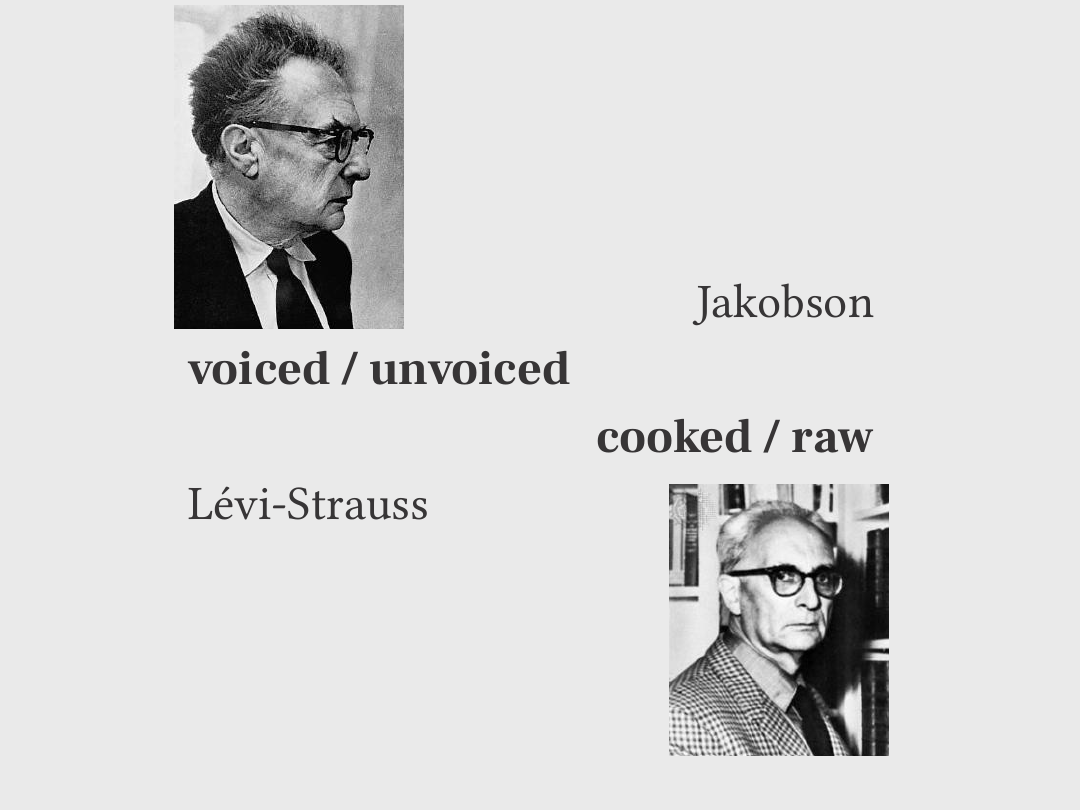
- Jakobson
- voiced / unvoiced
- cooked / raw
- Lévi-Strauss
Slide 5: Preliminaries
“I saw a guy at a party wearing a leather jacket and I thought, ‘That is cool.’ But then I saw another guy wearing a leather vest and I thought, ‘That is not cool’. Then I figured it out: ‘Cool’ is all about leather sleeves.”
– Demetri Martin
Slide 6: Preliminaries
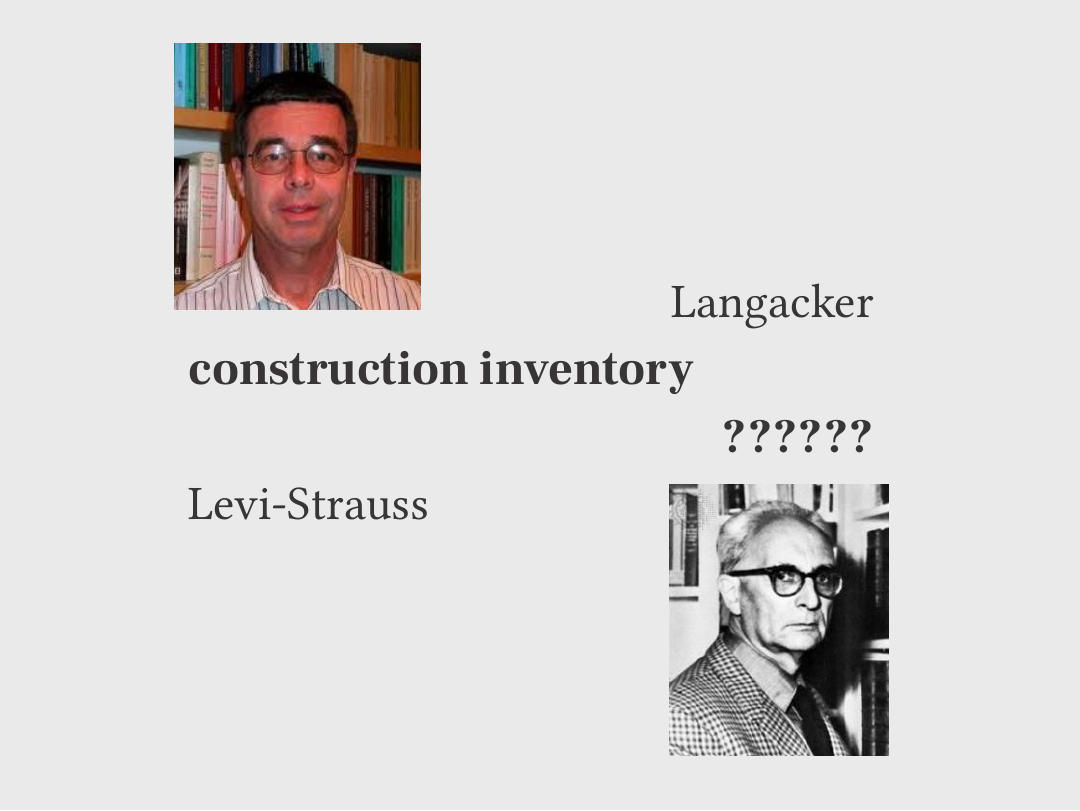
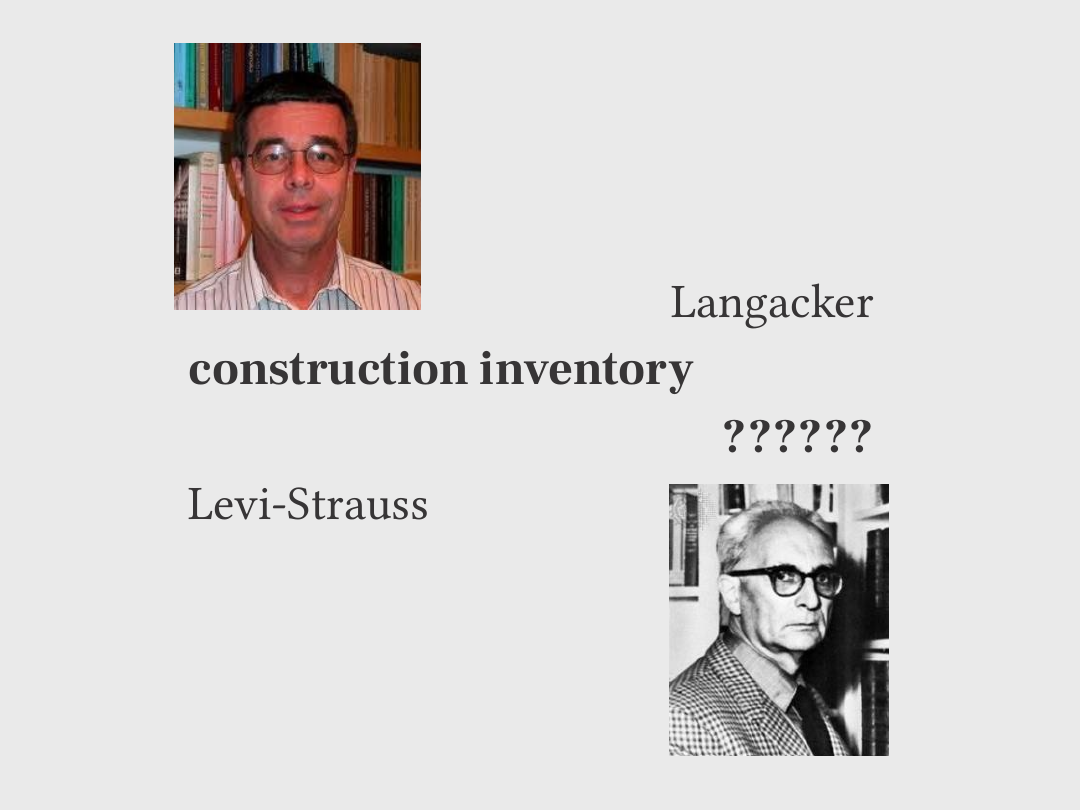
- Langacker
- construction inventory
- ??????
- Levi-Strauss
Slide 7: Preliminaries
Caveat
We need more than just using terms from one field to label phenomena in another without providing a benefit.
Slide 8: (Radical) Constructional view of language
(Radical) Constructional view of language
Slide 9: (Radical) Constructional view of language


Slide 10: (Radical) Constructional view of language
Language = Constructions (meaning/form pairs) + Integration (blending)
Slide 11: (Radical) Constructional view of language
- Language is a structured inventory of symbolic units
- Units are best described as constructions linking form and meaning
- Formal and semantic compositionality is the process of conceptual integration
Slide 12: (Radical) Constructional view of language
Everything we know as words and rules are just constructions.
Slide 13: (Radical) Constructional view of language
Knowledge of linguistic units is the same kind of knowledge as other kinds of knowledge (encyclopedic) and exhibits the same kinds of organizational, cognitive and social properties (incl. basic-level hierarchies, prototype category effects, underspecification, redundancy, conventionalization, culture/language-specificity, explication, negotiation)
Slide 14: (Radical) Constructional view of language
Knowledge is structured by frames (cognitive models).
(See talk on Frames.)
Slide 15: (Radical) Constructional view of language
conceptual integration is constrained, underspecified, opportunistic, dynamic, conventionalized
Slide 16: (Radical) Constructional view of language
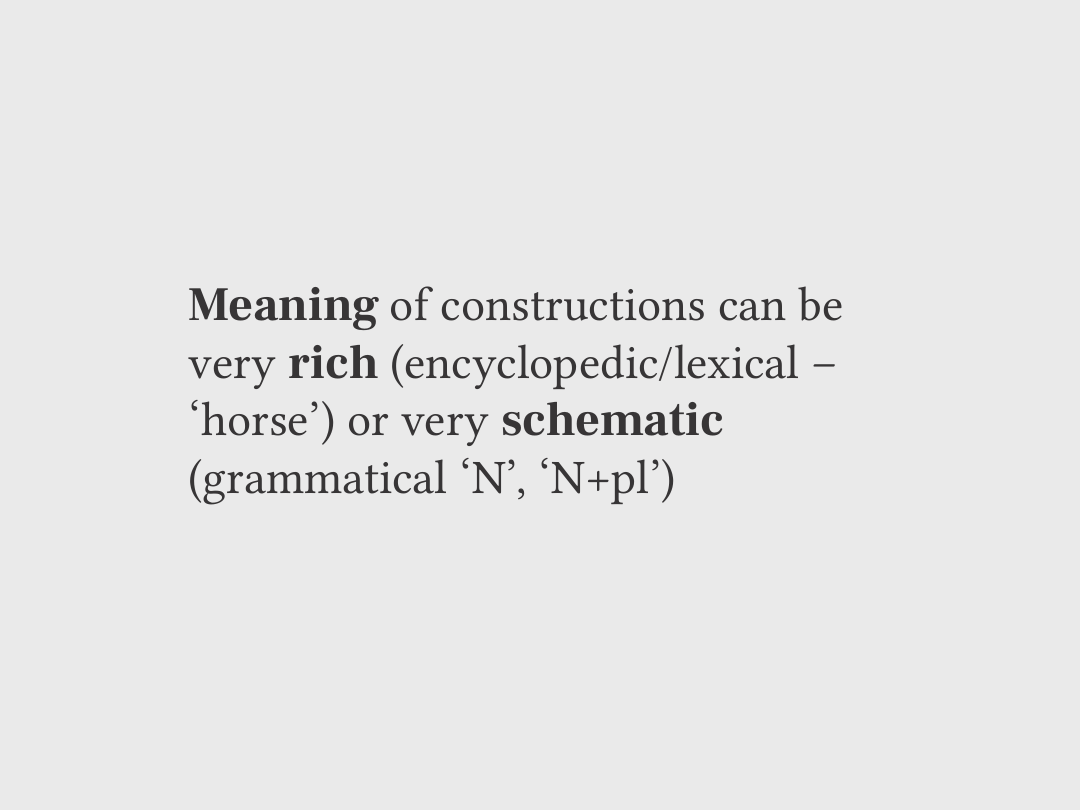
Meaning of constructions can be very rich (encyclopedic/lexical – ‘horse’) or very schematic (grammatical ‘N’, ‘N+pl’)
Slide 17: (Radical) Constructional view of language
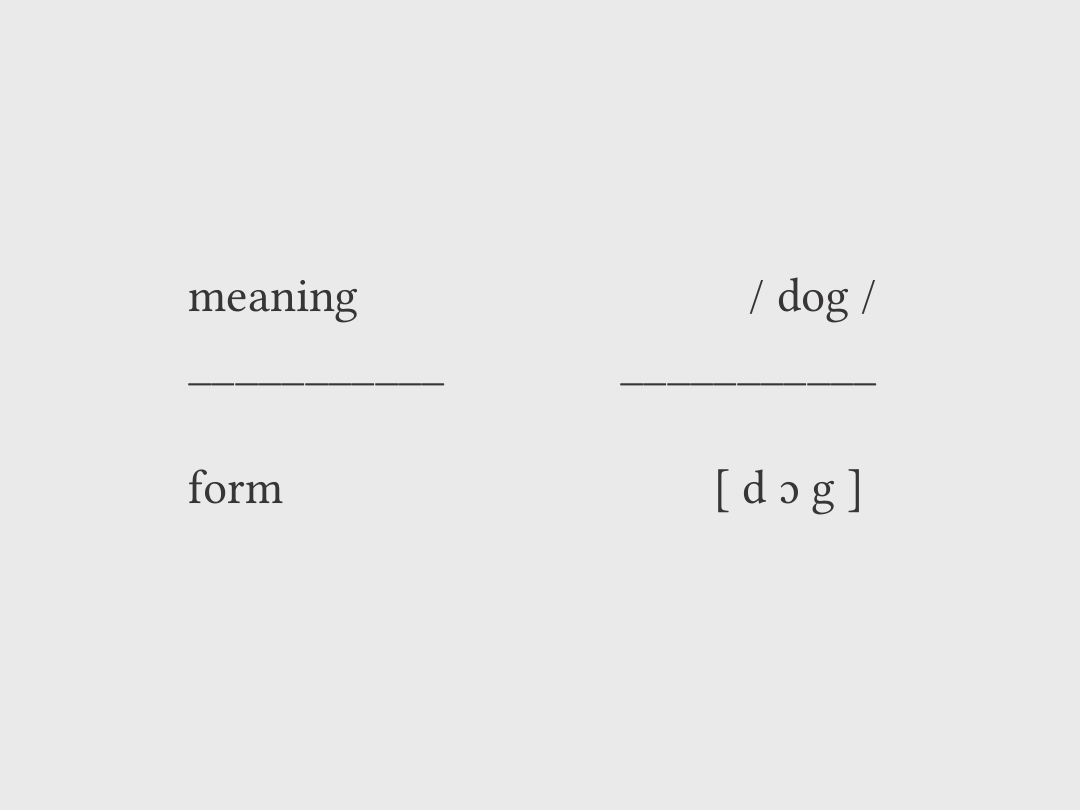
| meaning | / dog / |
|---|---|
| form | [ d ɔ g ] |
Slide 18: (Radical) Constructional view of language
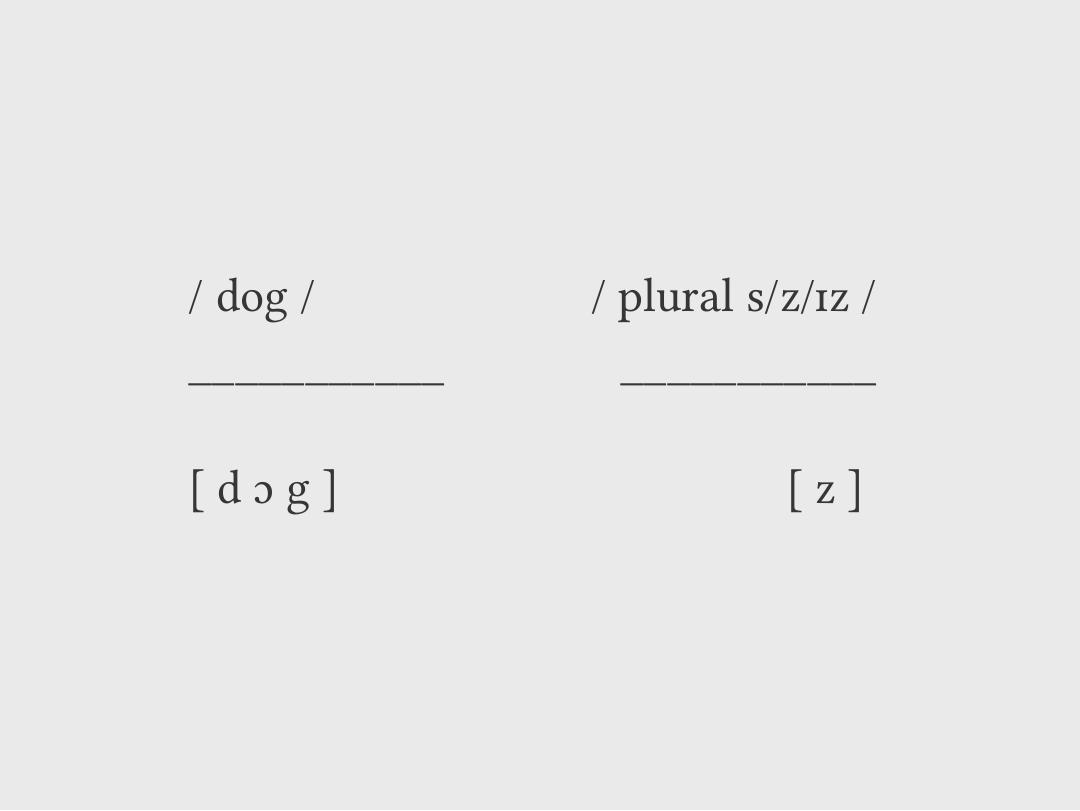
| / dog / | / plural s/z/ɪz / |
|---|---|
| [ d ɔ g ] | [ z ] |
Slide 19: (Radical) Constructional view of language
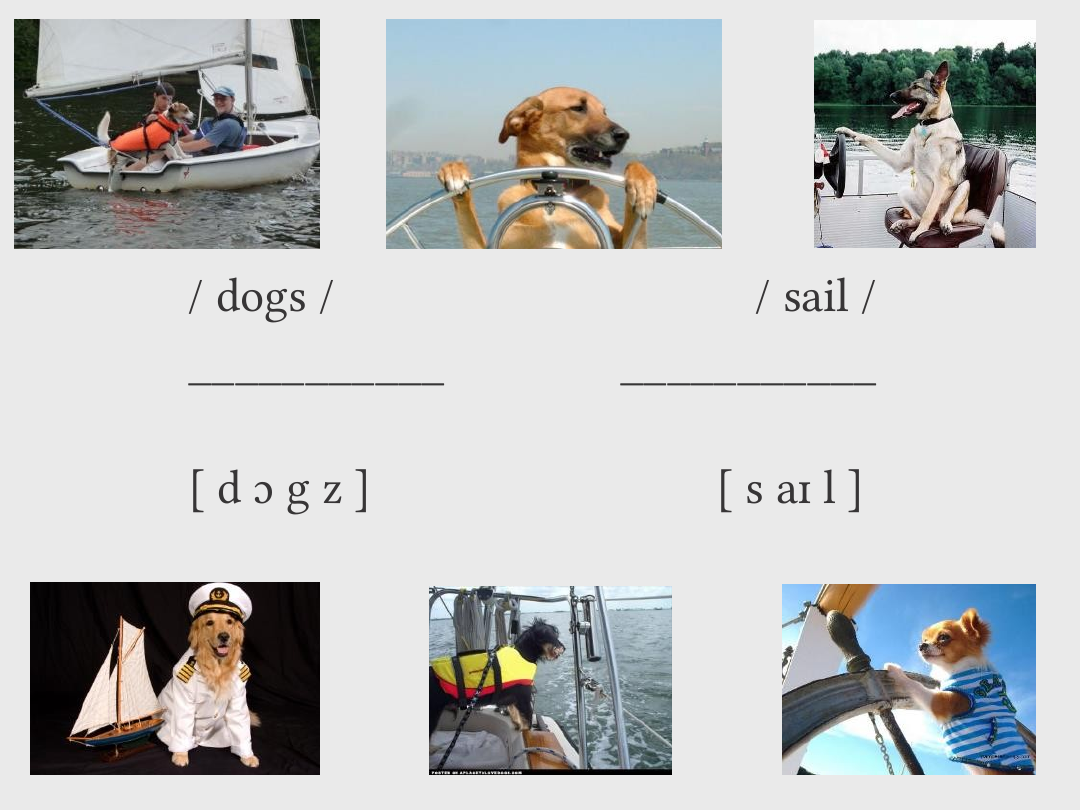
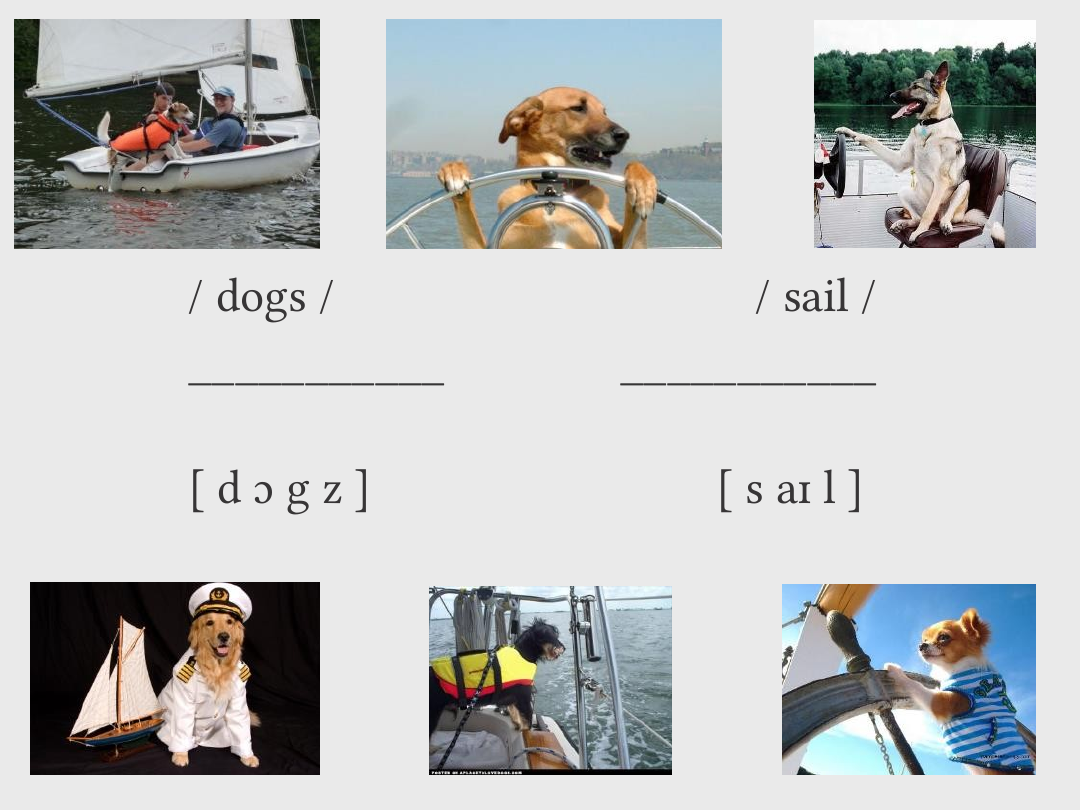
| / dogs / | / sail / |
|---|---|
| [ d ɔ g z ] | [ s aɪ l ] |
Slide 20: (Radical) Constructional view of language
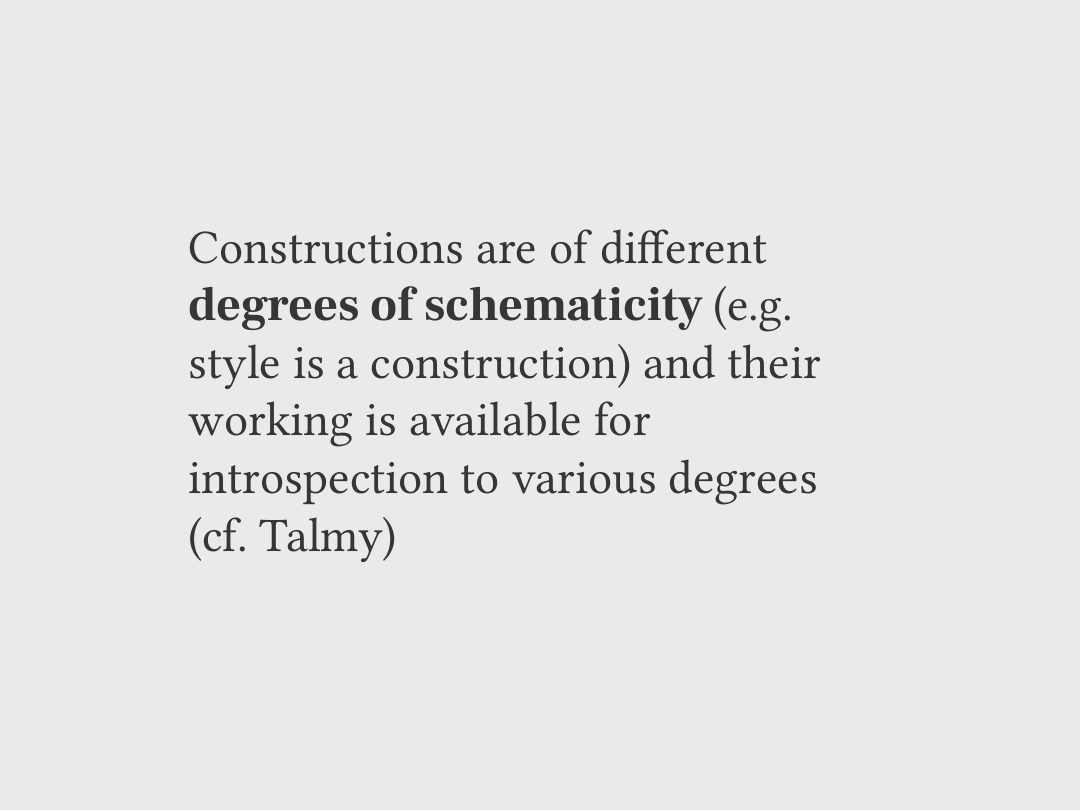
Constructions are of different degrees of schematicity (e.g. style is a construction) and their working is available for introspection to various degrees (cf. Talmy)
Slide 21: (Radical) Constructional view of language
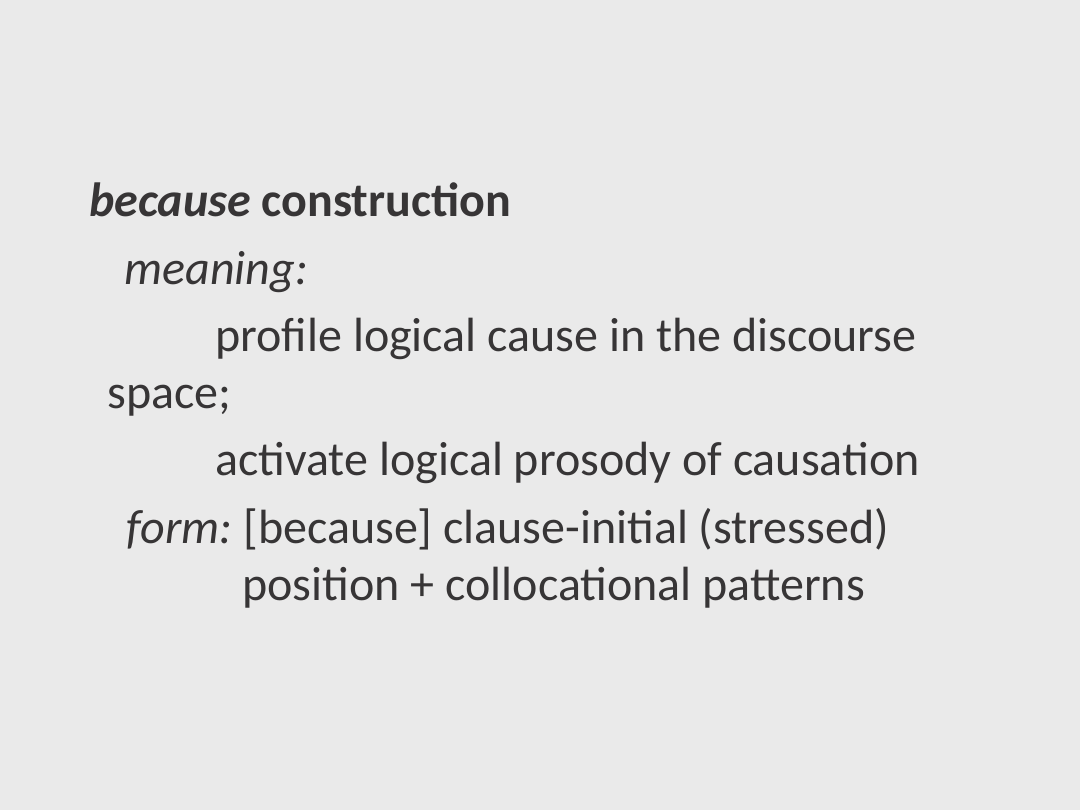
- because construction
- meaning:
- profile logical cause in the discourse space;
- activate logical prosody of causation
- form: [because] clause-initial (stressed) position + collocational patterns
- meaning:
Slide 22: (Radical) Constructional view of language
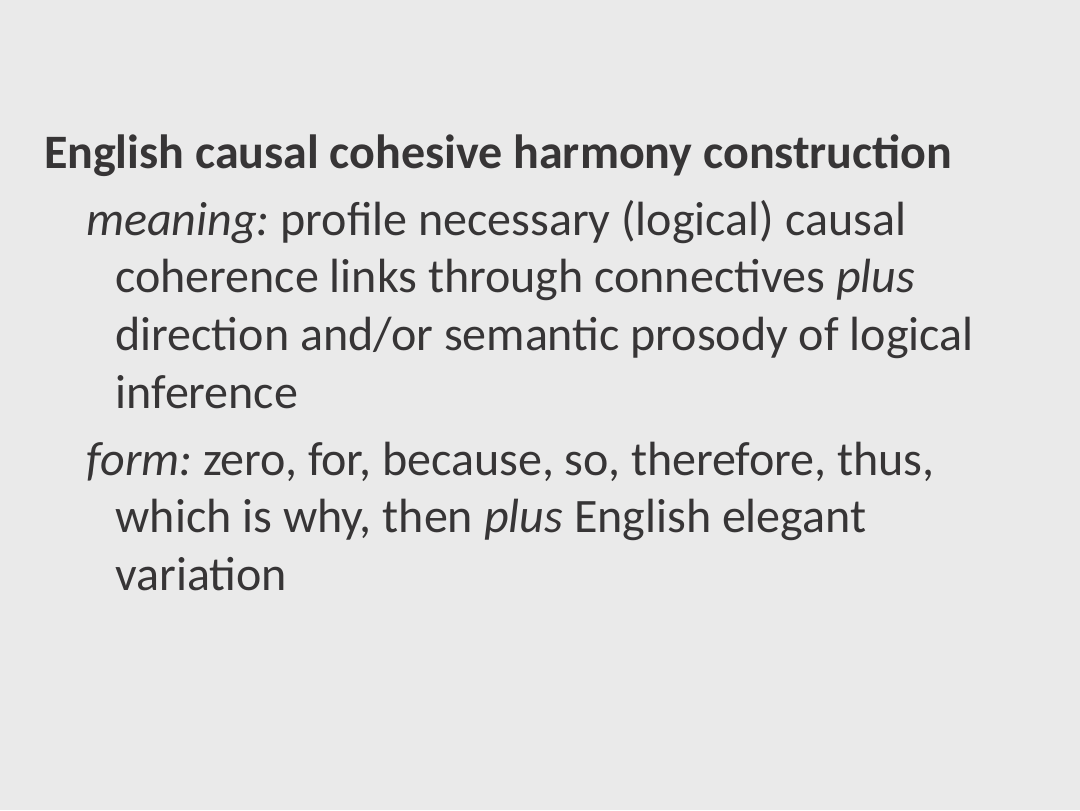
- English causal cohesive harmony construction
- meaning: profile necessary (logical) causal coherence links through connectives plus direction and/or semantic prosody of logical inference
- form: zero, for, because, so, therefore, thus, which is why, then plus English elegant variation
Slide 23: (Radical) Constructional view of language
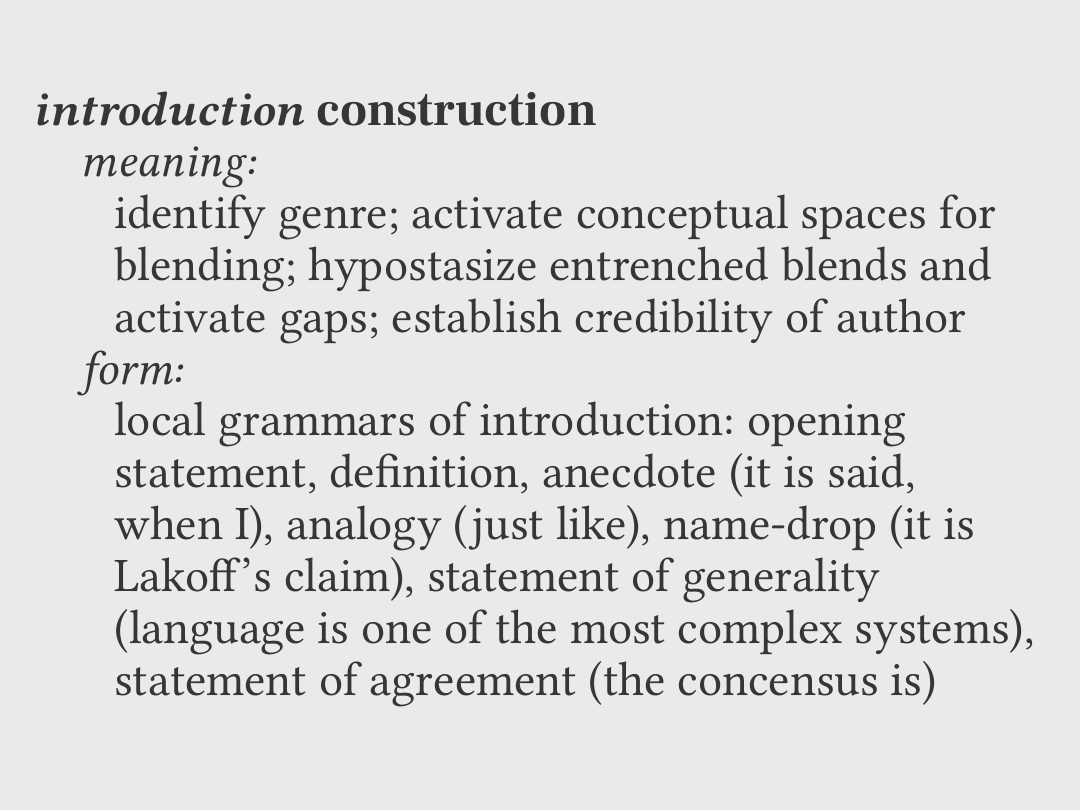
- introduction construction
- meaning:
- identify genre; activate conceptual spaces for blending; hypostasize entrenched blends and activate gaps; establish credibility of author
- form:
- local grammars of introduction: opening statement, definition, anecdote (it is said, when I), analogy (just like), name-drop (it is Lakoff’s claim), statement of generality (language is one of the most complex systems), statement of agreement (the concensus is)
- meaning:
Slide 24: (Radical) Constructional view of language
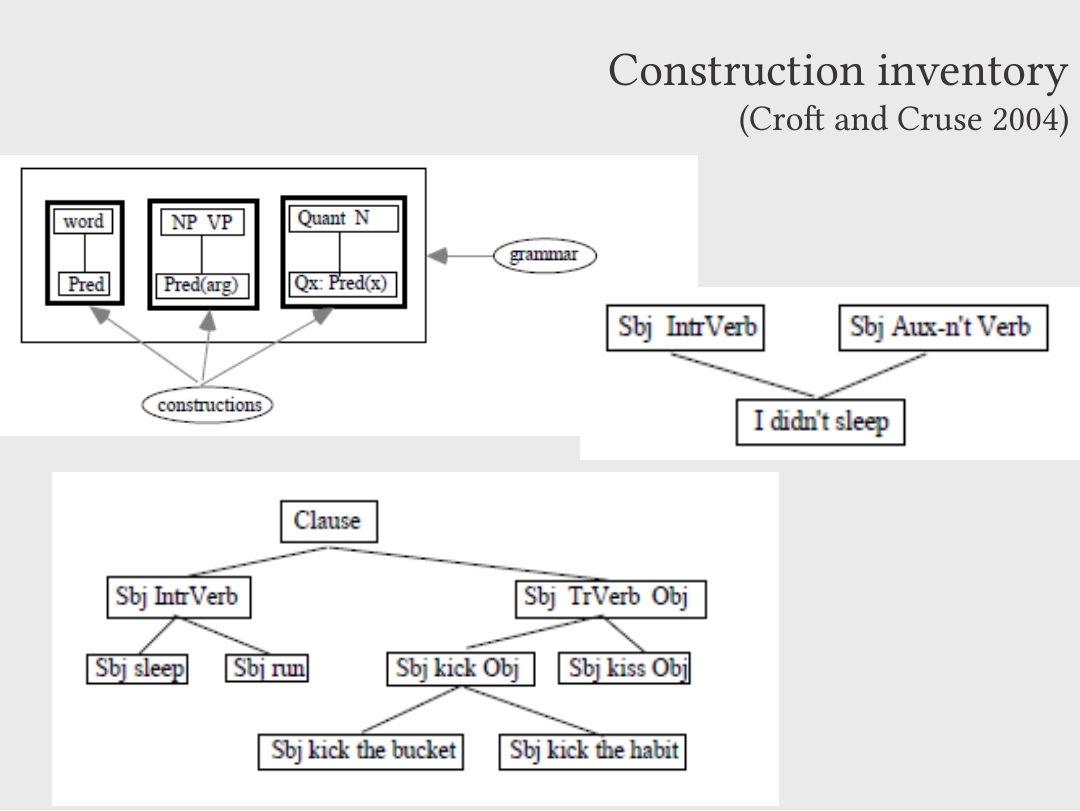
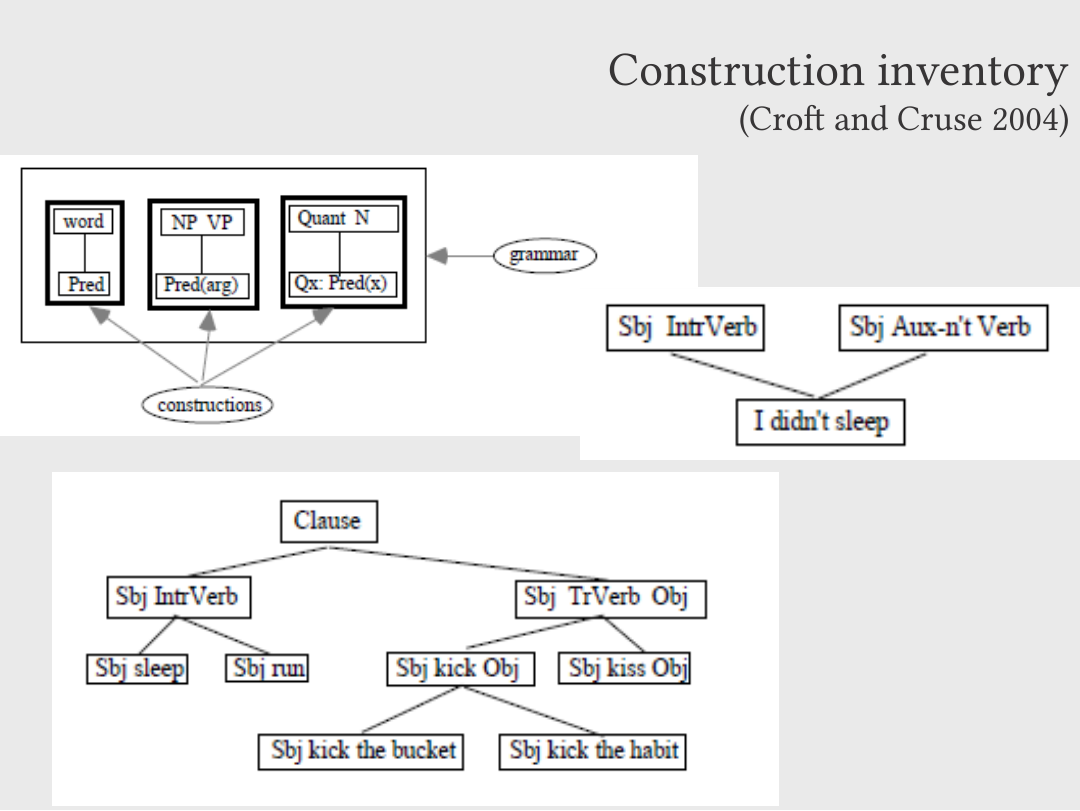
Construction inventory (Croft and Cruse 2004)
Slide 25: (Radical) Constructional view of language
Constructions are organized in a patterned inventory that is subject to both collective convergence and individual divergence.
Slide 26: (Radical) Constructional view of language
The inventory is collectively negotiated both implicitly through imitation and explicitly.
Slide 27: Culture as inventory of constructions
Culture as inventory of constructions
Slide 28: Culture as inventory of constructions
Behaviours, beliefs, social hierarchies, forms of speech = patterned inventory of form / meaning pairs
Slide 29: Culture as inventory of constructions
Culture cannot be summarized by general principles. There are regularities and patterns of motivation but no determination.
Slide 30: Examples of cultural constructions
Examples of cultural constructions
Slide 31: Examples of cultural constructions


Slide 32: Examples of cultural constructions
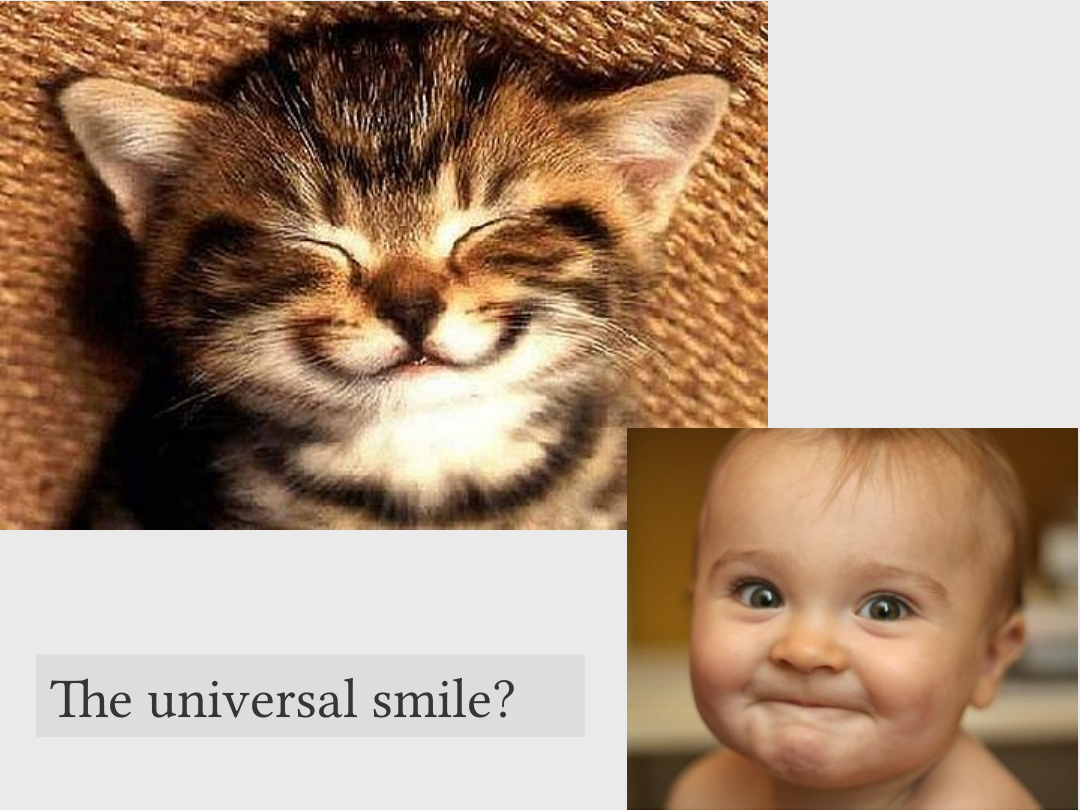
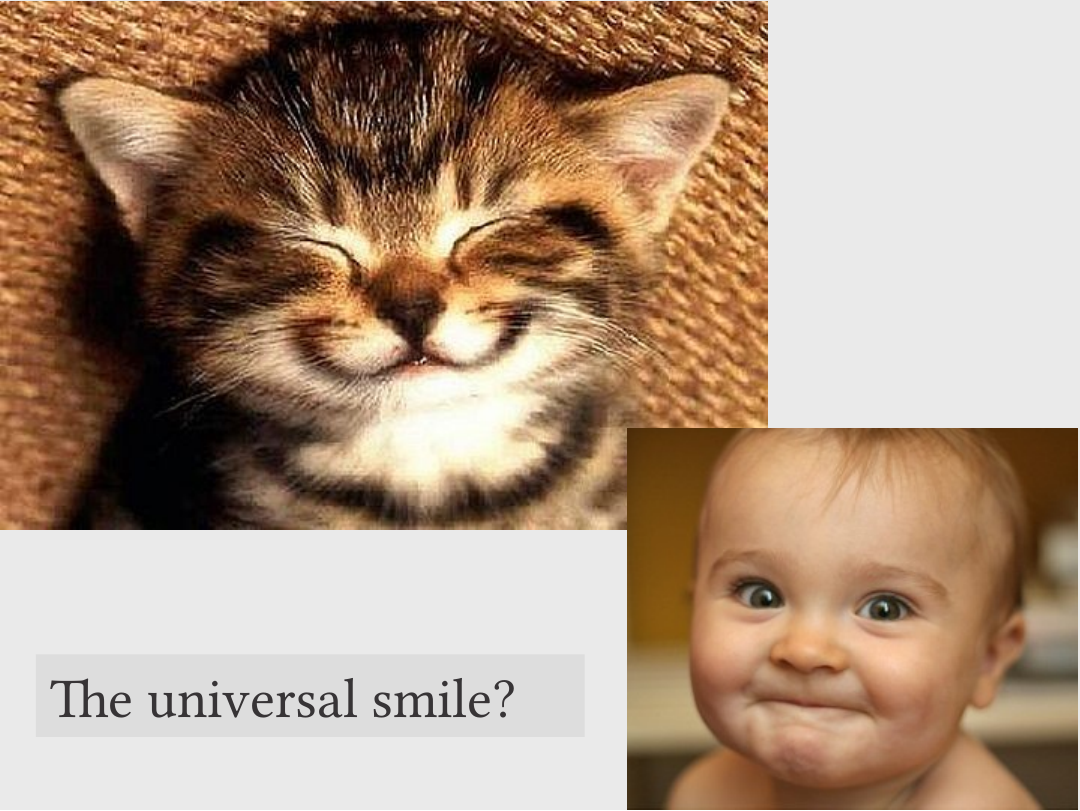
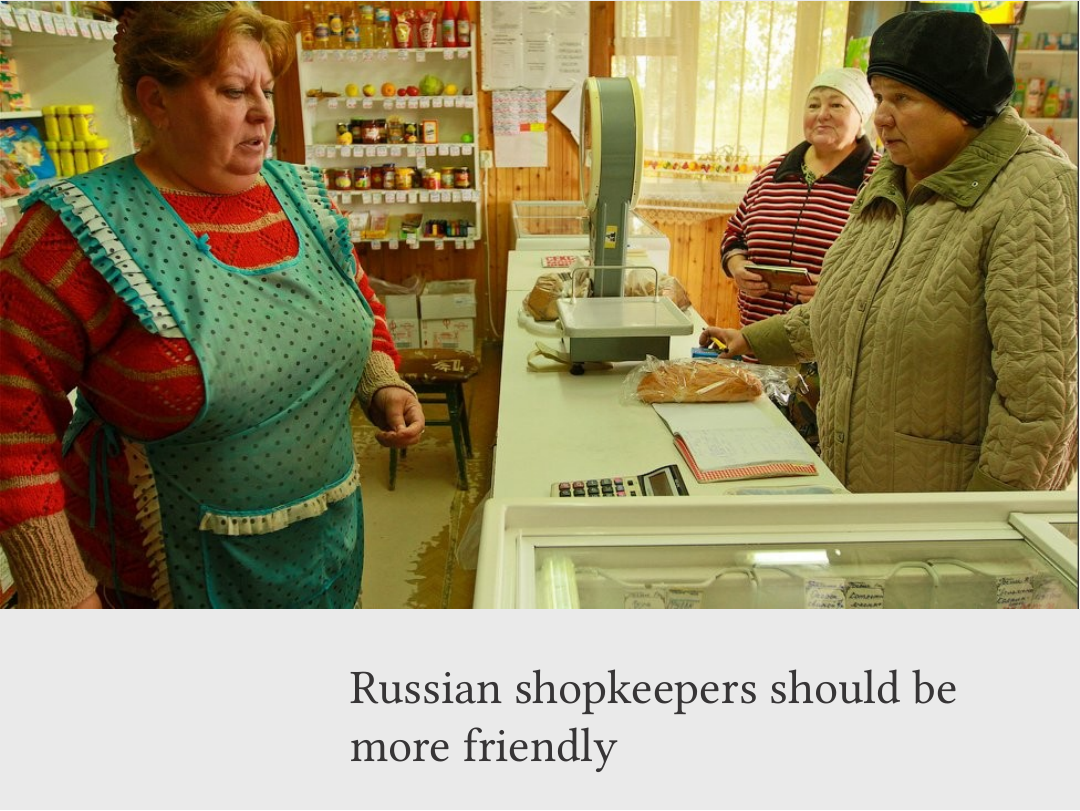
The universal smile?
Slide 33: Examples of cultural constructions
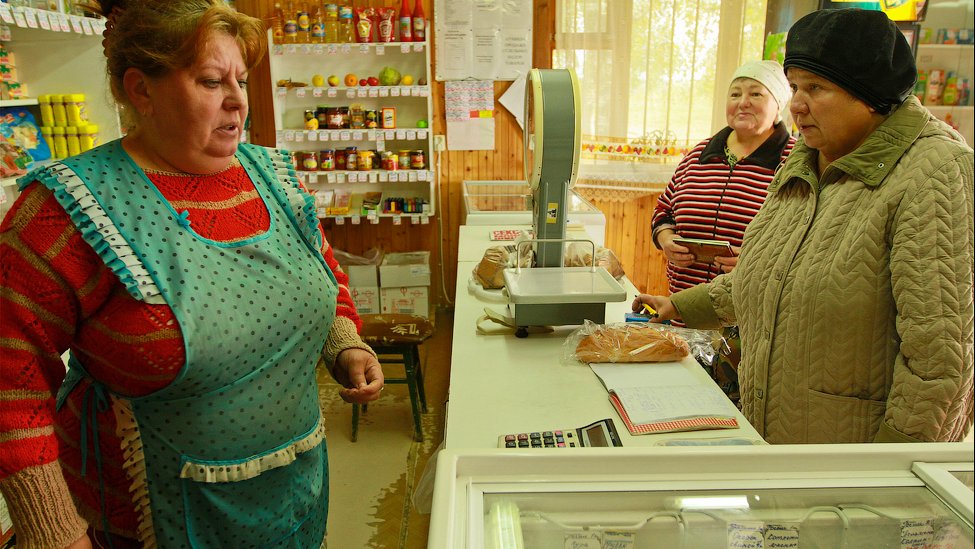
Russian shopkeepers should be more friendly
Slide 34: Examples of cultural constructions

Americans are insincere

Slide 35: Examples of cultural constructions
SMILE
- Person you know
- Express happiness
- Confirm emotional relationship
Slide 36: Examples of cultural constructions
SMILE
- Person you meet
- Express general connection/acknowledgement
Slide 37: Examples of cultural constructions
IMAGES OF SMILE / SAYINGS ABOUT SMILING / …
- Smiling means friendliness
- Smiling is better when sincere
- More people should smile
- …
Slide 38: Examples of cultural constructions
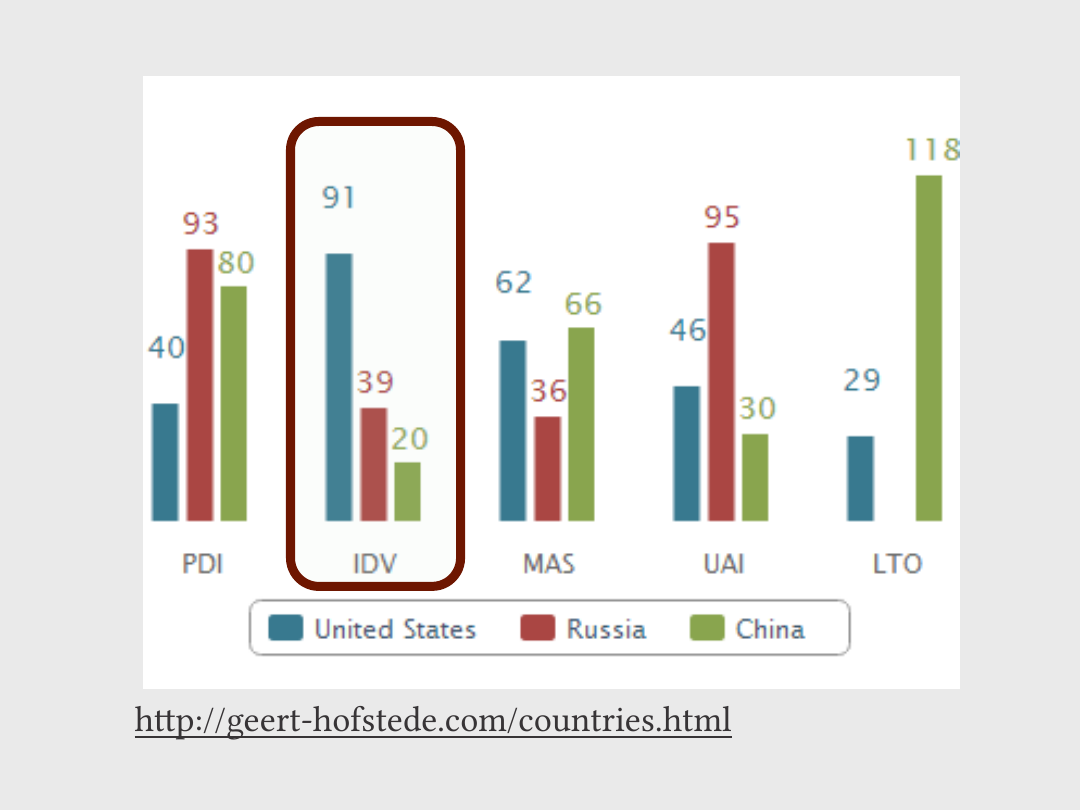
Collectivist / Individualist cultures
(Hofstede, Culture’s Consequences, 1983)
Slide 39: Examples of cultural constructions
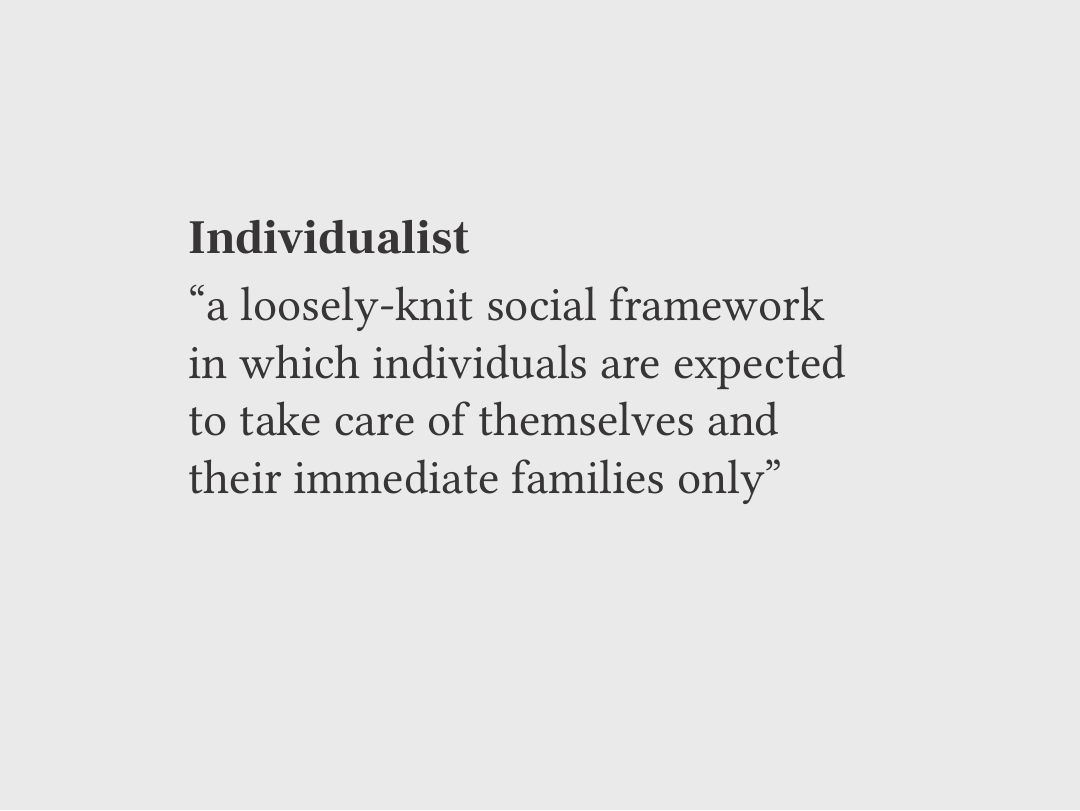
Individualist
“a loosely-knit social framework in which individuals are expected to take care of themselves and their immediate families only”
Slide 40: Examples of cultural constructions
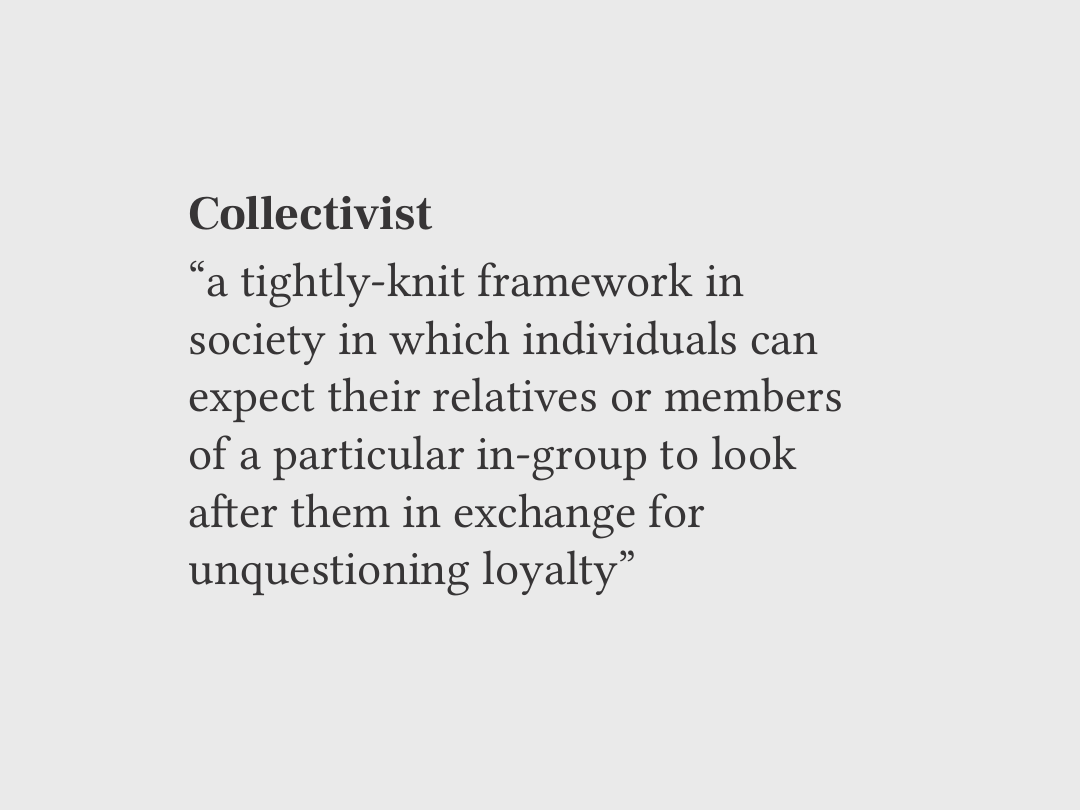
Collectivist
“a tightly-knit framework in society in which individuals can expect their relatives or members of a particular in-group to look after them in exchange for unquestioning loyalty”
Slide 41: Examples of cultural constructions
Slide 42: Examples of cultural constructions
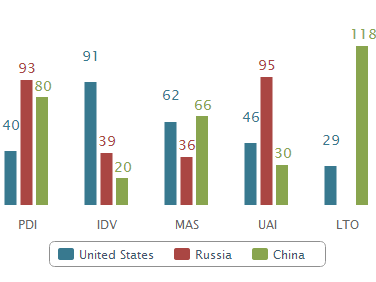
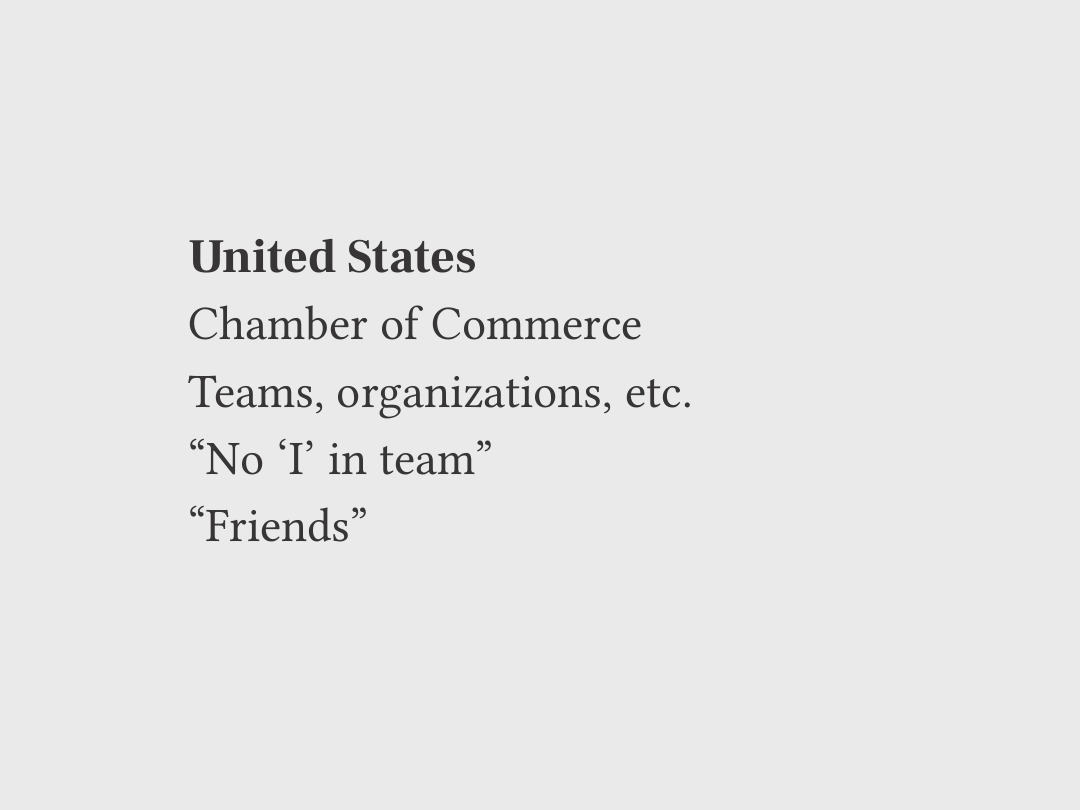
United States
- Chamber of Commerce
- Teams, organizations, etc.
- “No ‘I’ in team”
- “Friends”
Slide 43: Examples of cultural constructions
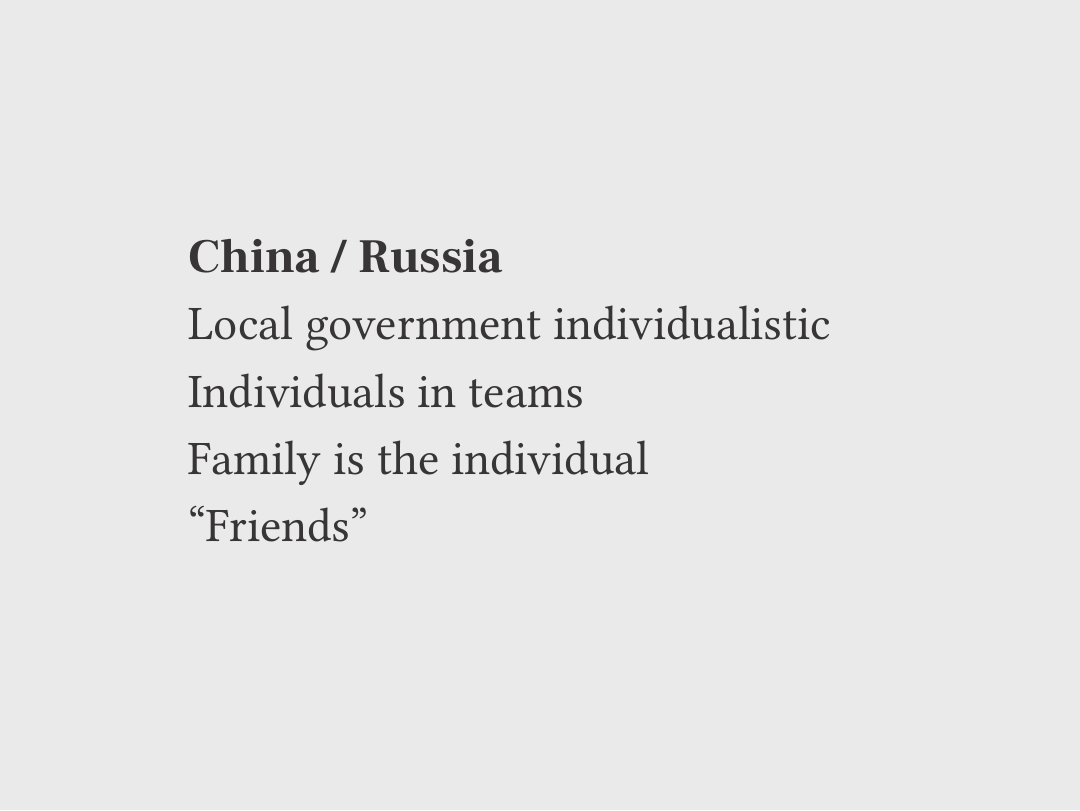
China / Russia
- Local government individualistic
- Individuals in teams
- Family is the individual
- “Friends”
Slide 44: Examples of cultural constructions

Wierzbicka
1997

Slide 45: Examples of cultural constructions
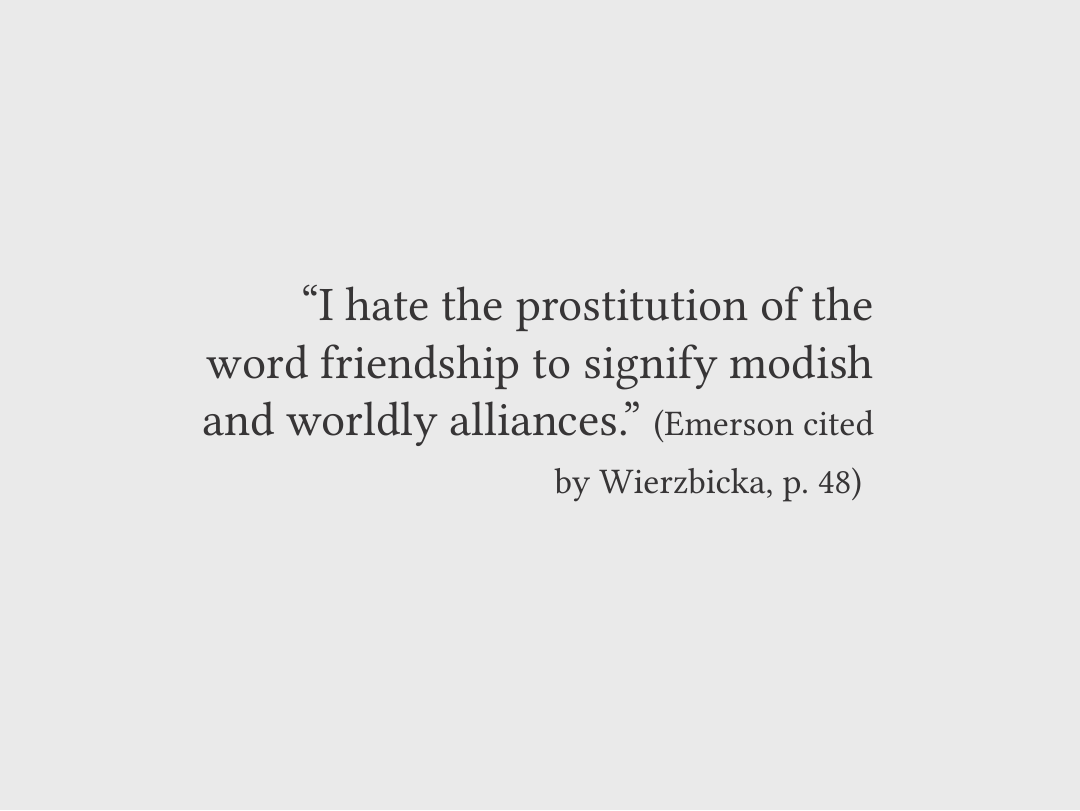
“I hate the prostitution of the word friendship to signify modish and worldly alliances.” (Emerson cited by Wierzbicka, p. 48)
Slide 46: Examples of cultural constructions
“By contrast, the modern expression close friend is not meant to have the same range of referents as the word friend; it is indeed intended to stand for a different category of people, linked to the target person by a different kind of relationship.”
Wierzbicka, p. 49
Slide 47: Examples of cultural constructions
FRIEND (forms)
FRIEND (meanings)
Slide 48: Examples of cultural constructions
“I'll be there for you
When the rain starts to pour
I'll be there for you
Like I've been there before
I'll be there for you
'Cuz you're there for me too...”
“V nouzi poznáš přítele.”
Friendship is important
Czech friend, American friend

Slide 49: Examples of cultural constructions
“How much money do you make now?”
Knowledge of earnings of a person
Czech friend, American spouse, Albanian acquaintance
Slide 50: Examples of cultural constructions
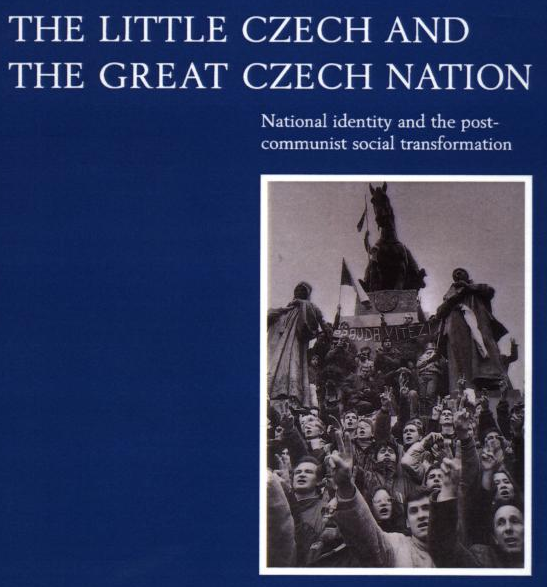
Ladislav Holý
1996

Slide 51: Examples of cultural constructions
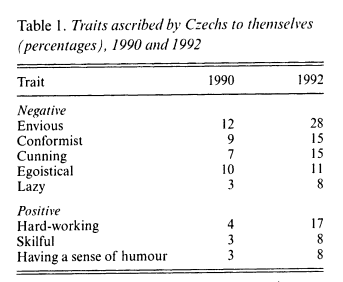
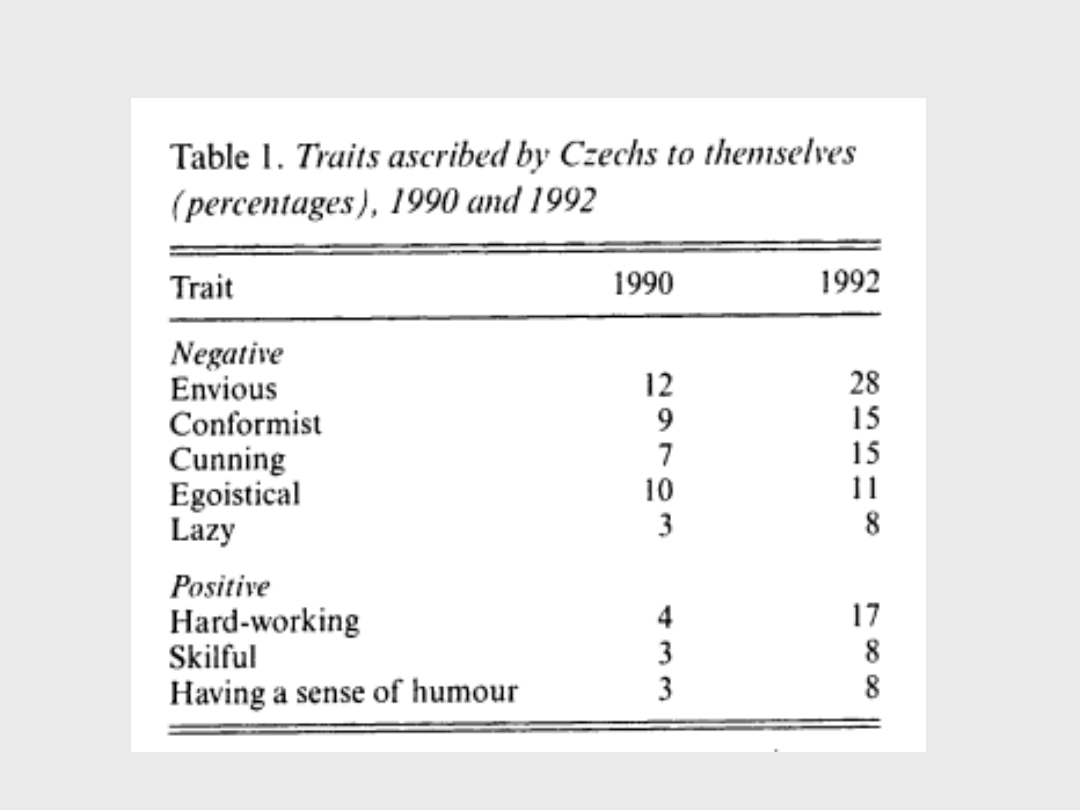
Slide 52: Examples of cultural constructions
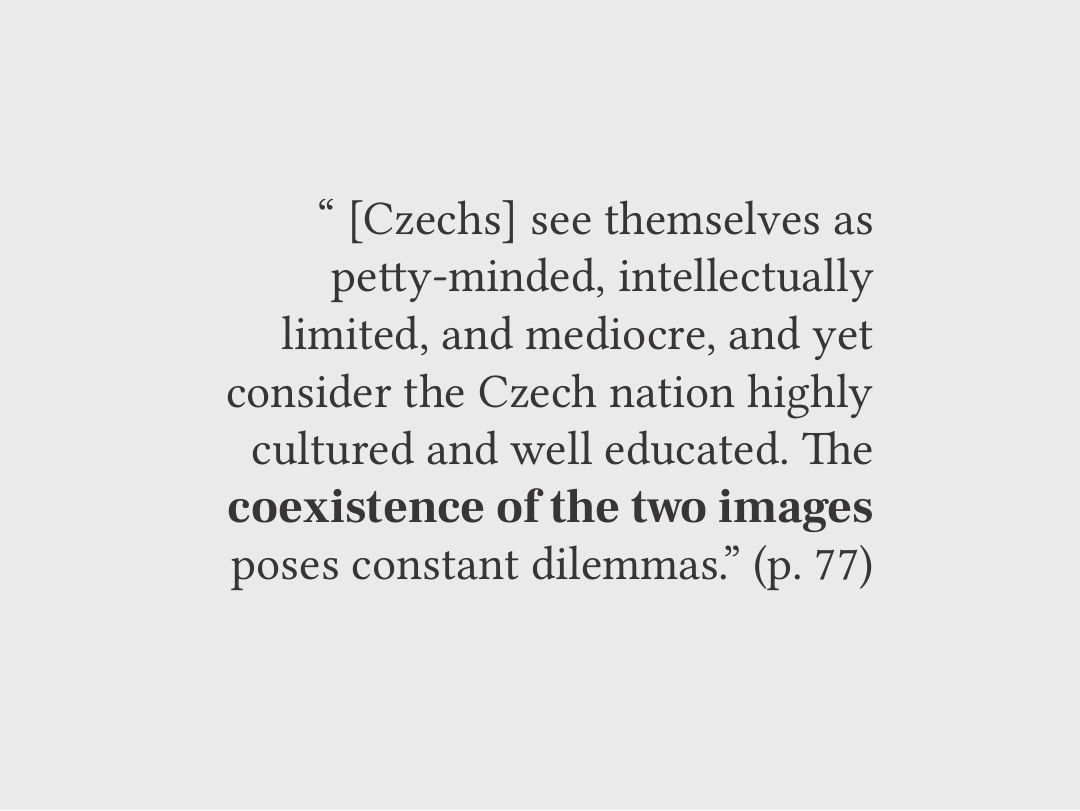
“ [Czechs] see themselves as petty-minded, intellectually limited, and mediocre, and yet consider the Czech nation highly cultured and well educated. The coexistence of the two images poses constant dilemmas.” (p. 77)
Slide 53: Examples of cultural constructions
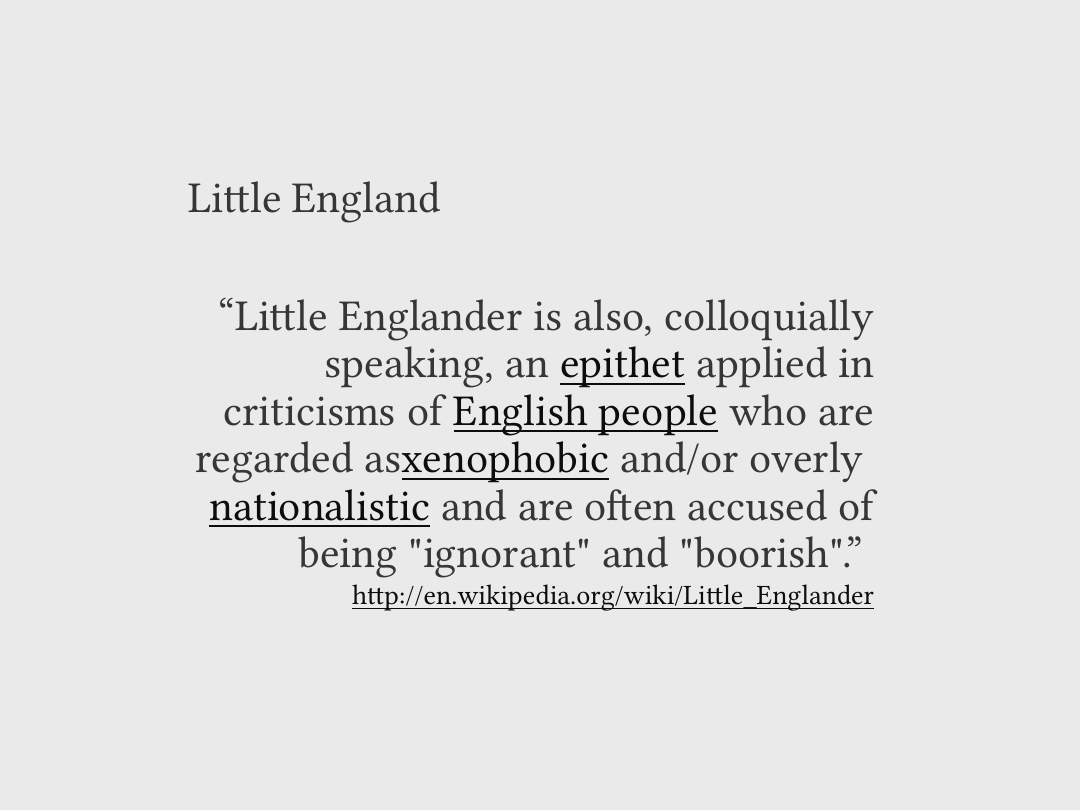
Little England
“Little Englander is also, colloquially speaking, an epithet applied in criticisms of English people who are regarded asxenophobic and/or overly nationalistic and are often accused of being "ignorant" and "boorish".”
Slide 54: Conclusion
Conclusion
Slide 55: Conclusion
Non-reductionist view of culture is possible. Research needs to focus on form/meaning pairings of different generality not the identification of general principles.