Metaphors in/of education
- SlideShare title: Metaphors in and of Education
- Talk date: Not established
- SlideShare upload: 2006-11-04 (upload date, not the delivery date)
- Event: Not established
- Place: Not established
- Topics: Language & meaning
- Language: en
- Slides in the original listing: 22
- Coverage: Full text of all 22 slides, each paired with its original slide image (slide N is section N).
- Original listing: https://www.slideshare.net/slideshow/metaphors-in-and-of-education/8586
- Cover image: https://slides.dominiklukes.net/readers/metaphors-in-and-of-education/pages/page-01.png
- Reader data (JSON): https://slides.dominiklukes.net/readers/metaphors-in-and-of-education/presentation.json
- TalkWeaver package (outline and images, ZIP): https://slides.dominiklukes.net/metaphors-in-and-of-education/metaphors-in-and-of-education-talkweaver.zip
- TalkWeaver outline: https://slides.dominiklukes.net/metaphors-in-and-of-education/talkweaver/metaphors-in-and-of-education-outline.md
- Markdown copy: https://slides.dominiklukes.net/metaphors-in-and-of-education/index.md
Slide 1: Metaphors in/of education
Metaphors in/of education
Dominik Lukeš
www.bohemica.com/metaphor
School of Education and Lifelong Learning, UEA

Slide 2: Outline
Outline
- … in education
- overview of metaphor inquiry in edu
- metaphor as a tool for instruction
- … of education
- TEACHER IS … (cognitive metaphors)
- school should be … (generative metaphors)
- … there and back …
- towards a classification of metaphor use
Slide 3: Uses of Metaphor in Education
Uses of Metaphor in Education
- Make sense of the world
- Express complex meaning
- Construct alternatives
- Organize systematic concepts
- Invite interaction
- Add dramatic effect
adapted from Cortazzi and Jin 1999
Slide 4: Context of Metaphor in Education
Context of Metaphor in Education
- Theory building
- generative
- exegetic
- Policy debates
- Teacher training
- Personal identity/motivation
- Organization and presentation of instructional content
Slide 5: Research of Metaphor in Education
Research of Metaphor in Education
- Metaphors as an instructional tool
- Metaphors in the language of instruction
- Metaphors in conceptualization of self in teachers (new and experienced) and students
- Metaphors in educational discourse
- Public discourse
- Policy debates (not all conceptual)
- Conceptualizing innovation (dtto)
- Conscious and unconscious metaphors
Slide 6: Metaphor as an instructional tool
Metaphor as an instructional tool
- Design of instructional content (Locus of classic debate)
- Presentation to students for ease of understanding
- Adapting ‘literal’ scientific content to ‘pedagogic’ level
- Method of inquiry to allow students to find personal meaning (both of academic content and own life)
Slide 7: Cognitive Metaphors of Education
Cognitive Metaphors of Education
- SCHOOLS ARE PRISONS, GARDENS, FACTORIES, SOCIETIES, FAMILIES
- TEACHERS ARE PARENTS, GUIDES, DIRECTORS, ACTORS, ANIMAL TRAINERS
- STUDENTS ARE CONTAINERS, PLANTS, ANIMALS TO BE CONTROLLED
- LEARNING IS GROWTH, FILLING UP, LIFE, ACQUISITION OF GOODS, BUILDING A PORTFOLIO, BUILDING A STRUCTURE
Slide 8: Education as a Source Domain
Education as a Source Domain
LIFE IS A TEACHER
EXPERIENCE IS A SCHOOL
COMPANY IS A SCHOOL (The learning organization)
EMPLOYEES ARE PUPILS
BEING ABLE TO DO SOMETHING IS BEING ABLE TO READ (functional literacy, emotional literacy, numeracy, computer literacy, academic literacy, oracy)
Slide 9: Generative Metaphors of Education
Generative Metaphors of Education
Market metaphor
Growth metaphor
Family metaphor
Engineering/scientific metaphor
Society metaphor (education for democracy)
Moral/humanistic metaphor (education to ensure moral humans)
Ad hoc generative metaphors
Slide 10: Metaphors and educational policy
Metaphors and educational policy
“Diverse and sometimes contradictory metaphors on schooling and school improvement dominate the thinking of policy makers, scholars and practitioners.” (Wincek, 1995)
“It was Napoleon who once famously described Britain as a nation of shopkeepers. Successive governments, since the premiership of Mrs Thatcher, have accepted this grocer-like view and attempted to turn every social institution into a commercial enterprise.” ... “This is a classic example of what philosophers call 'category error', the mistake of discussing - or in this case planning - one area of activity in the language and terms and with the concepts which are appropriate to another. ... It is a seriously fallacious form of reasoning.” (Kelly, 2004)
Slide 11: Market metaphor
Market metaphor
Product
Consumers
Manufacturing
Trade
Currency
Efficiency
Marketplace
Business theory
Parents
Students
Society
Government
Knowledge
Information
School
Employment
Slide 12: Examples of discourse
Examples of discourse
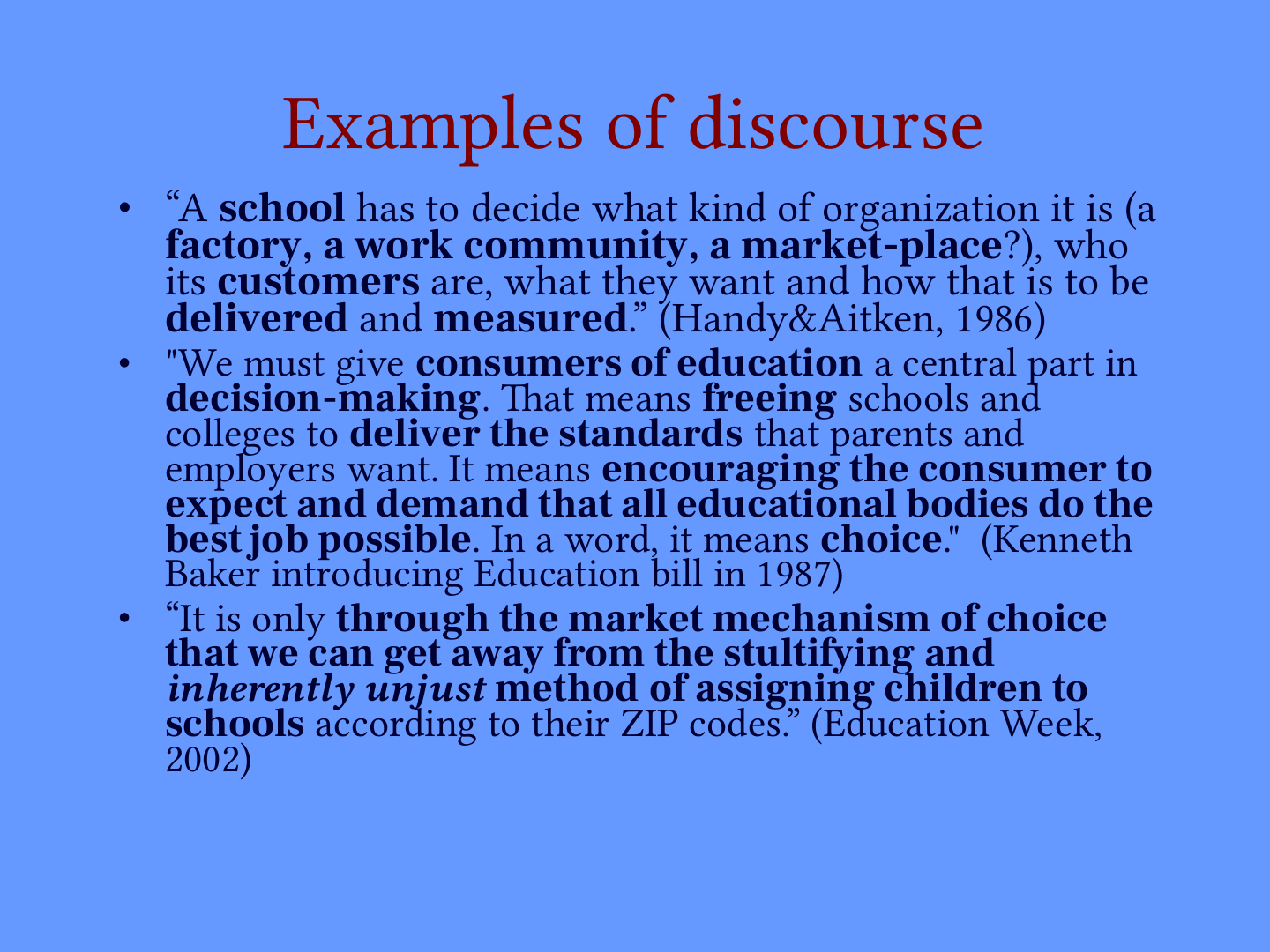
- “A school has to decide what kind of organization it is (a factory, a work community, a market-place?), who its customers are, what they want and how that is to be delivered and measured.” (Handy&Aitken, 1986)
- "We must give consumers of education a central part in decision-making. That means freeing schools and colleges to deliver the standards that parents and employers want. It means encouraging the consumer to expect and demand that all educational bodies do the best job possible. In a word, it means choice." (Kenneth Baker introducing Education bill in 1987)
- “It is only through the market mechanism of choice that we can get away from the stultifying and inherently unjust method of assigning children to schools according to their ZIP codes.” (Education Week, 2002)
Slide 13: Areas of policy influenced
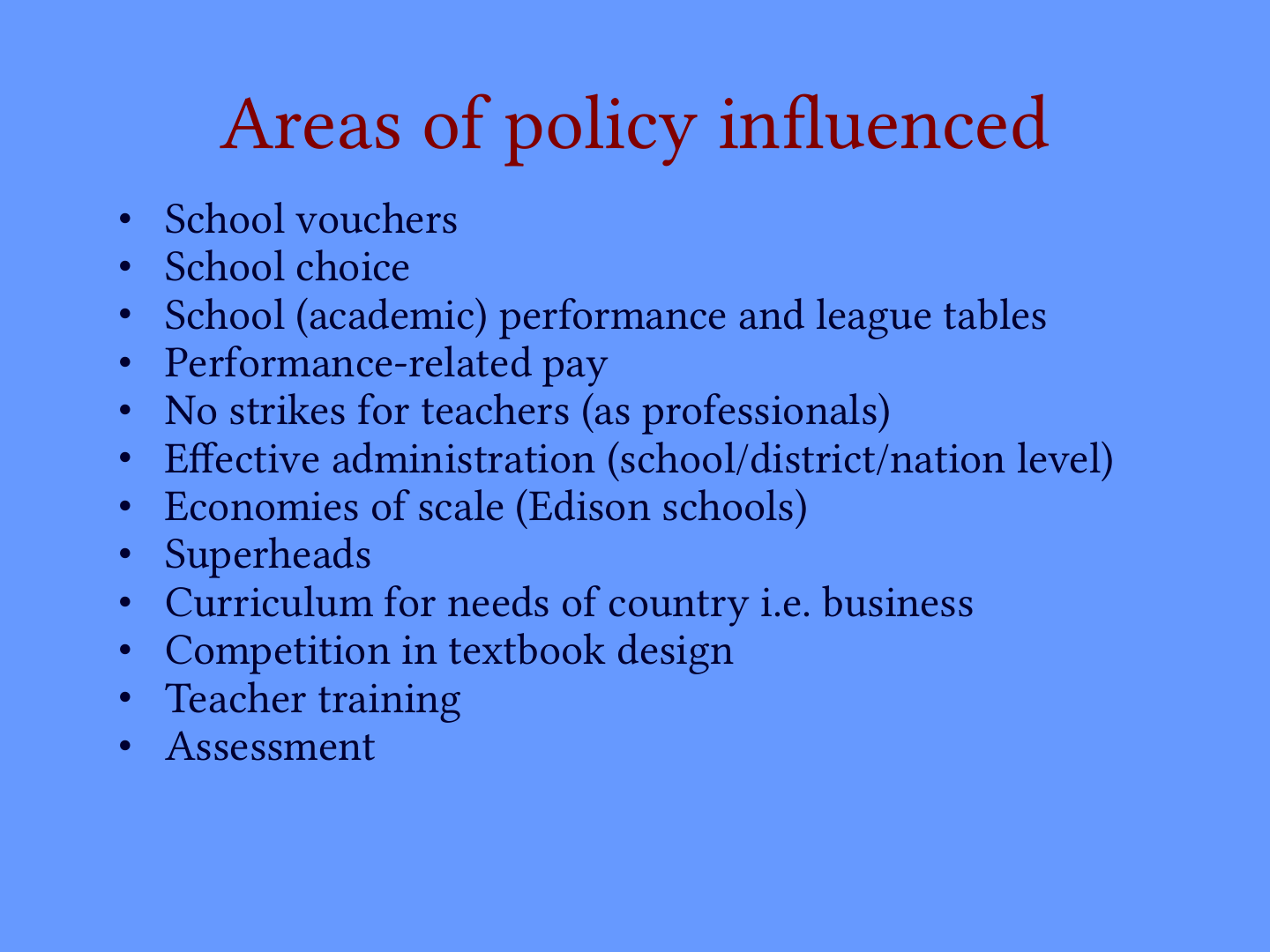
Areas of policy influenced
- School vouchers
- School choice
- School (academic) performance and league tables
- Performance-related pay
- No strikes for teachers (as professionals)
- Effective administration (school/district/nation level)
- Economies of scale (Edison schools)
- Superheads
- Curriculum for needs of country i.e. business
- Competition in textbook design
- Teacher training
- Assessment
Slide 14: Growth (organic) metaphor
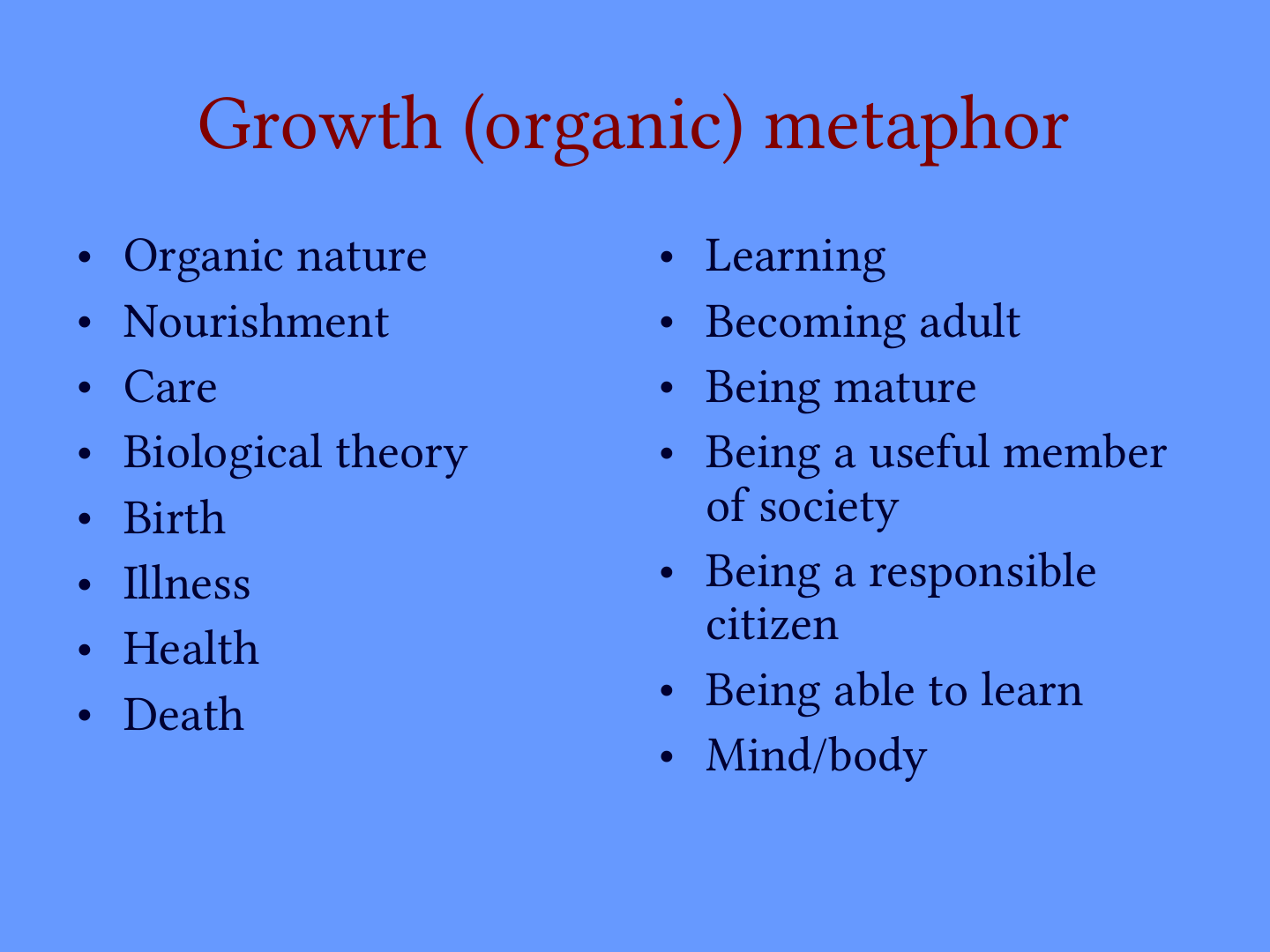
Growth (organic) metaphor
Organic nature
Nourishment
Care
Biological theory
Birth
Illness
Health
Death
Learning
Becoming adult
Being mature
Being a useful member of society
Being a responsible citizen
Being able to learn
Mind/body
Slide 15: Examples of discourse
Examples of discourse
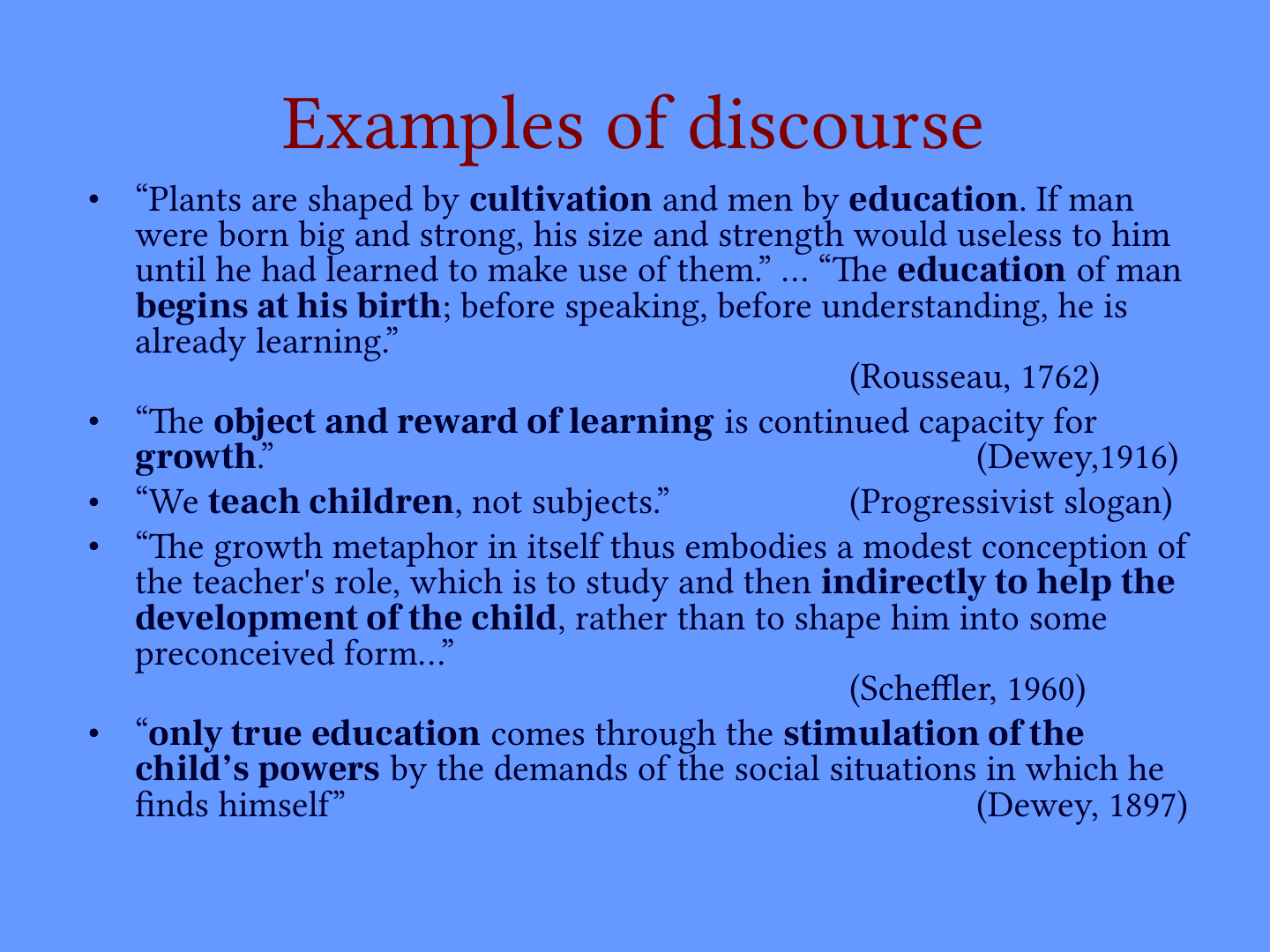
- “Plants are shaped by cultivation and men by education. If man were born big and strong, his size and strength would useless to him until he had learned to make use of them.” … “The education of man begins at his birth; before speaking, before understanding, he is already learning.” (Rousseau, 1762)
- “The object and reward of learning is continued capacity for growth.” (Dewey,1916)
- “We teach children, not subjects.” (Progressivist slogan)
- “The growth metaphor in itself thus embodies a modest conception of the teacher's role, which is to study and then indirectly to help the development of the child, rather than to shape him into some preconceived form...” (Scheffler, 1960)
- “only true education comes through the stimulation of the child’s powers by the demands of the social situations in which he finds himself” (Dewey, 1897)
Slide 16: Areas of policy influenced
Areas of policy influenced
- Child-centered education
- Textbook design
- National curriculum
- Teacher training in child psychology and physiology
- Physical education in the curriculum
Slide 17: Family metaphor
Family metaphor
Parents
Children
House rules
Obedience/Duty
Love
Rearing/behavior control
Society
Teachers
Students
Principals
School rules
School allegiance
Love for knowledge
Society
Slide 18: Examples of discourse
Examples of discourse
“The family metaphor is fundamental to education since society requires that school personnel and parents act as co-guardians of children. Even legally, school personnel act in loco parentis.” … “Mega Center's children developed a strong sense of loyalty to their individual family of learners and to the schoolwide family. The school's principal, teachers, and staff expressed both in words and in practice their conceptualization of school-as-family for the children. Although, the teachers and staff related to children as family, their relationships with one another did not flow from the family metaphor. Neither were parents and guadians of the children viewed through the lens of the family metaphor.”
(Wincek, 1995)
Slide 19: Areas of policy influenced
Areas of policy influenced
- School environment
- Teacher role
- Parental involvement
- Corporal punishment
- Proportion of moral education in the curriculum
- Proportion of socialization as a purpose of education
- Sex education
- Breakfast clubs
- No child left behind / Every child matters
Slide 20: Mixing metaphors for diversity
Mixing metaphors for diversity
- “it is undeniable that modern technology plays an increasingly important role in the process of wine-making, yet there is a definite limit to technical intervention. We are in fact operating within a triangle: nature, technique and care. Only the combination of these three can explain why each year, each winery, and even sometimes each bottle brings a different wine.” (Leirman, 1993)
- “Metaphorical language, it seems, has served as a vehicle for introducing concepts -- usually emanating from academic circles--into the parlance of practice. In decade after decade, scholars have clothed their newly developed ideas about leadership in metaphors from earlier eras.” (Beck and Murphy, 1993)
Slide 21: Metaphor Theory After Education
Metaphor Theory After Education
- Metaphors before Lakoff&Johnson
- Affective and higher cognitive role of metaphor
- Metaphorbility – Aptitude for metaphor
- Consequences of metaphor (Metaphors and actions)
- Metaphors and the nature (mental representation of understanding)
- Metaphors in use vs. metaphors in mind
- Classification of metaphor use
- Cognitive
- Interpersonal
- Textual
Slide 22: Consequences of Metaphors
Consequences of Metaphors
- Metaphors influence actions
- People who think of language as a tool are more likely to be pro-reform than those who think of it as a person
- Metaphors interpret actions/states
- Teachers are more likely to see students as container than students who might see themselves as such
- Metaphors and actions/states cooexist
- Experienced teachers see learning in a behaviorist way rather than constructivist way