Polysystémovost v jazyce: Konvergentní a divergentní modely procesu standardizace
- SlideShare title: Polysystémovost v jazyce (Polysystemiticity in language)
- Talk date: Not established
- SlideShare upload: 2010-12-07 (upload date, not the delivery date)
- Event: Not established
- Place: Not established
- Topics: Language & meaning
- Language: cs
- Slides in the original listing: 19
- Coverage: Full text of all 19 slides, each paired with its original slide image (slide N is section N).
- Original listing: https://www.slideshare.net/slideshow/polysystmovost-v-jazyce-polysystemiticity-in-language/6059565
- Cover image: https://slides.dominiklukes.net/readers/polysystmovost-v-jazyce-polysystemiticity-in-language/pages/page-01.png
- Reader data (JSON): https://slides.dominiklukes.net/readers/polysystmovost-v-jazyce-polysystemiticity-in-language/presentation.json
- TalkWeaver package (outline and images, ZIP): https://slides.dominiklukes.net/polysystmovost-v-jazyce-polysystemiticity-in-language/polysystmovost-v-jazyce-polysystemiticity-in-language-talkweaver.zip
- TalkWeaver outline: https://slides.dominiklukes.net/polysystmovost-v-jazyce-polysystemiticity-in-language/talkweaver/polysystmovost-v-jazyce-polysystemiticity-in-language-outline.md
- Markdown copy: https://slides.dominiklukes.net/polysystmovost-v-jazyce-polysystemiticity-in-language/index.md
Slide 1: Polysystémovost v jazyce: Konvergentní a divergentní modely procesu standardizace
Polysystémovost v jazyce: Konvergentní a divergentní modely procesu standardizace
Dominik Lukeš

Slide 2: Motto:
Motto:
Studium jazyka by mělo vycházet ze skutečnosti, že multilingvalismus je normální stav jazykové dovednosti. (E Chaika, parafráze)
Slide 3: Odkojeni strukturalismem
Odkojeni strukturalismem
- Redukcionismus
- Minimalismus popisu
- Hierarchismus a atomismus
- Formalismus
- Scientismus
Slide 4: Konvergence a divergence
Konvergence a divergence
- Divergence
- Ústřední systém, od nějž se odlišují a oddalují jednotlivci a skupiny
- Konvergence
- Federace systémů, které se přibližují až vytvoří iluzi jednoho systému
Slide 5: Příklady „systémů“ v jazyce
Příklady „systémů“ v jazyce
- Flexe
- Čas-Vid-Modalita
- Lexikon
- Fonontaxe
- Slovosled
Slide 6: Slovní druhy
Slovní druhy
- Kolik má angličtina slovních druhů?
- 4, 8, 9, 12
- Jsou přivlastňovací zájmena adjektiva? A co adjektiva?
- čí, jeho, jejim, našemu, Petrovi, Karlimu, první
- Adjektiva v širším smyslu? (Trávníček)
- Co s koho, nikoho, někoho, leckoho, jakkoho, kohosi, kohopak, kohokoli?
- ně-, ni-, jak-, kde-, lec-, -koli, -pak, -si
Slide 7: Vida -va-
Vida -va-
- Kolik má čeština vidů a jaký mají význam?
- Nesedni si na to v. nesedej si na to?
- On si sem klidně každý den přijde...
- Co má -va- společného s videm?
- použít – používat – používávat
- „S obavou a nejistotou očekávává každý rok příchod jara i Milan Kupka (32) z Ostravy.“ (syn2005)
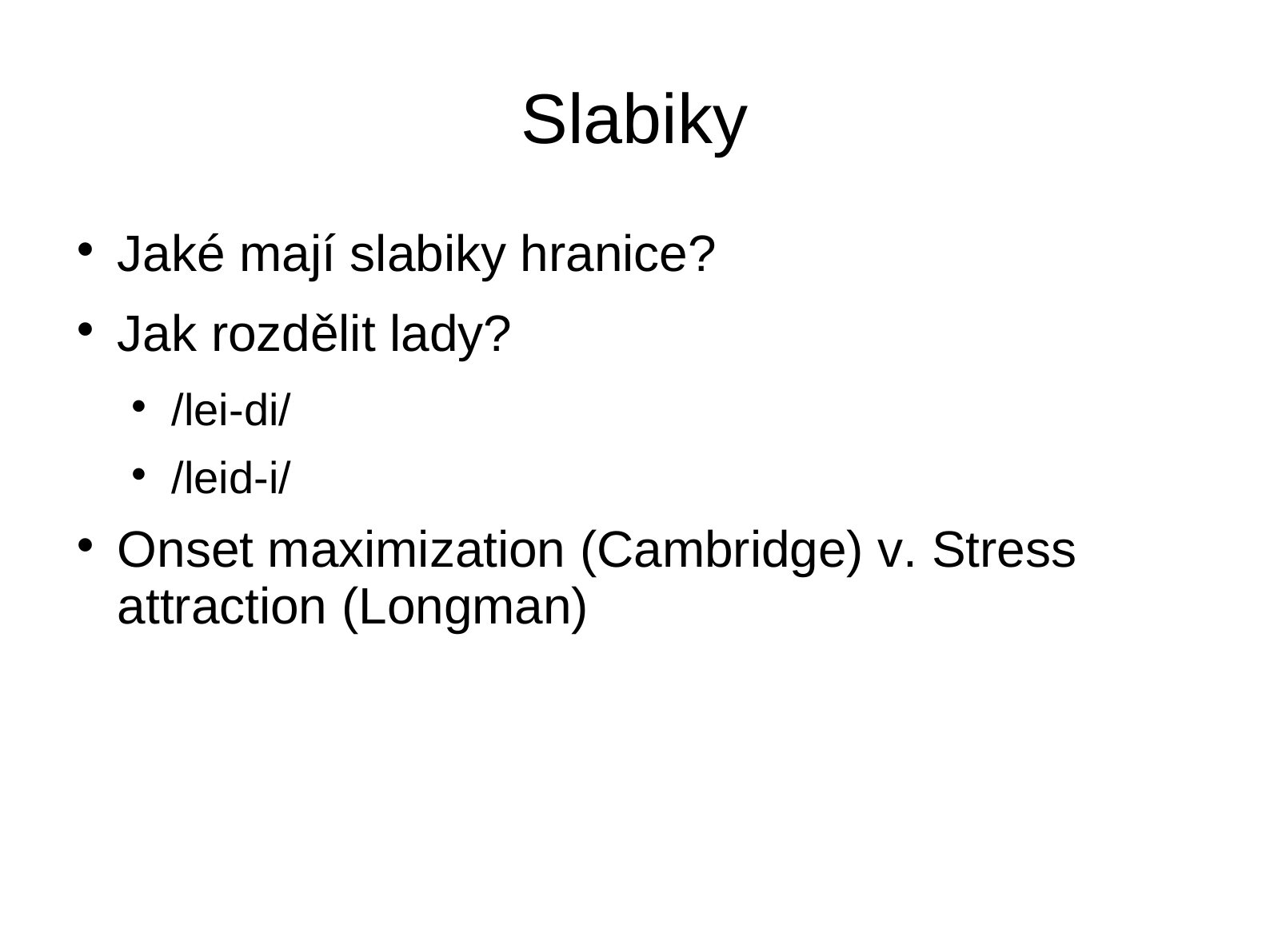
Slide 8: Slabiky
Slabiky
- Jaké mají slabiky hranice?
- Jak rozdělit lady?
- /lei-di/
- /leid-i/
- Onset maximization (Cambridge) v. Stress attraction (Longman)
Slide 9: Inventář s ostrovy
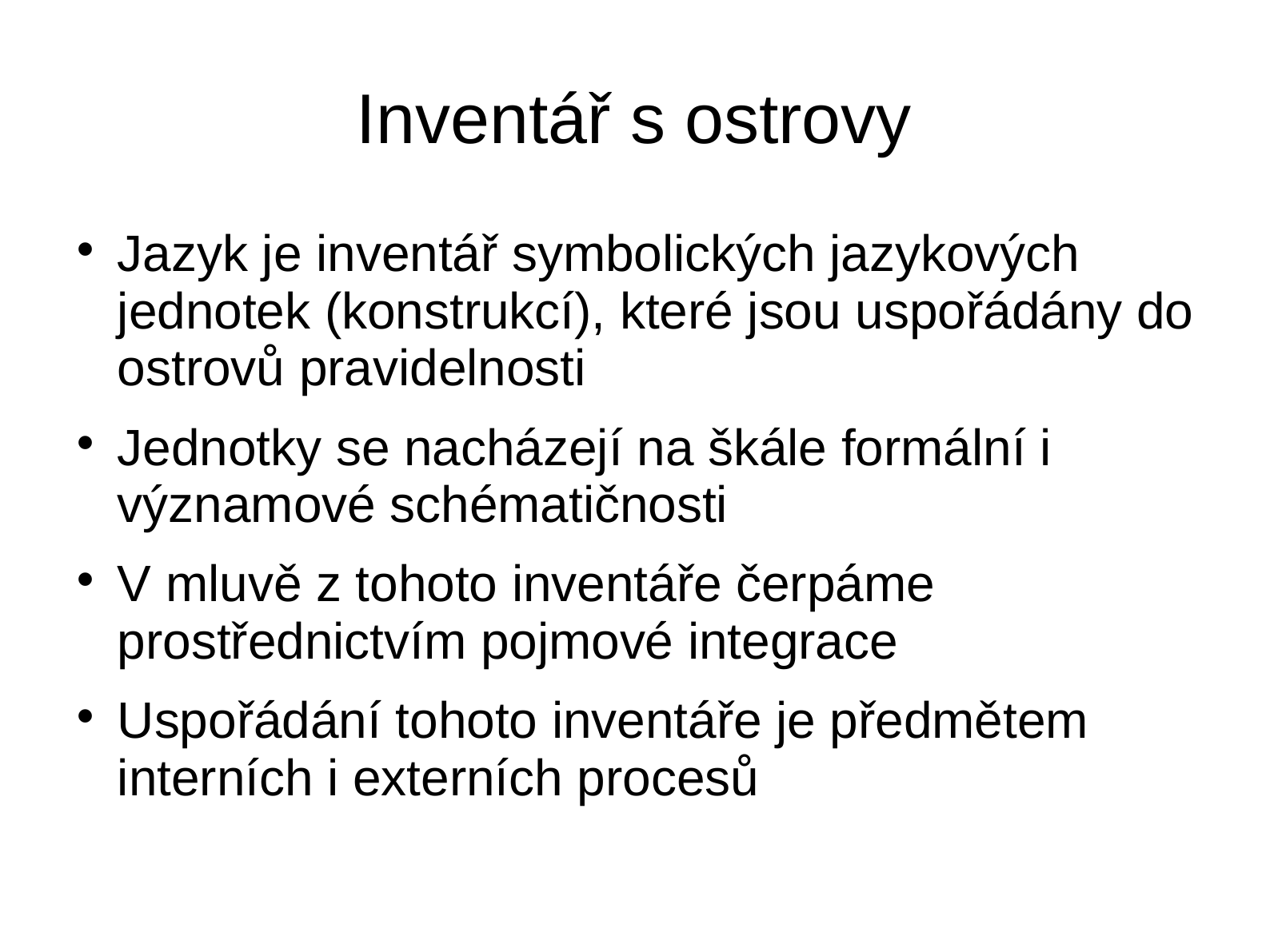
Inventář s ostrovy
- Jazyk je inventář symbolických jazykových jednotek (konstrukcí), které jsou uspořádány do ostrovů pravidelnosti
- Jednotky se nacházejí na škále formální i významové schématičnosti
- V mluvě z tohoto inventáře čerpáme prostřednictvím pojmové integrace
- Uspořádání tohoto inventáře je předmětem interních i externích procesů
Slide 10: Konstrukce = jednotky
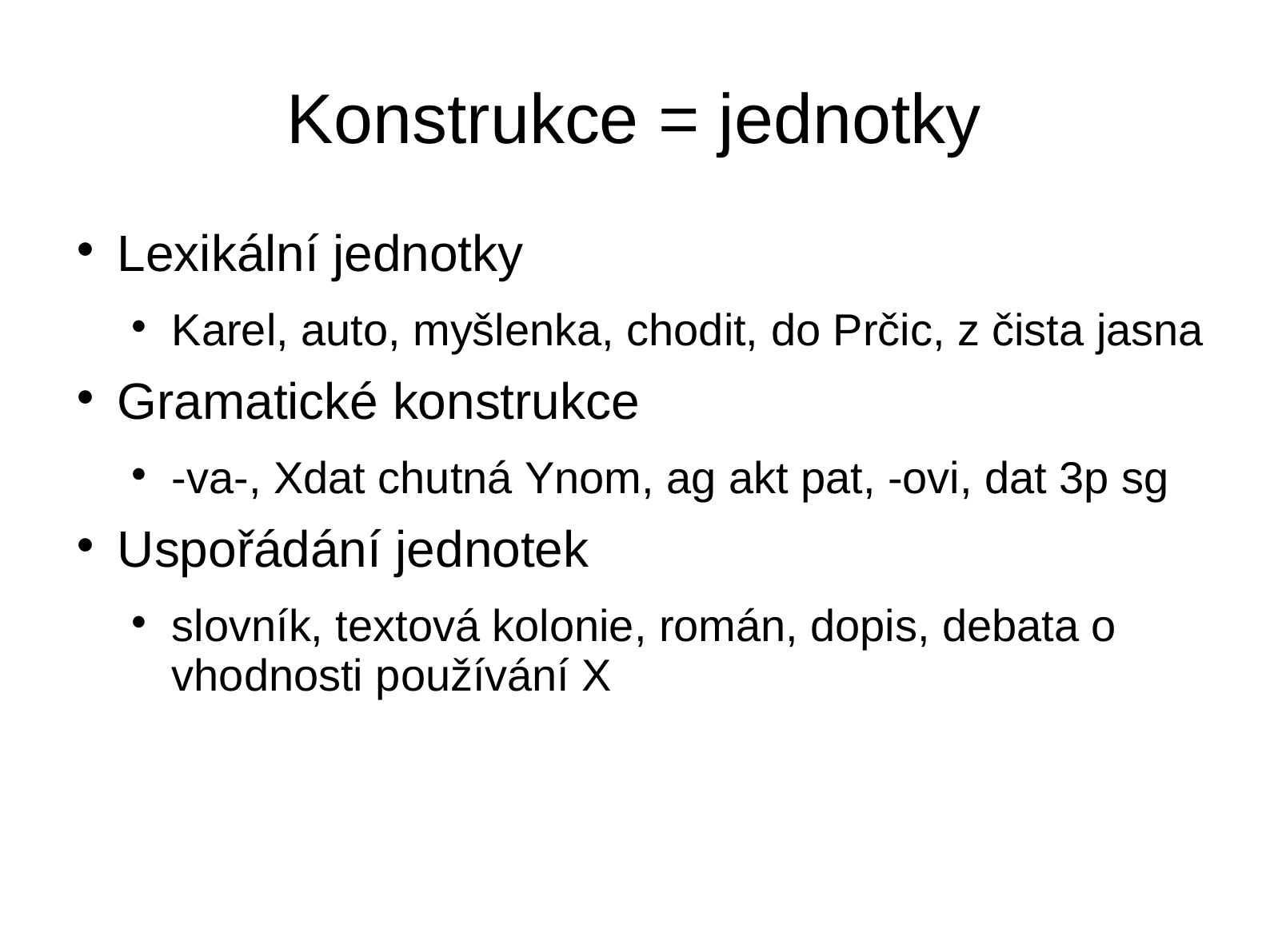
Konstrukce = jednotky
- Lexikální jednotky
- Karel, auto, myšlenka, chodit, do Prčic, z čista jasna
- Gramatické konstrukce
- -va-, Xdat chutná Ynom, ag akt pat, -ovi, dat 3p sg
- Uspořádání jednotek
- slovník, textová kolonie, román, dopis, debata o vhodnosti používání X
Slide 11: Ukázky konstrukcí v praxi
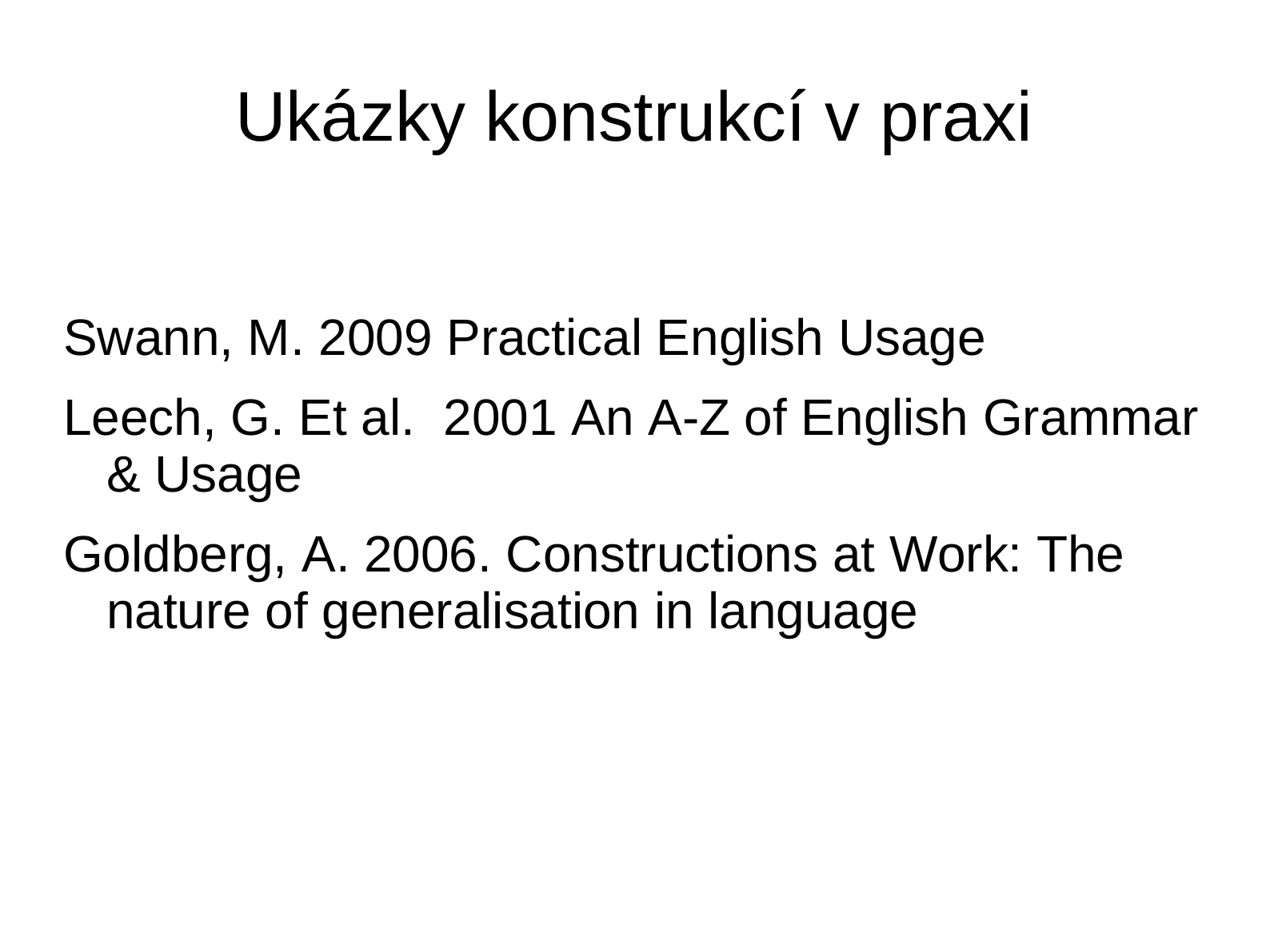
Ukázky konstrukcí v praxi
- Swann, M. 2009 Practical English Usage
- Leech, G. Et al. 2001 An A-Z of English Grammar & Usage
- Goldberg, A. 2006. Constructions at Work: The nature of generalisation in language
Slide 12: Slide 12
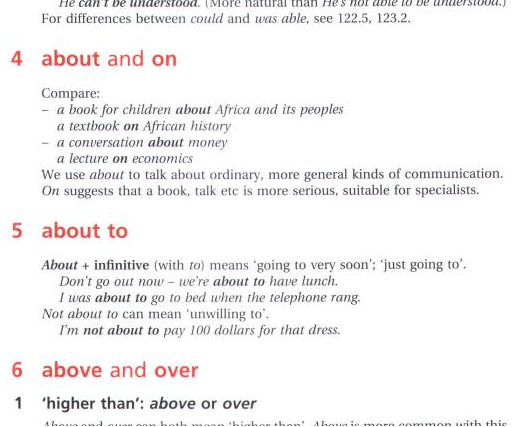
(The top of the page ends an earlier entry:) For differences between could and was able, see 122.5, 123.2.
4 about and on
Compare:
- a book for children about Africa and its peoples; a textbook on African history
- a conversation about money; a lecture on economics
We use about to talk about ordinary, more general kinds of communication. On suggests that a book, talk etc is more serious, suitable for specialists.
5 about to
About + infinitive (with to) means ‘going to very soon’; ‘just going to’. Don’t go out now – we’re about to have lunch. I was about to go to bed when the telephone rang. Not about to can mean ‘unwilling to’. I’m not about to pay 100 dollars for that dress.
6 above and over
1 ‘higher than’: above or over
(The next line is cut off at the foot of the image.)
Slide 13: Slide 13
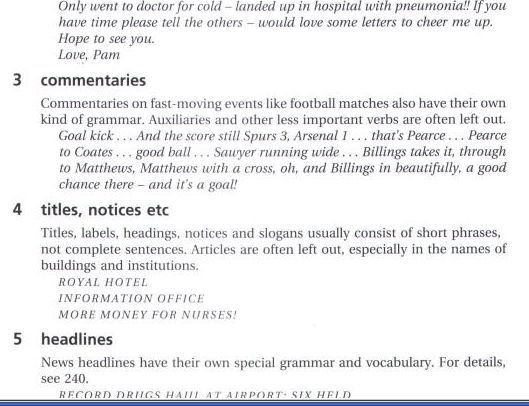
(The top of the page ends an example letter:) Only went to doctor for cold – landed up in hospital with pneumonia!! If you have time please tell the others – would love some letters to cheer me up. Hope to see you. Love, Pam
3 commentaries
Commentaries on fast-moving events like football matches also have their own kind of grammar. Auxiliaries and other less important verbs are often left out.
Goal kick … And the score still Spurs 3, Arsenal 1 … that’s Pearce … Pearce to Coates … good ball … Sawyer running wide … Billings takes it, through to Matthews, Matthews with a cross, oh, and Billings in beautifully, a good chance there – and it’s a goal!
4 titles, notices etc
Titles, labels, headings, notices and slogans usually consist of short phrases, not complete sentences. Articles are often left out, especially in the names of buildings and institutions.
- ROYAL HOTEL
- INFORMATION OFFICE
- MORE MONEY FOR NURSES!
5 headlines
News headlines have their own special grammar and vocabulary. For details, see 240.
RECORD DRUGS HAUL AT AIRPORT: SIX HELD (cut off at the foot of the image: only the upper half of the letters is visible)
Slide 14: Slide 14
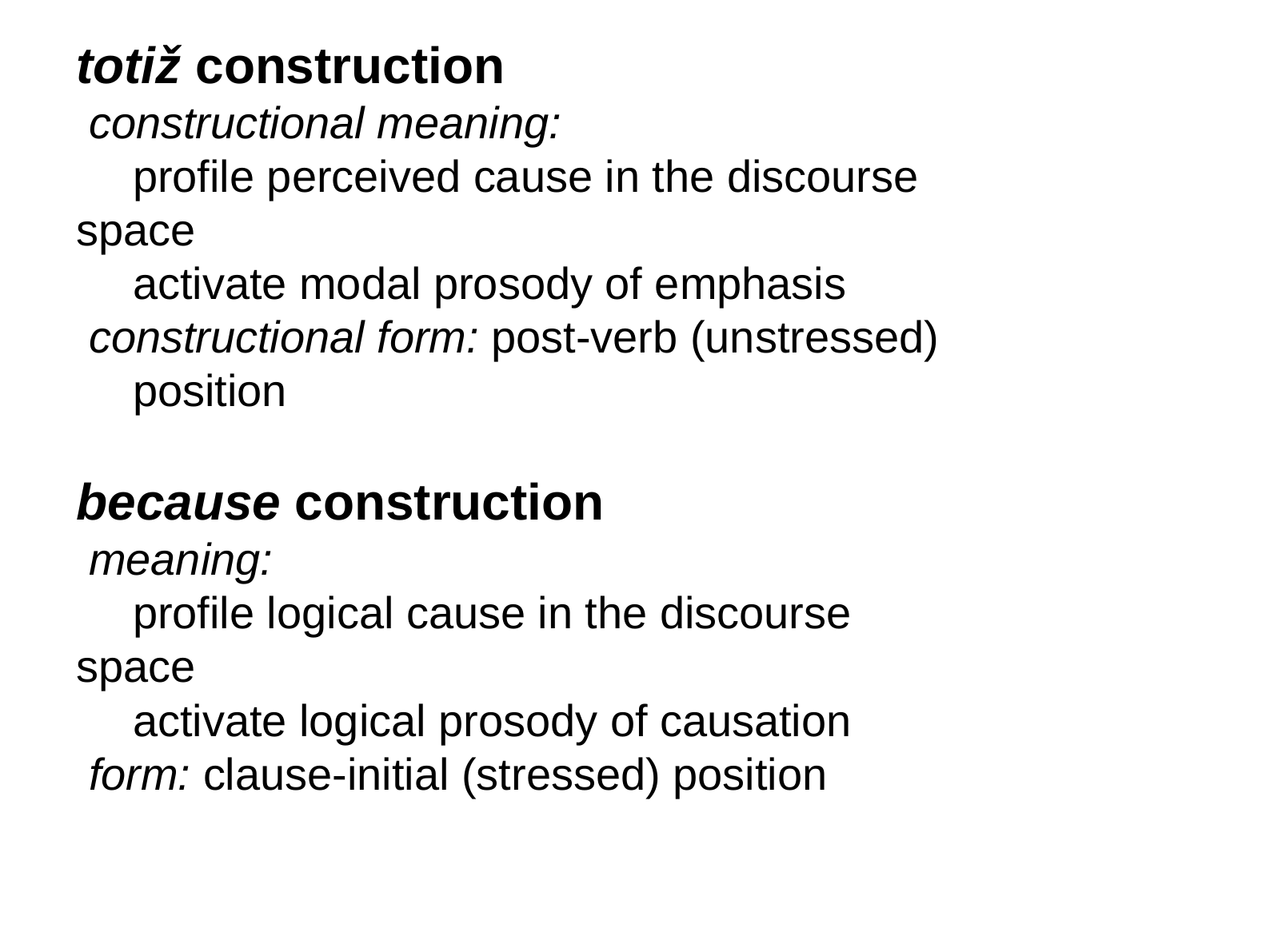
totiž construction
- constructional meaning:
- profile perceived cause in the discourse space
- activate modal prosody of emphasis
- constructional form: post-verb (unstressed) position
because construction
- meaning:
- profile logical cause in the discourse space
- activate logical prosody of causation
- form: clause-initial (stressed) position
Slide 15: Slide 15
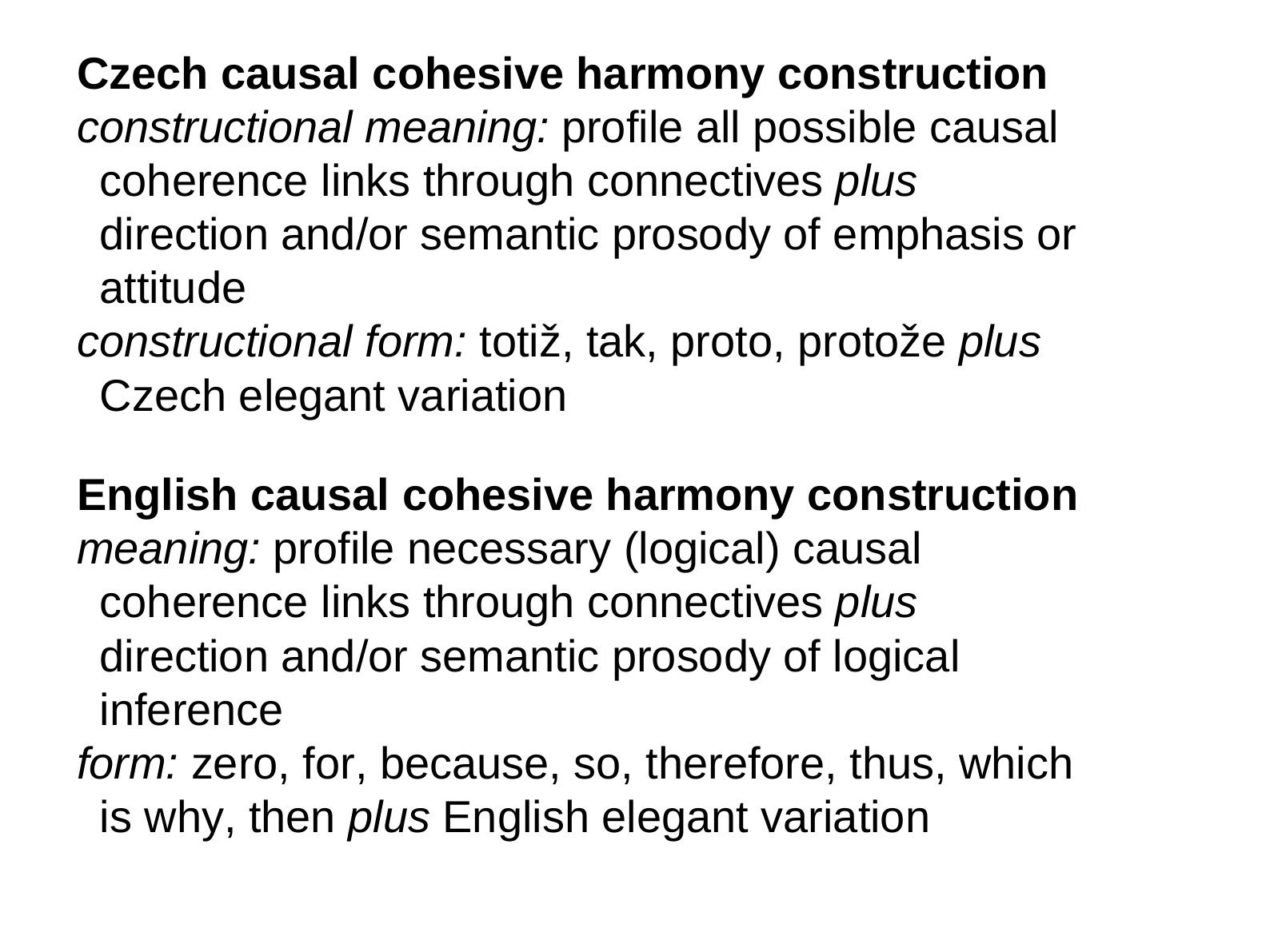
Czech causal cohesive harmony construction
- constructional meaning: profile all possible causal coherence links through connectives plus direction and/or semantic prosody of emphasis or attitude
- constructional form: totiž, tak, proto, protože plus Czech elegant variation
English causal cohesive harmony construction
- meaning: profile necessary (logical) causal coherence links through connectives plus direction and/or semantic prosody of logical inference
- form: zero, for, because, so, therefore, thus, which is why, then plus English elegant variation
Slide 16: Metaphor negotiation construction(s)
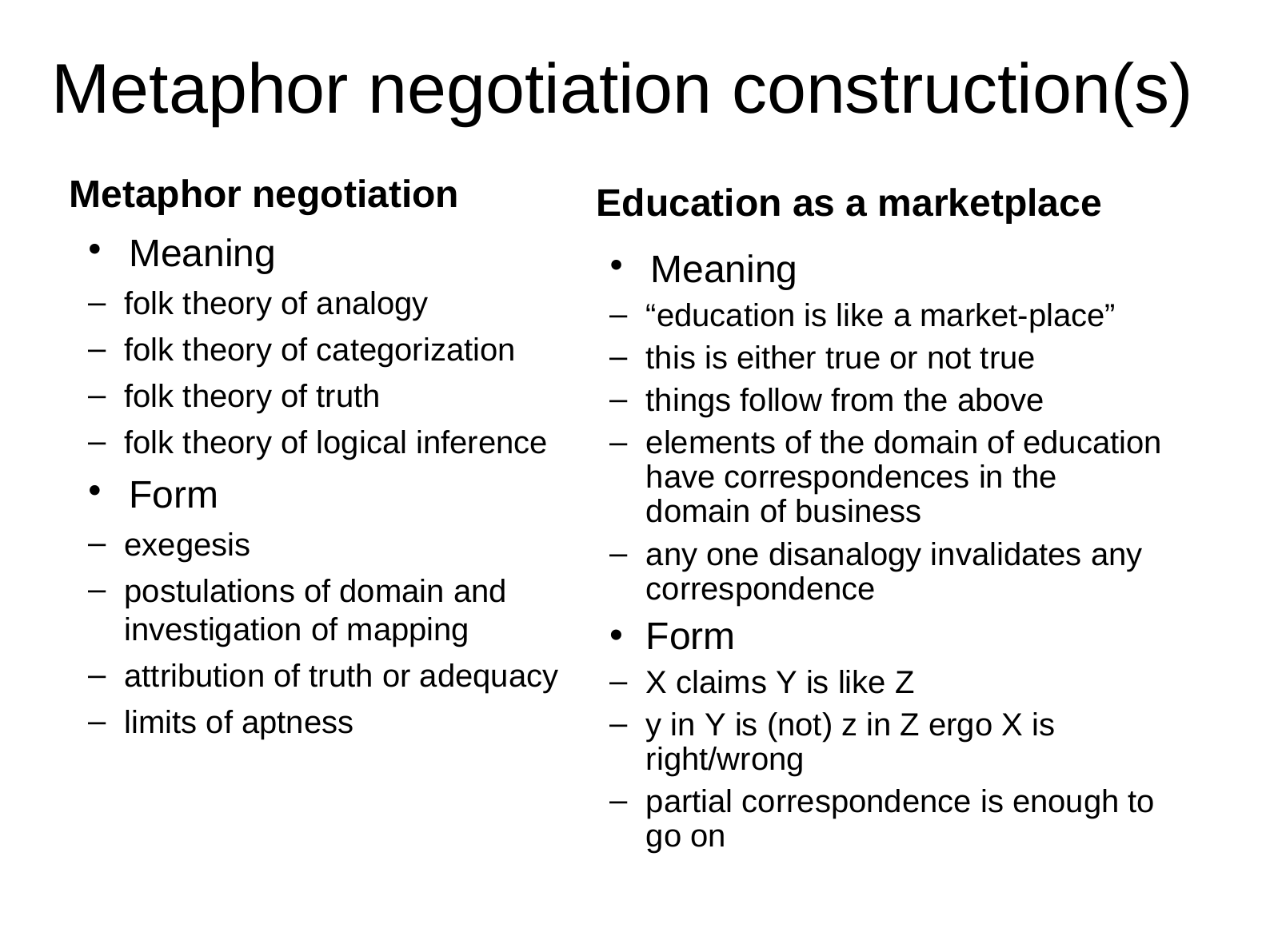
Metaphor negotiation construction(s)
Metaphor negotiation
- Meaning
- folk theory of analogy
- folk theory of categorization
- folk theory of truth
- folk theory of logical inference
- Form
- exegesis
- postulations of domain and investigation of mapping
- attribution of truth or adequacy
- limits of aptness
Education as a marketplace
- Meaning
- “education is like a market-place”
- this is either true or not true
- things follow from the above
- elements of the domain of education have correspondences in the domain of business
- any one disanalogy invalidates any correspondence
- Form
- X claims Y is like Z
- y in Y is (not) z in Z ergo X is right/wrong
- partial correspondence is enough to go on
Slide 17: Výhody inventarizace jazyka
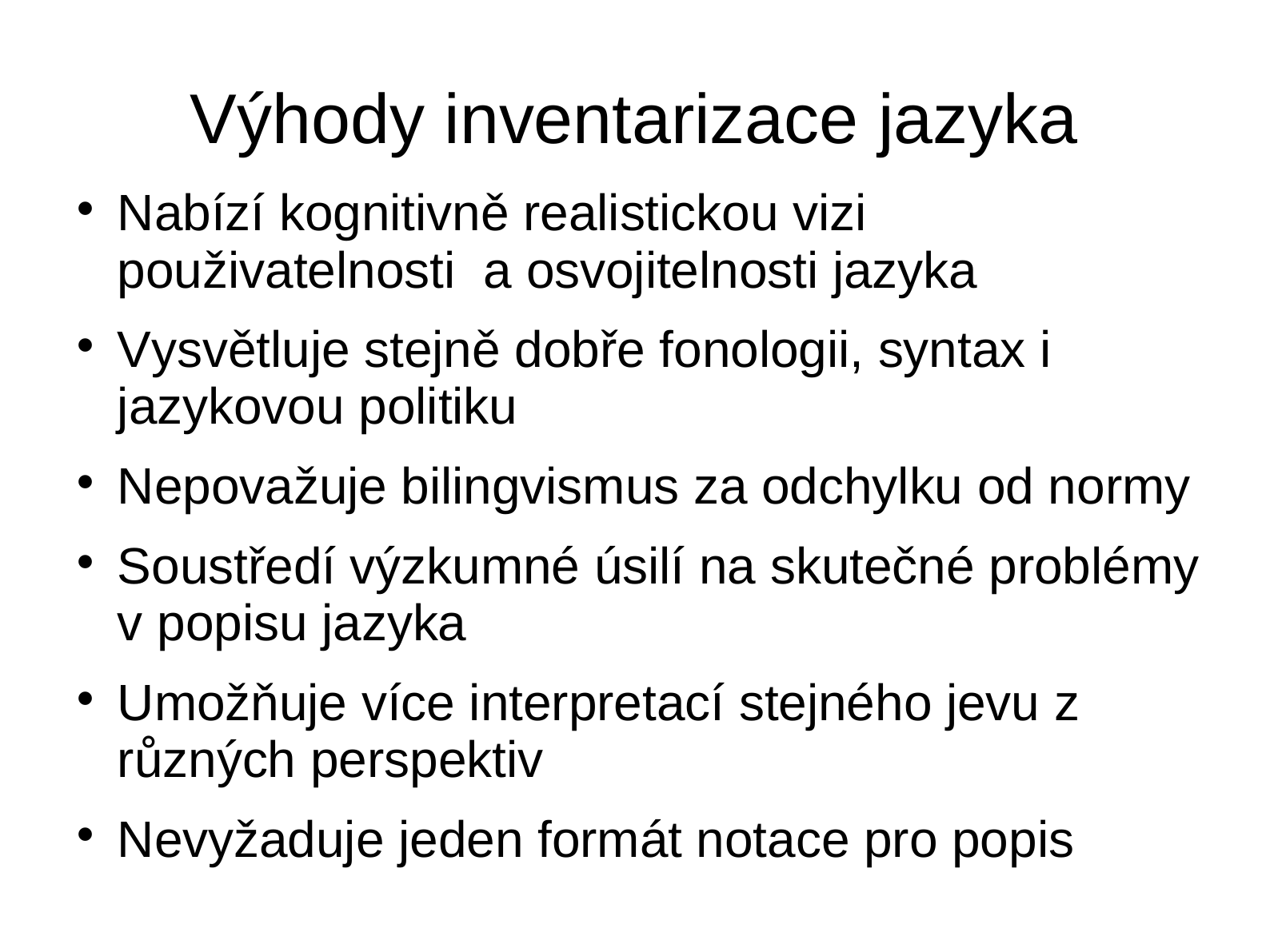
Výhody inventarizace jazyka
- Nabízí kognitivně realistickou vizi použivatelnosti a osvojitelnosti jazyka
- Vysvětluje stejně dobře fonologii, syntax i jazykovou politiku
- Nepovažuje bilingvismus za odchylku od normy
- Soustředí výzkumné úsilí na skutečné problémy v popisu jazyka
- Umožňuje více interpretací stejného jevu z různých perspektiv
- Nevyžaduje jeden formát notace pro popis
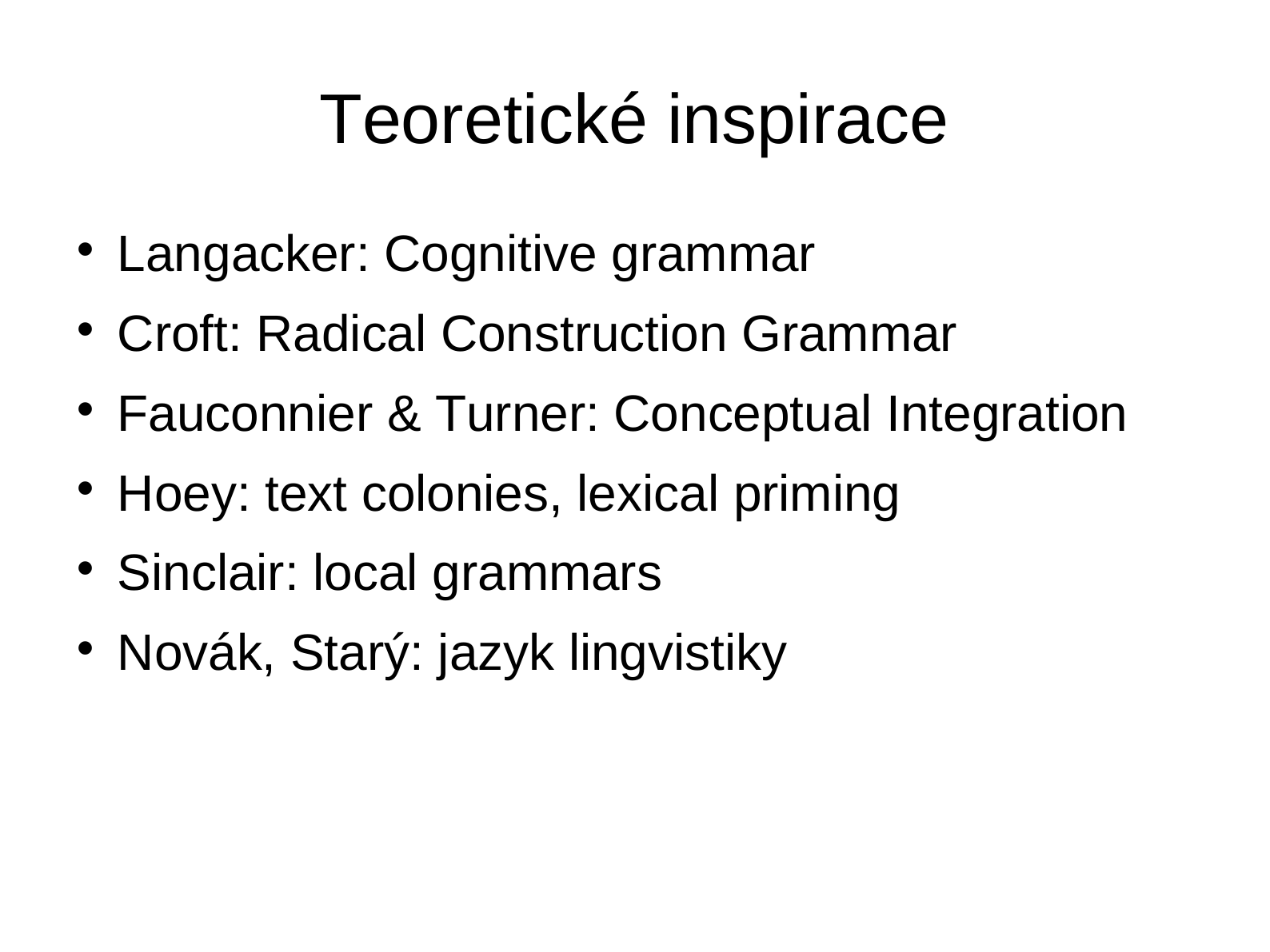
Slide 18: Teoretické inspirace
Teoretické inspirace
- Langacker: Cognitive grammar
- Croft: Radical Construction Grammar
- Fauconnier & Turner: Conceptual Integration
- Hoey: text colonies, lexical priming
- Sinclair: local grammars
- Novák, Starý: jazyk lingvistiky
Slide 19: Slide 19
V lingvistice je po mém soudu třeba stále obnovovat kontakt s „jazykovou realitou“, snažit se, aby „teorie“ byly teoriemi a ne ideologiemi, a kultivovat k tomu přijatelné (neškodlivé, snesitelné, dokonce vhodné) způsoby vyjadřování. A nemusí to pořád dělat všichni, stačí, když to dělá někdo a je slyšen.
– Pavel Novák